Lysichiton americanus and L. camtschatcensis – May 9th 2022 – Skunk Cabbage
Skunk cabbage is not a cabbage at all, but a member of the Araceae, the family of the Arum Lily (‘Lords-and-ladies’ or ‘Cuckoo-pint’). It is a large and very striking plant. It shoots up at this time of year, looking like bright-yellow flames. A few weeks later, large glossy leaves appear, over 1 metre long. The plant emits a skunky smell to attract pollinating insects.
The Araceae is a very primitive family, with one of the oldest fossil records of all flowering plants. The flowers of Skunk cabbage have no petals, just a fleshy spike (‘spadix’) of about 700 small hermaphrodite flowers. surrounded by what resembles a single large yellow petal. It isn’t a petal, merely a leafy bract (‘spathe’) that will soon wilt.
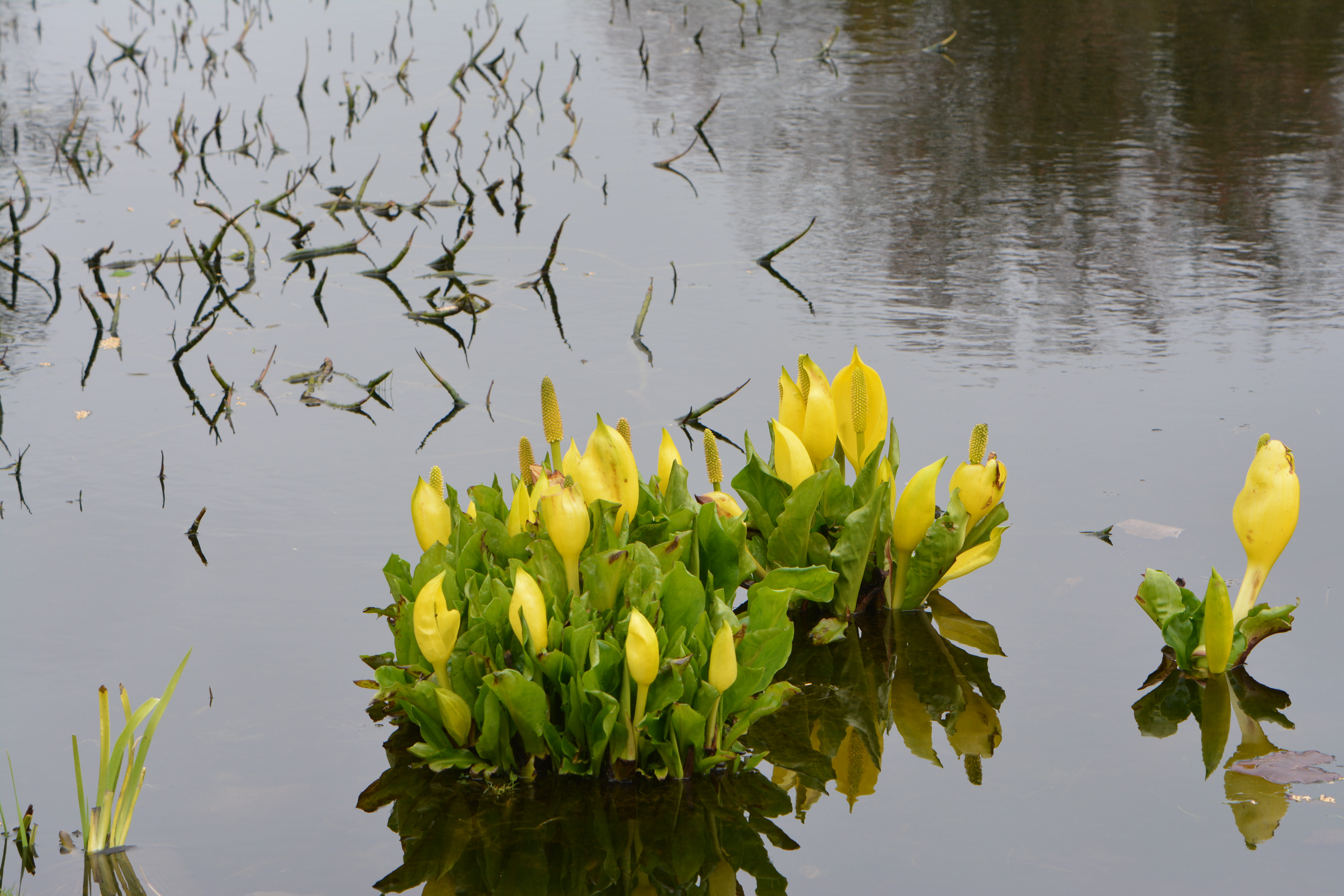
L. americanus can grow in shallow water as well as soil. This image from Glenwhan in Dumfries and Galloway, Scotland. April 18th, leaves still quite small. Photo: John Grace.
The clever insect-trapping pollination mechanism found elsewhere in this Family (see our blog on Arum maculatum ‘Lords-and-Ladies https://botsocscot.wordpress.com/2020/09/06/plant-of-the-week-7th-september-cuckoo-pints-arum-maculatum-and-a-italicum/) is not present in Lysichiton. It doesn’t trap the insects, they just fly to the flowers, attracted presumably by the smell. The pollinating insects are not midges as in Arum but small beetles (Pellmyr & Patt, 1986). The individual tiny flowers are hermaphrodite but the whole spadix is first functionally female and then functionally male. Green berries appear later in the year, and they may be washed downstream to create new colonies.
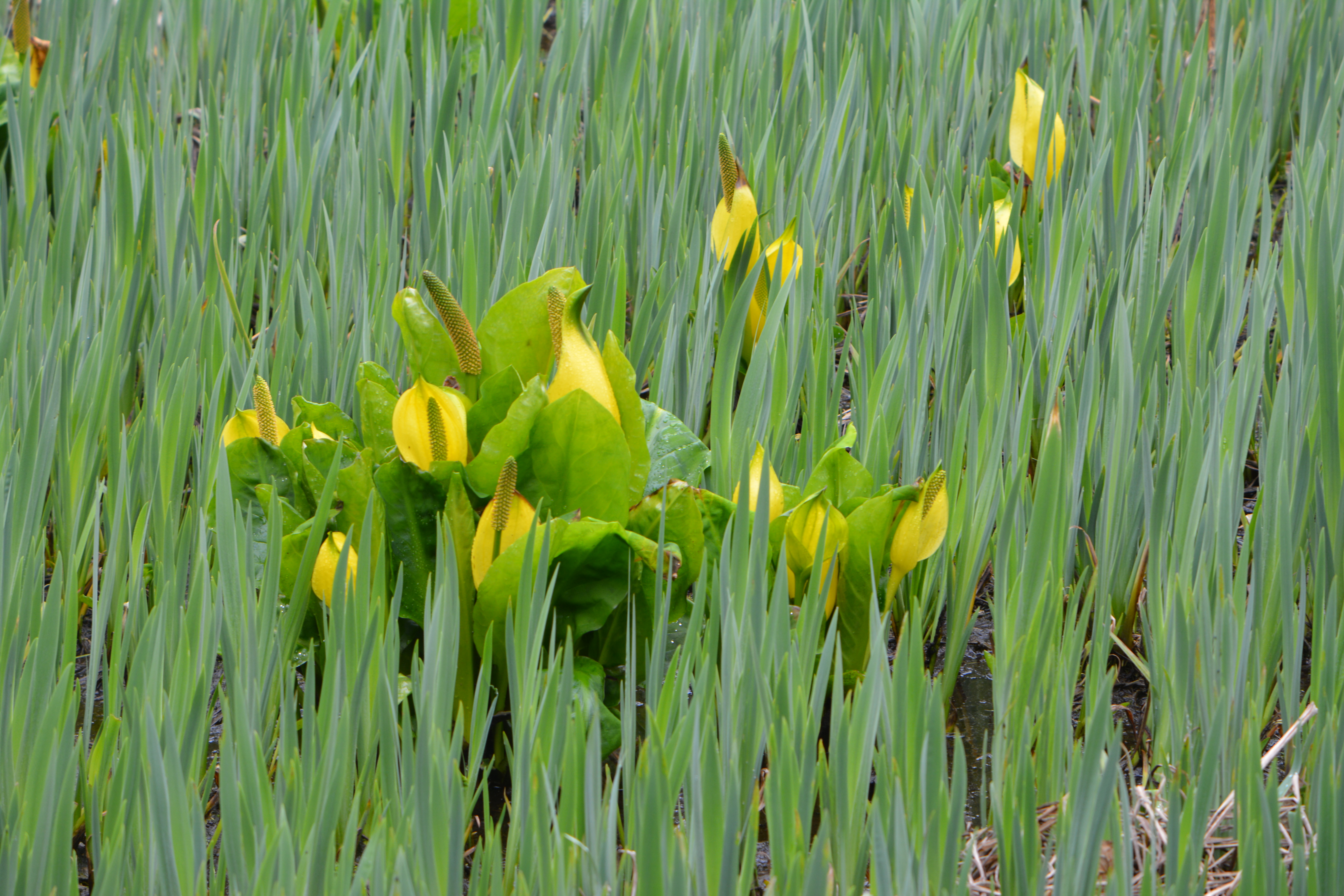
At the water’s edge, it is invading an Iris bed. Who will win? From Glenwhan in Dumfries and Galloway, Scotland. Photo: John Grace.
Lysichiton is considered more primitive than Arum because its flowers are hermaphrodite with tiny petals whereas Arum has unisexual flowers, no petals, and a complex pollination system (Grayum 1990).
The American Skunk Cabbage is native to the north-west of North America, where the climate is somewhat similar to that of the British Isles. In Oregon it occurs in spruce forest, of a type known as Picea sitchensis / Cornus sericea / Lysichiton americanus. This is highly relevant because Picea sitchensis is Sitka Spruce, the mainstay of commercial forestry in Northern Britain and especially in Scotland. I have never seen Skunk cabbage in Sitka Spruce plantations but I’ll be looking out for it from now on.
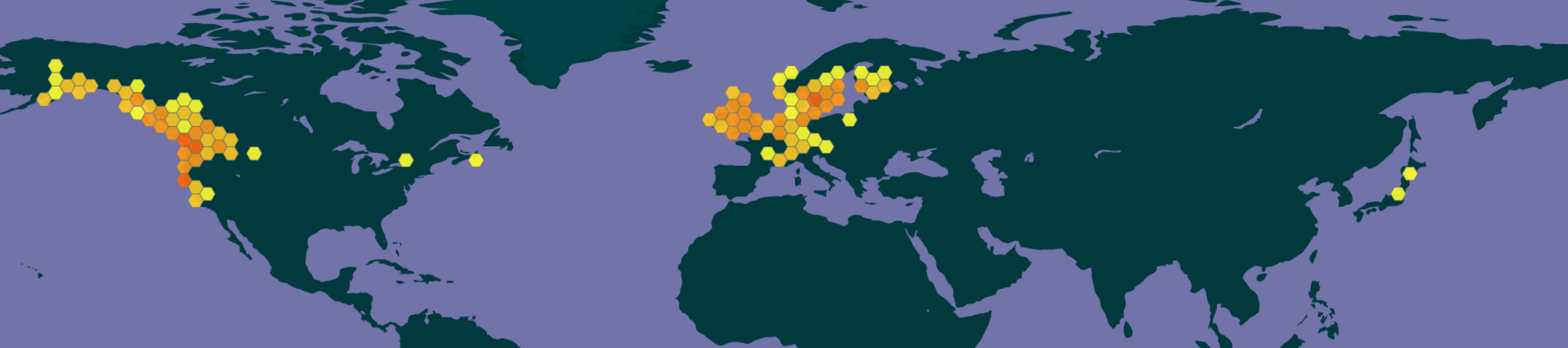
Lysichiton americanus, native of NW America, now widespread in Europe. Image: GBIF
Lysichiton americanus was introduced to British horticulture in 1901 when it was established at Wisley, the soon-to-be-famous botanic garden south of London. This garden still has Lysichiton americanus. The species was first recorded in the wild in 1947; and since then it has spread throughout Britain and Ireland.
It grows in wet habitats, often in the shade of woodland. Pond edges, ditches, slow-flowing streams and water gardens are common habitats. It’s not fussy about the soil as long as there’s plenty of moisture. I mostly see this species when I visit the large gardens of stately homes, or when I am near tributaries of the River Clyde in Glasgow. From the distribution map, Glasgow seems to be its Scottish headquarters. Dickson (1991) commented “Along the burn that flows through Barloch Moor in Milnagarvie there are hundreds of plants of Skunk Cabbage which make a splendid display in spring”. The maps below show it has spread rather quickly since the year 2000.
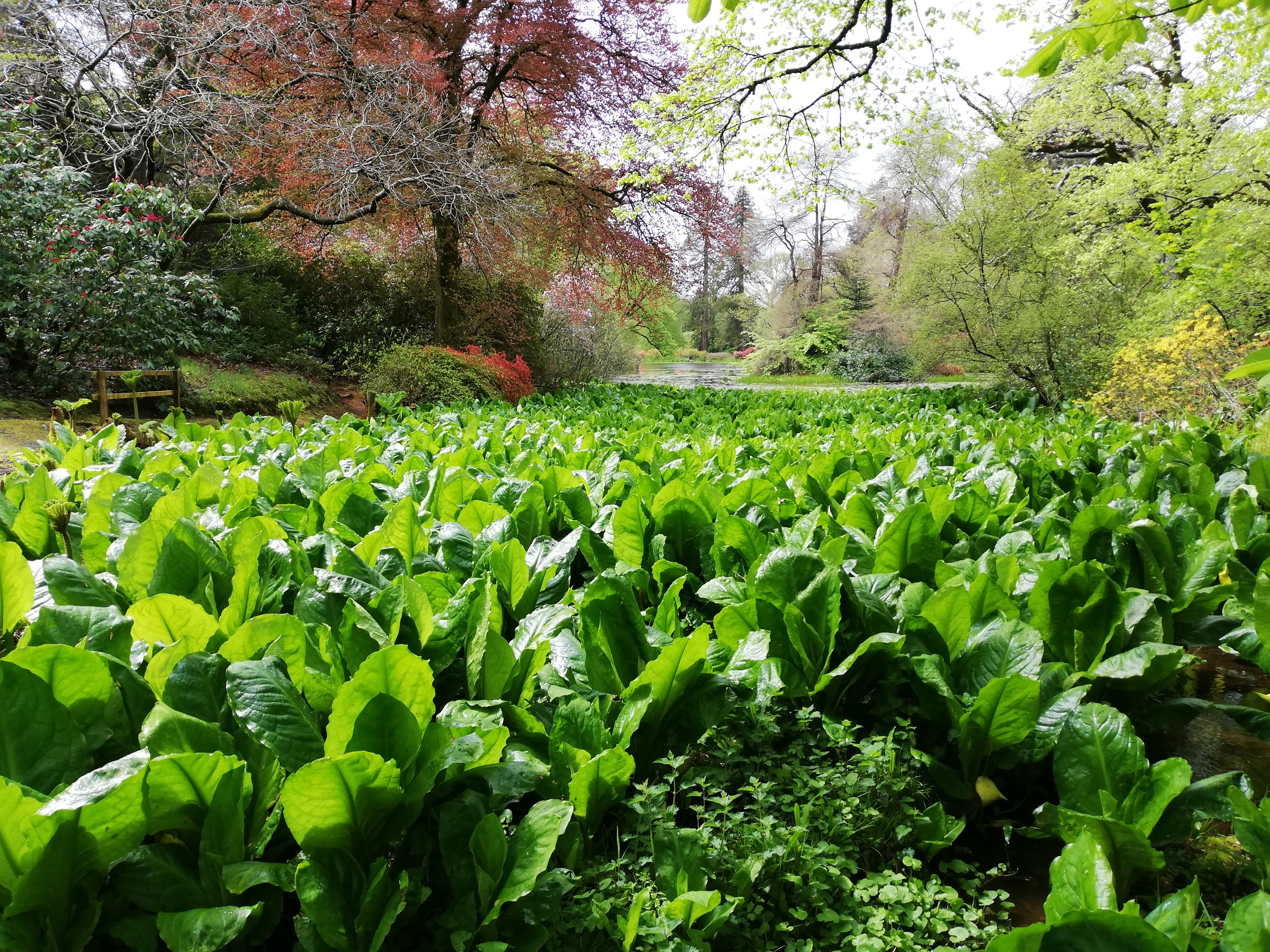
Lysichiton americanus early May 2022, Bargany in South Ayrshire. By now the glossy leaves have expanded, hiding the spathes (which have wilted). This is a large dense stand in a shallow pond. It does look somewhat cabbage-like at this stage.
It forms dense masses of plant material, extending via stout rhizomes to make a mat, excluding other species from the habitat. It is one of those invasive aliens with a reputation as a ‘thug’ and outlawed by European and British legislation. The wording says “you cannot intentionally plant listed species on your land, or intentionally cause existing listed plants to spread ”. Exceptions can be made but you would need to have a special licence (if, for example, the plant was required for research). Note however that if you already have these plants in your garden, you are not obliged by law to remove them.

The Asian Skunk Cabbage (Lysichiton camtschatcensis), late April in the Magic Garden at Cluny in Perthshire, Scotland. Photo: John Grace.
There is a rare related species and a hybrid. The Asian Skunk Cabbage (Lysichiton camtschatcensis) has a white spathe and more or less scentless flowers. It comes from eastern Asia. It is much smaller and its leaves are not glossy. Both species have a chromosomes count of 2n=28, and they may hybridise when they grow together. The hybrid is known as L x hortorum and is thought to be sterile. You can see all three if you visit Cluny House Garden garden in Perthshire, but there is only a single specimen of the hybrid. I’ve just been talking to the owner to discover whether the hybrid specimen might be fertile. It probably isn’t, but it is very large and its spathe is white, tinged with yellow.

The hybrid, known as L x hortorum. A large plant with a yellowish tinge to the tips of its scape. Growing alongside its parent species in the Magic Garden at Clunie in Perthshire, Scotland. Photo: John Grace.
This species intrigues me. The one who first described it, the Swedish botanist and explorer Oskar Eric Gunnar Hultén (1894 – 1981) found it when he went to Alaska. Its full name is Lysichiton americanus Hulten & H. St. John. The second author was Harold St. John (1892 – December 1991) Professor of Botany at the University of Hawaiʻi at Mānoa from 1929 to 1958.
Many plants of this family are thermogenic – they generate heat and are sometimes several degrees above ambient. The Giant Titan Arum, one of the most famous members of the Araceae, is thermogenic, see https://www.rbge.org.uk/news/amorphophallus-titanum/.
I suspect the Skunk Cabbage is thermogenic too, but more work is needed to show this (Onda et al 2008). Not many plants are thermogenic – the process of heat production burns up precious food reserves. But heat production does attract insects as it drives evaporation of low molecular weight hydrocarbons (in this case the smell of rotting meat) and the production of CO2. Most flying insects make their way to the source of CO2; that’s one way that midges and other biting insects find our flesh.

British and Irish distribution of L. americanus. Left, prior to 2000; right, records since 2000. BSBI
The BSBI map above shows how the species has spread over the last two decades. I think that BSBI recorders have only recorded the plant ‘in the wild’ , ignoring its presence in many of the large estates where it was planted decades ago as a strikingly handsome and much admired ornamental. It is now thoroughly naturalised and should be recorded and checked every year in case it gets out of control.
References
Brodie BS et al (2018) Identification and field testing of floral odorants that attract the rove beetle Pelecomalium testaceum (Mannerheim) to skunk cabbage, Lysichiton americanus (L.) (sic.) Arthropod-Plant Interactions (2018) 12, 591–599.
Dickson JH (1991) Wild Plants of Glasgow. Aberdeen University Press.
Grayum H (1990) Evolution and phylogeny of the Araceae. Annals of the Missouri Botanical Garden 77, 628-697.
Onda Y et al (2008) Functional Coexpression of the Mitochondrial Alternative Oxidase and Uncoupling Protein Underlies Thermoregulation in the Thermogenic Florets of Skunk Cabbage. Plant Physiology 146, 636–645.
Pellmyr O and Patt JM (1986). Function of olfactory and visual stimuli in pollination of Lysichiton americanum (Araceae) by a staphylinid beetle. Madroño 33, 47-54.
John Grace