

Having chosen a row in the grid, you next answer a series of simple questions about the individual flowers, to pick a page, then a column: First, are the flowers green or brown? If so, go to the first two columns on page two. Green or brown flowers are often very small (they tend to be pollinated by wind, not insects) and hard to examine, therefore choose the left or right column depending on whether the leaves are grasslike (i.e. long, thin and parallel sided, as seen in daffodils, crocus, bluebell etc), or broad (i.e. a different shape without parallel sides, often with branching veins, like dock, nettle, oak, etc).
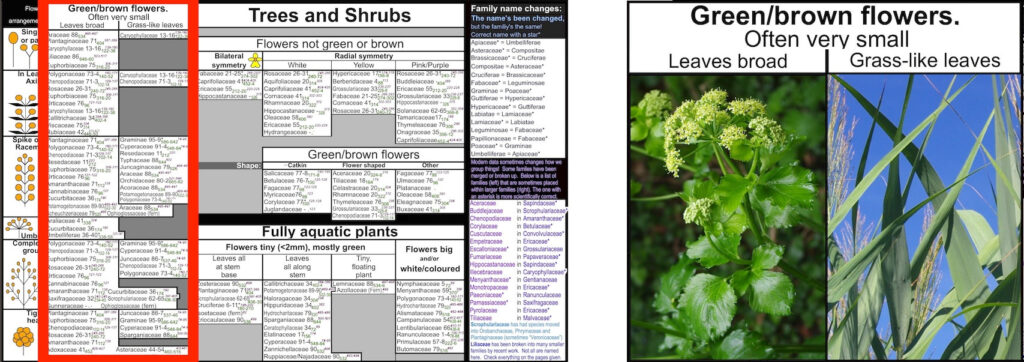
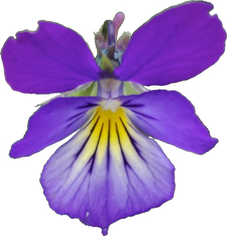
If it is not green or brown, you will find it on page 1. The next question to ask is, Are the flowers bilaterally symmetric? That means an individual flower that, if you rotate it, looks different – or technically speaking, there is one line of reflectional symmetry but no axis or rotational symmetry. The human face is bilaterally symmetric; flower examples include pansy, orchids, and all British members of the pea family. All bilaterally symmetric flowers go in the column on the right-hand side of page 1.
