

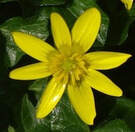
If not bilaterally symmetric, flower will be radially symmetric, i.e. if the flower is rotated it looks the same, as in buttercup, wild rose, crocus etc. Note that symmetry must always be judged looking at the flower end-on, not from the side (e.g. a tulip is radially symmetric, but appears bilateral from the side, as do all radially symmetric flowers). Because radially symmetric flowers are much more common in Britain, we need to ask more questions:
If it is radially symmetric, how many petals does it have? The categories here are 3 or 6, 4, 5, or 7+. Three and six are grouped together because often flowers with three true petals have another three that look like petals. Also note that a few plants have petals that are forked, giving the impression there are twice as many as there really are, but I have controlled for this by listing the relevant families in brackets in the 7+ petals category, as well as the one where they properly belong.


Now, because five is by far the most common petal number, for these we ask one final question: are the petals joined? Some will have petals very obviously fused into a funnel shape (like a bindweed or gentian), while on others they may be fused only at the base, almost out of sight (like a forgetmenot or cyclamen). A good way to tell if the petals are not joined even at the base is to see if they fall from the flower separately, as on a wild rose or buttercup. Compare a speedwell or scarlet pimpernel, where the petals are fused, and all fall off together as a group. Based on this, pick the left or right hand of the two columns for 5-petalled flowers.
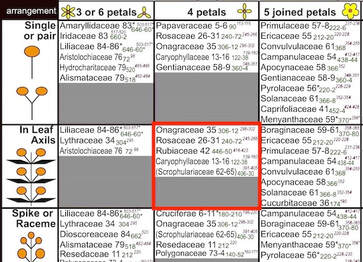
Now, you should have chosen a row, and a column. You are now faced with a list of possible families, e.g. for 4 petals, in leaf axils, the list is Onagraceae, Rosaceae, Rubiaceae, Caryophyllaceae, (Scrophulariaceae). If you have answered your questions correctly, your plant is in one of these families. Check them in the order they are listed, because the top one (in this case Onagraceae) is the most likely. Remember that to save you time, black numbers give plates of Keble Martin’s Concise British Flora, whereas red and green numbers are pages in The Wild Flower Key, and Collins’ Flower Guide, respectively. Keep going till you find a match! Remember you can check possible matches by typing the scientific name into a search engine like Google Image, and comparing photos.

Good luck! Once you’ve used it a few times, you’ll be able to dispense with these instructions and just use the 2 sheets alone. And soon, you’ll start recognising families without assistance!
