

Some families have had their names changed, and/or been broken up or merged with others. A list of these is on the second sheet, and an asterisk by a family name indicates that it might be known by another name in your book. I’ve often used older names here because the method was originally designed to work with Keble Martin. Where family names are given in brackets, it means that family technically doesn’t belong in that category (e.g. it really has 4 petals but looks like it has 8), but I’ve put it there because it looks like it does. Separating similar species.
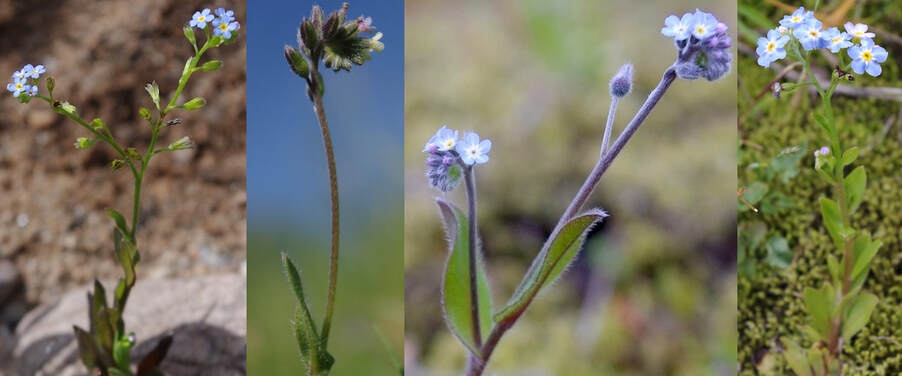
In some groups, like speedwells and forgetmenots, you will find that there are many species that look very similar, and it is difficult to get an exact identification by looking at pictures alone. When you’re starting out, don’t worry about this – it’s OK to say “it’s a forgetmenot” and leave it at that.
However, when you’re ready, the best and correct way to separate similar species is using keys. Both the Collins Flower Guide and Rose’s Wild Flower Key contain such keys. These ask a series of questions with two possible answers, until you get to a single species and hence a precise ID. Using these requires patience, and learning some terminology, but the books will help you with that.
This method has been tested for a decade in classes with me there to help, but I’d love to know how people get on with it based only on the instructions here. What could be clearer? What could be improved? Does it work for you? I’d love some feedback, so do drop me an email!
