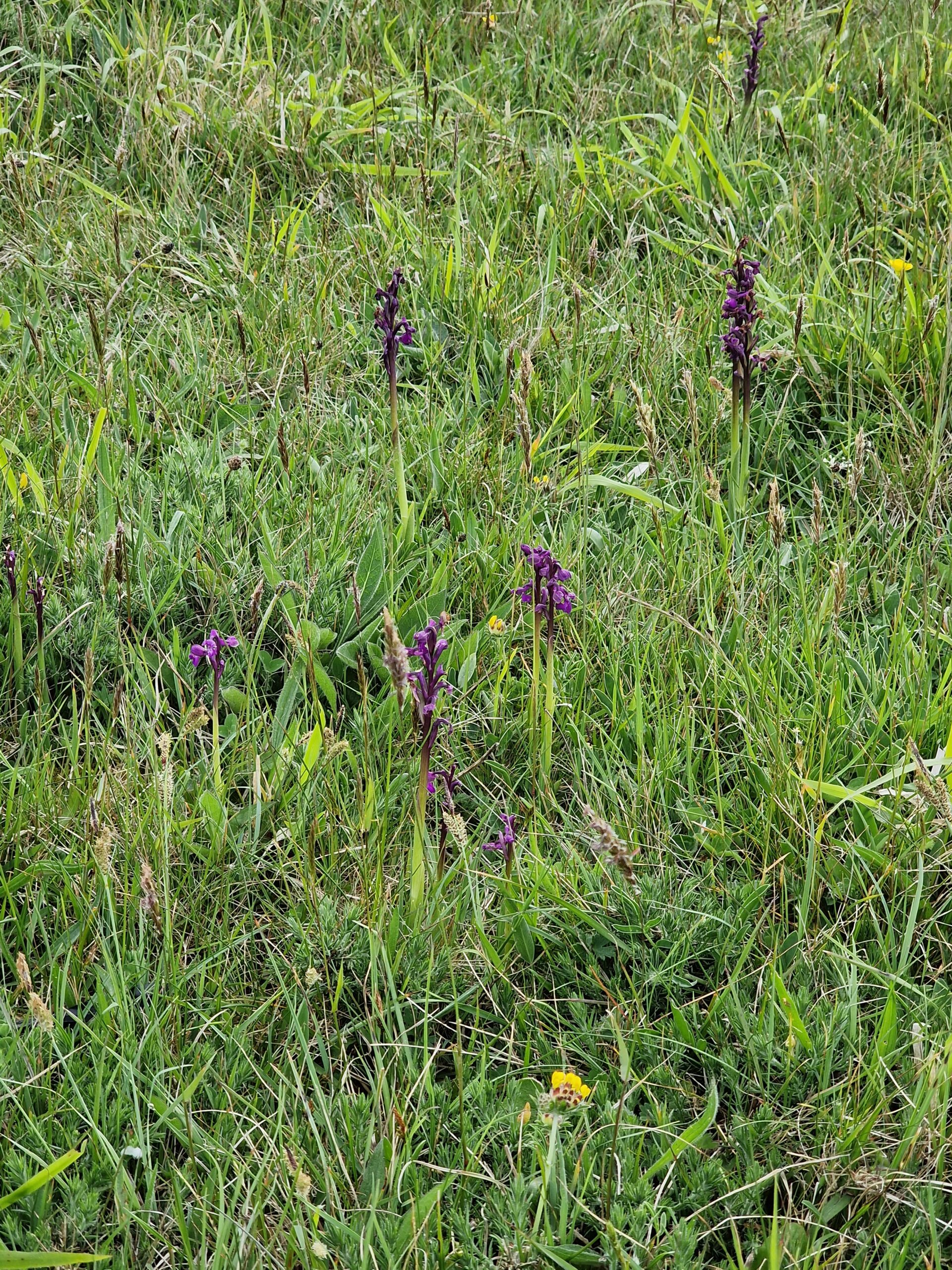
Anacamptis morio – May 13th 2024- (Green-winged Orchid)
Some people spend hours spotting orchids, and even travelling great distances up and down the country to see the flowers. I am not one of those, but I have been trying for a couple of years to see the Green-winged Orchid. This year I succeeded.
In Scotland there is only one place where it has been recorded year-after-year, and that is in Ayrshire. I knew this, but I hadn’t realised it produces flowers so early and I’ve been turning up too late. It has roughly the same flowering period as the Early-purple Orchid, and so April and May are the months to search for it. Any later, and the flowers will have withered.

Anacamptis morio the Green-winged Orchid, pictured in Italy. Image: Chris Jeffree.
Its name ‘Green-winged’ refers to veins appearing as green stripes on the two sepals which converge to form the hood. Sometimes they are not particularly green, but always they are visible and diagnostic. It has rather few flowers (5-12) and isn’t very tall (10-40 cm). The stem-leaves are pale green and without the dark splodges often seen on the Early-purple Orchid.
It normally grows in sort grassland, on calcareous or nearly-neutral soils. In England and Wales it has declined because its habitats including hay meadows have been ‘improved’ and now support tall-growing species which shade out this orchid. In Scotland, it was first recorded in 1983 by a stream at Bennane Head in South Ayrshire and nearly all the records are from around there. We wrote about Bennane Head in an earlier blog. The area became a Site of Special Scientific Interest (SSSI) in 1981 because of its “rich flora associated with the ultrabasic rocks of the Ballantrae Complex … distinctive in lying over neutral soils”.

Green-winged Orchid by the busy A77, with Kidney Vetch. Image: Dave Lang.
The impact of fertilizers on this species is well-documented. Silvertown et al (1994) reported a long-term experiment in England on the effect of fertilizer treatment at a meadow rich in Green-winged Orchid. Quite modest applications of fertilizer produced a decline in the number of flowering spikes. The reason for the decline was presumed to be the stimulus of fertilizer on the growth of competing species but the authors also considered possible toxic effects of phosphorus on the mycorrhizal system of the orchid.
Orchids have declined everywhere in Europe. Kull and Hutchings (2006) made a detailed assessment of this decline, using data from UK and Estonia. For the UK they were able to use the data from the BSBI to compare the number of grid-cells occupied in the period 1930-1969 with those occupied 1987-1999. Every one of the 51 species of British orchids had declined, and the picture was similar in Estonia. Reports from other parts of Europe show the same pattern. Most authors blame the intensification of agriculture and especially the use of fertilizers, as suggested by Jonathan Silvertown’s analysis. Another part of the story may be the decline of insect pollinators, attributed to the widespread use of pesticides.

Another image of the Green-winged Orchid at Bennane Head, taken May 3rd 2024. Image: John Grace.
Orchids need large insects as pollinators. The early investigators (like Charles Darwin) must have spent many hours simply watching and noting the behaviours of bees and moths on the chalk downs and hay-fields where orchids in those days flowered in profusion. Darwin wrote a book about it, which can now be viewed online.
As far as orchid pollination is concerned, two evolutionary strategies are recognised. There are ‘rewarders’ where the insect gets its reward in the form of nectar and ‘deceivers’ which have attractive flowers and perhaps an enticing sexual smell but no reward. The Green-winged is a deceiver. Insects are deceived into thinking food will be there; they probe about within the flower in vain, but the orchid’s pollinia (the discrete packages of pollen that orchids have) stick to their bodies and will be transferred to another flower later. Deceivers ‘win’ because there is no need to spend precious resources to manufacture nectar. Possibly the insects become wise after a few fruitless visits, and in the case of the Green-winged there is often a rewarding Early-purple nearby. Occasionally hybrids are formed (records from England and Anglesey).

Distribution of Anacamptis morio in Britain (from the BSBI) and Europe (from GBIF). Note: there are some discrepancies in the Scottish distribution shown on the two maps.
The Green-winged Orchid is pollinated by early-emerging bees, especially bumble bees. The decline of bumble bees is discussed by Dave Goulson and others from the University of Stirling (Goulson et al 2008). As bees decline, orchids will fail to produce seed. The seeds are tiny with almost no food reserves; they need a mycorrhizal fungus to fuel their germination. The fungus too may be threatened by the use of pesticides.
According to Chatters (1994) the Green-winged Orchid is a monocarpic perennial which can persist for years in a vegetative state as a rosette of leaves sprouting from a spherical tuber. Ultimately, it produces its flowers and then dies. It does not self-pollinate and reproduction is solely by seed and so bees are crucial for its survival.
Notes
1.Previously the species was called Orchis morio, but it has been taken out of Orchis and put into Anacamptis based on molecular studies.
2.The colour of the flowers varies. They are a variable shade of purple but white forms have been recorded too.
3.The GBIF map disagrees with the BSBI map. GBIF shows records in the North-West of Scotland and near Edinburgh. I’d be interested to hear from anyone who can enlighten me about this discrepancy. I’ve zoomed the GBIF map below:

References
Chatters C (1994) Orchis morio L. Page 287 in Stewart A et al (1994) Scarce Plants in Britain. Published by JNCC, Peterborough.
Cole S and Waller M (2020) Britain’s Orchids – a field guide to the orchids of Great Britain and Ireland.
Goulson D et al (2008) Decline and conservation of bumble bees. Annual Review of Entomology 53, 191-208. doi: 10.1146/annurev.ento.53.103106.093454. PMID: 17803456 but also available at https://dspace.stir.ac.uk/bitstream/1893/862/1/Conservation%20Review6.pdf
Kull T and Hutchings MJ (2006) A comparative analysis of decline in the distribution ranges of orchid species in Estonia and the United Kingdom, Biological Conservation, 129, 31-39. https://doi.org/10.1016/j.biocon.2005.09.046
Proctor M et al (1996) The Natural History of Pollination. Harper Collins.
Silvertown J et al (1994) Short-term effects and long-term after-effects of fertilizer application on the flowering population of Green-winged orchid, Orchis morio. Biological Conservation 69 (1994) 191 – 197.
See Also
Jeremy Bartlett wrote a nice blog on the Green-winged Orchid in 2020 which you can see by clicking the panel below.
©John Grace