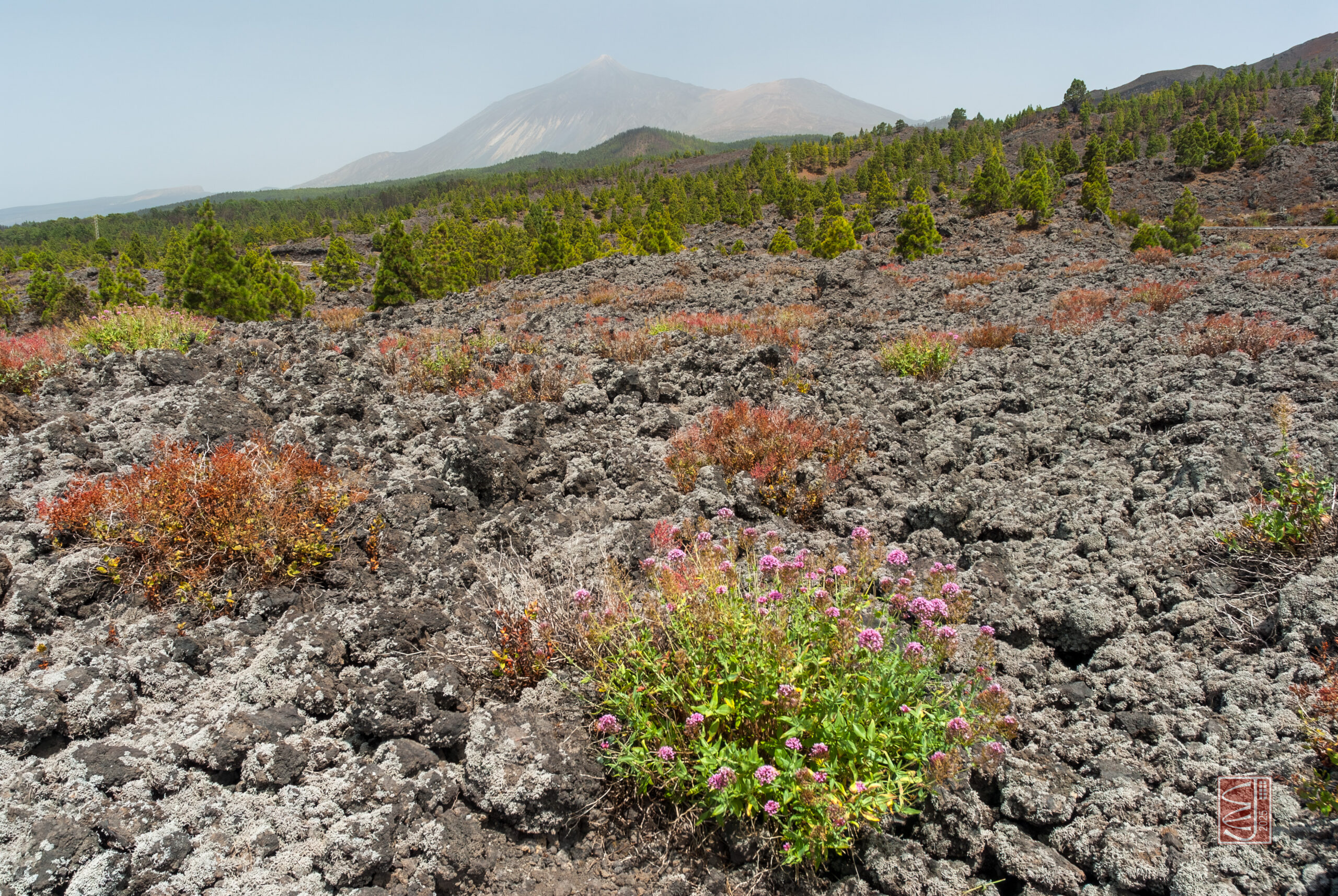
Valeriana rubra – July 21st 2025 – Red Valerian (previously called Centranthus ruber)
At least half of the British Flora consists of alien species. Where did they all come from, and how do we know? Many came to us as garden plants, and this is one of them.

Valeriana rubra on larva from the 1944 eruption of Vesuvius. Image: Chris Jeffree.
Valeriana rubra is a mediterranean plant brought to England as a garden plant in the 16th Century. John Gerard the herbalist, grew it in his garden in 1597. Like many other species, it escaped from cultivation (first recorded in the wild, 1763) and spread throughout England and Wales in the 20th Century. It established itself as a wildflower in Scotland more recently and continues to spread wherever the right sort of habitat presents itself.

A brief history of the records of V. rubra obtained from GBIF.
It finds suitable sites near to human habitation as it favours limestone and therefore grows in the mortar of old walls, and the cracked and crumbling concrete of derelict sites. Quarries, roadsides and railway tracks are also potential habitats. It doesn’t mind dry conditions, and it tolerates salt, so cliffs near the sea and the tops of urban walls can provide a home.

V. rubra at Arthur’s seat, to the west of the road known as the Queen’s Drive. Image: Chris Jeffree.
We saw it at Arthur’s Seat in Holyrood Park, Edinburgh. It has also become widespread on the limestone karst of the Burren, on the west coast of Ireland. Many people find it beautiful in such wild places but it may eventually overwhelm the rare native flora.

Valeriana rubra, white form, Leith sea wall. Image: Chris Jeffree.
What of its name? The Flemish physician-botanist Rembert Dodoens (1517 – 1585) called it Valeriana rubra and Gerard copied him. But in 1753 Linnaeus called it Centranthus ruber in his great work Species Plantarum. That name remained in use until very recently, when taxonomists considered Dodoens to have been right after all, and so now we should call it Valeriana rubra although I’m sure gardeners will call it Centranthus for many years to come. English names? ‘Red Valerian’ is merely a translation of the Latin, but I’ve seen other more imaginative names: Fox’s Brush and Jupiter’s Beard.

Close-up view of flowering head. Image: Chris Jeffree.
The species is a vigorous rhizomatous perennial, that can grow large (0.8 m tall) and becomes woody after a few year’s growth. We usually see it as a herb but some authors have described it as a shrub. Hill et al. (2004) write that its life form is ‘genuinely intermediate’. It belongs to the Caprifoliaceae, the Family of honeysuckles.

Flowering head cut away to show the nectar-bearing spurs. Image: Chris Jeffree.
The flowers are pink or red, but sometimes white. A red variety called ‘Pretty Betsy’ is widely available from nurseries. Flowers are hermaphrodite; each flower bears a long spur containing nectar-secreting trichomes. A variety of insects including bees and butterflies are attracted to this prize, and thus pollination is facilitated. The seed is enclosed within a dry, one-seeded fruit (an ‘achene’) and each achene has an intricate ‘parachute’ to disperse the seed widely in the wind.

Detail of the ‘parachute’ of fine hairs, very like the pappus of hairs in members of the dandelion Family Asteraceae. Image: Chris Jeffree.
Where did it come from? According to Kew’s Plants of the World Online (POWO) its native lands border the mediterranean, including North Africa (Morocco, Algeria and Tunisia). However, when I go to the Global Biodiversity Information Facility (GBIF) it seems the first records came from southern France and northern Spain. The two sources are not in conflict. POWO considers information from early writers, archaeological sites and pollen analysis. GBIF is simply a log of records, and of course there were not so many observers in the 18th Century. Even in modern times, trends in abundance such as those shown on GBIF should really be calibrated to allow for the increase in ‘recorder effort’. In the early days the recorders were the few mostly physician-botanists collecting for herb-gardens, later recorders were gentlemen-scientists representing Learned Societies but in recent times very many folk have become ‘citizen scientists’ equipped with illustrated floras and phone-Apps. No wonder more records appear.

Valeriana rubra beside a railway track at Stranraer, with several other alien species including Buddleja davidii. Image: John Grace.
We can however safely say that this is a mediterranean species that has spread north, aided by the horticultural trade, helped by its own efficient dispersal mechanism and perhaps facilitated by the increase in the exposure of limestone through cycles of building and demolition. Possibly its poleward spread has been accelerated by global warming.

In the urban environment, V. rubra frequently grows on the tops of old walls. Its roots become woody and it may cause damage. Image: Chris Jeffree.
Valeriana rubra has also spread to other parts of the world, and in some parts of North America and in South Africa it is considered invasive.
Note
At the head of the page: V. rubra on lava at La Montañeta in Tenerife. Image: Chris Jeffree
References
De Micco V et al. (2020) Dust accumulation due to anthropogenic impact induces anatomical and photochemical changes in leaves of Centranthus ruber growing on the slope of the Vesuvius volcano.” Plant Biology 22, 93-102.
Geerts, S et al. (2017) Emerging ornamental plant invaders in urban areas—Centranthus ruber in Cape Town, South Africa as a Case Study. Invasive Plant Science and Management 10, 322-331.
Gwynn Ellis R (1993) Aliens in the British Flora. National Museums and Galleries of Cardiff.
Hill MO, Preston CD, and Roy DB (2004) PLANTATT-attributes of British and Irish plants: status, size, life history, geography and habitats. Centre for Ecology & Hydrology,
Holmes PM, Rebelo AG & Irlich UM (2018). Invasive potential and management of naturalised ornamentals across an urban environmental gradient with a focus on Centranthus ruber. Bothalia-African Biodiversity & Conservation, 48, 1-14.
Starr F, Starr K and Lloyd Loope (2003) Centranthus ruber. Red Valerian, Valerianaceae. Maui, Hawai’i: Biological Resources Division Haleakala Field Station.
©John Grace