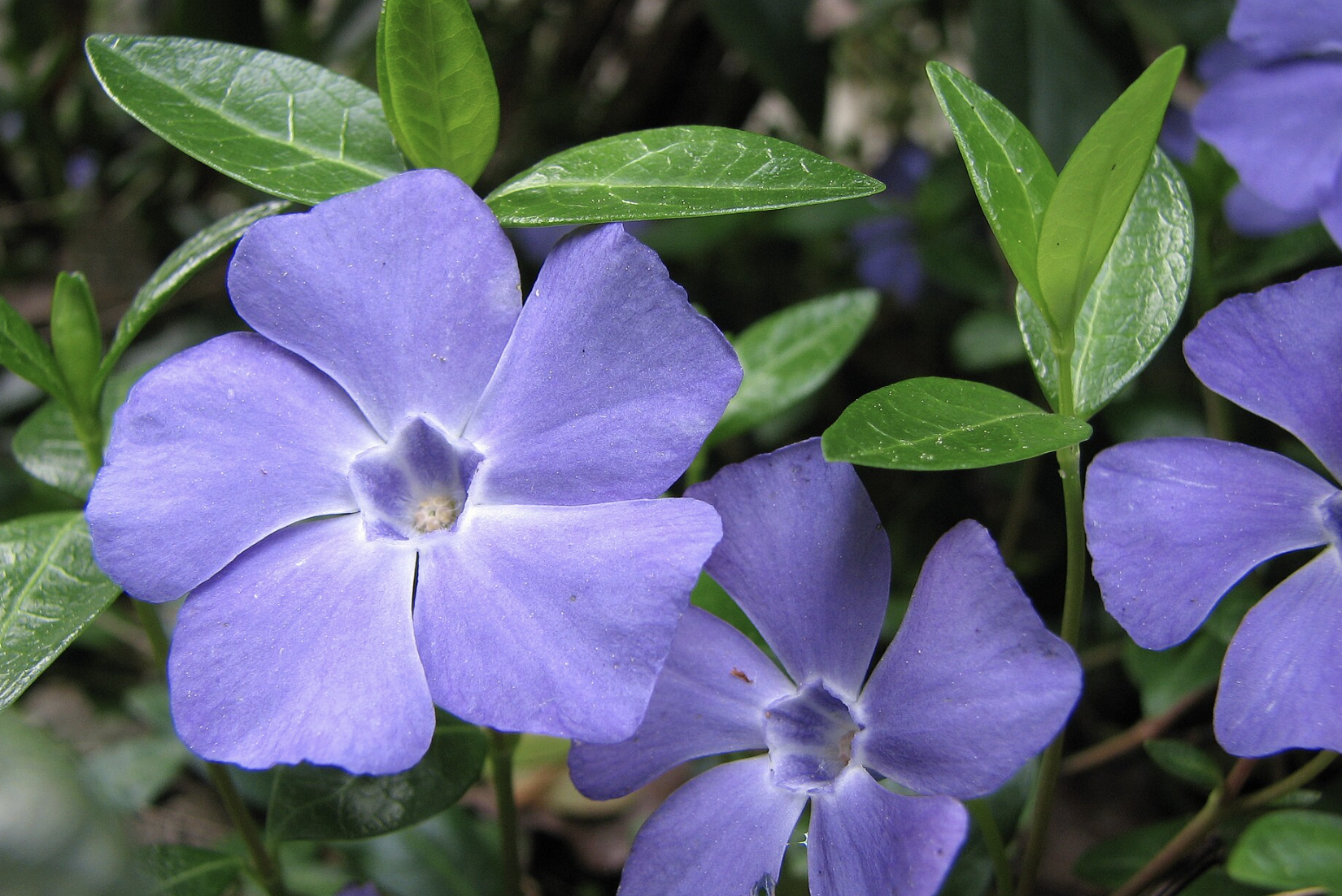
Vinca minor and Vinca major – April 20th 2026 – Periwinkles
These plants are known as ‘periwinkles’ but no-one really knows how they come to share this name with the small edible sea snail (Littorina littorea)1.

Vinca minor. Attribution: from Flora von Deutschland, Osterrich u.d. Schweiz, by Otto Wilhelm Thomé, Public domain, via Wikimedia Commons
They belong to the Family Apocynaceae (alongside such plants as Oleander and Hoya). They are evergreen vine-like perennials with stems that arch and trail along the ground, sprouting roots from their shoot-tips whenever they touch the soil. Both are widely grown in public and private gardens – the reasons are obvious – they cover the ground, look cheerful in spring and early summer and they can tolerate shade. Both are now found in the wild, and according to the BSBI records they are increasing. Part of the increase may be because the BSBI recorders are now more inclined to record ‘garden plants’ seen in the wild (before the 1960s, recorders sometimes turned away, but attitudes have now changed).

Vinca major, maritime grassland, Ardrossan North Shore. Image: Chris Jeffree
Both plants are recorded in shady places but also in the open. Quoting directly from the BSBI Atlas 2020 we can see a similarity of habitats:
V. minor: woodland, copses, plantations, scrub, hedgerows, shady roadside banks and verges, as well as on waste ground and refuse tips.
V. major: base of hedges, waste ground, refuse tips, disused railways, roadside verges, shaded banks and woodland. Often grown in shaded gardens, it can spread very effectively onto adjacent hedgebanks and under trees. It also occurs as a throw-out from garden waste.

Vinca minor (left) and Vinca major (right). Image: Chris Jeffree
We have recorded both plants many times in our survey of Scotland’s towns and cities. They seem especially associated with urban spaces. V. major was often found on walls and coastal paths whilst V. minor occurred in many woodland habitats but also in the open, including the Edinburgh tram line.

Vinca major in an unusual mode at Dalkeith. They normally sprawl not climb. Image: Chris Jeffree.
There is a tendency for both species to become invasive. There are some complaints from British gardeners about this, but far more from the United States, South Africa, Australia and New Zealand. There is some evidence that at least part of periwinkle’s success is an ability to produce chemicals that inhibit germination of other species (‘allelopathy’). Moreover, V. minor appears to alter the soil fauna.
Both have five petals, usually blue. As their names suggest, the two species vary in size. In V. minor the flower-tube is 9-11 mm long whereas in V. major it is 12-15 mm. A definitive character is that major has tiny hairs at the edges of leaves and calyx (this character is well-illustrated in the image below).

Demonstration of the hairs (‘cilia’) on the margins of leaves and calyx in V. major. The cilia are absent in V. minor. Image: Chris Jeffree
Neither of these European species are native to Britain. However, V. minor has been here a long time– we know it was grown in British gardens in medieval times and is thus considered to be an archaeophyte. Possibly it came here with the Roman invasion. We know it was a garden plant by 1596 and recorded in the wild by 1677. We can’t be sure which one Jon Gerard referred to in his 1597 Herbal but most likely it was V. minor. Here’s what he said:
Periwinkle hath slender and long branches trailing upon the ground, taking hold here and there as it runneth; small like to rushes, with naked or bare spaces between joint and joint. The leaves are smooth, not unlike to the Bay leaf, but lesser. The flowers grow hard by the leaves, spreading wide open, composed of five small blue leaves.
He described a larger version of periwinkle but it may have been a Clematis. Then he goes on to say:
They grow in most of our London gardens; they love a moist and shadowy place: the branches remain always green.
The flowers of both species look quite simple but if you care to tear one apart and look inside with a hand lens you will see great complexity. There is an excellent description from New Zealand of the flower of Vinca major by Rhys Gardner2. The author takes issue with Charles Dawin’s 1862 interpretation of the structure and function of the flower.

Vinca minor, centre of flower. For a detailed description of what lies within, see Gardner (2019). Image: Chris Jeffree
The flowers are pollinated by long-tongued insects, including butterflies. They are cross pollinated and can produce seeds, but mostly they reproduce vegetatively, spreading via the arching and trailing stems. Garden throw-outs may assist spread – small fragments of the stem sometimes take root.
Both species have been used in medicine. They contain several alkaloids which have biological activity, such as vincamine and vincristine. Vincamine (V. minor) increases cerebral blood flow, oxygen, and glucose utilization, and so has been used in treating age-related conditions, and in European folk medicine V. minor was used for cerebral
and memory disorders. Vincristine (V. major) is administered intravenously as a chemotherapy for some forms of cancer; it works by halting cell division. The closely related Catharanthus roseus, from Madagaster, is however the main source of chemotherapy medications. It does not occur in Britain; it cannot tolerate our low temperatures, although seeds can be purchased here, online. Tinctures of Vinca are available from herbalists, but no claim is usually made regarding efficacy.

Vinca major, showing how the flowers and leaves are inserted into the stem. Image: Chris Jeffree
All three species are poisonous to humans3, and in the case of Catharanthus roseus a large dose was given to suspected criminals in Madagaster to decide whether they were guilty. It seems they usually were. Closer to home, there are several equally morbid stories about V. minor. Alice Coats, in her 1968 book Flowers and Their Histories describes the use of V. minor as a garland for criminals on their way to execution. She presents us with the particularly gruesome case of Simon Fraser (executed 1306); he was a Scottish knight and commander who supported William Wallace during the Wars of Scottish Independence. He was paraded through the streets of London with a garland of periwinkle on his head before being hung, drawn and quartered.

Distribution of the two Vinca species in Britain and Ireland. From BSBI/Maps.
Notes
1 The name periwinkle may be derived from the Latin word pervinca, which comes from vincio meaning ‘to bind’, referring to the plant’s vine-like behaviour. Someone may have mumbled “pervinca” and to the listener it sounded like “periwinkle”. Hence, it is possible that both the Common name and the Latin name Vinca come from pervinca.
2 You can freely download it here.
3 The Apocynaceae contains many poisonous plants and its members have been used for various rituals, vermin control and to make poisonous arrows. As a medicine (presumably consumed in very small quantities. Culpeper, in his Complete Herbal of 1653, says of periwinkle: “the leaves eaten by man and wife together, cause love between them”.
The image at the top is by Jina Lee, uploaded to wikipedia in 2007., and now licenced by Creative Commons.
References consulted
Barreto C et al. (2025). Lesser periwinkle (Vinca minor L.) invasion alters the composition of soil invertebrate communities in two mixed deciduous forests. Pedobiologia, 151072.
Darcy AJ and Burkart MC (2002) Allelopathic potential of Vinca minor, an invasive exotic plant in west Michigan forests. Bios, 127-132.
Gardner R (2019) A pretty problem: the flowers of Vinca major (Apocynaceae). Aukland Botanical Society Journal 74, 48-51.
Khanavi M et al. (2010) Cytotoxicity of Vinca minor. Pharmaceutical biology 48.1, 96-100.
Stroh PA, Humphrey TA, Burkmar RJ, Pescott OL, Roy DB and Walker KJ (2020) Vinca minor L. in BSBI Online Plant Atlas 2020. Princeton University Press.
©John Grace