Glechoma hederacea – April 27th 2026 – Ground Ivy
On a single day last week I saw more of this plant than I’ve seen in my entire lifetime. I was visiting the southern part of the Czech Republic, a region known for its vineyards, where I stayed in a small village. Stepping out of the hotel I saw a mass of Ground Ivy, practically a lawn of it. Walking around, first on a playing field and then amongst a huge array of solar panels, there was still more. I decided it deserves ‘Plant of the Week treatment’.

Glechoma hereracea seen near Hotel Kraví Hora, near Bořetice, Czech Republic, forming a dense mat, in full flower on 13th April 2026. Image: John Grace.
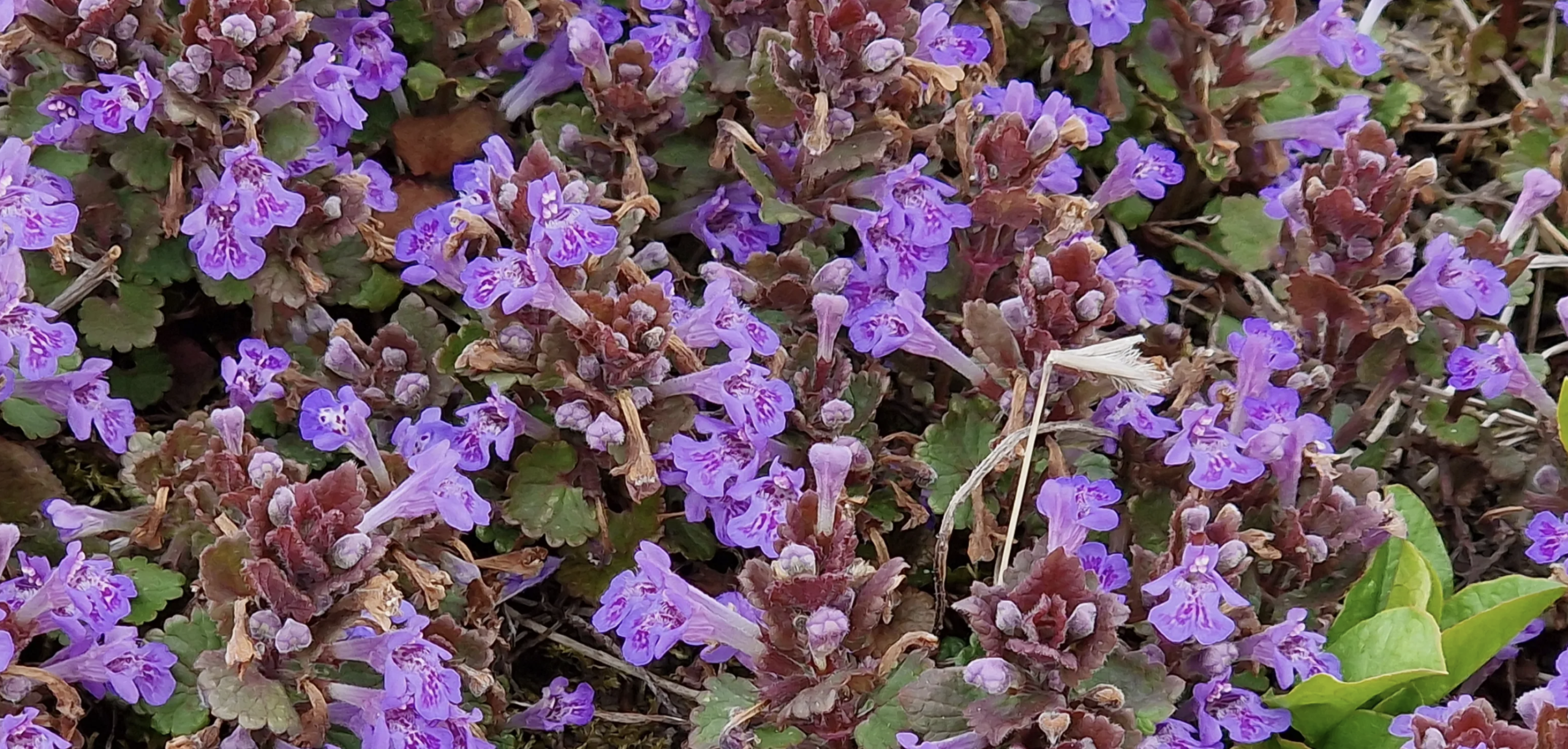
Glechoma hederacea is a perennial and a member of the Lamiaceae (the mint family). It is a native of Europe (including Britain) and has a long history of medicinal and culinary use. It has the unmistakable features of its family: square stems, opposite leaves, and two-lipped flowers. The flowers appear in spring and early summer and are adapted for pollination by bees and hover-flies, providing nectar for early-season pollinators. Its leaves are kidney shaped with crenelated edges and carried on stalks (3–6 cm long, more in shade). The leaves of those I saw were reddish-tinged, but this may not always be the case. The flowers were purple-red, but they may be more blue elsewhere.

The plant has hairs and is usually tinged red. Note the kidney-shaped leaves with marginal crenelations. Image: Chris Jeffree.
It reproduces both sexually (via seeds) and vegetatively (via stolons). Vegetative reproduction is particularly efficient, allowing rapid colonization of new areas. In North America, where it was introduced by European settlers, it is considered a nuisance weed but here in the British Isles I believe it is relatively benign. We have discussed in previous blogs how plants become more vigorous when away from their native range, a widespread phenomenon usually ascribed to the lack of natural enemies when the plant is introduced.

This shows the insertion of the flowers and leaves into the stem. In a newly opened flower the blue forked stigma stands just above the stamens (see flower on the left). After the anthers (white) have shed their pollen the style bends down so that the stigma is exposed below the stamens. Image: Chris Jeffree.
As for habitat, Grime et al. (1988) provide a good synopsis: “frequent in hedgerows, on shaded roadsides and in woodlands, and tends to occur beside rides, on floodplains, beside rabbit scrapes or in clear-felled areas”. The BSBI Atlas gives “woods, grassland, hedgerows and waste places, usually on fertile soils”. In our urban flora of Scotland project we find it also along coastal paths, parklands, railway embankments, riversides and in cemeteries. The earliest description of its habitat is probably the one in Gerard’s 1597 Herbal. He says “It is found as well in tilled as in untilled places, but most commonly in obscure and dark places, upon banks, under hedges, and by the sides of houses”. Evidently it is quite adaptable.
Insights into this adaptability can be seen in work from the 1980s by Mike Hutchins and colleagues at the University of Sussex. In shade, the stolons are long and thin compared to when the plant is grown in open conditions.
As for soil, Glechoma hederacea occurs mainly on damp\ heavy\ fertile and calcareous soils (Hutchings and Price 1999). Certainly, the soils round my hotel last week were calcareous.

Here, moles have helpfully provided a view of the soil at the Czech Republic site. Its light colour suggests it is derived from limestone. Image: John Grace.
Historically, G. hederacea has been valued for its medicinal properties. In traditional European herbal medicine, it was used to treat a variety of ailments, including respiratory issues, digestive disorders, and inflammation. The plant was often prepared as an infusion or decoction. It contains chemical compounds with known pharmacological properties, such as anti-inflammatory, antimicrobial, and antioxidants, and extracts of G. hederacea may have potential in treating conditions like chronic bronchitis or mild infections. It should not be consumed in large quantities – it contains pulegone, a colorless oil with a pleasant odour, found in peppermint too. The herbal supplier Napiers of Edinburgh markets a tincture, advising customers thus: “extracts such as tinctures or essences offer a convenient alternative to herbal teas. Many are used in food, food supplements, cosmetics and as an ingredient by herbalists in bespoke formulas. A herbal food supplement”.

Distribution of Glechoma hederacea in Britain and Ireland, from BSBI/Maps. You may be able to view the world map at https://www.gbif.org/species/2926557
One of its historical uses was in brewing. Before the widespread adoption of hops, ground ivy was used to flavour and preserve beer, hence the name Garard used, ‘alehoof’.
References consulted
Gerard J (1597) Herbal. The page on Ground Ivy is here, and can be freely downloaded. https://www.exclassics.com/herbal/herbalv30141.htm
Grime JP, Hodgson JG and Hunt R (1989) Comparative Plant Ecology. Unwin Hyman.
Hutchings MJ and Price EAC (1999). Biological Flora of the British Isles. No. 205. Glechoma hederacea L. (Nepeta glechoma Benth., N. hederacea (L.) Trev.). Journal of Ecology 87, 347–364.
Glechoma hederacea L. in BSBI Online Plant Atlas 2020, eds P.A. Stroh, T. A. Humphrey, R.J. Burkmar, O.L. Pescott, D.B. Roy, & K.J. Walker. https://plantatlas2020.org/atlas/2cd4p9h.14s [Accessed 23/04/2026]
Slade AJ and Hutchings MJ (1987). The effects of light intensity on foraging in the clonal herb Glechoma hederacea. The Journal of Ecology, 639-650.
©John Grace