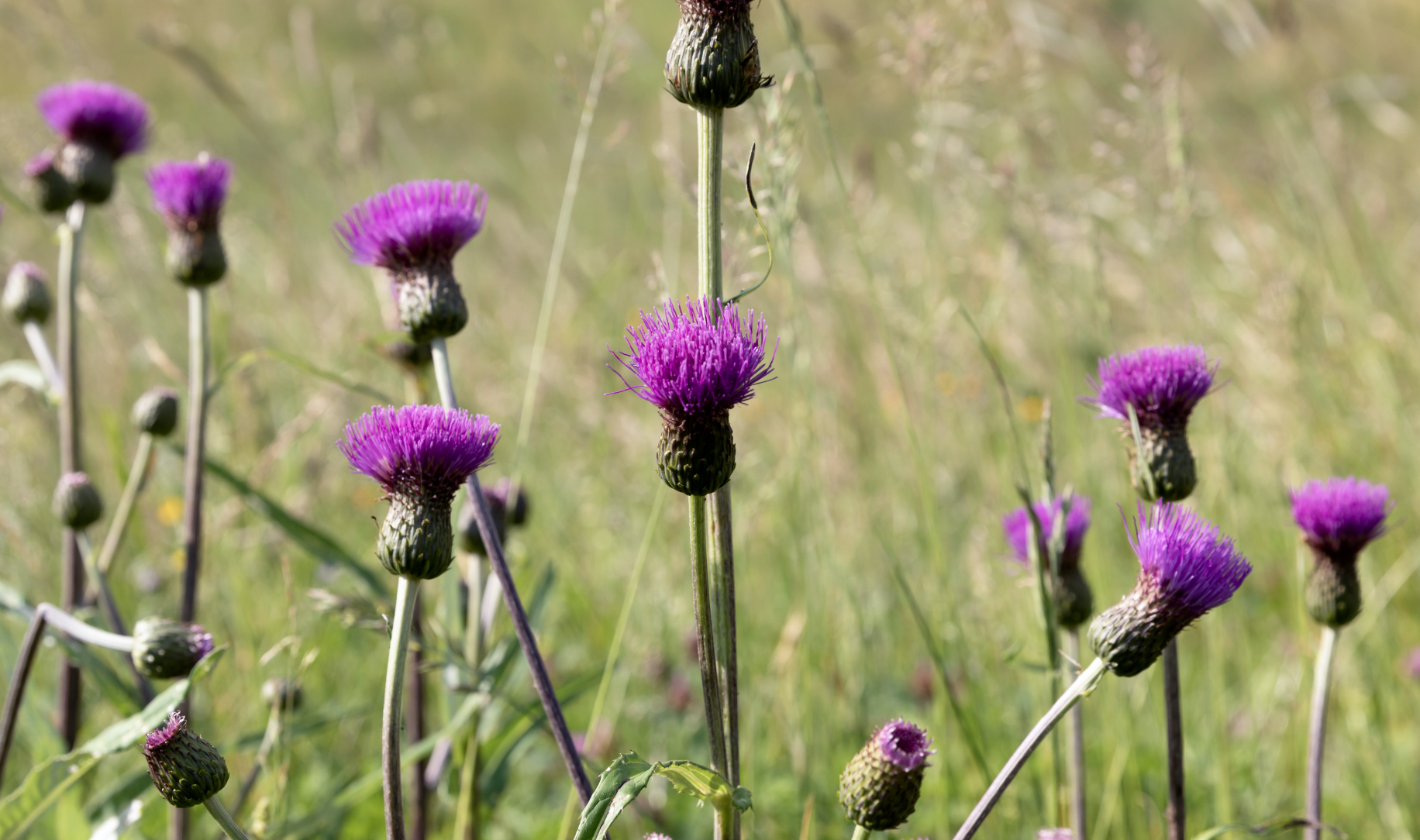
Cirsium heterophyllum – August 10th 2026 – Melancholy Thistle
Readers from the southern parts of the UK probably won’t know this plant. I didn’t notice it until my late teens when I travelled north to Teesdale (County Durham). There, it was common by roadsides. It’s an example of a northern species, growing best in damp, moderately base-rich environments including upland hay meadows, streamsides, moist woodland margins, and river valleys.

Cirsium heterophyllum – usually seen in small groups like this. Image: Chris Jeffree.
Thistles belong to the daisy family, the Asteraceae, where the flowering heads are made up of many tiny florets. Cirsium heterophyllum forms sterile rosettes of soft leaves, some developing into flowering shoots (60–125 cm) bearing 1–8 large flowering heads (each with 140–390 tiny purple florets). It reproduces sexually but also has creeping rhizomes to produce new shoots each year, helping colonies to survive even when seed production is poor or when flowering stems are damaged in storms or floods.

Melancholy thistle, detail of flower head. Image: Chris Jeffree
It’s a highly decorative plant and I’m sure it would be planted widely in gardens if only it could tolerate the warmth of the south. Unusually for thistles, it isn’t spiny. Its flowerhead has been likened to a purple shaving brush. The underside of its leaves are ‘white-hairy’. The stem sways gracefully in the wind, and the flowers are visited by several species of flying insect.
Its vibrant display attracts long-tongued insects such as bumblebees and butterflies. Thistles are generally rich in nectar and this one is no exception: the tubular disc florets store energy-rich nectar deep within their structures. Foraging insects brush against the five fused stamens, picking up and depositing pollen grains. They go from flower to flower, typically travelling short distances between flower heads. But cross-pollination easily occurs with another native thistle, Cirsium palustre (marsh thistle). The two thistles grow in more or less the same damp grassy places, flower at the same time (July-August) and have the same number of chromosomes (2n=34). The offspring is called Cirsium x wakelii, described as a ‘very handsome, easily recognised hybrid with branched stems, and leaves grey-felted abaxially…weakly spiny (Stace et al. 2016). Cirsium heterophyllum is also known to hybridise with the most common of our thistles, Creeping Thistle (Cirsium arvense, also with 34 chromosomes). But those hybrids are rare.

Examples of insect visitors: Cinnibar Moth and Bumble bee. Image: John Grace
Cirsium heterophyllum has both female and hermaphroditic individuals, a condition known as gynodioecy – only seen in 1% of angiosperms globally, but as much as 14% in the genus Cirsium. The question often raised regarding this condition is: how and why do females persist when hermaphrodites are perfectly capable of setting seed? It seems to be a waste of the plant’s resources to have two ways of making offspring; is it merely vestigial, i.e. an evolutionary ‘left-over’? And why is the condition so much more common in thistles? I have been (frankly) baffled by research that address these questions, and even though I’ve just read a recent paper on the subject (Dias Mahadura et al., 2026) I do not feel equipped to attempt a summary.

A slice throught a young shoot, showing developing flower head. Image: Chris Jeffree.
The species seems to be declining. Climatic warming is likely to push it still further north. But changes in land management may have been a bigger threat so far. To quote the BSBI’s Atlas 2020:
“C. heterophyllum has retracted from the lowland margins of its range since the 1960s, where it was always likely to have been rare, and therefore more vulnerable to land use change. Here, as elsewhere, it has declined due to a shift from low intensity (traditional) hay meadow management to intensive silage making, and changes to the management of road verges that provided a refuge for this species in many areas (Bradshaw 2009)”.
Margaret Bradshaw’s paper focuses on the decline of several species in the hay meadows of her beloved Teesdale, whilst an earlier paper (Smith and Rushton,1994) reported field-based experiments on grazing intensity, showing how the greatest reduction in species richness occurs in ungrazed plots. To maintain the native biodiversity, it turns out that the timing of grazing is key.

It’s called ‘heterophyllum’ because the two sides of the leaf look quite different. The underside is covered with short white hairs, giving a silvery appearance. Image: John Grace.
Turning now to lighter issues: why is Cirsium heterophyllum called the Melancholy Thistle? Nicholas Culpeper in his Complete Herbal of 1653 wrote “the decoction of the thistle in wine being drank, expels superfluous melancholy out of the body, and makes a man as merry as a cricket; … my opinion is, that it is the best remedy against all melancholy diseases”. Whereas there is absolutely no evidence for this assertion, the name has stuck. Today, Culpeper’s reputation is tarnished – analysis shows he copied from an earlier work: John Parkinson’s Theatrum Botanicum of 1640.

Cirsium heterophyllum distribution in Britain and Ireland. From BSBI/Maps
In one of our earlier (2021) blogs, Maria Chamberlain considered Melancholy Thistle as a candidate for the title of the Scottish Thistle. But to qualify as the national emblem, the thistle needs sharp spines to ward off the 12th Century invading gangs of sea-faring Danes (as legend has it). And somehow, Cirsium vulgare (Spear Thistle) with its erect stance and needle-sharp spines, fits the bill and the Scottish temperament better.
Note: Image at the top of the article is by Manfred Werner (Tsui), CC BY-SA 4.0 https://creativecommons.org/licenses/by-sa/4.0, via Wikimedia Commons
References
Bradshaw ME (2009). The decline of Lady’s-mantles (Alchemilla vulgaris L. agg.) and other hay meadow species in Northern England since the 1950s. Watsonia, 27(4), 315.
Charlesworth D (1981). A further study of the problem of the maintenance of females in gynodioecious species. Heredity, 46(1), 27-39.
Cirsium heterophyllum (L.) Hill in BSBI Online Plant Atlas 2020, eds P.A. Stroh, T. A. Humphrey, R.J. Burkmar, O.L. Pescott, D.B. Roy, & K.J. Walker.
Dias Mahadura A et al. (2026). How Do Females Persist? Life History, Environment, and Female Advantage in Gynodioecious Cirsium. Ecology and Evolution, 16(7), e74093.
Jump AS and Woodward FI (2003). Seed production and population density decline approaching the range‐edge of Cirsium species. New Phytologist, 160(2), 349-358.
Pavlů L et al. (2011). Effect of long-term cutting versus abandonment on the vegetation of a mountain hay meadow (Polygono-Trisetion) in Central Europe. Flora, 206(12), 1020-1029.
Smith RS and Rushton SP (1994). The effects of grazing management on the vegetation of mesotrophic (meadow) grassland in Northern England. Journal of Applied Ecology, 13-24.
Starr‐Keddle RE (2022). Evaluating the success of upland hay meadow restoration in the North Pennines, United Kingdom, using green hay transfer. Ecological Solutions and Evidence, 3(1), e12134.
© John Grace