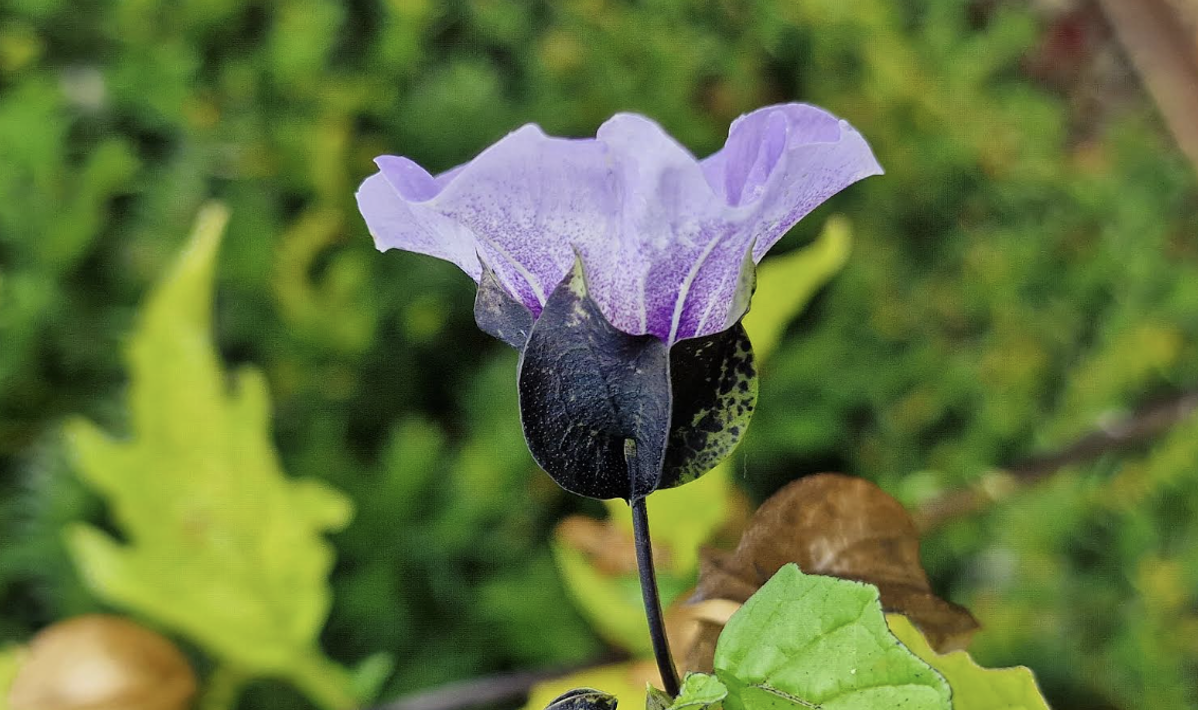
Nicandra physalodes – September 13th 2026 – Apple of Peru

Nicandra physalodes, old painting by Peter Heinrich Esser (1859–1945), known for his book Die Giftpflanzen Deutschlands (The Poisonous Plants of Germany). Colours may have faded. No copyright restrictions: https://commons.wikimedia.org/w/index.php?curid=42729198
Someone gave us this plant, as they knew we liked unusual flowers. It grew well in our little garden, and made seeds – and the next year we had many seedlings. The year after, we had none but our elderly neighbour was surprised to see many seedlings in her patch. Then we had nothing at all until this year (some six years later) when ten seedlings appeared in our asparagus bed but nowhere else.

Nicander physalodes, Apple of Peru, in the dappled shade of an asparagus bed. Image: John Grace
This story prompted my interest in the species. I haven’t personally seen it ‘in the wild’ but many people have. On the database of the Botanical Society of Britain and Ireland (BSBI) there are plenty of British records. In Scotland, there are just 34 records, the earliest (1915) being by none other than Ida M. Hayward, the amateur botanist who wrote a famous book about the plants growing near her uncle’s woollen mill in Galashiels. She saw it “by the side of the Tweed, two miles below Galashiels” and “in the vicinity of Galashiels Skin-works”. Of course, it’s an alien species, native to Peru as its common name suggests, but also a native of Argentina, Bolivia and Chile. Did we import wool from the western part of South America? I don’t know, but it seems probable as Scottish merchants identified the vast, fertile plains of South America especially Agentina, as prime sources for fine fleeces. But it was grown in England by 1759 and first recorded in the wild in 1850 (Isle of Wight). It has long been considered as a good ornamental garden plant, as Haywood mentions in her book.

This plant is growing in an Edinburgh allotment. It was grown from commercially-available seed. Under these conditions it has grown to 1.5 metres, and the plant is much-branched. Image: John Grace
It’s often been seen in the North-East of Scotland: Mary McCallum Webster1 saw it at Brodie Castle and at a rubbish tip in Elgin (1970s). It has been recorded too at Findhorn2. More recent records include one from Henry Noltie, who recorded it in 2020 at Calton Hill in Edinburgh. How did it get there? One theory is ‘the footfall of strangers’ – visitors from abroad may bring seeds on their boots. A more prosaic theory is ‘it comes in birdseed’. Unsterilized commercial birdseed from abroad contains the seed of many species. But the most recent observations may be the result of garden escapes – the Royal Horticultural Society (RHS) identifies four seed suppliers, three in England and one in Wales.
Is it invasive? According to the BSBI “its distribution has increased dramatically since the 1960s”. Elsewhere in the world, it is known to be highly invasive in East Africa, and to be an emerging weed threatening vegetable crops in parts of the USA including Hawaii. In Canada it is classed as a Primary Noxious Weed and in Australia it is known as a weed from coastal areas in Queensland and New South Wales.

Left: with part of calyx removed to show the nearly-ripe fruit (the overall structure is very like the more familiar Physalis alkekengi (Chinese Lantern). Right: the same fruit, sliced longitudinally (note the similarity to a tomato). Images: John Grace.
It belongs to the Solanaceae, the Family of nightshades, tomatoes and potatoes. This raises the question, is it poisonous like many of its Family? It is generally considered as having low to moderate severity for humans, but it remains a dangerous plant to have around curious children or pets. The brown berries inside the papery, lantern-like pods can look tasty, increasing the risk of accidental ingestion. Australian reports of it being poisonous to sheep are somewhat conflicting, but when the animals have gorged on Nicandra physalodes they have become fatally bloated with extensive haemorrhages of hearts and lungs. I have read the summary of a dissertation (Master of Science in Clinical Studies from the University of Nairobi, Muthee 2008), where the toxicity of Nicandra physalodes was tested on Swiss Mice and Friesland calves. The mice and calves died horribly, but the dose required for 50 % mortality was quite high, 1.8 to 2.5 grams of the plant per kg of animal.

Nicandra physalodes, distribution in Britain and Ireland, from BSBI/Maps
On the other hand, the plant has useful properties. In south-west China the plant has been used to make a type of jelly from the time of the Qing dynasty (17th Century). Much recent research has focussed on the chemistry of this jelly, which is a type of pectin easily extracted from the surface of the seeds to form a pale-yellow translucent gel. Evidently the jelly does not contain the poison, although it is generally said “all parts of the plant are toxic”.
An alternative common name for Apple of Peru is ‘shoo-fly’, referring to the belief that it makes a good insect repellant, warding off flies, aphids, and whiteflies. However, research shows that it does not repel insects, but poisons them. Several unique steroidal chemicals called nicandrenones and withanolides have been isolated from the plant, and found to be highly potent against certain insects.

Global distribution from Kew’s Plants of the World Online. Green shows the native range, purple is where the species has been introduced.
The flowers open for just a few hours each day, often coinciding with the period when flying insects are busiest. Flying insects, often bees, are the pollinators (they must have resistance to the toxic compounds). The plant is however self-fertile, and so seeds can be formed without a visit from any insect pollinator. This appear to be a general feature of the Solanaceae (think of tomatoes in a greenhouse).
It is difficult to find information on the ecology of this species, except that it is a ‘ruderal’ (i.e it colonizes bare or heavily disturbed land). It is listed in the database of Henniges et al. (2022), from which we may confidently say it flourishes best in open conditions (full sunlight), it has a degree of drought tolerance, and requires moderately fertile soils.
There is however, some ecological research on the seeds, especially trying to understand their unusual pattern of seed dormancy. Lovey et al. (2007) tested dormancy in these tiny seeds, collected in Argentina. Newly-collected seeds (‘control’) showed only 2% germination and when the seed coat was abraded (‘scarified’) there was no improvement. But when the seeds were ‘detipped’ the germination was 94%. How this relates to conditions in the soil I do not know. Perhaps the seeds are nibbled by hungry soil invertebrates and thus ‘detipped’. Or, perhaps heavy cultivation (as in my asparagus bed) damages the seed and thus promotes germination. Other research has shown how temperature fluctuations of a particular magnitude may be an effective trigger.
How did the plant get its Latin name? The name Nicandra was chosen in 1763 to honour Nicander of Colophon, a Greek poet, physician, and grammarian who lived during the 2nd century BCE. The specific name physalodes comes from the Greek word physa (meaning ‘bladder’ or ‘bubble’) with the suffix -oides (meaning ‘resemblance to’ or ‘in the form of’. Thus the name translates to ‘bladder-like’.
Notes
1. Mary McCallum Webster (1906 – 1985) collected plant specimens in Scotland and Africa, and published the Flora of Moray, Nairn and East Inverness in 1978, the result of fifty years of study. We visited Brodie Castle on 11/09/26 to look for the Nicandra physalodes she recorded long ago. There it was, just outside the cafe in full view, planted in flowerpots.
2.The Findhorn Ecovillage is an international spiritual community founded in 1972. It has been the home of people from more than 40 countries.
References Consulted
Felix J et al. (2005) Apple-of-Peru (Nicandra physalodes): A New Invasive Weed Threatening Ohio Agro-Ecosystems. In Ohio Invasive Plant Research Conference (p. 129).
Hayward IM and Druce GC (1919) The Adventive Flora of Tweedside. Arbroath, Buncle & Co. Now available as a reprint by Forgotten Books of London.
Henniges MC et al. (2022). A taxonomic, genetic and ecological data resource for the vascular plants of Britain and Ireland. Scientific Data, 9(1), 1.
Lovey R et al. (2007). Seed structure and dormancy of Nicandra physalodes (Solanaceae). Seed Science and Technology, 35(3), 560-568.
Meng D et al. (2026). Soy protein isolate-pectin from Nicandra physaloides (Linn.) Gaertn seeds nanogels: A hydrocolloid system for blueberry preservation. Food Chemistry: X, 103567.
Muthee JK (2008) Acute and subacute toxicity of Nicandra physaloides in mice and calves respectively. Masters Dissertation, University of Nairobi. http://erepository.uonbi.ac.ke:8080/xmlui/handle/123456789/19603
Watanabe H et al. (2002). Environmental factors affecting germination of apple of Peru. Weed Science. 50 (2): 152–156. (unexpectedly, the journal Weed Science has denied me access to this paper, so I cannot write about this important work).
Yang X et al. (2022). Rheological and gelling properties of Nicandra physalodes (Linn.) Gaertn. pectin in acidic media. Food chemistry, 373, 131711.
©John Grace