Counting species on Edinburgh’s streets
This year our pavements and roadsides are greener than usual. Some of them are very green indeed – under COVID-19 lockdown the regular weed control by the Edinburgh City Council seems to have ceased, and the quieter streets provide more opportunity for plants to thrive. I’ve been recording whilst walking; I did get queer looks from some folk but I soon lost my self-consciousness and didn’t notice passers-by as I became absorbed by the task in hand.
In 14 half-hour walks in South Morningside I recorded 151 species most of them several times. Readers may be curious to know which species are the most common (see the Table). Geum urbanum and Lolium perenne were ubiquitous (in all 14 walks). About one quarter of all the species are aliens.
| Geum urbanum | Herb Bennet, Wood Avens | 14 |
| Lolium perenne | Ryegrass | 14 |
| Poa annua | Annual Meadow-grass | 13 |
| Senecio vulgaris | Groundsel | 13 |
| Stellaria media | Common Chickweed | 13 |
| Taraxacum officinale agg. | Dandelion | 13 |
| Plantago major | Greater Plantain | 12 |
| Campanula poscharskyana | Trailing Bellflower | 11 |
| Epilobium montanum | Broad-leaved Willowherb | 11 |
| Alchemilla mollis | Garden Lady’s Mantle | 10 |
| Cardamine hirsuta | Hairy Bittercress | 10 |
| Veronica arvensis | Wall Speedwell | 10 |
There were some surprises. The roadside gutter is where the curb-stones abut the road: water trickles, silt accumulates and plants can thrive. Some species colonise the narrow crevices between the pavement and the wall. Species I would not have expected to find include: Briza major (Greater Quaking Grass), Cortaderia selloana (Pampas Grass), Erigeron karvinskianus (Mexican fleabane), Erigeron glaucus (Seaside daisy), Polypogon viridis (Water Bent) and, in an adjacent strip of grass under some trees, I spotted Ornithogalum umbellatum (Star-of-Bethlehem). Each of these except for Water Bent is a garden plant and can be seen growing in at least one nearby garden; they have been brought to these shores by humans. We call them ‘aliens’. Some aliens are fully naturalised (forming a sustaining population), others may not be there next year or pop up in another street (‘casuals’). There were also some vegetables and herbs: I found a short row of healthy carrots in nearby Fairmilehead and a single plant of lovage at the end of my street.
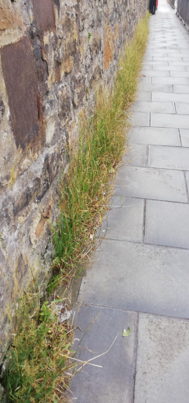
The grass, Water Bent, has only recently been recorded in Scotland, and is said to be one of the fastest spreading plants in the British Isles. You can read about it here: Ambroise Baker and Oliver Pescott at http://nora.nerc.ac.uk/id/eprint/507448/1/PvAEM6.pdf
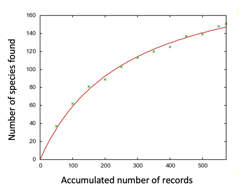
How many species might there be altogether in South Morningside’s streets? I drew up a species accumulation curve (see the graph) and concluded that a whole army of botanists in this part of Morningside, searching all streets, might find 265 ± 20 species. I came to this estimate after finding the asymptotic value from the mathematical form of the fitted curve. That’s about one-sixth of Edinburgh’s known plant species from all habitats. For the urban flora project we are currently comparing methods for estimating biodiversity, and please regard this value as provisional.
Data like these are easy to collect (once you know your species), and the great value of such data sets is that they can be brought forward in future years to investigate change. I think a blog coming shortly by David and Maria Chamberlain will be able to start this task.
Posted by John Grace, June 3rd 2020.