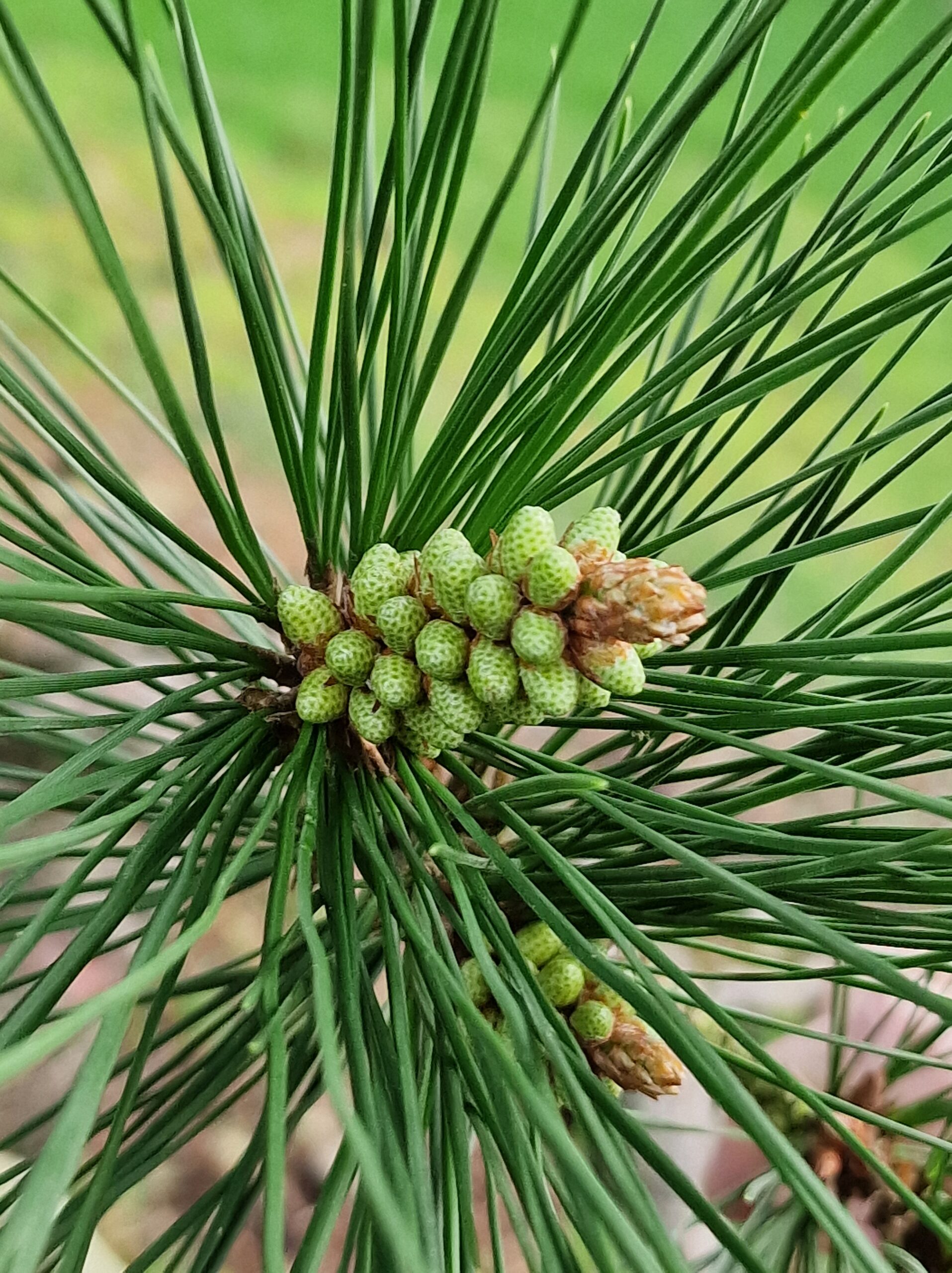
Pinus radiata – 27th February 2023 – Monterey Pine
Last weekend I visited the Logan Botanic Garden near Stranraer in SW Scotland. It’s opening this month but only at weekends for ‘snowdrop viewing’. Adjacent to this garden is a rather different sort of garden, the privately owned Logan House Garden. I had never visited this one, but I’d seen its huge trees from a distance and wondered what they might be. On this occasion, I was surprised to see a side-gate left open and so I ventured in. Immediately my attention was drawn to a huge gnarled pine tree. What could it be?

Pinus radiata tree at Logan House Garden, 19 February 2023. Using the standard figure as a scale, the girth and height may be estimated as: girth = 5.3 metres, height = 14 metres. Note also the tall Araucaria tree in the background. Photo: John Grace.
I took a peek at its foliage with my binoculars and eventually managed to grab a low-hanging branch. Pine leaves are always in bunches of between 2 and 8, and by counting the number per bunch (in this case it’s 3) and measuring their length (= 11 cm) I was able to guess that this was Monterey Pine, Pinus radiata. The size and shape of the mature cones confirmed the identity.

View of low-hanging branch. The needles are especially long and slender. Photo: John Grace
It’s an American species, coming from a small area of the Californian coast, where it has the status of ‘critically endangered’. It was ‘discovered’ by that intrepid plant hunter from Scotland, David Douglas, in his travels to North America 1831-2. He brought material home and seedlings of the Monterey Pine were raised in the gardens of the Horticultural Society and in the grounds belonging to the Duke of Devonshire at Chiswick (west London).

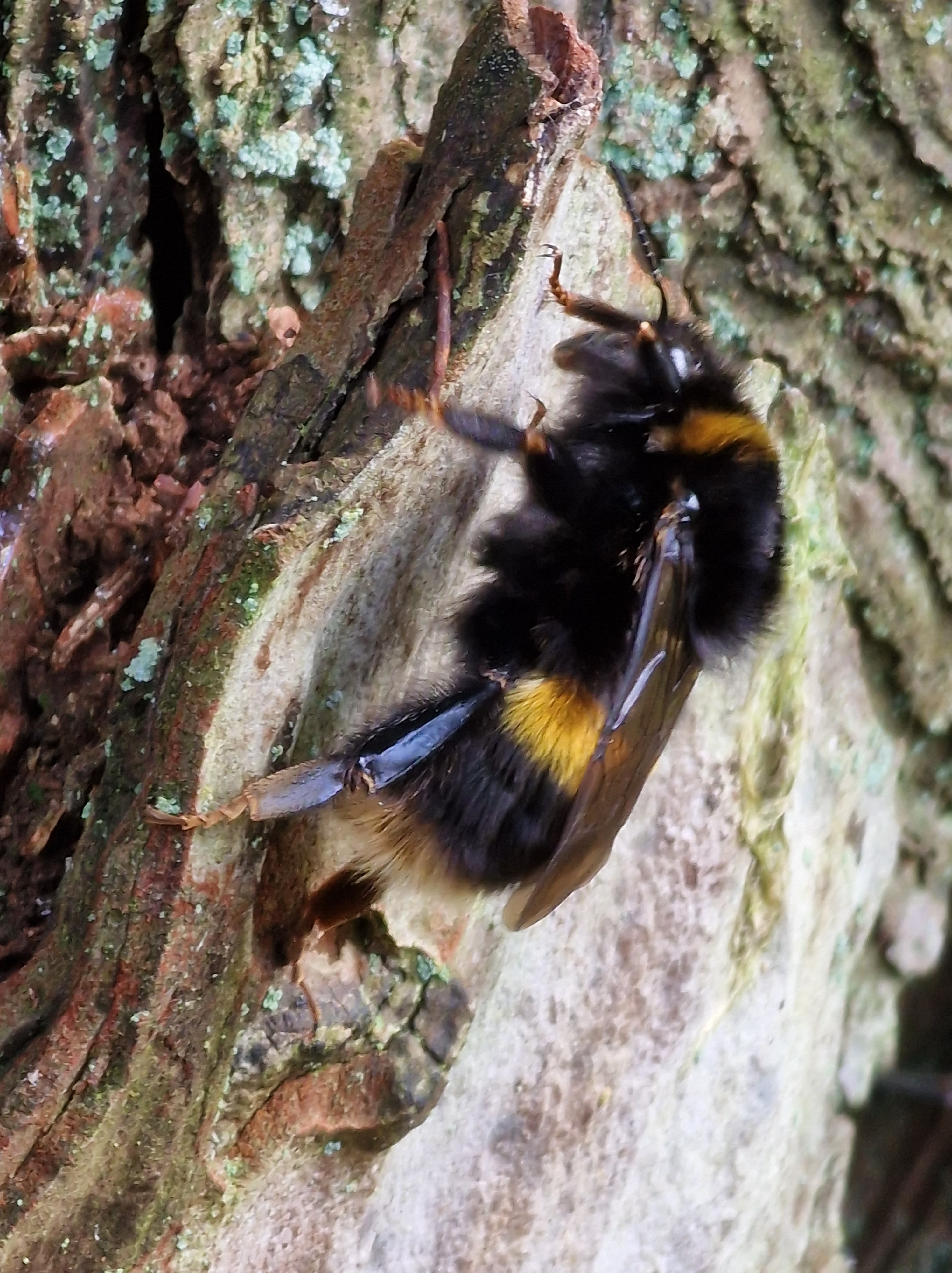
Two associated species. There were several honeysuckle plants and a bramble on the heavy branches. We saw this newly emerged bumble-bee Bombus terrestris walking slowly up the gnarled bark. Photo: John Grace
Many years ago I found myself at a conference in Monterey Bay and the coastal P. radiata trees looked rather miserable, growing near the shore. My interest in the species was re-kindled when I visited New Zealand and saw it in a quite different setting; tall straight trees of P. radiata growing fast in plantations and providing good quality timber. It was introduced there in 1859 and huge plantations were created using prisoners to do the planting. It thrived, and now about 90% of all plantations in that country are Pinus radiata (they call it Radiata Pine). Its timber is like Scots Pine, but because the lateral branches are cut away (foresters call it ‘brashing’) it has no knots. I have purchased quite a lot from B&Q to make shelves, bookcases and kitchen boards. It can easily be sawn, but like most softwood it tends to split when you make intricate joints.

Pinus radiata needles and cones. The needles are 10-12 cm long, slightly flattened and 1.2 mm x0.8 mm in section. They have a slight twist. The leaf margins are very finely toothed and therefore feel rough. The cones are markedly asymmetrical, 10 cm tall and weight around 160 grams. For this image, I have placed the items on a piece of P. radiata wood, an offcut from a DIY bookshelf. Photos: John Grace
The New Zealand story is truly remarkable. The government asked the Wellington Botanic Garden to test the suitability of over a hundred exotic tree species for use in that country. Two were outstanding: Pinus radiata and Cupressus macrocarpa, both from Monterey Bay. Details from a relatively recent New Zealand Encyclopedia are “Seed and seedlings from the garden were sent all over New Zealand, half a million between 1870 and 1875, and DNA tests show that some of the ancestors of our forestry industry came from Wellington Botanic Garden. The oldest tree in the country is believed to have been planted in 1859 at Mt Peel Station in South Canterbury” (Berg 2008).
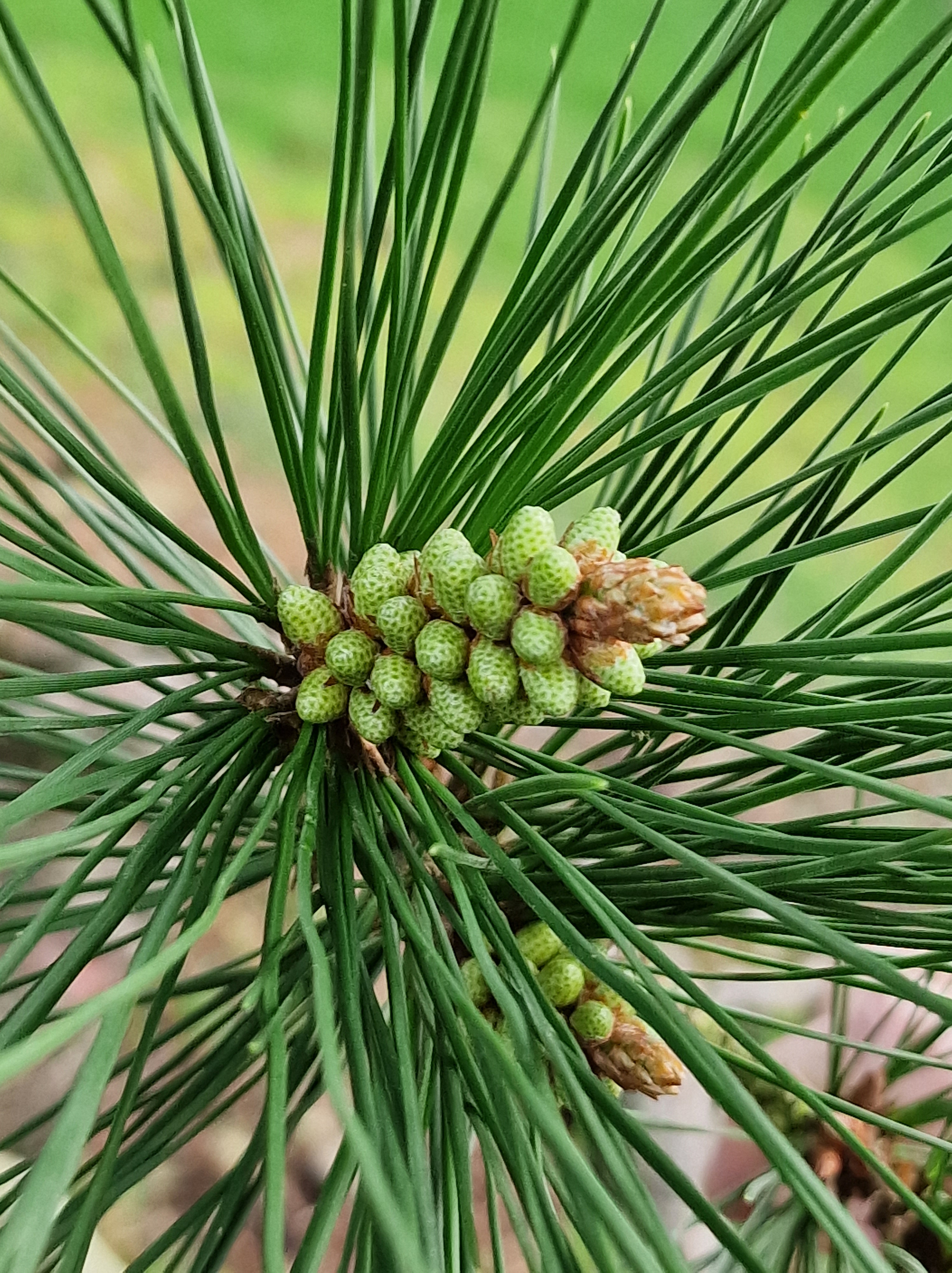
Cluster of male flowers, not yet mature (19 February 2023). Photo: John Grace
Monterey Pine did well in New Zealand but how did it fare in Britain? To answer this question I consulted The Trees of Great Britain and Ireland by Elwes and Henry (1913). This is a rare forestry book: an original can be purchased for about £5,000. However, a brown and somewhat faded copy can be viewed on-line at the Biodiversity Heritage Library. The authors listed some of the finest specimens they knew about when they wrote their book. For Scotland, they report that it had been killed by frost in the east but had done well in the west (England and Scotland) near the coast. They cite specific tall trees at Monreith and Castle Kennedy, both of which are close to the Logan tree in Dumfries and Galloway. But the species has not been taken up much by British forestry (just 270 hectares of plantations at present) and is found merely as scattered individuals adorning large estates and private grounds. It seems this tree can tolerate wind and salt spray but cannot tolerate very low temperatures and/or low humidity. It is sometimes recommended as a coastal windbreak.

The bark is very thick, and annual growth rings in the bark tissues are easily seen in broken-off pieces. The thick bark may be a protection against fire. Photo: John Grace
Elsewhere in the world it is grown in Australia, Chile, South Africa and South West Europe. It thrives in Madeira. Huge plantations can be found in the Basque Region of Spain.
I looked for research on this species using the Web of Science. There are about 5,000 articles; it might be most heavily researched of all tree species. As I scrolled through the most recent 100 of these my attention was drawn to an article published in the journal Biological Invasions, concerning the spread of the species beyond plantations and its effect on other ecosystems (Bellingham et al. 2023). The authors state that 76% of New Zealand’s land area is climatically capable of supporting populations of P. radiata. They argue for a levy on any new plantations, to pay for the cost of managing the spread of this fast-growing pine, which has become a weed. Of course, New Zealand has one of the highest levels of alien species in the world (most of them from Europe) but this one has the potential to cause real damage. Its ecological behaviour in New Zealand is a far cry from how the species performs in its native Californian range where it is troubled by disease and likely to become extinct.
I gathered a few pine cones from the ground. They had survived the impact and some of them seemed old and had lichen growing over them. They were still closed. To extract the seeds from our own Scots pine cones it is necessary to warm them; a sunny window-ledge will usually suffice. Then the scales should open and the seeds drop out. But this pine is different – to release seeds the cones must experience fire. This phenomenon is called serotiny, and is found in many species that grow in hot fire-prone regions (Eucalyptus, Protea, Cupressus). A forest fire will therefore result in a flush of seedlings to replace those trees that have perished. However, one report says that heating cones of P. radiata to a mere 45 degrees is sufficient to release about half of the seeds (Wyse et al. 2019).
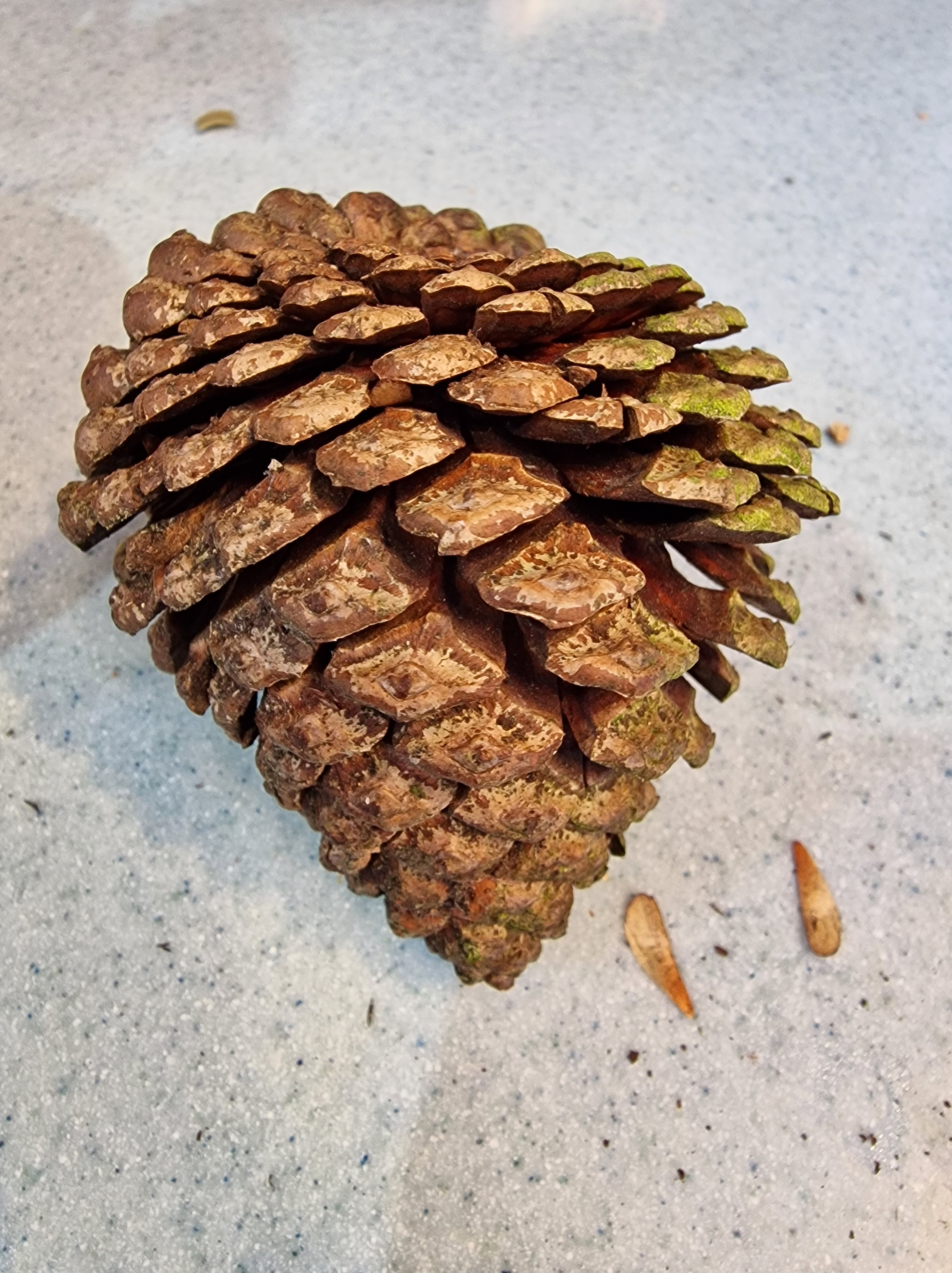
One of the cones illustrated above, after heat treatment to mimic fire. I placed the cone in an air-fryer (a small oven) set at 75 degrees C for 15 minutes. The cone has partially opened but the ‘seeds’ have not developed. Presumably there needs to be male cones on nearby tree shedding their pollen. Photo: John Grace.
My curiosity about the size of the Logan tree compared to other fine specimens in Britain was aroused. Mitchell (1974) records a tree 44 m tall with a girth of 3.4 metres in Hampshire. I consulted a list of ‘monumental trees’ in Scotland here. The tree at Castle Kennedy is said to have had a girth of 5 metres in 2012, so I decided to hunt it down.
It wasn’t hard to find. It’s near the entrance to the toilet block, but inside the fence and a little way down the track. I measured the girth as 6.1 metres, and it’s the Champion Monterey Pine of Scotland. I could’t measure its height in a worthwhile way as it is flat-topped and on a slight mound. Nearby were some logs made from sawn off branches. The tree has been growing very slowly in recent years and it is therefore hard to count the annual growth rings. It isn’t especially old (about 130 annual growth rings) but it is a fast-grower.
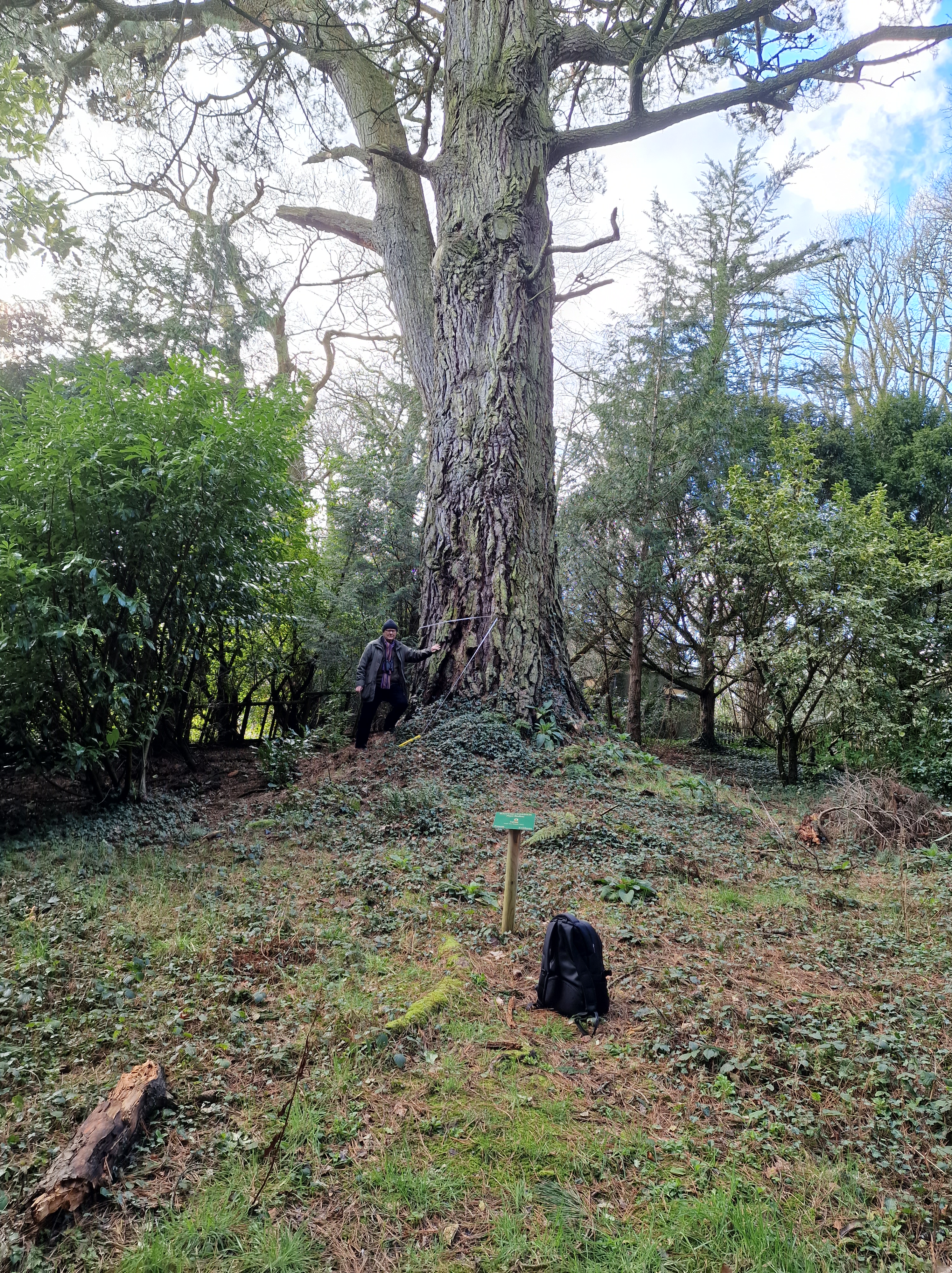
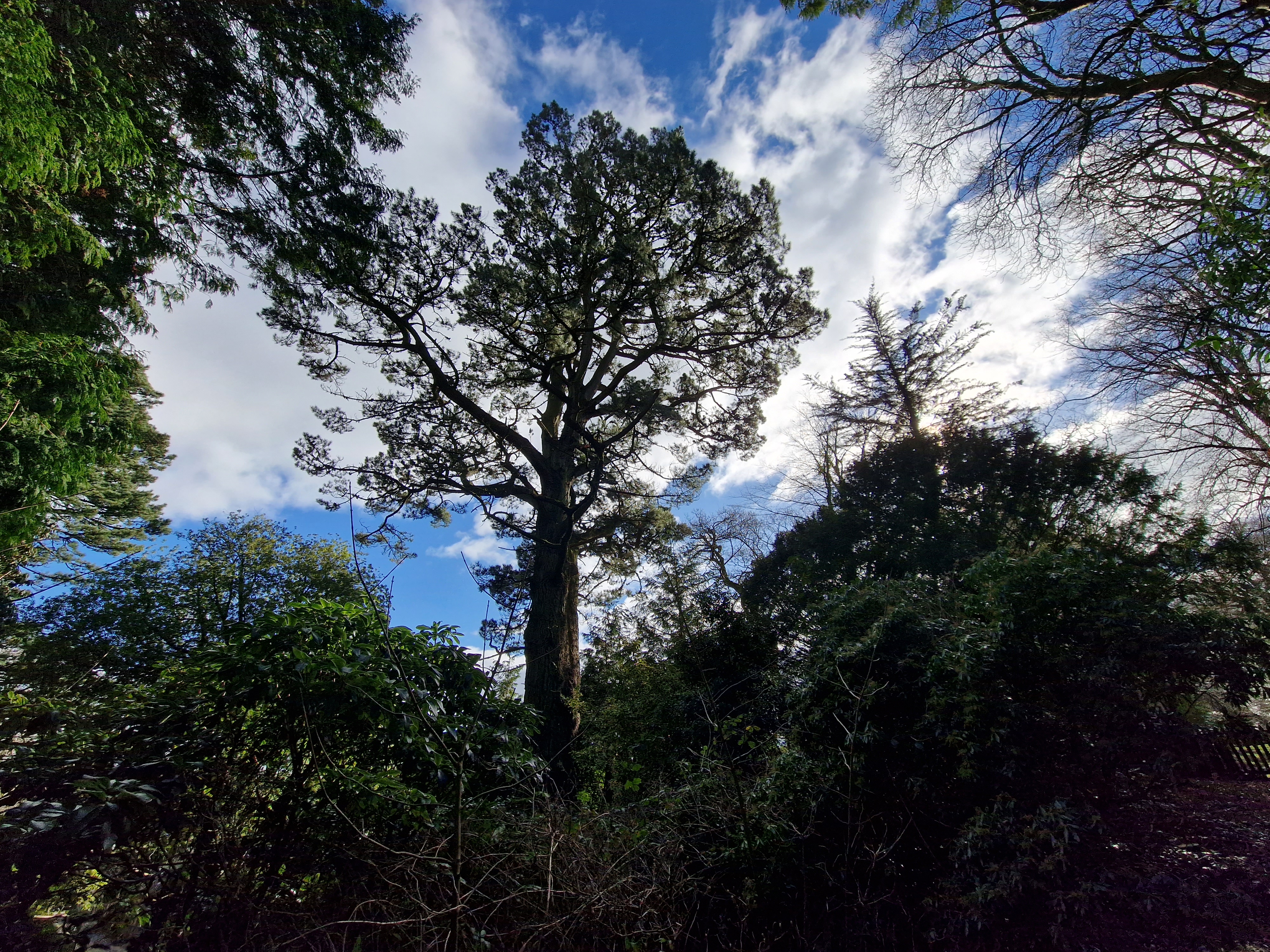


Top: Scotland’s Champion Pinus radiata at Castle Kennedy, Dumfries and Galloway. Lower left: distant view to show canopy shape; lower centre: label (note the stated diameter of 1.95 metres is equivalent to a girth of 3.14 x 1.95 = 6.1 metres); lower right: growth rings on log from a detached branch (the green card is 5.2 cm wide).
Intriguing questions about this species remain. How does it perform so poorly in its native Californian habitat but so well in Scotland and New Zealand? Presumably California was formerly much like Scotland is today (in terms of temperature, precipitation and atmospheric water content). Perhaps the pests and diseases in California have become so challenging, but elsewhere on the planet they have not had time to become a threat.
References
Bellingham PJ et al. (2023) The right tree in the right place? A major economic tree species poses major ecological threats. Biological Invasions 25, 39–60. https://doi.org/10.1007/s10530-022-02892-6
Berg P (2008) Radiata pine – A Californian import’, Te Ara – the Encyclopedia of New Zealand, http://www.TeAra.govt.nz/en/radiata-pine/page-1 (accessed 21 February 2023).
Mitchell A (1974) A Field Guide to Trees of Britain and Northern Europe. Collins.
Wyse SV et al. (2019) Seed release by a serotinous pine in the absence of fire: implications for invasion into temperate regions. AoB Plants plz077, https://doi.org/10.1093/aobpla/plz077
John Grace