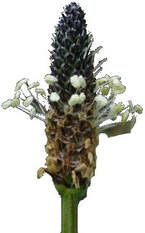
For most ‘flowers’ you encounter, the answer to these first three questions will be ‘no’. The next operation is a tiny bit more difficult, but essential: you must determine the arrangement of the flowers (collectively, the term for a group of flowers is an ‘inflorescence’). Choose from one of six categories:
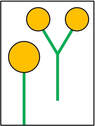
1. Single or pair
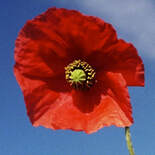
The flower, or two flowers, is/are on a single stem, like a poppy or tulip. Paired flowers are seen in cranesbills.

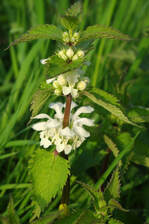
2. In leaf axils
This means that the flowers emerge from exactly the point where a leaf or leaf-stalk is joined to the stem. The flowers themselves may have a stalk or be stalkless. Examples are mints, deadnettles and rosebay willowherb.

3. Spike or raceme
A spike is a stem with stalkless flowers all along it; a raceme is the same but the individual flowers have stalks. This is seen on bluebells, hyacinths, foxgloves, lupins, plantains and forgetmenots.
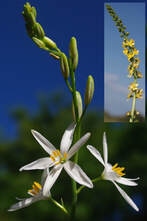

4. Umbel/double umbel
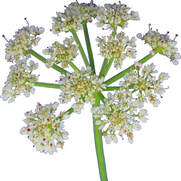
An umbel is a very particular arrangement, where a stem ends in a single junction, at which point it breaks into >3 stalks of normally equal length, ending in a flower. On a double umbel, each stalk then does the same, breaking into many even smaller stalks, each ending in a flower. Hence on a single umbel, there is always exactly one junction between any flower and the stem, whereas on a double umbel there is always exactly two (by contrast, in the ‘Complex Group’ category that follows, the number will vary between flowers). Examples of single umbels are Ivy, Agapanthus lilies, and wood garlic, whereas double umbels are seen on most members of the carrot family, e.g. Cow Parsley and Hogweed.
5. Complex group
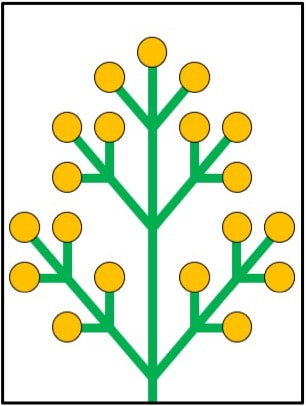
This category includes any loose, branching grouping of flowers that do not fall into the categories above. Sometimes they may look like umbels or racemes, but on closer inspection there will be additional branches or junctions within the inflorescence. This category includes many grasses, elder, docks, and valerian.
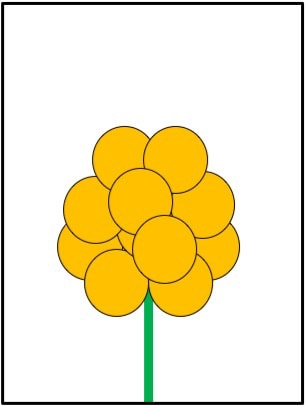
6. Tight head
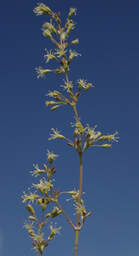
This is when the flowers are so tightly packed together that you cannot see the stalks beneath them. This is seen in clovers and teasels. Also, all members of the daisy family (e.g. dandelion, thistle, sunflower) have this arrangement, with lots of tiny flowers masquerading as one big one.
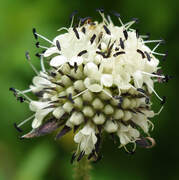
Based on which of these your plant fits, choose a row from 1-6 in the family-finder sheet. A couple of things to be aware of:
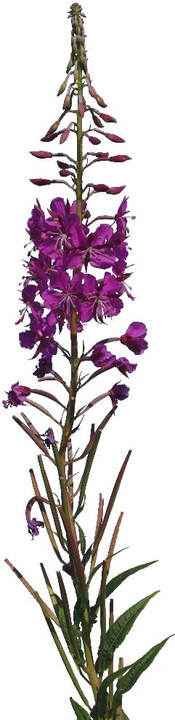
- When assigning categories, you must remember that the inflorescence (group of flowers) includes those flowers that have gone over, and those still in bud, as well as those currently open. For example, look at the seed pods lower down on the Rosebay plant on the left – they are part of the inflorescence. Likewise on a forgetmenot, often only one or two flowers is open at any one time, but more will be curled up as buds above the open flowers, and/or turning into fruits below them, forming a spike overall.
- You’ll also find that certain plants may fall into two of the above categories. The rosebay willowherb’s lower flowers (or fruits, as they become) grow out of leaf axils (category 2) but the upper ones look more like a raceme (category 3); likewise a plantain flowering stem (right) is both a spike and a tight head. When unsure, just pick one group that seems to fit; the method is designed to work whichever one you choose, in these instances.