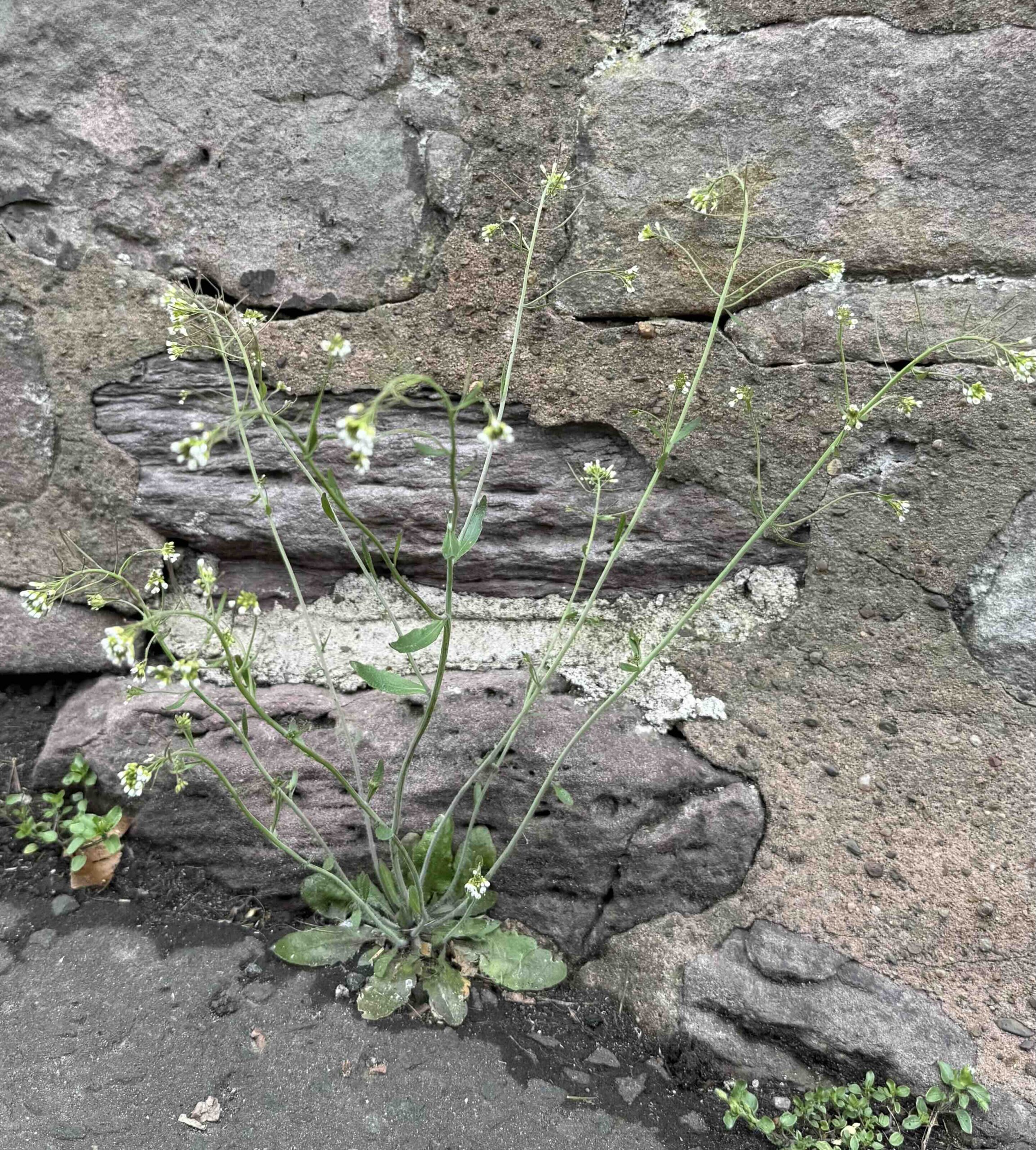
Arabidopsis thaliana – June 8th, 2020 – Thale Cress
Thale Cress (Arabidopsis thaliana)
by Maria Chamberlain
For plant biologists Arabidopsis thaliana is an iconic species – it’s the Drosophila of the plant world. This was the first plant to have its genome sequenced – in the year 2001. The species has a very rapid life cycle – six weeks from germination to seed production – and has a small genome (only five chromosomes and 27,000 genes). It grows from a basal rosette of hairy leaves, and soon develops 1-4 flowering stalks each with a terminal corymb of rather few white flowers 3 mm in diameter.
It belongs to the mustard and cabbage Family, the Brassicaceae (also called Cruciferae), and it is a native plant.
It grows in rocky, sandy and disturbed habitats, including gardens, waysides and walls. Since it reproduces so fast, local ecotypes can evolve relatively quickly, each adapted to the prevailing conditions (e.g. temperature, drainage, light intensity). However, the differences are mostly physiological; the general morphology of the plant is well conserved, so there should be no problems with ID!
Seeds of the species have recently had the great honour of being one of six living species (along with cotton seeds, potato seeds, silk worm eggs, fruit-fly eggs and yeast) to be transported to China’s spacelab on the moon.
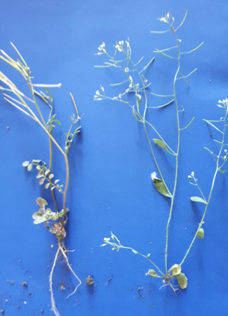
It is one of several cresses that are common in the urban flora, particularly along pavements. In the photo, the plant on the left is Cardamine flexuosa and the plant on the right is Arabidopsis thaliana. Note that the leaves of Arabidopsis are entire, while those of the Cardamine flexuosa are pinnate (divided). Their flowers are fairly similar, and both can grow to a height of 30 cm though often less. The long thin seed pods develop after fertilisation of the flowers. Note the seed pods in A. thaliana are thinner than those in C. flexuosa. Also note that Cardamine flexuosa has a common closely related species, the very early flowering Cardamine hirsuta. C. hirsuta has 4 (sometimes 5) stamens whilst C. flexuosa has six, and hirsuta’s pods usually overtop its flowers. However, both Cardamine species have pinnate leaves, so if you find a little cress plant with entire leaves it will be Arabadopsis.
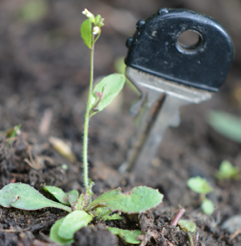
Note that very small plants are often found in highly cultivated soil (see the photo of the plant next to a Yale key). When this small, the plant is inconspicuous and more likely to escape the hoe. This one will probably survive and produce seeds, adding further to the already-large seed bank.
If you would like to find out more about Arabidopsis and the role it plays in plant molecular biology you might like to read From Seed to Seed by Nick Harberd, published by Bloomsbury. It tells the story of the plant in the field and in the lab. It also tells of how Nick’s daily life as a molecular biologist is driven by the sense of wonder, which this tiny little insignificant weed inspires.