SOME INSECT/PLANT RELATIONSHIPS IN THE BRAIDS AREA OF EDINBURGH.
by Barbara and Mike Richardson
Since the ‘Covid lockdown’ we have spent time throughout June-July recording insect/plant relationships along roadside verges, the prolific streamside vegetation in Braidburn Valley Park, and our own garden. Broadly there are two groups of insects, those feeding on pollen and nectar and accidentally pollinating flowers, and insects that feed on foliage and roots, causing some physical damage, with the piercing insects, such as leaf and froghoppers, having potential to transmit viruses and other diseases.
We have been interested to find some insects which are European in origin that have spread north from southern England, paralleling the northward spread of some plants and birds with the increasingly milder climate.
POLLINATORS
Tree Bumblebee
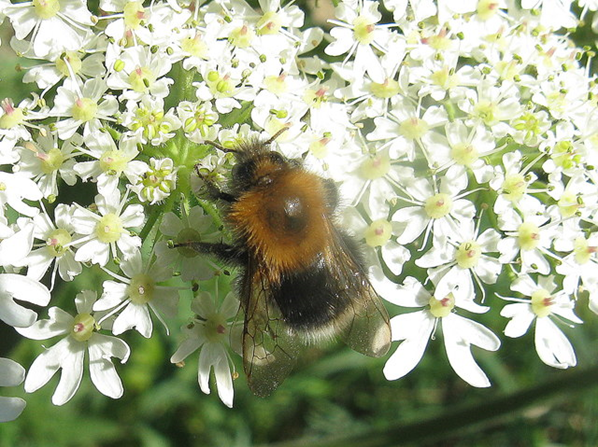
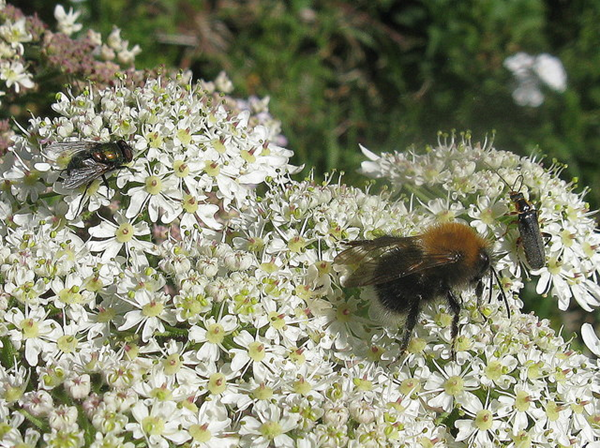
This large bee (Bombus hypnorum) has a wide distribution in Europe, the Mediterranean, and Asia but was first recorded in Wiltshire in 2001, and in Southern Scotland in 2013. It nests in tree holes, bird boxes and loft spaces, and queens overwinter in the ground and is easily recognised by the bright ginger thorax, black abdomen and white tail. The prolific Hogweed (Heracleum sphondylium) along the Braid Burn, with its large umbels, was providing food for this bee and many other species of bumble bee, beetles and flies. See lower picture, from the left, a fly (Diptera), a Tree Bumblebee (Bombus hypnorum) and a beetle (Coleoptera, possibly a cantharid).
Red- and White-tailed Bumblebees
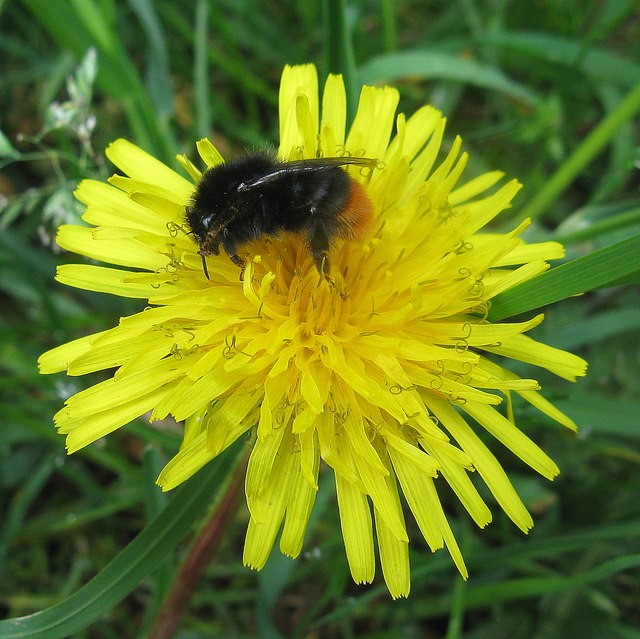
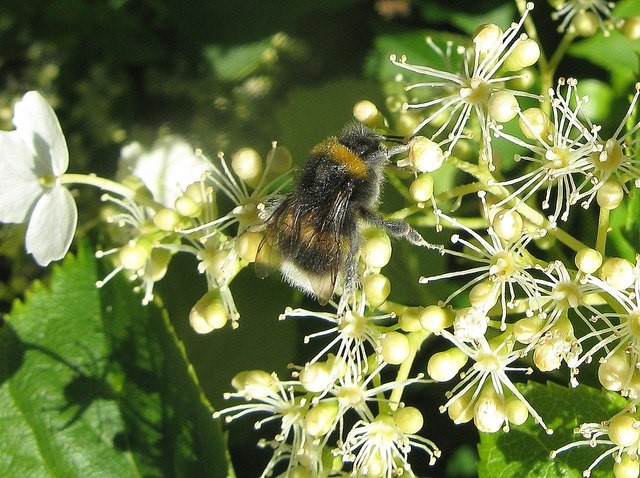
These also are common pollinators in the Braids area. A Red-tailed bumblebee (Bombus lapidarius), left, feeding on Dandelion flowers is nationally abundant and a major pollinator, but restricted in the highlands of Scotland. The White-tailed Bumblebee, Bombus lucorum, right, was feeding on Hydrangea petiolaris flowers in the garden.
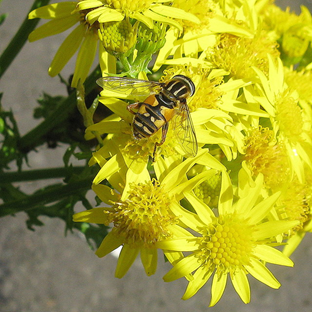
Hoverfly on Ragwort flowers
Bees are not the only major pollinators. This hoverfly is Helophilus pendulus (helo-, marsh; philus-, loving; the larvae of many hoverflies are aquatic) and it is the most common species in Britain and Europe, from the Mediterranean to Scandinavia. Hoverflies, like bees, also feed on nectar and pollen, and resemble bees and wasps in colouration. Some species are bee mimics which gives them protection from predators. They are, however, Dipteran (two-winged) flies of the family Syrphidae, and have a darting flight and the ability to hover in front of a flower before resting to feed.
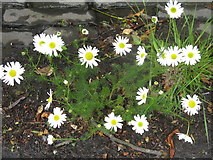
Scentless Mayweed and a bark louse, Ectopsocus petersi
A member of the daisy family (Asteraceae), this mayweed (Tripleurospermum inodorum) was flourishing in the gutter of Braid Road. Pavement and roadside plants are thriving as a result of reduced road cleaning and herbicide spraying generally and also during the Covid lockdown; this part of the road has also been closed to traffic to facilitate safer use by pedestrians and cyclists.
Bark lice are one of a group of tiny four-winged insects (Psocoptera) that feed on small particles, pollen, fungal spores, algae, dead bark and other organic matter. (One of the hind wings became detached). This species has a characteristic wing pattern of small pigmented dots at the wing margin and its body was only 2mm long. It was on the Scentless Mayweed ray florets.

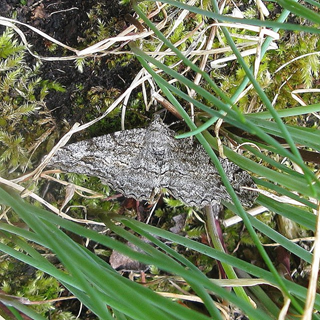
Mottled Beauty moth
Moths are night-time pollinators, finding flowers by their scent. The Mottled Beauty (Alcis repandata) is quite common in the UK. It was disturbed, and flew and landed in a pot of chives; it stayed long enough to be photographed but had gone by the time something to measure it with was obtained – its wingspan was about 40-45 mm. Its identity was confirmed by Keith Bland.
INSECTS FEEDING ON PLANT TISSUES – LEAVES AND ROOTS
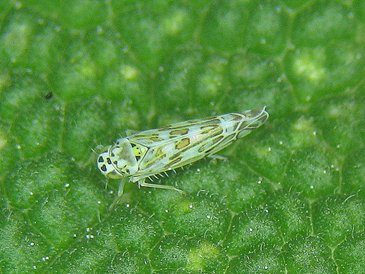
Sage leafhopper
Leaf-hoppers (Cicadellidae) have piercing mouthparts and often cause damage to leaves.
This attractive leafhopper (Eupteryx melissae) is 3 mm long. The very large spines on the femur of the hind leg can easily be seen (under the body) and distinguishes leafhoppers from the froghoppers. They are highly specific to particular plant species. There were many on a Sage plant in the garden.
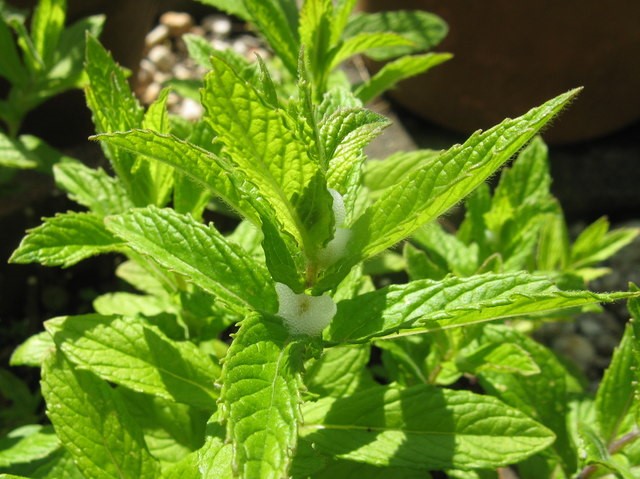
Froghopper nymphs from Cuckoo spit
Froghoppers (Family Cercopidae) are also host-specific and cause considerable damage, often stunting growth. These are nymphs of Philaenus spumarius from Cuckoo spit on the Mint in the garden. They are true bugs (Hemiptera), in the entomological sense of the term, and have piercing mouth parts to suck up plant sap. The ‘cuckoo spit’ bubbles are created by the nymphs, and protects them from predators and from drying out. The nymphs shown here are of different ages and were removed from the foam. They were 4 and 5mm long, and wing buds are visible on the larger, older nymph.

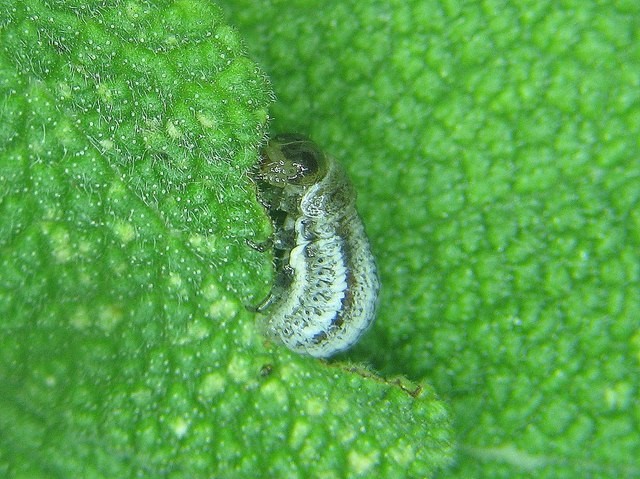
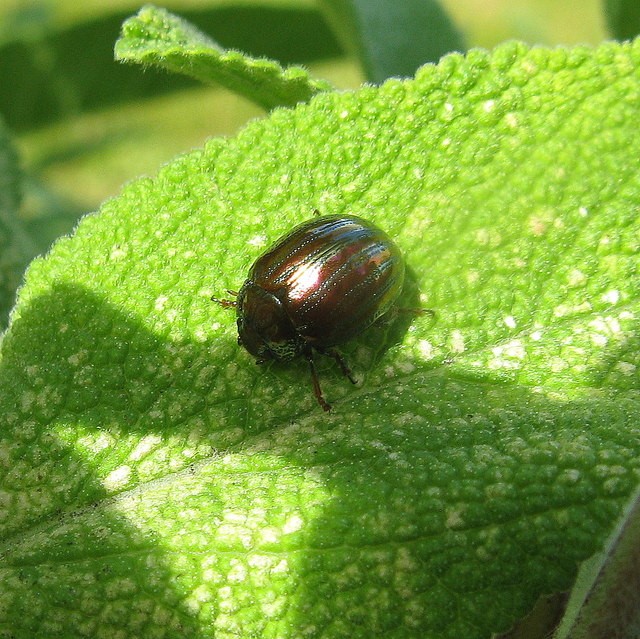
Rosemary Beetle larva and adult
Rosemary Beetles and their larvae (Chrysolina americana) feed mainly on Rosemary, but also on related aromatic plants like Sage (as here), Lavender and Thyme. Despite the specific name, it is native and common in S. Europe and first recorded in the UK in 1994, and in Musselburgh 3 years ago. The larva was 6 mm long, comma-like with darker head and legs than the paler soft body. The adult beetle was 7 mm long, and developed from one of the larvae found on the same Sage plant four weeks earlier. It has beautiful iridescent purple and gold striped elytra with a pattern of longitudinal lines of small punctures. There are many records around the Central Belt, but it does not yet seem to have migrated further north. Do look out for it.
Vine Weevil – Otiorhynchus sulcatus
A beautiful beetle, except to gardeners, for whom it is one of the most damaging pests. Both adults, which feed on leaves, and the underground larvae feeding on roots, do a lot of damage to a wide range of plants. This adult was 11 mm long and was resting on the side of a compost bin – it was moved to make photography easier and fed voraciously on the leaf. Their wing cases (elytra) are fused, so they cannot fly; they are parthenogenetic, and eggs develop into females unless fertilized. There are rings of stout hairs on the elytra which are a gleaming gold in bright light under the microscope.

This was a fun-project which got us out and about, and we will continue to look for more examples.
© Text – Barbara Richardson, Photographs – Mike Richardson.