Chlorociboria aeruginascens – October 11th 2021 –The green elf-cup
Chlorociboria aeruginascens is a saprophytic Ascomycete fungus, a rotter that grows on dead wood. It is one of about 23 species in the genus Chlorociboria and the commoner of 2 similar species that occur in the British Isles and throughout the Northern Hemisphere, the other being Chlorociboria aeruginosa. Both go by the common names ‘green elf-cup’ or ‘green wood-cup’. The two species can only be distinguished with certainty by their ascospores, which are shaped like rugby balls and about 50% larger in C. aeruginascens at 9–15 µm long by 1.5–2.5 µm wide.
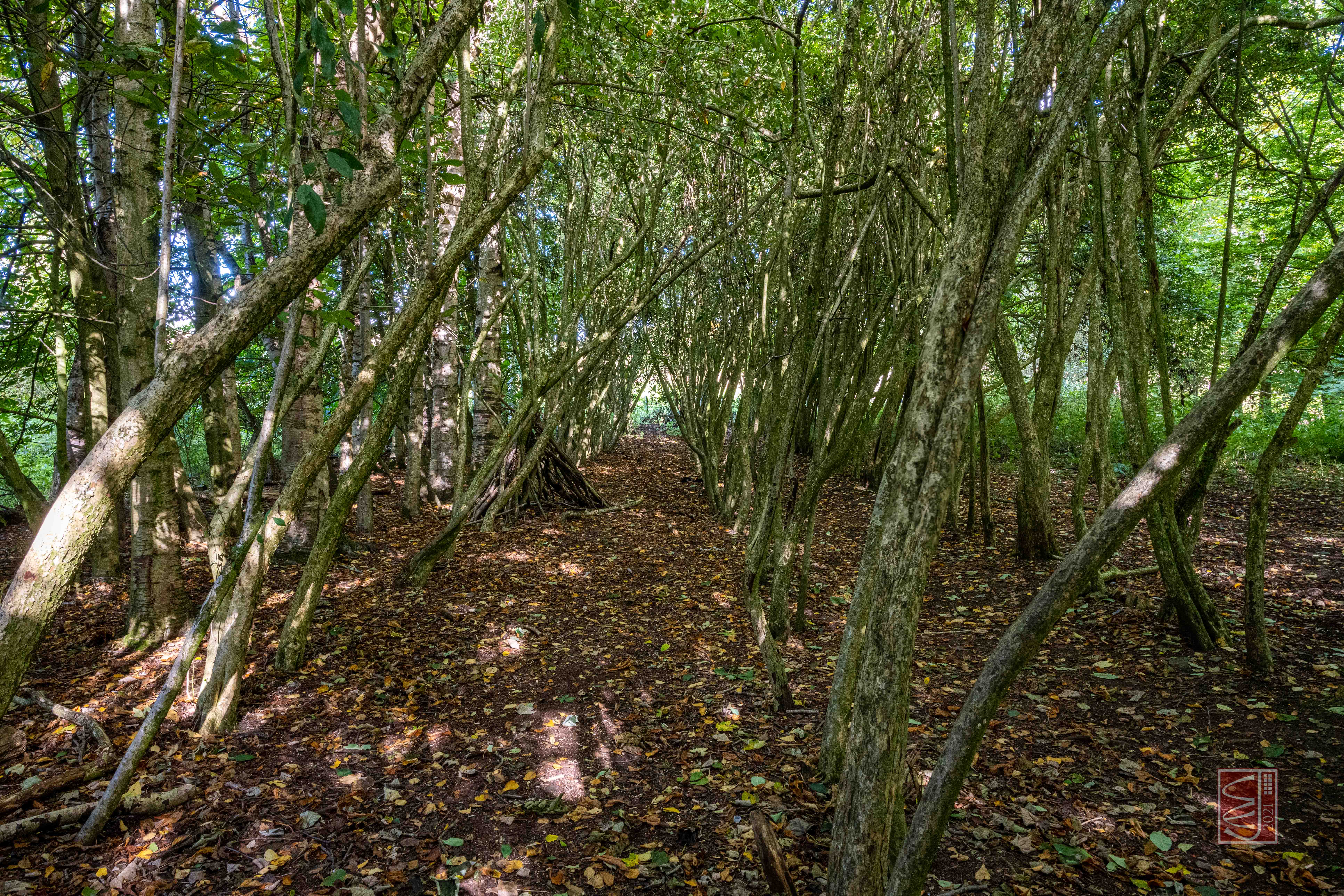
We came across it during a Botanical Society of Scotland fungal foray at Vogrie Country Park on the floor of a patch of dense planted woodland consisting of tall, thin cotoneasters with nearby birches and horse chestnut.
This fungus has a startlingly unusual colour, a deep turquoise green, present both in the fruit bodies and the mycelium, which strongly stains the decaying wood and contrasts with the sombre grey browns of the woodland floor.

It seems to be most common on long-dead branches fallen on moist soil that have already been de-barked by earlier phases of decay. The first indicator is the flash of green staining of the wood, but when we turned the branches turned over, minute fruit bodies were often found beneath.
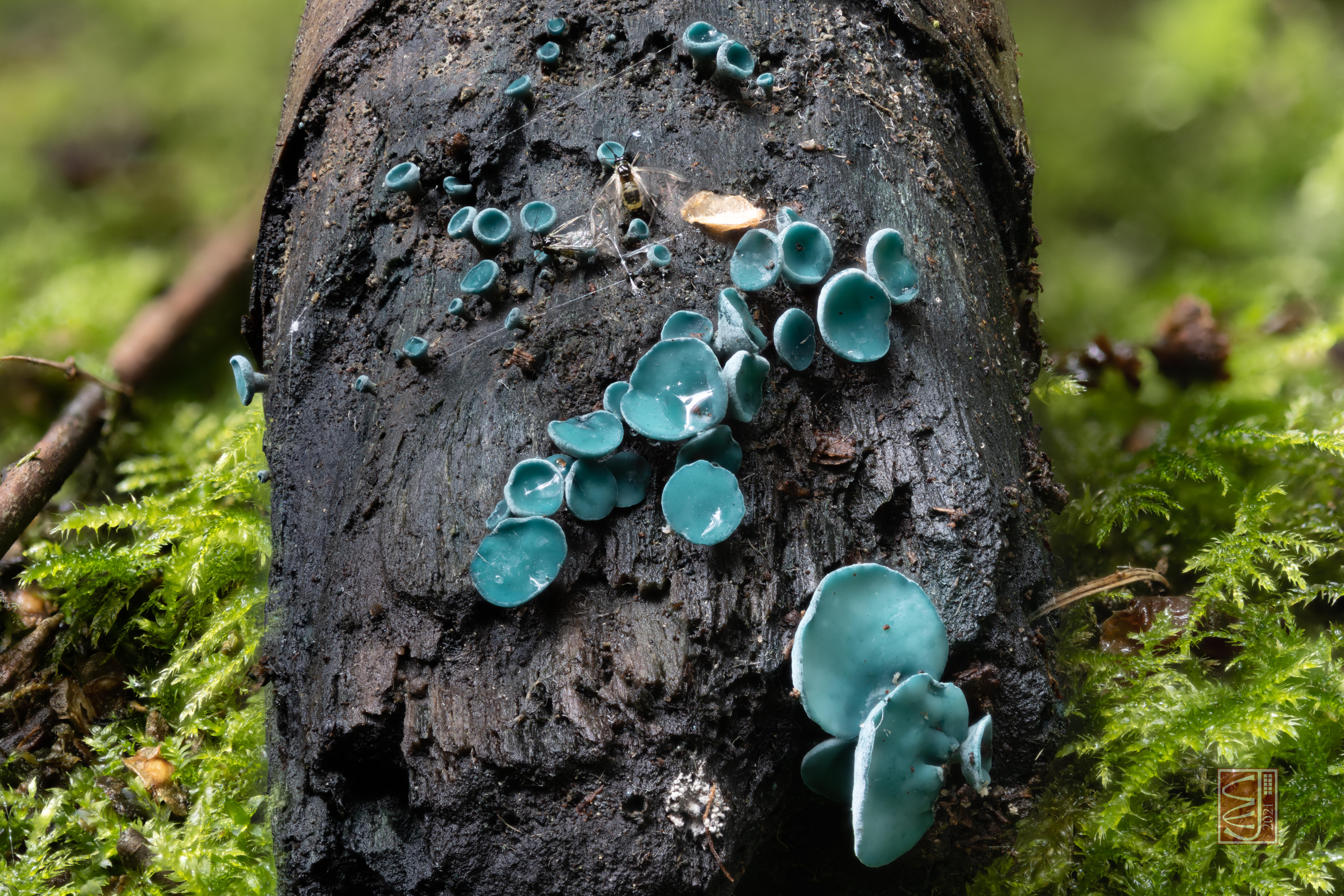
These are cup-shaped and short-stalked when young but expand asymmetrically as they age as shown below.

The blue-green or cyan colour recalls that of copper or even nickel salts but is certainly not attributable to either of these. Might it contain chlorophyll perhaps? No, the pigment was extracted long ago by Thenard and Rommier (1868), who gave it the name “xylindein”, which they derived from the concept of wood (xylem) indigo. Much more recently, xylindein has been determined to be a spectacularly complex dimeric napthaquinone with a structure that looks like molecular chicken-wire.

A 3D representation of a molecule of xylindein, product of Chlorociboria fungi.
l=Carbon l=Oxygen l=Hydrogen UIPAC name: 8,16-dihydroxy-3,11-dipropyl-3,4,11,12-tetrahydro-pyrano[4,3-h]pyrano[4′,3′;5,6]xantheno[2,1,9,8-klmna]xanthene-1,7,9,15-tetraone. ©Wikimedia Commons under licence CC BY-SA 3.0 Unported Creative Commons Legal Code
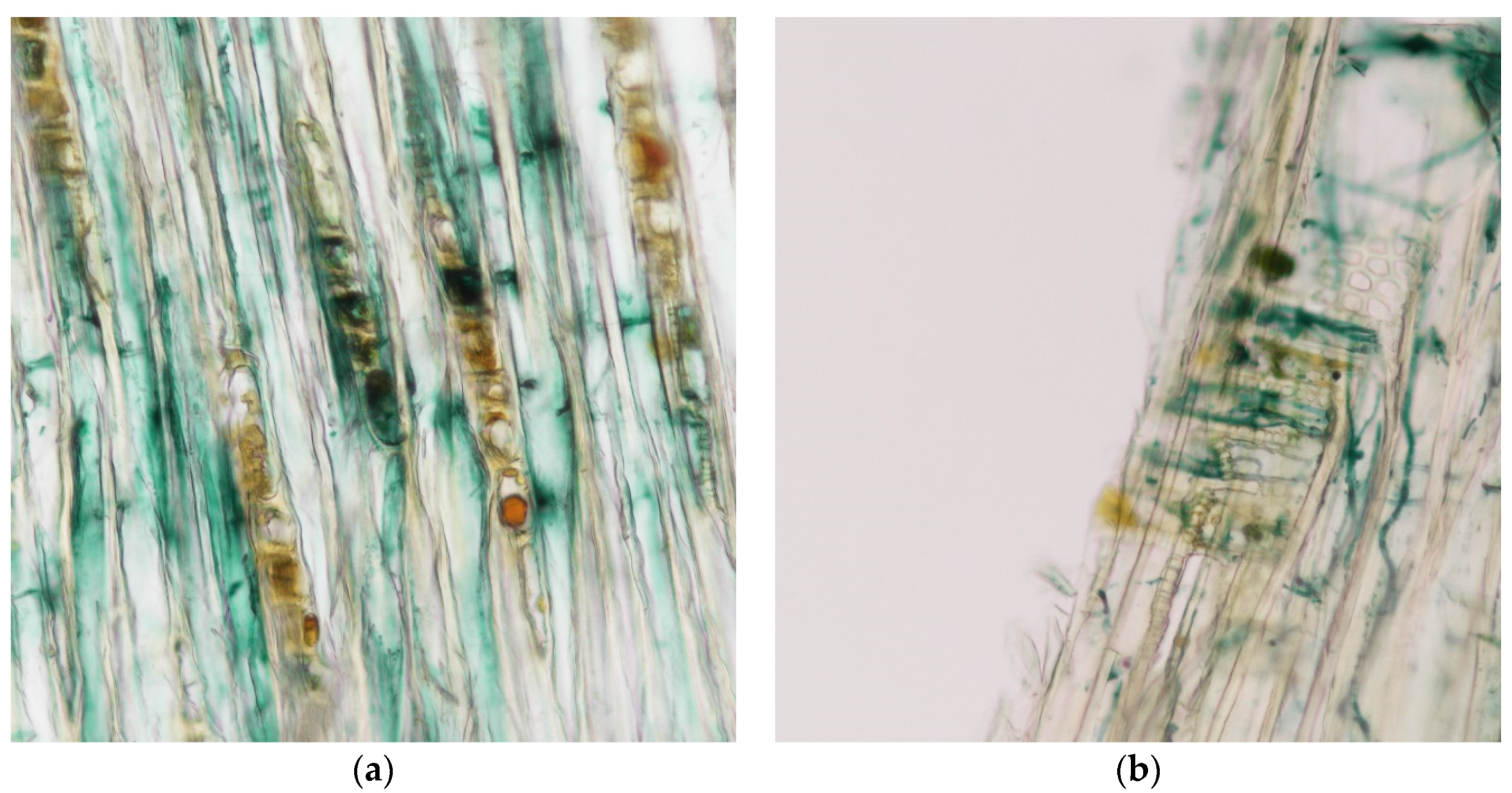
(a) Tangential section showing staining in ray cells, (b) Radial section showing that the concentration
of xylindein is higher in ray cells than in fibres and vessels.
Photos © Sarath M. Vega Gutierrez, in Vega & Robinson (2017) under licence by CC BY 4.0
Strikingly coloured timbers have been highly sought after for ornamental use, often, like ebony, commanding premium prices. Timber stained or ‘spalted’ by Chlorociboria was used in high-value, labour-intensive decorative cabinet-work and flooring such as intarsia, marquetry, parquetry and Tunbridge ware, which were popular in the 18th and 19th centuries, but are now rarely seen. The preferred wood is often referred to as “green oak”, but many other species are used by the fungus including poplar (see illustration above). Our specimens were clearly on old decorticated birch branches, despite being found beneath a canopy of Cotoneasters.
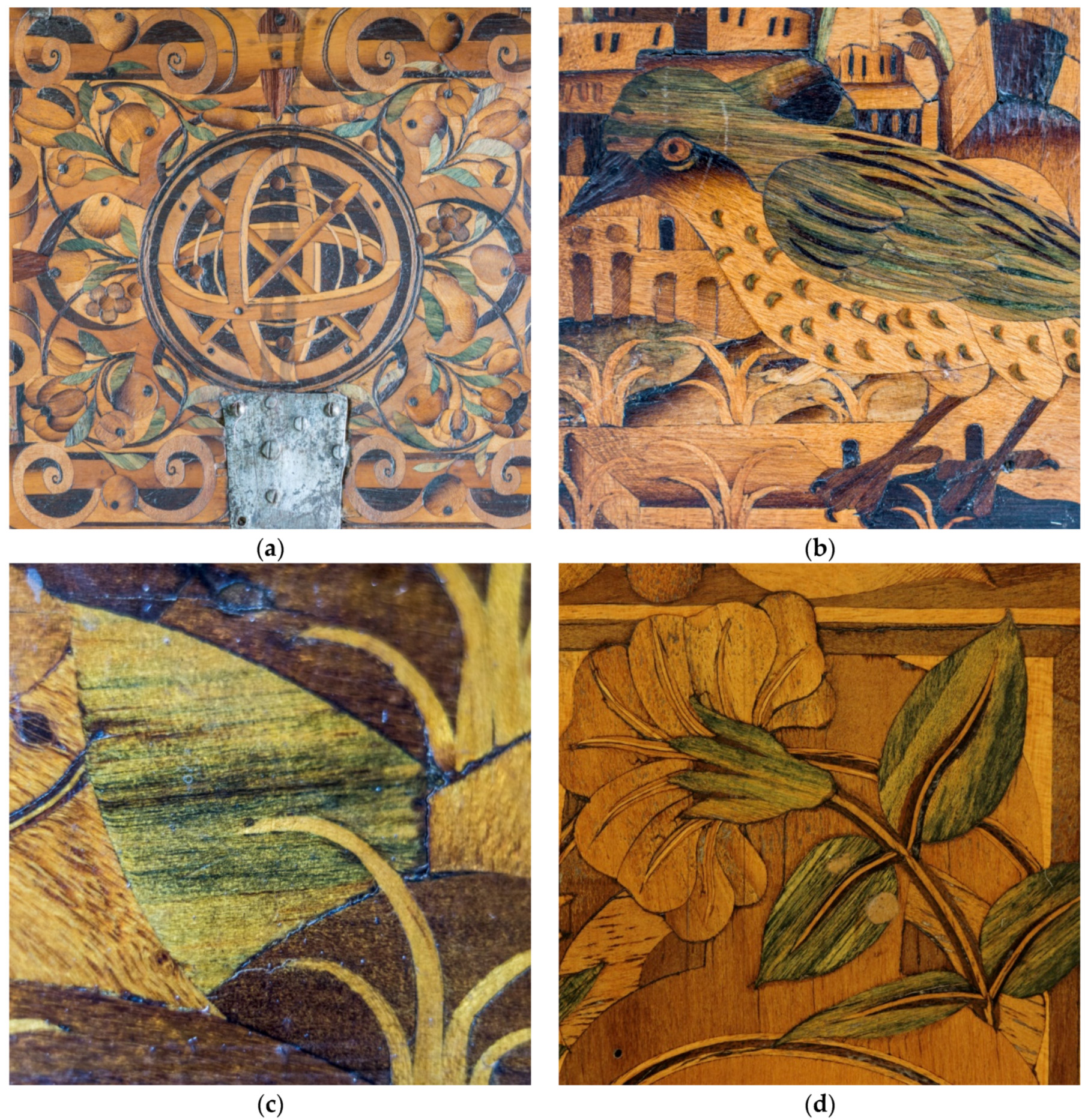
Photos ©Vega & Robinson (2017), under licence CC BY 4.0
Fungi produce some unique chemical compounds with properties that are distinct from those made by plants. The xylindein molecule is photosensitive and fluorescent, and those properties are currently under investigation for potential uses in opto-electronic devices. However, I could only convince myself that the fresh fungus itself is very weakly fluorescent if at all. Unlike many pigments of plant origin such as indigo, xylindein is light fast over very long periods, remaining green in artworks made as long ago as the 14th century.
References
Dixon J.R. (1974). Chlorosplenium and its segregates I. Introduction and the genus Chlorosplenium. Mycotaxon 1, 65-104
Johnston, P.R. and D. Park (2005) Chlorociboria (Fungi, Helotiales) in New Zealand. New Zealand Journal of Botany, 43 (3), 679-719. doi: 10.1080/0028825X.2005.9512985
Ostroverkhova, O., Robinson, S., Vega Gutierrez, SV; Schenck, J. and G. Giesbers (2018). Fungi-derived pigments for sustainable organic (opto)electronics. MRS Advances. 3 (59), 3459–3464. doi:10.1557/adv.2018.446
Thenard, P. and A. Rommier (1868). Sur un nouvelle matière colorante appelée xylindeine et extraite de certains bois morts. Comptes rendus hebdomadaires des séances de l’Académie des Sciences (in French). Paris. 66, 108–109.
Vega Gutierrez, P.T. and S.C. Robinson (2017). Determining the presence of spalted wood in Spanish marquetry woodworks of the 1500s through the 1800s. Coatings 7 (11), 188-202. doi:10.3390/coatings7110188
Chris Jeffree, October 2021