Primula veris – 7th March 2022 – Cowslip
I shall concentrate on the cowslip in this blog, but the other four native species, P. vulgaris (the primrose), P. elatior (the oxslip), P. scotica (the Scottish primrose), and P. farinosa (bird’s-eye primrose) need a mention as several of them hybridise with each other. Of these five, only P. veris and P. vulgaris are common; the other three are very local or nationally scarce.
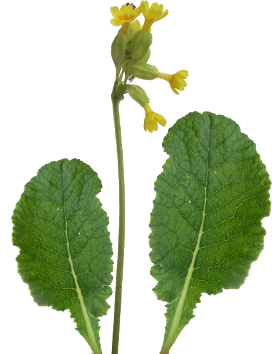
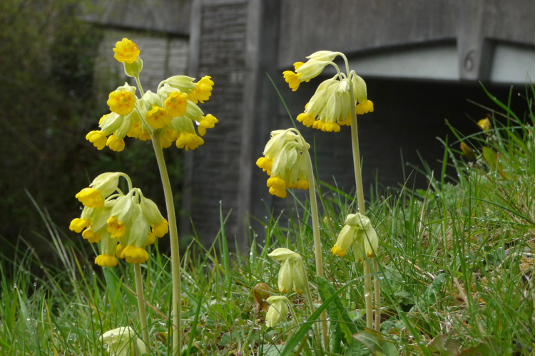
Primula veris is less common than its cousin, the primrose, Primula vulgaris. It is also less common in Scotland than in England and less common in the UK than it used to be, so any new finds of wild-growing cowslips are a cause for celebration and conservation. Grassland meadows, where cowslips thrive, can serve as biodiversity hotspots hosting not just cowslips, but up to as many as 35 other species per square metre. Due to intensive farming practices 90% of those habitats have been lost in the last 100 years (https://www.youtube.com/watch?v=UombI9-BWHo). Now, wild cowslip populations are happily on the increase again, but only due the widespread practice of scattering wild-flower seed mixtures on road verges and village greens.
The cup-shaped, yellow flowers are similar in both P. veris and P. vulgaris, but the cowslip’s tall stems bearing nodding lop-sided clusters (umbels) of 10-30 flowers – each petal marked with a splodge of orange – make its identification unmistakable. Both species are perennial, and both bear basal rosettes of green crinkly leaves, however, the leaves of P. veris differ slightly, narrowing more abruptly into the petiole.
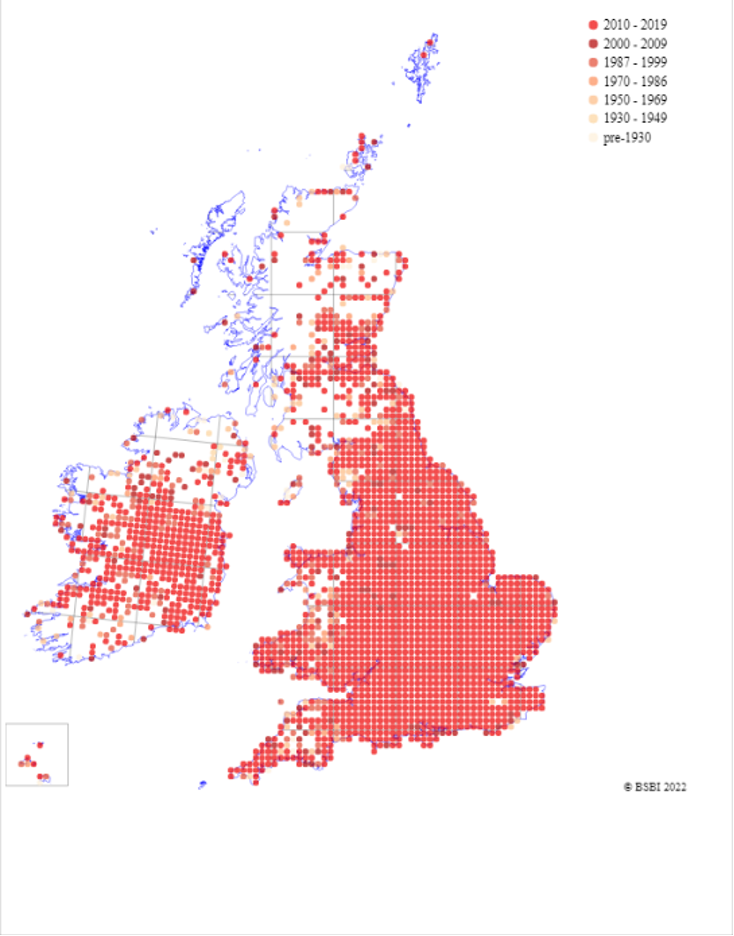
The paler dots (there are several in Scotland) signify losses.
As the name suggests, the wild habitat of the cowslip is a cow pasture, particularly in base-rich areas. The name cowslip may derive from the old English for cow dung (cow slop or the Anglo-Saxon cu-slippe), probably because the plant likes meadows rich in manure, or it may derive from ‘cow’s lips’ referring to the soft velvety texture of the leaves (https://woolfherbarium.blogspot.com/p/cowslips.html). Another name for cowslips, but much less commonly used is ‘keys of heaven’ – because the nodding flowers resemble an old-fashioned bunch of keys. According to the Norse legend the flowers were dedicated to Freya and symbolised the keys to that goddess’s treasure palace. Christianised to ‘Our Lady’s keys’, they eventually came to be associated with St. Peter, that most famous of key-holders. A north European legend tells that they sprung up where Peter, shocked to find that a duplicate had been made, dropped the key of Heaven to earth (Yarham, 1995). The cowslip broke from the ground where the keys fell.
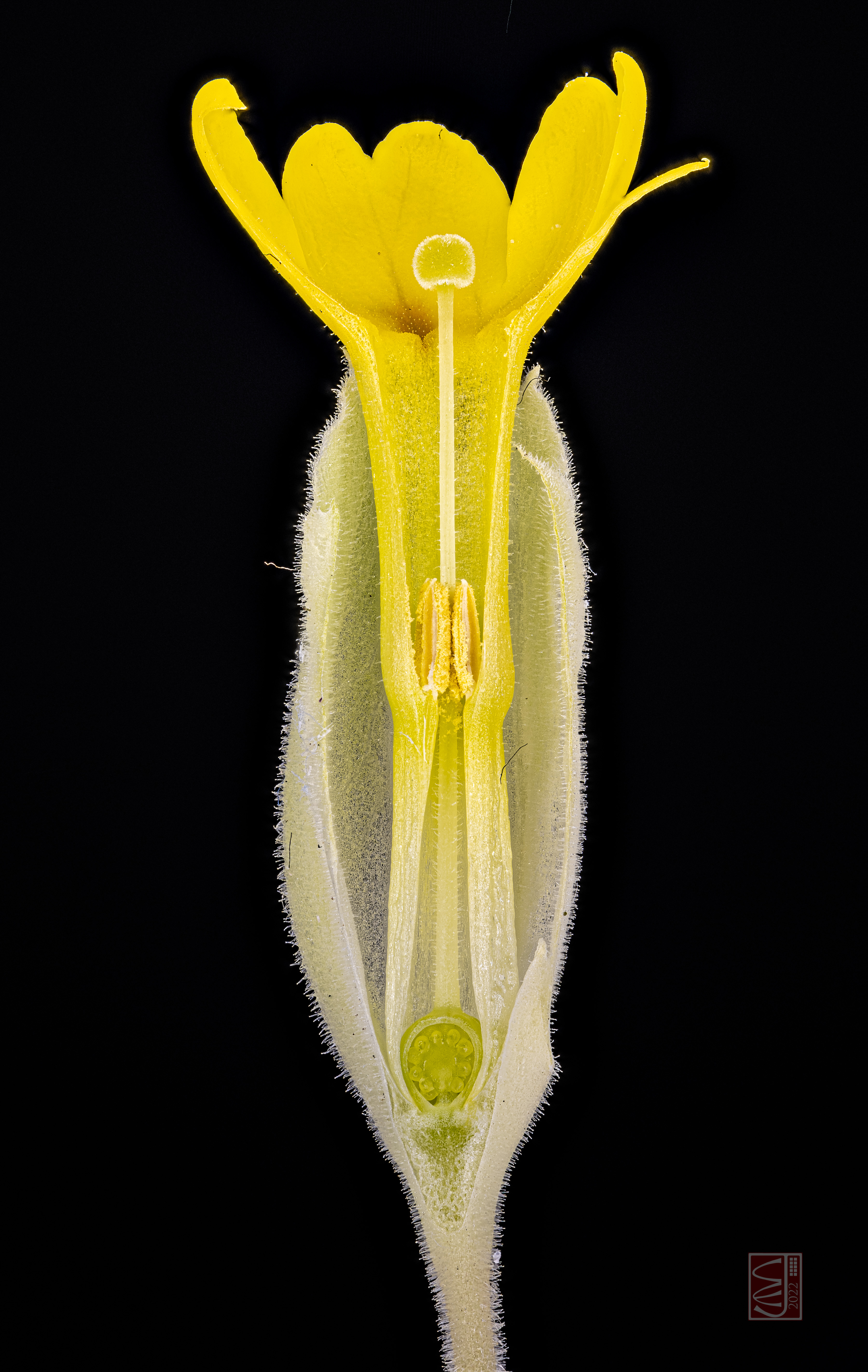
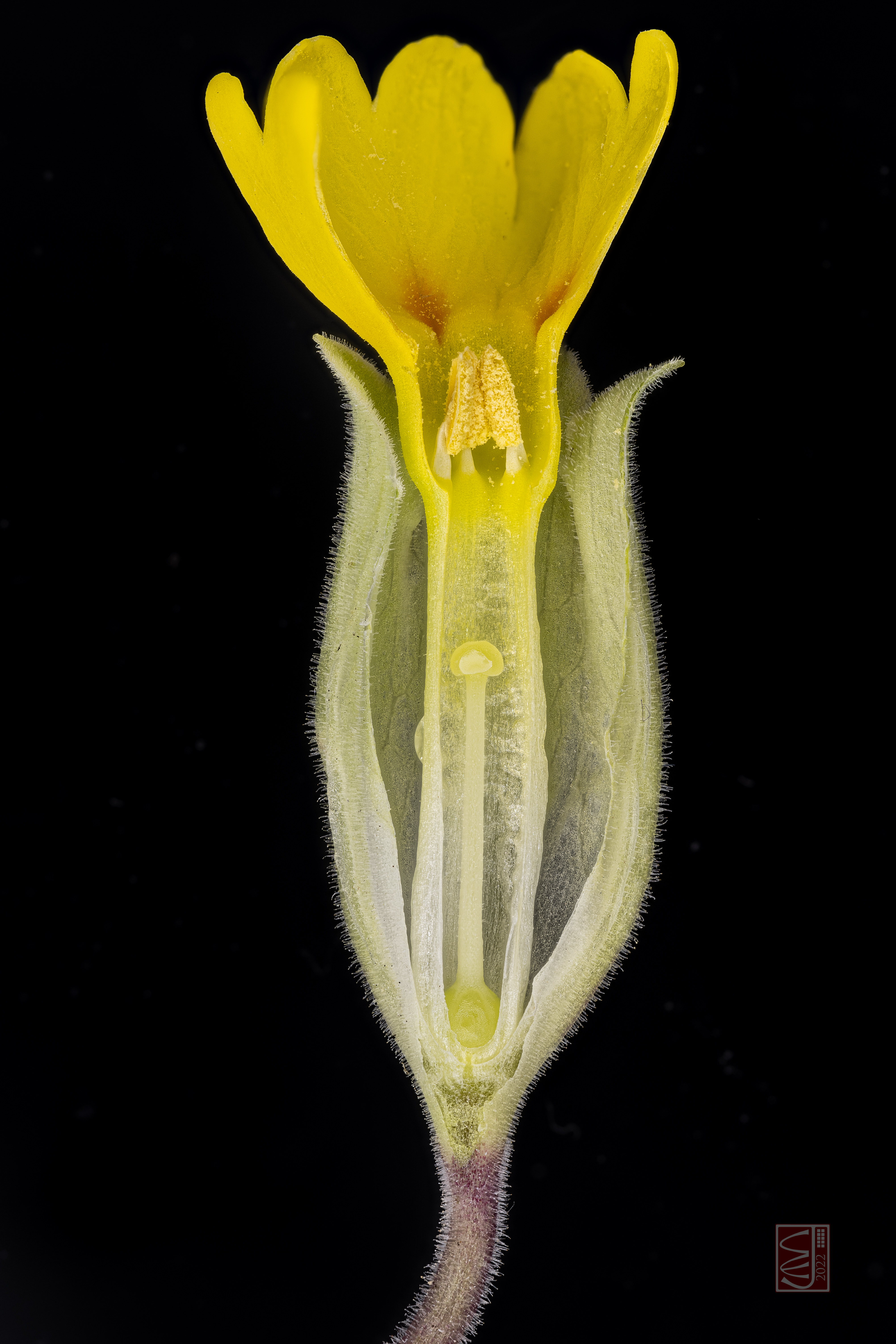
Pin (left) and thrum (right) morphs of Primula veris. Photos © Chris Jeffree

Wikipedia Commons
Cowslips have featured in English folklore and literature. They were made into garlands round maypoles as described in Tomas Hardy’s The Return of the Native and strewn on church paths at weddings. Richard Adams mentions them in Watership Down, as he does many other native species – mostly as rabbit food. Alison Uttley in her charming story, The Country Child, describes the part that cowslips played in rural life in England – children sipping the sweet nectar, and the wine-making. And there are numerous references in Shakespeare’s plays. The most famous one is from the Tempest (“Where the bee sucks, there suck I/ in a cowslip’s bell I lie”), but there is also a lovely fairy chant from Midsummer Night’s Dream:
I serve the Fairie Queen,
To dew her orbs upon the green,
The cowslips tall her pensioners be;
In their gold coats spots you see – these be rubies, fairy favours,
In those freckles live their savours…
Matthew Arnold in his poem Thyrsis also refers to them:
I know these slopes; who knows them if not I?—
But many a tingle on the loved hillside,
With thorns once studded, old, white-blossom’d trees,
Where thick the cowslips grew, and far descried…
Of course, when the cowslips grew thickly as they did in Arnold’s poem, there was no problem with wild collecting for garlands or wine. There is no shortage of cowslip wine recipes online, but I am deliberately not supplying any because we REALLY don’t want you to be collecting kilograms of flower-heads.
In herbal medicine cowslips have a long history of medicinal use. They contain flavonoids (which inhibit histamine and act as free radical scavengers) and salicylates (which act as anti-inflammatories). There are many internet sites that claim relief from bronchitis, spasms, hysteria, paralysis, dizziness, migraines, insomnia, depression, inflammation of the bladder, gout, rheumatism…. I am again deliberately not supplying sources because I do not know how reliable they are. I would in any case strongly urge anyone who wants to harvest the plants for either culinary or medicinal uses to plant their own meadow in their back yard.
Of the five native species listed above, all except P. scotica (which is self-fertile) exhibit genetically determined heterostyly. Heterostyly is a complex floral polymorphism that has evolved convergently in at least 28 families of angiosperms to encourage outbreeding. In distylous flowers, such as P. veris and P. vulgaris, there are just two morphs: ‘pin’ (sometimes known as ‘L’) and ‘thrum’ (sometimes known as ‘S’). An insect visiting a long-styled ‘pin’ flower (left photograph below) brushes pollen from another flower onto its stigma, while an insect visiting a short-styled ‘thrum’ flower (right photograph below) picks up pollen from anthers conveniently placed at the mouth of the flower.
While the structural adaptations encourage cross-pollination, obligate outbreeding is underpinned by an underlying genetic incompatibility. Richards (1989) showed that although pollen from pin to pin and thrum to thrum crosses can germinate on the stigma, the pollen tube never makes it down the style, so only pollination between pin and thrum flowers (obviously on different plants) results in successful seed set.
It was Darwin (1862) who first brought heterostyly in Primulas to public attention. I believe he got his many children enthused, encouraging them to collect data for his surveys. “No little discovery of mine ever gave me so much pleasure as making out the meaning of heterostyled flowers”, he is quoted to have said. While being unaware of the underlying genetic mechanism, the discovery of heterostyly shaped his thoughts about out-breeding, intra-specific variation and hence adaptation and evolution.
In fact, the genetics is simple. The ‘pin’ plants are homozygous and have the genotype ss, and the ‘thrum’ plants are heterozygous with the genotype Ss. Matings between them should yield equal numbers of pin/ thrum. The incompatibility locus (self-incompatibility locus S) is not in fact a single gene, but a group of five tightly linked genes, which segregate together. The downside of the system is that in small remnant populations where there may be imbalance between the numbers of each morph, the opportunity for successful seed set is reduced (Brys et al, 2003). The anthers in the two morphs are equal in size – a fact noted by Darwin (1877), but the fact that the thrum plants bear significantly larger pollen grains was only observed by careful microscopic measurements (Brys and Jacquemyn, 2009). The larger pollen grains of the thrums are thought to provide resources for the growth of the pollen tube down the long ‘pin’ style.

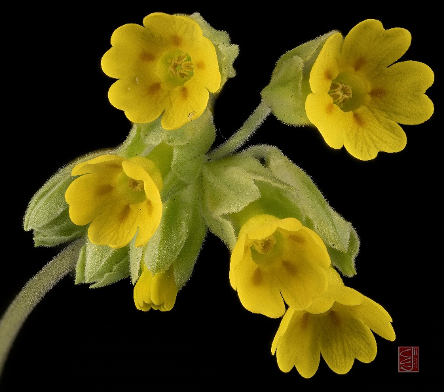
After fertilisation seed heads turn upright as they ripen, presumably to better scatter and disperse seed which develop in fruits hidden by the sepals. Once shed they need a period of cold to break their dormancy before they will germinate. Wild-collected seeds ready for planting can now be bought from responsible suppliers such as Scotia seeds.
Where Primula veris coexists or overlaps with P. vulgaris and/or P. elatior, natural hybrids between the populations of different species can form. Stace (1997) lists several:
P. vulgaris x P. elatior = P. x diganea
P. vulgaris x P. veris = P. x polyantha
P. elatior x P. veris = P. x media
As well as the three-way cross P. vulgaris x P. elator x P. veris = P. x murbeckii
All three species have the same number of chromosomes (2n = 22), allowing for regular meiosis and viability of hybrid seed. For horticultural breeders, this a bonus, but ecologists fear that repeated back-crossing and subsequent introgression can be detrimental to small natural populations of the rarer species.
The hybrid P. veris × P. vulgaris = P. × polyantha occurs frequently in Britain where native populations overlap, whereas the hybrid P. veris × P. elatior = P. × media has been rarely reported (Brys and Jacquemyn, 2009). The Polyanthus beloved of gardeners and tub planters originated as a cross between the cowslip and the primrose, though breeders have also used the oxlip in some varieties. In the UK all these species bear yellow flowers, but on the mainland of Europe pink and purple subspecies of the primrose occur naturally. It is mainly from these that many colourful F1 hybrid varieties have been produced, varying in colour from white to orange, red, purple or mauve, and recently even blue.
A pan-European Citizen Science Campaign, initiated in Estonia, is currently underway (https://eu-citizen.science/project/185) to examine the patterns of heterostyly in cowslip populations. Preliminary studies from the 2019-2020 seasons have detected a shift in the balance between the thrum (‘S’) and pin (‘L’) forms, with the ‘S’ forms predominating in almost all countries sampled (Aavik et al., 2020). Interestingly the largest deviations from the norm occur in urban habitats. Maybe a deviation from an even distribution is not too surprising in small, isolated urban populations derived from a small number of seeds, but there is so far no clear answer as to why the ‘S’ form is ‘fitter’. I feel that we in our Urban Flora Project (and perhaps readers of this Blog) should prepare to collect data in the coming season.
The remit of the cowslip project might at first sight appear to be trivial, but the cowslips serve as a sort of ‘canary in the mine’ warning about the degradation of temperate grassland habitats. Do please check out the cowslip project and listen to their webinar available at: https://www.youtube.com/watch?v=UombI9-BWHo and when the cowslips come into flower this spring do please collect some data for the project.
References:
Aavik, T., Carmona, C.P, et al., (2009). Landscape context and plant population size affect morph frequencies in heterostylous Primula veris – Results of a nationwide citizen-science campaign. Journal of Ecology, 108, 2169-2183.
Brys, R., Jacquemyn, H., Endels, P., Hermy, M., De Blust, G. (2003). The relationship between reproductive success and demographic structure in remnant populations of Primula veris. Acta Oecol. 24, 247–253.
Brys, R. and Jacquemyn, H. (2009). Biological Flora of the British Isles: Primula veris L. Journal of Ecology, 97, 581-600.
Darwin C.R., (1862). On the two forms or dimorphic condition in the species of Primula, and on their remarkable sexual relations. Journal of the Proceedings of the Linnean Society, Botany 6: 77– 96.
Darwin C.R., (1877). The different forms of flowers on plants of the same species. London, UK: John Murray.
Richards, A.J., (1989). Primulas of the British Isles. Princes Risborough, UK: Shire.
Stace, C. (1997). New Flora of the British Isles, Second Edition, Cambridge University Press.
©Maria Chamberlain