Cardamine corymbosa – 4th April 2022 – New Zealand Bittercress
I promised to mow the lawn of an elderly neighbour in South Ayrshire. I thought it would be an easy task but it turned out to be a challenge as the lawn was mostly moss. I’ve never mowed such mossy lawn and my mower was most unwilling. It didn’t actually cut; it chewed, its motor complained, and it was very hard to push. Both man and machine needed to rest. I left the mower and looked over her garden instead, to identify the weeds. I spied a very tiny white flower. Behold, it was the New Zealand Bittercress, which I saw last year in Edinburgh. It hasn’t been recorded yet in South Ayrshire.
It belongs to the Brassicaceae, the cabbage family.
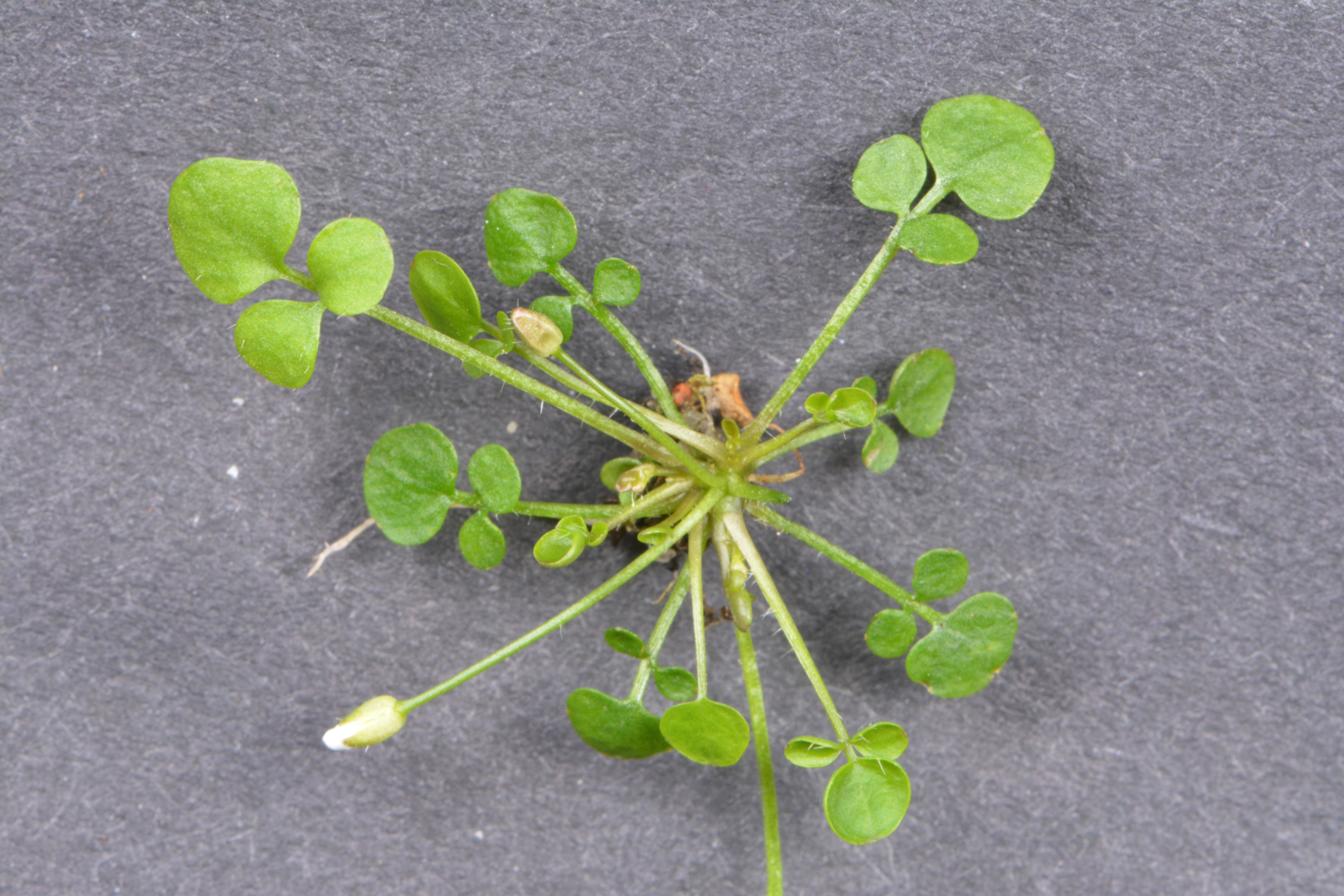
In this tiny patch of garden there were perhaps twenty plants, most of them in flower, crowded together. The peculiar feature of the species is that it has a variable number of petals. Four petals looks right for a member of the Brassicaceae, but this one has one, two, three or four petals. Sometimes, I’ve read, it has no petals at all. The variable number can be on one single plant. This is most unusual.
Once it flowers, it cannot easily be confused with other bittercresses. The two common bittercresses in the British Isles are Cardamine hirsuta (Hairy Bittercress) and Cardamine flexuosa (Wavy Bittercress). These can be quite hard to tell apart and they are among the most common species you see in towns and cities. They can be very small, but not usually as small as C. corymbosa. The Hairy and the Wavy have multiple flowers on quite stiff erect stalks but C. corymbosa has single flowers on filamentous stalks that arise from the base of the plant and tend to flop sidewards.
Although small in stature, C. corymbosa has flowers that exceed C. hirsuta and C. flexuosa, and they are pure white and held in a very conspicuous way that attracts attention, with only one flower on each flower-stalk. Formerly it was called Cardamine uniflora, indicating the solitary flower. It seems strange that it is now called C. corymbosa as it doesn’t usually have a corymb (a flat-topped cluster of flowers), but see below for the possible explanation.
Braithwaite (1991) shows a good line drawing of the species. He remarks on the tendency to produce stolons from the leaf-tips. I haven’t seen this in the few specimens I’ve observed: perhaps they come later in the year, after flowering. You can find his account in the archive of the BSBI here: https://archive.bsbi.org.uk/BSBINews58.pdf
The earliest record in Scotland appears to be from the Royal Botanic Gardens Edinburgh, where Ron McBeath saw it in 1975. I suspect it is now common in people’s Edinburgh gardens but not yet noticed (Noltie 2021). Aliens often appear first at Botanic Gardens where visitors traipse. We have several alien species coming from New Zealand, but nowhere near as many as they have of our British species. New Zealand has a similar climate to ours, and somewhat similar land uses, but most importantly people are frequently coming and going to New Zealand to visit relatives. Seeds often travel on footwear, and I recall the immigration procedure at the airports there: my boots were taken away for steam cleaning and returned a few minutes later looking much cleaner.
The species was first described by Joseph Dalton Hooker. He was the young botanist on the Antarctic voyage of the H.M. discovery ships Erebus and Terror in the years 1839-1843. The expedition confirmed the existence of Antarctica and found the southern magnetic pole. They called at various places during the voyage, including New Zealand. Hooker called the little plant Cardamine hirsuta var. corymbosa, thinking it to be a form of the familiar Hairy Bittercress. It is possible that his specimen had corymbs, as the plant is very variable in New Zealand. Cardamine uniflora is a later and quite appropriate name but the botanical rule of historical precedence applies – we must name the plant C. corymbosa following the older name given by young Hooker.
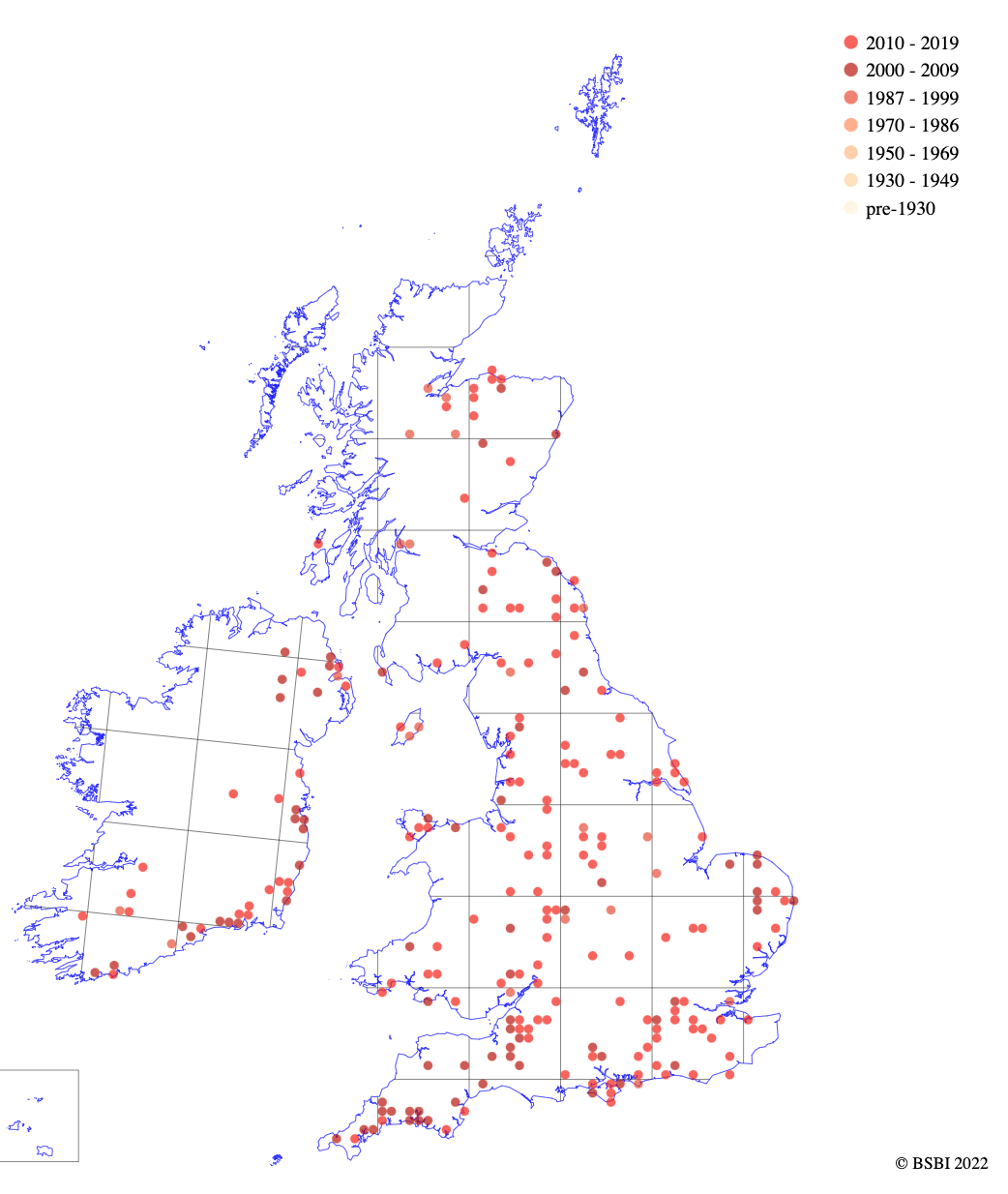
Now, it is scattered throughout the British Islands. It may be much more common than the maps below suggests, as it only recently entered handbooks and floras, and people will have thought it to be a form of Cardamine hirsuta, just as Hooker did.
References
Braithwaite M (1991). The Scottish Cabbage Patch. New Zealand Binercress. BS81 News 58:
38-19
Hooker JD (1844–1859) Flora Antarctica: the botany of the Antarctic voyage. 3 vols, 1844 (general), 1853 (New Zealand), 1859 (Tasmania). Reeve, London.
Noltie H (2021) Shock! Horror! Alien invader reaches genteel Moray Place. https://stories.rbge.org.uk/archives/35217
©John Grace