Crassula tillaea – 27th June 2022 – Mossy Stonecrop
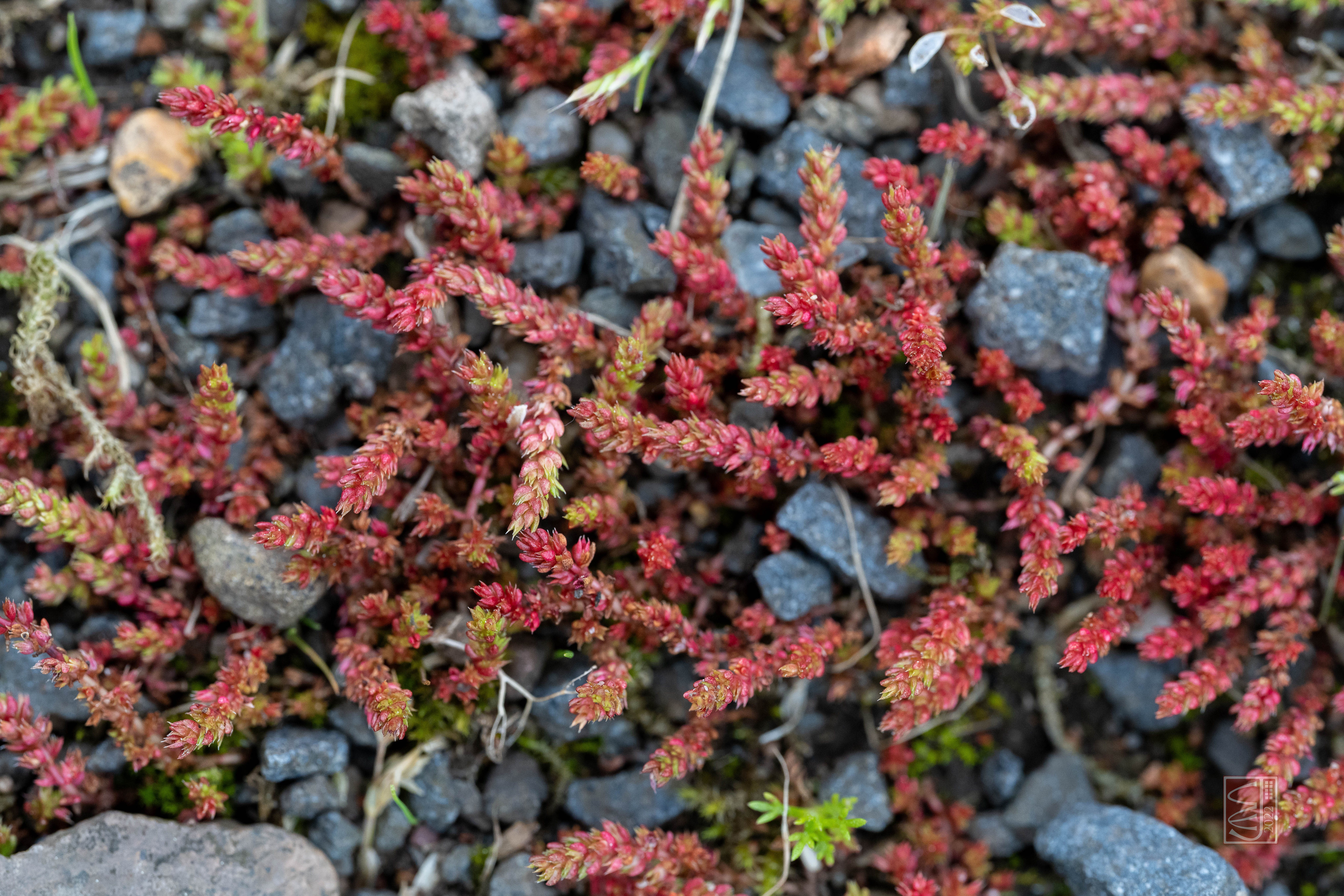
Crassula tillaea on the edge of a gravel path, Ardrossan cemetery. Photo: Chris Jeffree.
This tiny plant has now been seen several times in our survey of Scottish towns and cities. Brian Ballinger already featured it in his blog of August 2020. During the last month we have seen it in Ardrossan (cemetery), Troon (cemetery), Cawdor Castle (car park) and Nairn (coastal grassland). When I contacted Brian about these observations and he replied thus:
“This has only been recorded fairly recently in north-east Scotland. It was described in Mary McCallum Webster’s Flora of Moray, Nairn and East Inverness (1978)*. It was introduced in wool shoddy at Dyke in 1968 and was growing along the cinder track by the Caledonian Canal at Inverness in 1970.
Crassula tillaea was not known in Easter Ross until 2004 when my late wife and I found it growing in gravel at Dingwall station and also in the car park at Invergordon station where it survives. It took us some time to identify it. Since then, it has appeared in many places in the Vice-County and 109 records have been entered. It is also become widespread in the neighbouring counties.
It is much less common further south with, for example, only two records for Angus. The second of these was in the car park of the Rottal estate spotted during a Dundee Naturalists’ field meeting in 2019”.
The plant is described as ‘native’ by Stace (2019) and it was first recorded in 1775 in Norwich. It is native to Eurasia. But in Scotland, as Brian points out, it is a recent introduction. It seems to be spreading. How does it do it? Horticulturalists know that any ornamental crassula can be propagated vegetatively, by simply breaking off a small piece and inserting it into gritty soil. My guess is that C. tillaea is no exception, and that it spreads by fragments sticking to muddy shoes. Just look at where it has been found: railway stations, car parks, cemeteries. They are all places where people shuffle about. I found it in much-worn grassland outside the public conveniences on the coast of Nairn.
Here is its (abbreviated) botanical description. “Small usually reddish annual, 1-5 cm. Stems prostrate or ascending with short branches. Leaves closely set on stems, ovate or elliptic, 1-2 mm, thick, fleshy. Flowers solitary in axils of nearly all the leaves, whitish, 3-4 petals and sepals, sepals larger than petals”.
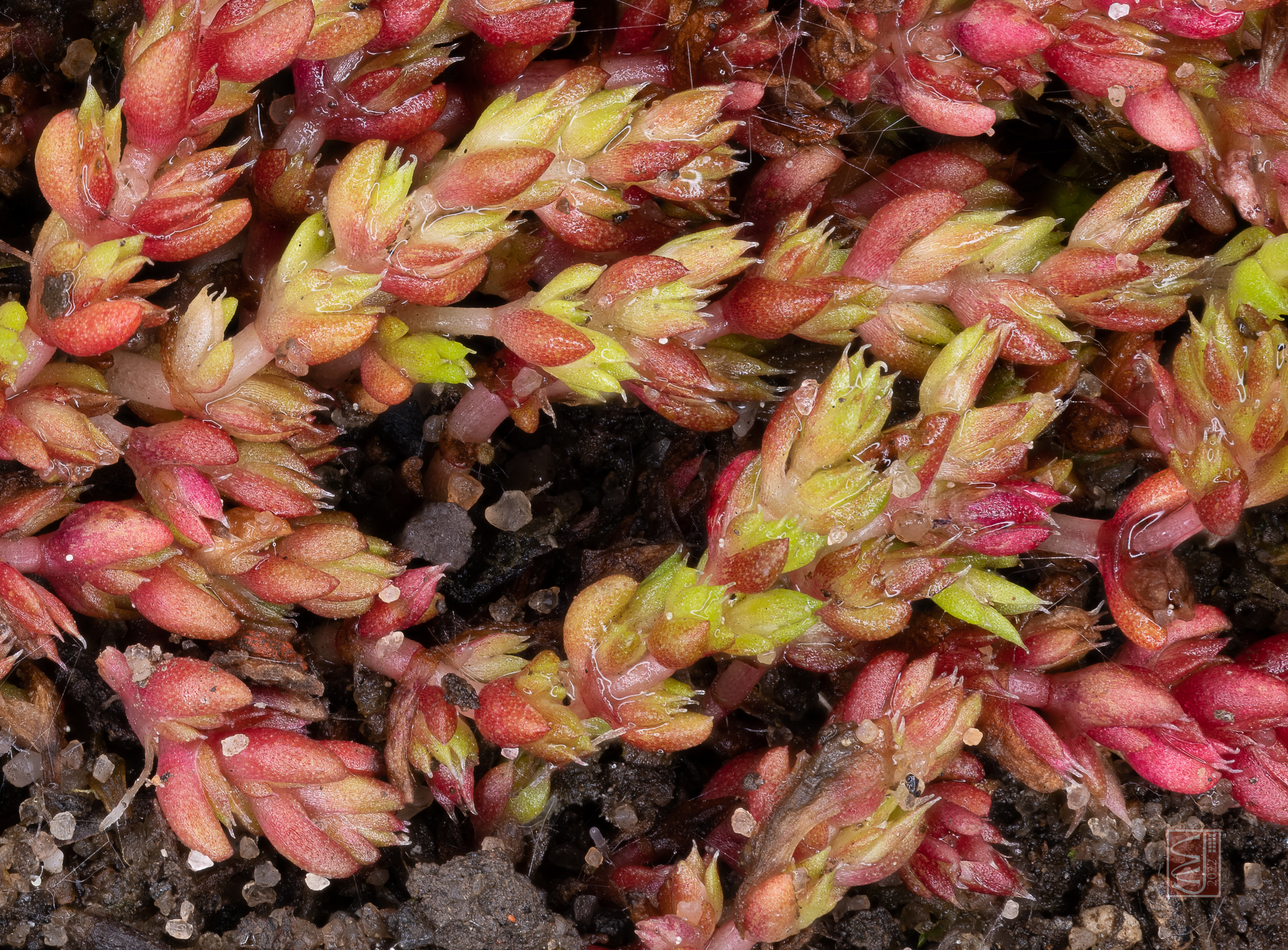
See the pale green flowers in the axils of the red leaves. Photo: Chris Jeffree
Botanical descriptions are not helpful when trying to visualise what a plant looks like. The photos on this page illustrate the adage “A picture is worth a thousand words“. I hope you can see enough to be able to recognise the plant when you see it.

Crassula tillaea in an area of heavy foot-fall. Despite a period of dry weather and trampling, it remains in a healthy state, in contrast to the other species it lives with. June 2022, coastal grassland, Nairn. Photo: John Grace
Cemeteries are potentially good hunting grounds for interesting plants, but too many of them are manicured by Local Councils. The one at Troon has a highly ‘managed’ section which is relatively devoid of wild plants and a more naturalistic area of mostly older graves where wild plants (like Crassula tillaea) can flourish. Of course, if Councils and relatives of the deceased really cared about biodiversity, things could be different. Cemeteries could be local nature reserves.
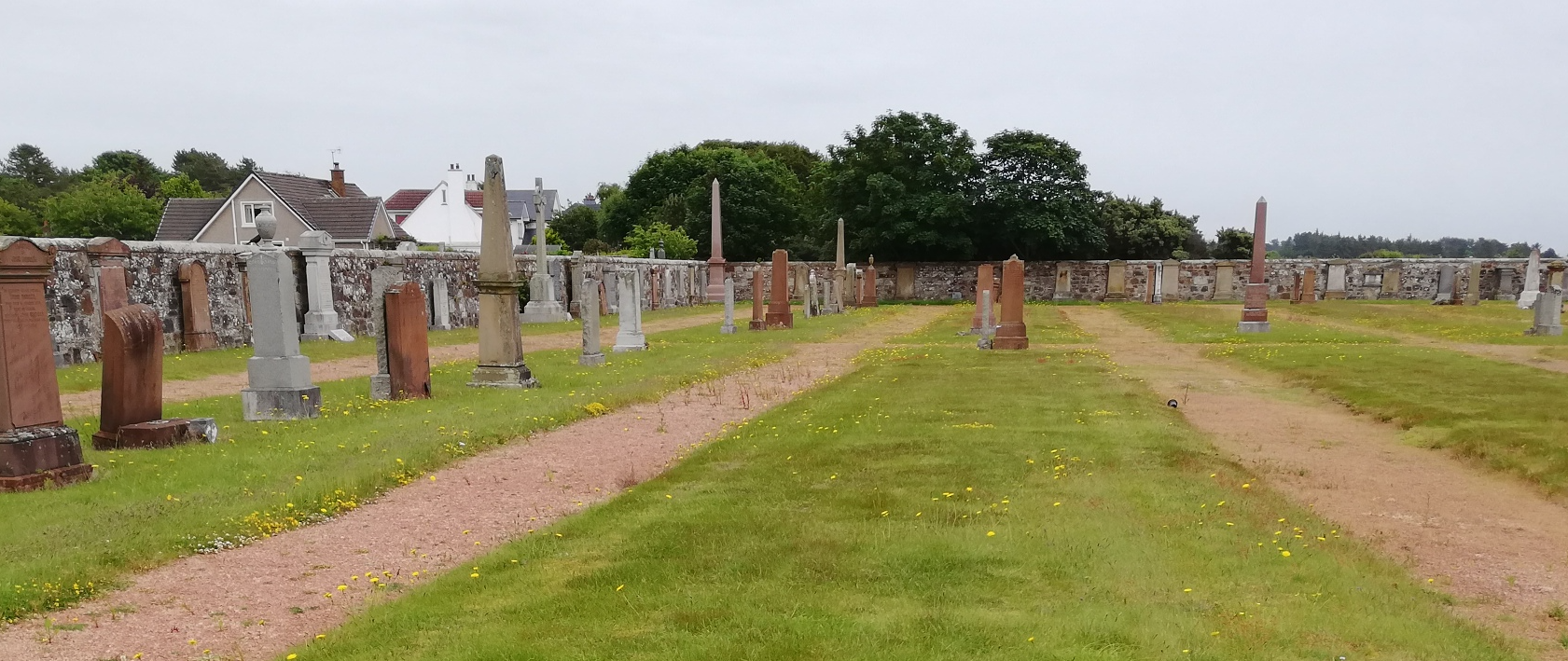
Troon Cemetery, Ayrshire. This part of the cemetery is not cut and sprayed quite as much as the main part, and the grass areas, paths and walls are relatively rich in species. C. tillaea grows on the gravel paths. Photo: John Grace.
The distribution of the species in the British Isles is most unusual. Its historical headquarters are in East Anglia and parts of the south. But now there is a rash of records in the North-East. One wonders whether we are talking of two subspecies – and from my own observations and internet browsing I suspect the northern one is more often prostrate, in contrast to the more erect southern plant. I put this forward not as rash speculation but in the spirit of a testable hypothesis. Certainly, the plant has not received much attention from researchers and perhaps it deserves more.
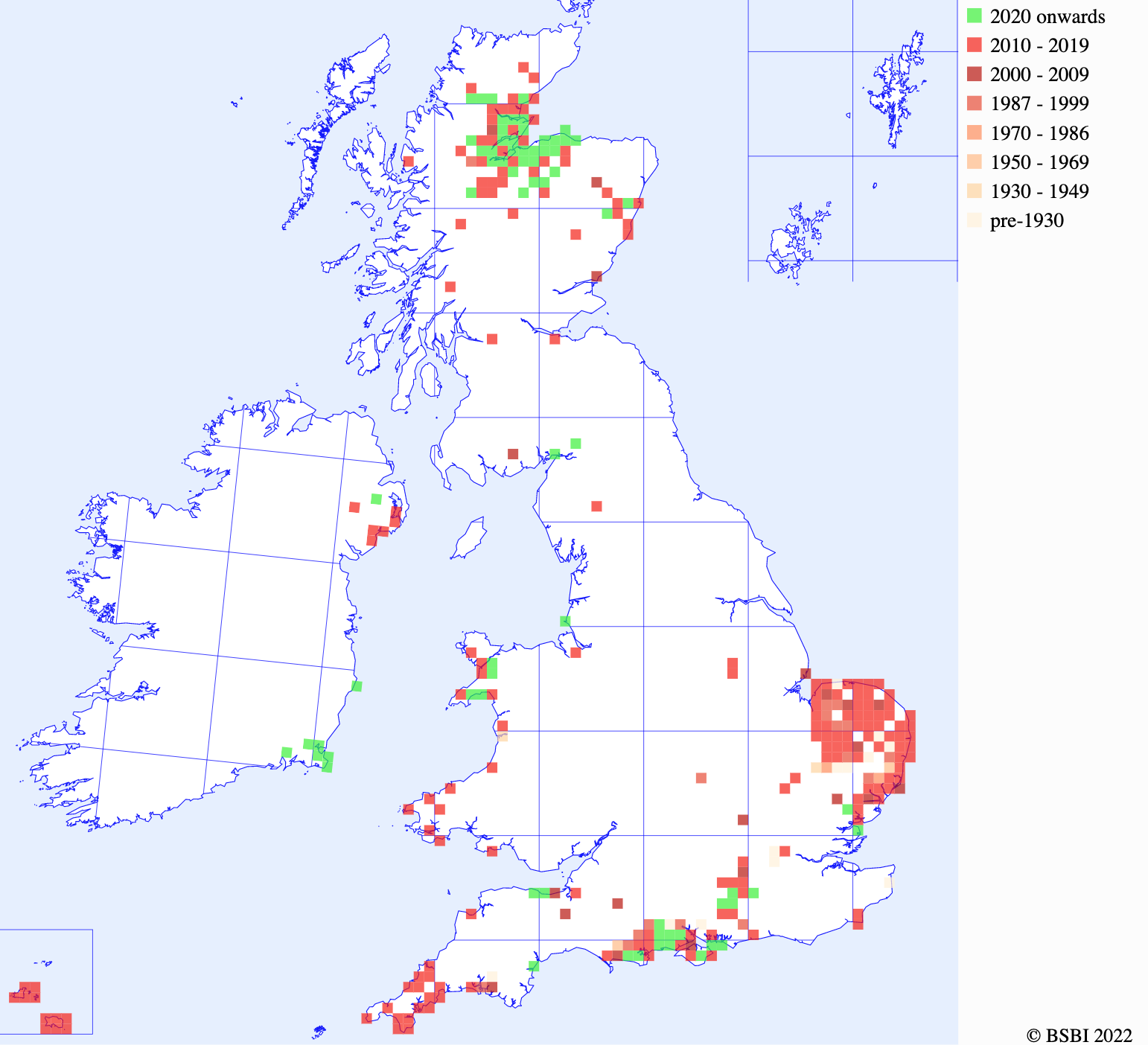
British distribution of Crassula tillaea. Green squares indicate records from 2020 onwards. From BSBI.
References
Ballinger B (2020) https://botsocscot.wordpress.com/2020/08/04/scarce-plants-in-towns-and-cities-in-scotland/
Stace CA (2019) New Flora of the British Isles. C&M Floristics.
©John Grace