Armeria maritima – 11th July 2022 – Thrift
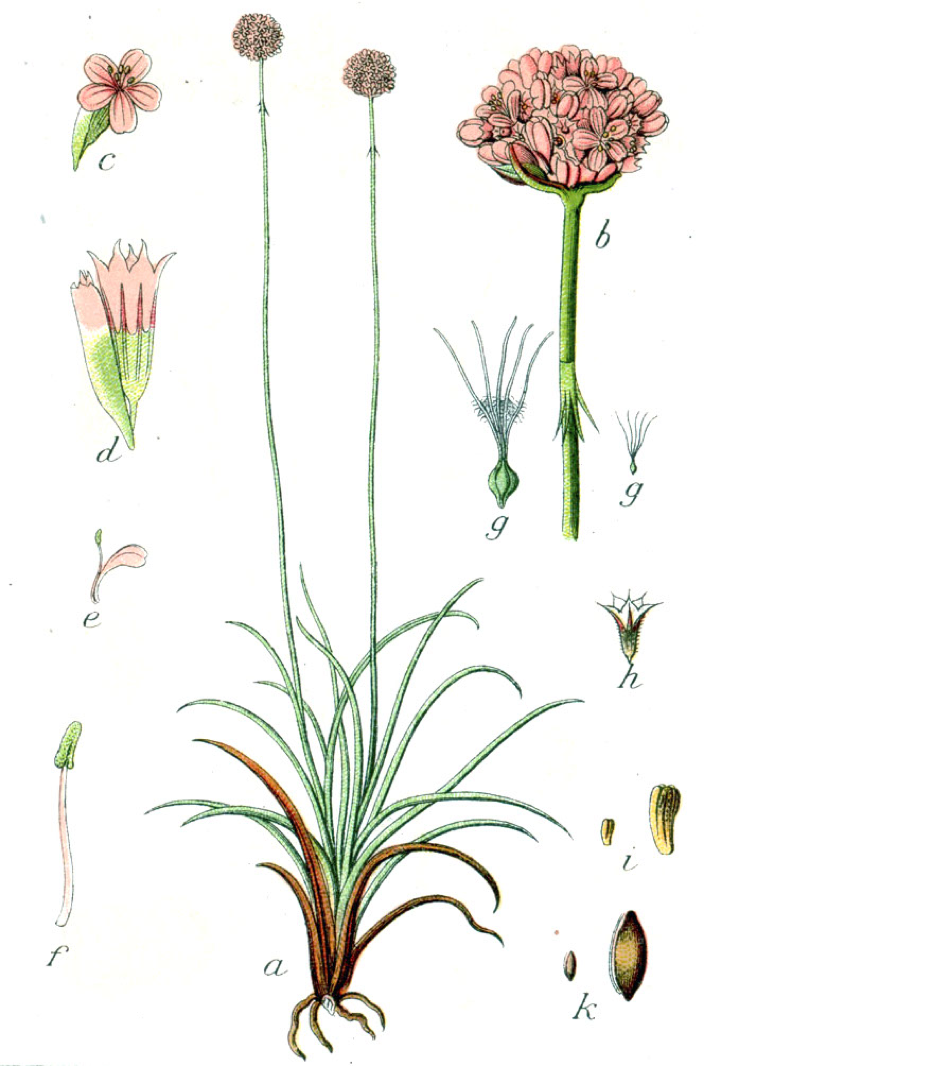
A. maritima by Johann Georg Sturm (1742–1793) (Public domain, via Wikimedia Commons).
Thrift is a species you are unlikely to miss when you visit our western shoreline. Its pink flower-heads, seen against a rocky backdrop, are a special delight in early summer. Older folk will recall its outline from the design of the three-pence coin from 1937 to 1952, a period when the British were being urged to ‘be thrifty’.
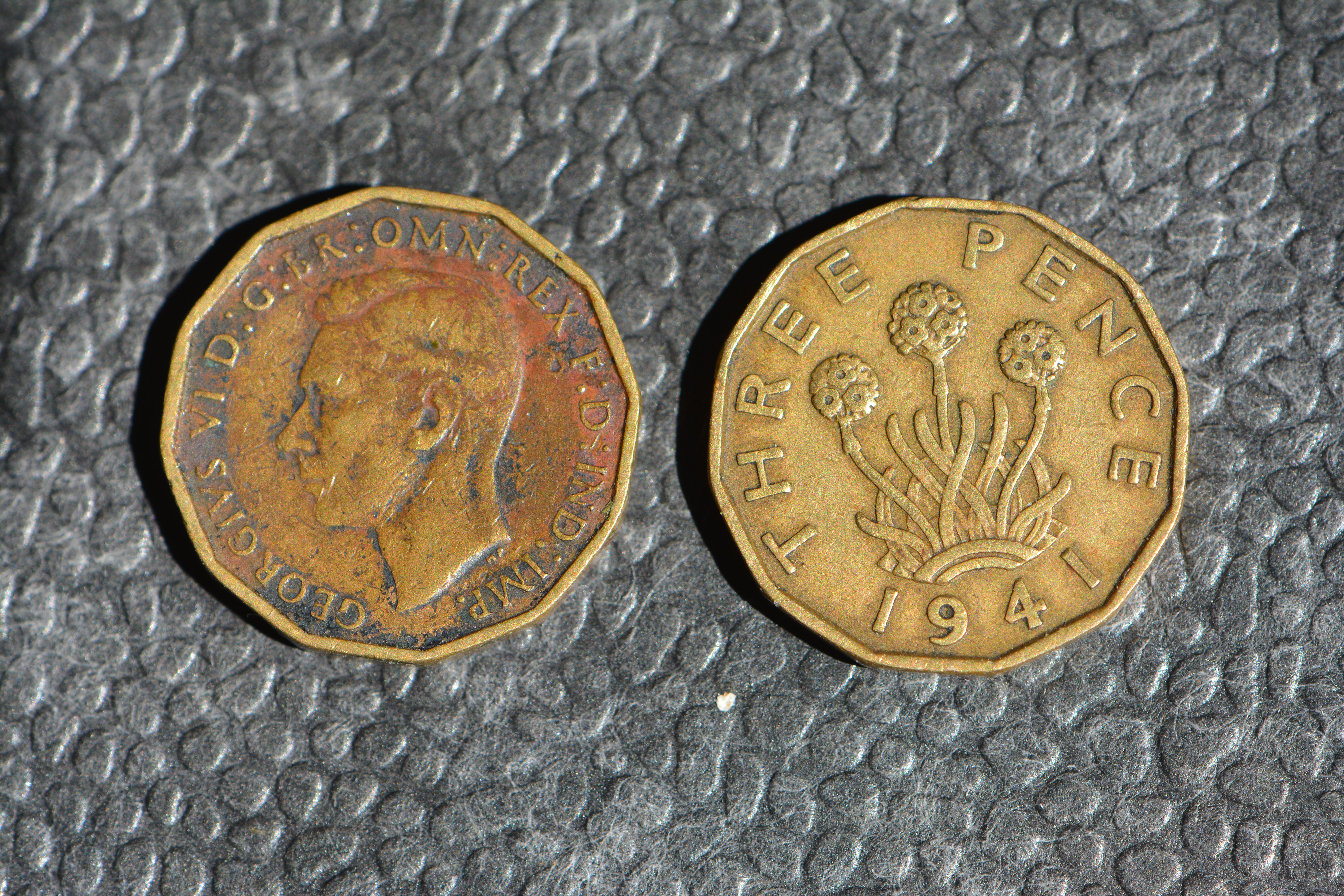
The three pence coin, the ’thrupence’ or ‘thruppenny bit’, from 1937-1952 had the King’s head on one side and a Thrift plant on the other. Madge Kitchener was the artist. In 1937 only 12 coins with King Edward VIII’s head were ever minted due to his untimely abdication, and the whereabouts of six of them are still unknown. Such rare coins are very valuable to collectors. These are mine, not worth much, with King George VI and Thrift. Botanical point: some people mistake this Thrift for a Dandelion.
It is a native plant. Macroscopic remains and pollen grains have been found at several sites in Britain in deposits from the end of the last glacial period. The first historic account was in 1571 by the Flemish botanist Mathias de l’Obel (1538 – 1616) who settled in London during the Elizabethan era. The genus Lobelia was named after him.
It is a member of the Plumbaginaceae, a smallish family that includes the sea-lavenders. The family itself belongs to the very large Order Caryophyllales, wherein we also find the family of the pinks and carnations, the Caryophyllaceae. Sometimes Armeria maritima is called Sea Pink, but its ‘official’ English name is Thrift. However, the GBIF web-site thinks its English name is Marsh Daisy. That is surely wrong: I have never heard of Marsh Daisy except as a breed of chicken.
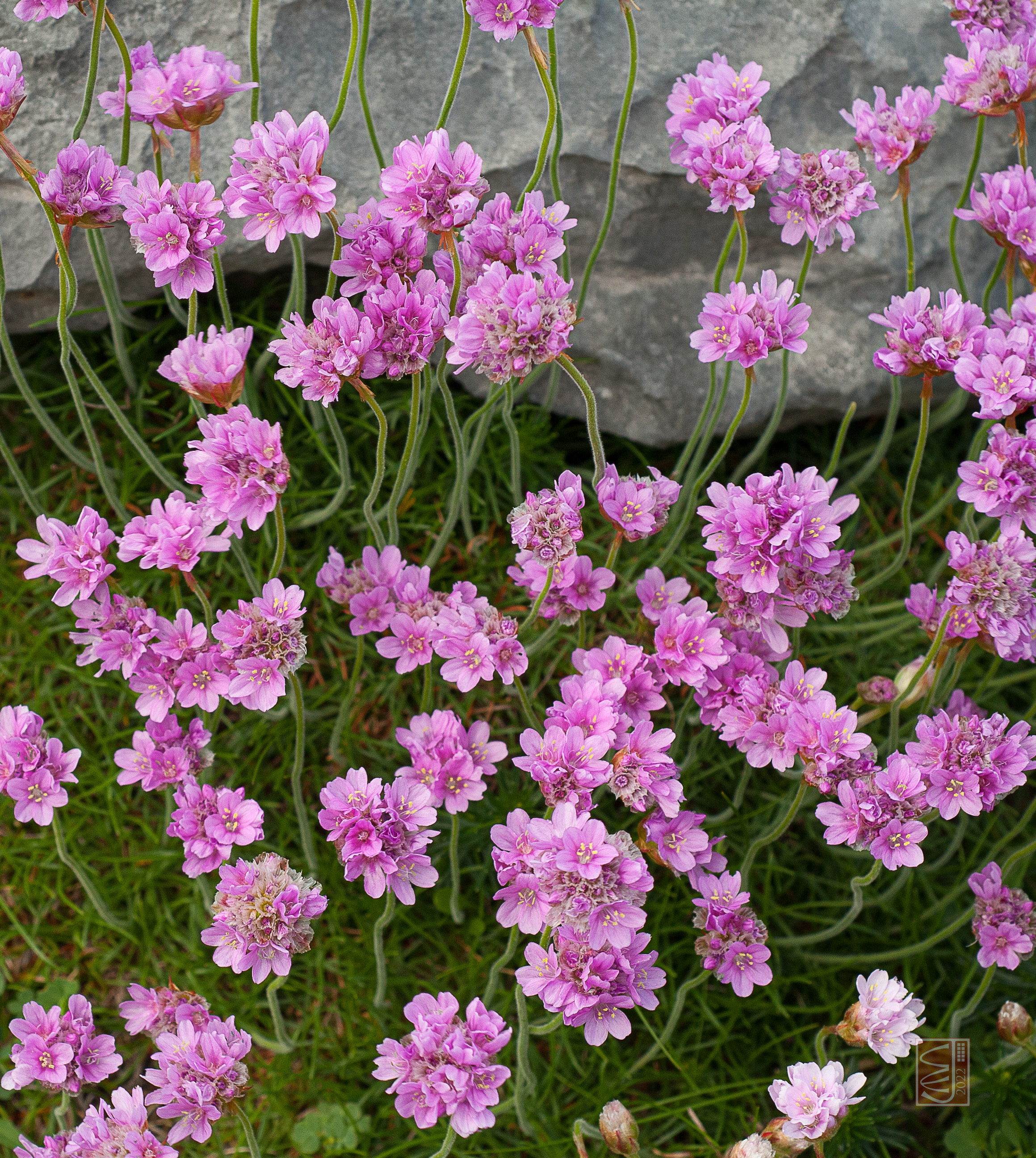
Flower heads of A maritima. On limestone, at the Burren, County Clare, Ireland. Photo: Chris Jeffree.
The very narrow (2 mm) linear leaves form a basal rosette, from which arise several flower stalks (10-300 mm) each bearing a globe of pink flowers (see the images). The tiny flowers are formed from five petals and are pollinated by honeybees, bumblebees and hoverflies.
The plant has a woody tap-root, usually branched, enabling it to cling to fissures on rock-faces and thus survive the wildest storms. An individual plant produces new rosettes around it, and so a dense clump is formed over many years (large clumps can be up to 100 years old).
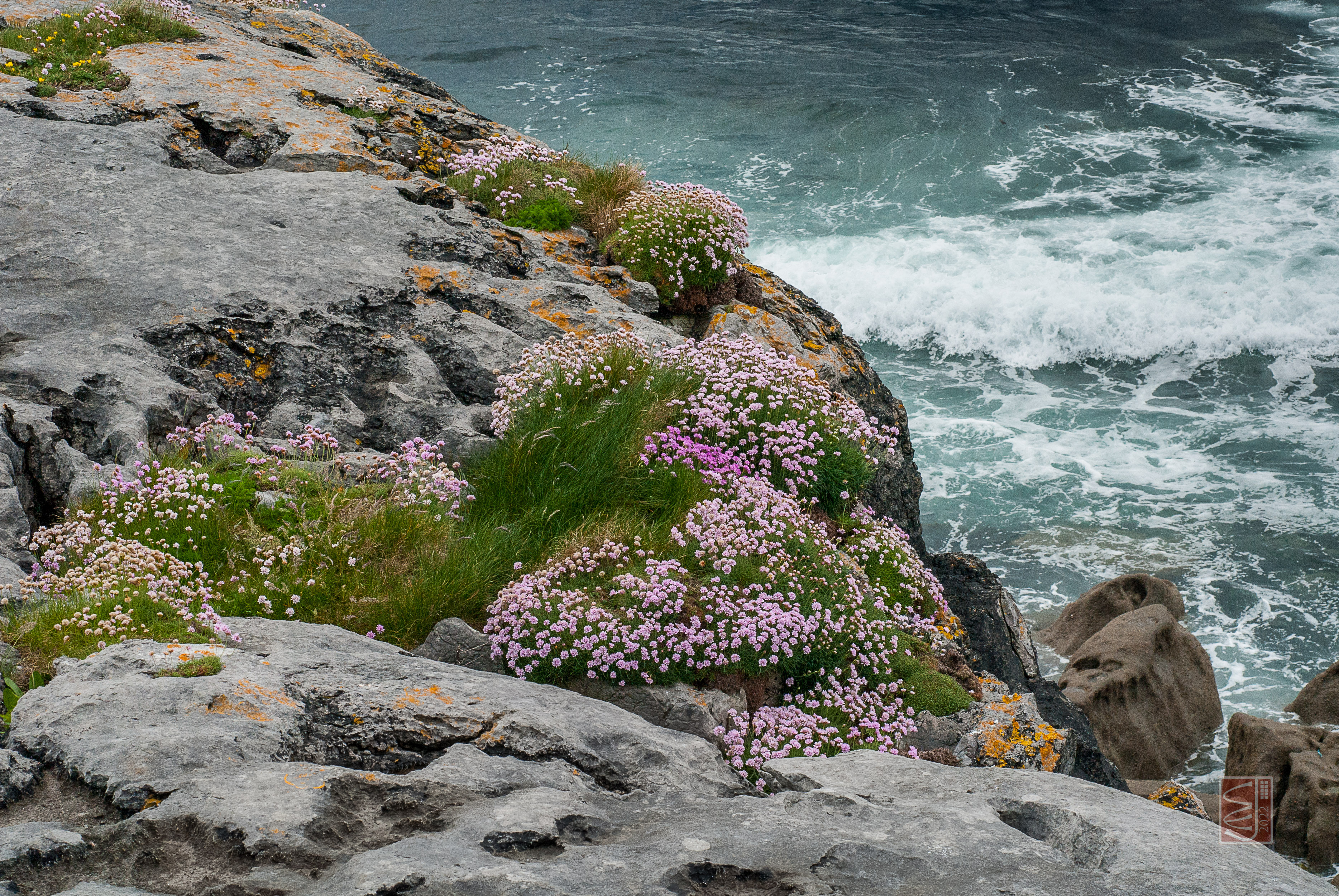
Large population of Thrift on sea cliffs, the Burren, County Clare, Ireland. Photo: Chris Jeffree.
Although Gerard included the plant in his 1597 herbal, he said it had no medicinal value but recognised its value as an ornamental plant “in gardens, for the bordering up of beds and banks, for the which it serveth very fitly”. However, more recent work shows that seeds of this species and several others from Scotland have antibiotic activity (Kumarasamy et al 2002).
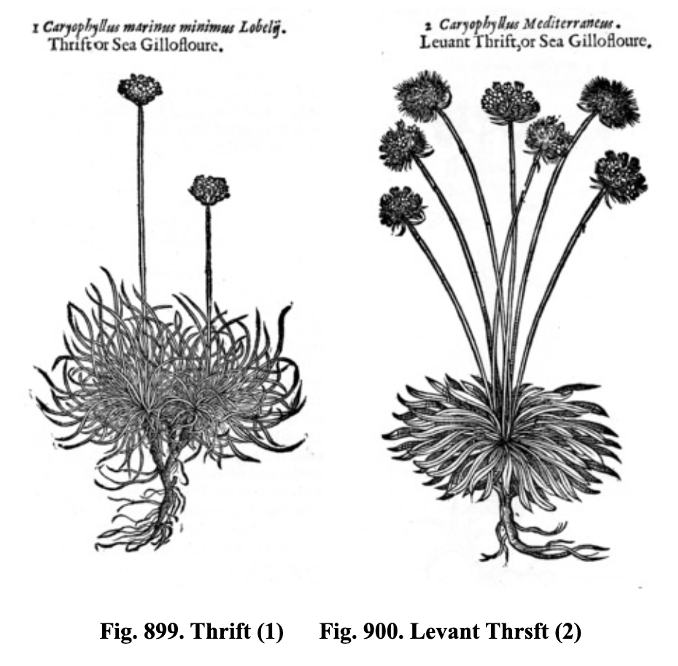
Drawings from Gerard’s 1597 Great Herbal, made available through www.exclassics.com (its contents are public domain and free to use).
The species is highly salt-tolerant (‘halophytic’), enabling it to survive repeated drenching by wind-driven sea-spray on coastal rocks and cliffs. If also occurs on salt-marshes and coastal grassland. Occasionally it is seen inland on salt-treated roads, and on mountains. In common with many halophytic species it has special glands on its leaf surfaces, made of just eight cells, which enable it to excrete salt (Caperta et al. 2020). It is also remarkably tolerant of toxic metals (lead, zinc, nickel, cadmium, copper, chromium, arsenic) enabling it to colonise the heaps of ‘spoil’ found at abandoned lead and copper mines. Like the sodium and chloride of seawater, these elements are also excreted via the glands on the leaf surface, although most of the metallic elements are deposited in the cell walls of the roots.
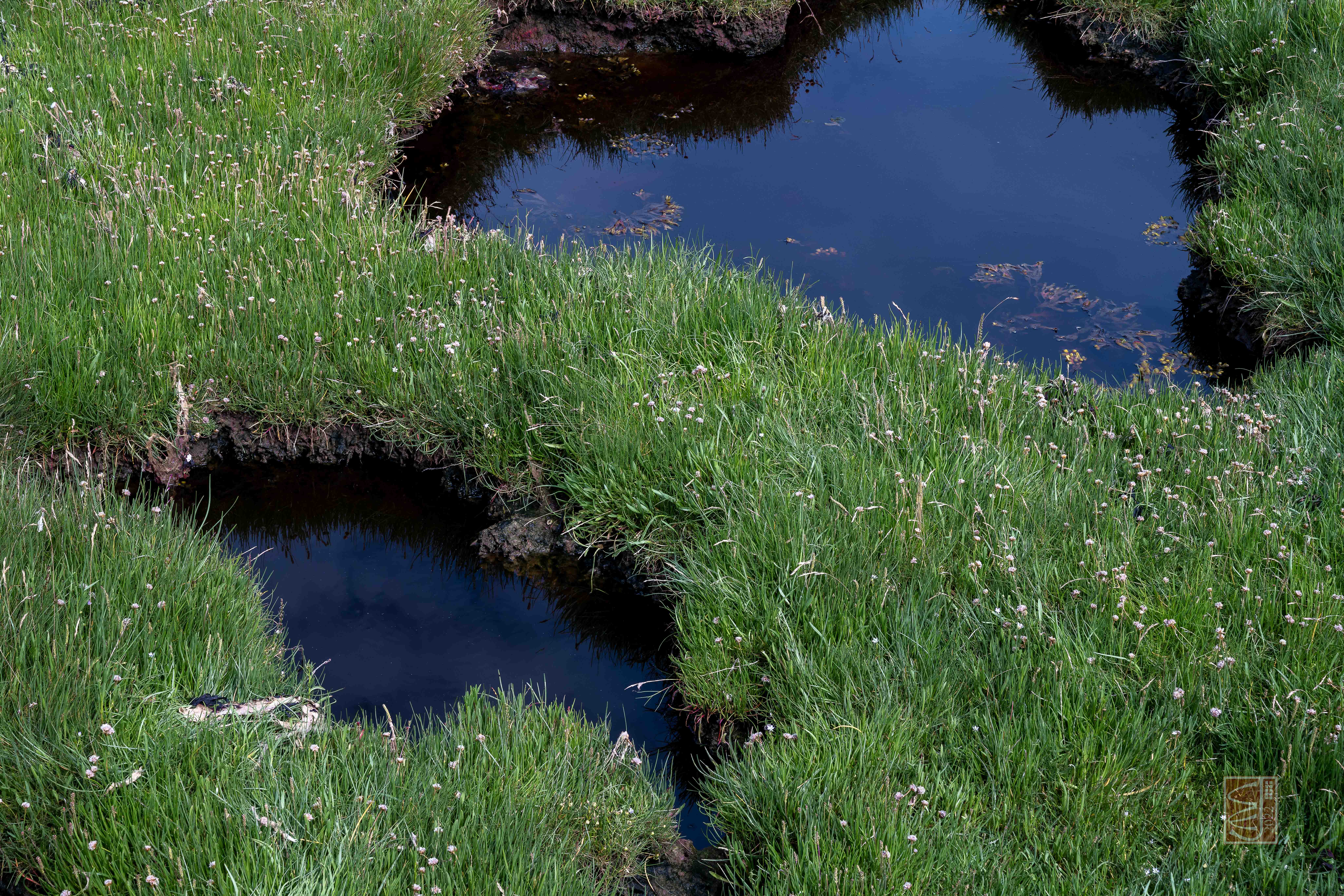
A. maritima as a componet of salt-marsh vegetation. Aberlady, East Lothian, Scotland. Photo: Chris Jeffree.
Thrift has a modern use in green roof systems. Only a small number of species can tolerate being exposed on flat rooftops with limited soil. These species must tolerate extremes of water supply and be able to grow on shallow substrates made of materials including mixtures of crushed brick and clay or recycled municipal waste. They must also look colorful. Here are some candidate species found to be useful in Turkey by Eksi et al. (2019): Achillea millefolium, Armeria maritima, Sedum acre and Sedum album. Thrift also showed promise as a species for ‘living wall systems’ in Denmark (Lausen et al 2020).
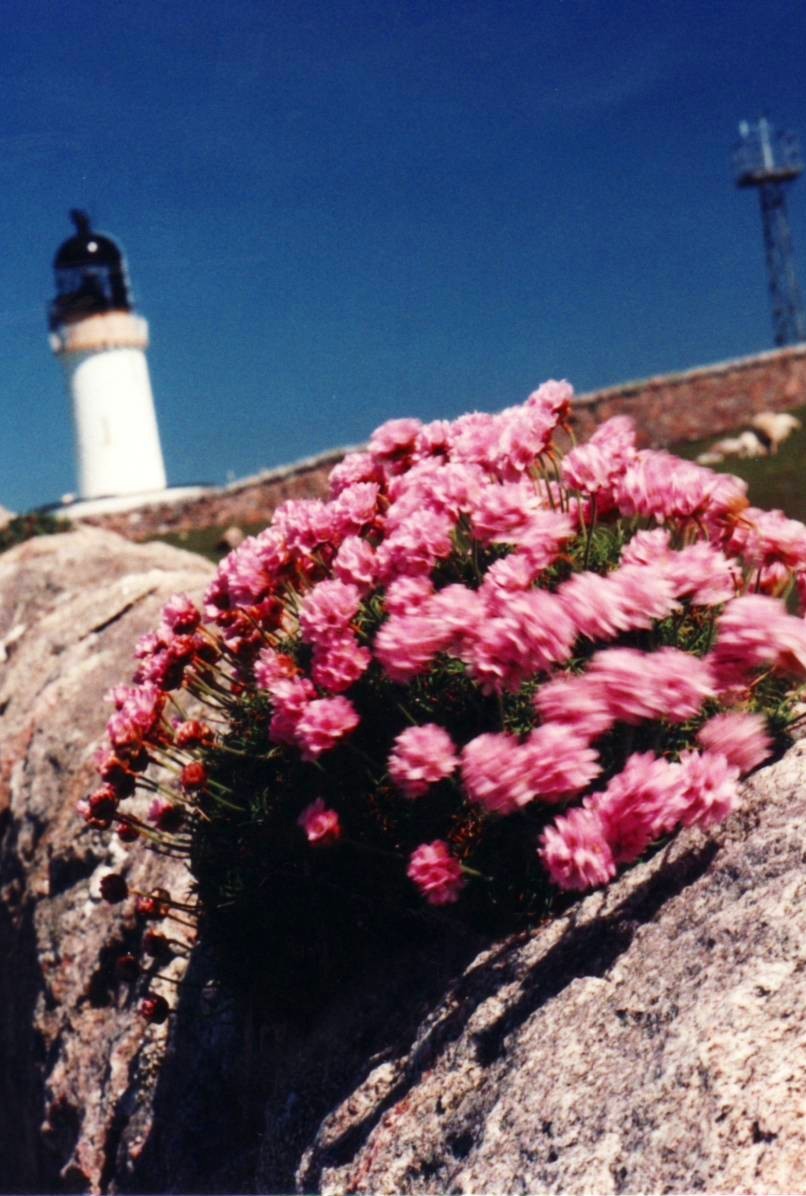
Rare image of A. maritima blowing in the wind, on a wall at Cape Wrath, the most north-westerly point in mainland Britain. Lighthouse in background. Image: Richard Milne.
It is a somewhat variable species and several ecotypes have been recognised (Woodell and Dale, 1993). In the New Flora of the British Isles Stace (2019) recognised two subspecies: A. maritima ssp. maritima is the common one with faintly hairy stems up to 30 cm whilst subspecies elongata has hairless stems 20-55 cm, and is found only around Lincolnshire. Over four hundred years ago, Gerard’s Herbal showed two species: ‘Thrift’ and ‘Levant Thrift’. Levant is a Cornish site where tin and copper were mined in ancient times, and we suspect that thrift grew somewhat abnormally in those extreme conditions. Or, this may have been a Mediterranean species brought to the tin mine inadvertently by miners and metallurgists from the European continent.
The British distribution shows it to be a common coastal plant, but especially abundant in the west of the country, presumably because of the many suitable habitats created by the highly fragmented coastline. The inland sites include major roads and disused mines. The world distribution shows it to be circumpolar, mostly in the northern hemisphere, and highly concentrated in Europe.
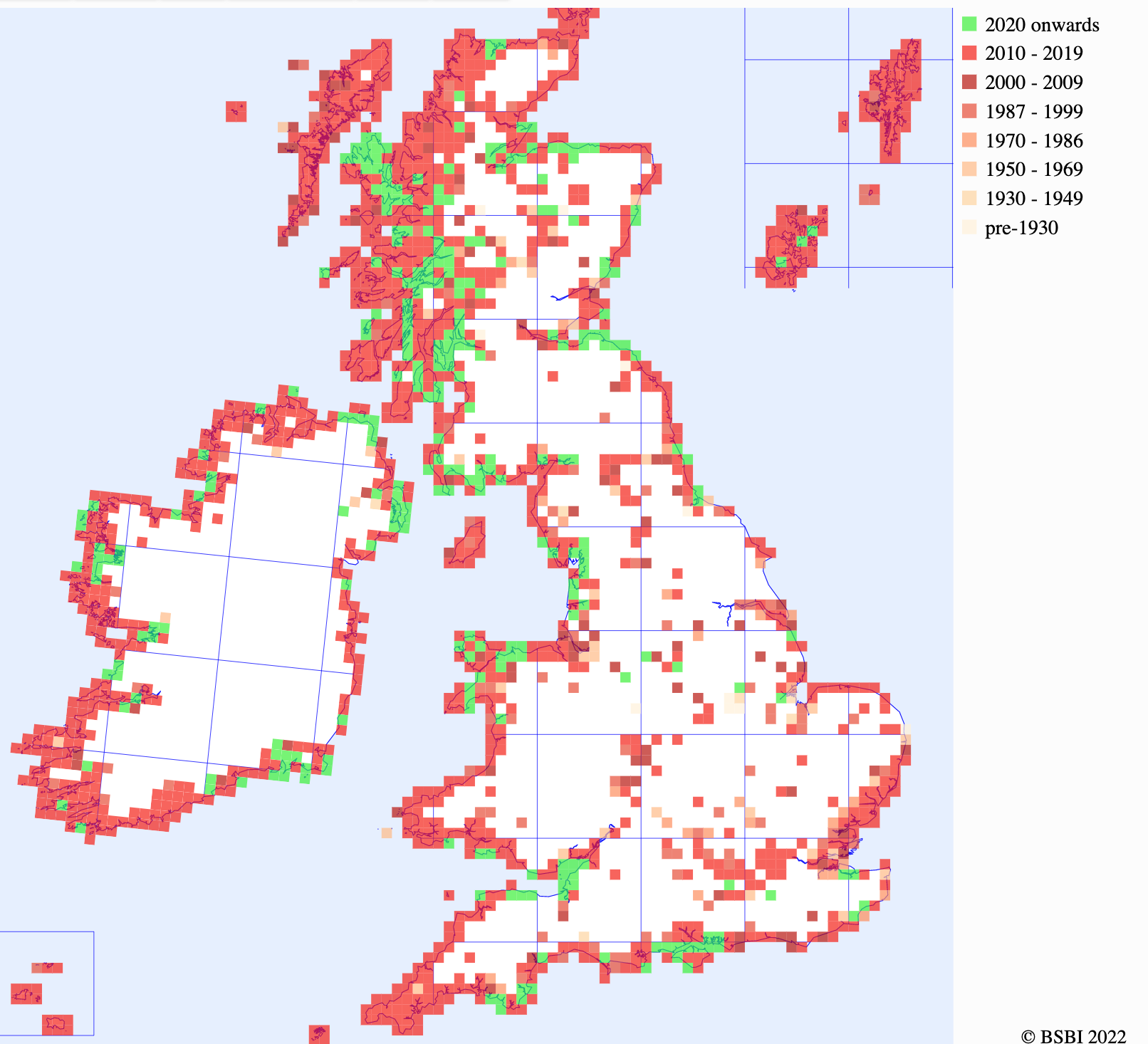
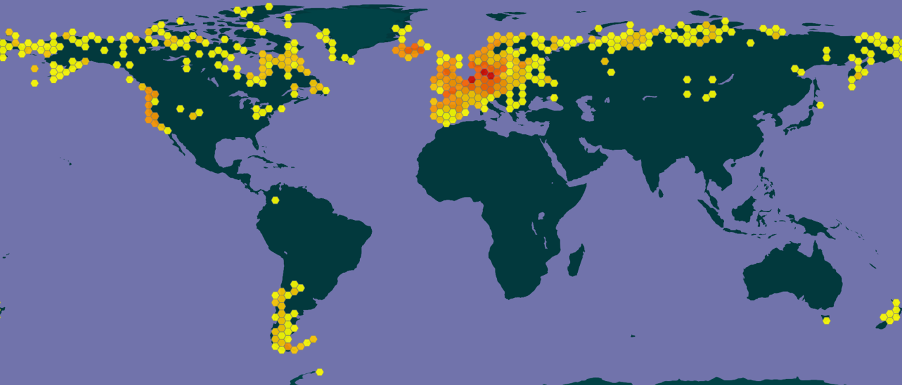
British and global distribution of A. maritima. (British data from the BSBI, the global data from GBIF).
References
Caperta AD et al. (2020) Secretory structures in plants: lessons from the Plumbaginaceae on their origin, evolution and roles in stress tolerance. Plant Cell and Environment 43, 2912-2931.
Eksi M et al. (2019) Effect of substrate depth and type on plant growth for extensive green roofs in a Mediterranean climate. Journal of Green Building 14, 29-44.
Kumarasamy Y et al. (2007) Screening seeds of Scottish plants for antibacterial activity. Journal of Ethnopharmacology 83, 73-77.
Lausen ED et al. (2020) Water use and drought responses of eight native herbaceous perennials for living wall systems. Urban Forestry and Urban Greening 54, Article 126772.
Stace CA (2019) New Flora of the British Isles. C&M Floristics, Suffolk.
Woodwell SRJ and Dale A (1993) Armeria maritima (Mill.) Willd. Journal of Ecology 81, 573-588.
©John Grace