Galeopsis speciosa – 1st August 2022 – Large-flowered Hemp-nettle
This is an annual plant, possibly a native. It can be found elsewhere in Europe, from Norway south and east to France, Bulgaria and Siberia. It belongs to the Lamiaceae, the family of mints and dead-nettles. It stands erect, surely one of the boldest and best of all our wild dead-nettles. Its pale yellow flowers with their violet lower lip are prominent. One early author is quoted as saying he considered it to be “One of the most splendid of our native wild flowers” (see Crawley 2020).

Galeopsis speciosa. Note the square stem, hairiness of the stem, opposite leaves. Acknowledgement: Christian Fischer, CC BY-SA 3.0 <https://creativecommons.org/licenses/by-sa/3.0>, via Wikimedia Commons
Formerly, it was a common weed of arable land, often on black peaty soils. I know it well from my Edinburgh allotment. It was first spotted there in 2015 when the Urban Flora group came to record wild flowers. It has been there ever since, not always in the same spot. Last year it emerged from the pea crop along with the ever-present Nipplewort, Lapsana communis. I’ve seen it among the potatoes. This year it has appeared next to sweet peas. Flowering starts in July and continues through August. It can grow fast and tall (up to 1 metre, but usually less) and this, and its good timing, seems to be the secret of its success as an arable weed.
The species has attracted recent attention. The Royal Horticultural Society (RHS) has been making a new garden in the north of England (RHS Bridgewater, a reclaimed site near to Manchester). Crawley (2020) reports his survey of the vegetation before and during construction. The work to prepare the site involved much excavation and moving of soil. Looking at the emerging plants he found:
“A spring-germinating ruderal community with a diverse, long-lived seed bank producing a dense cover of species-rich vegetation by late summer. Galeopsis speciosa has a strong dormancy that is sufficiently alleviated during the winter to allow germination of only part of a seed batch each spring; hence a stepwise germination pattern occurs over a period of several years”.
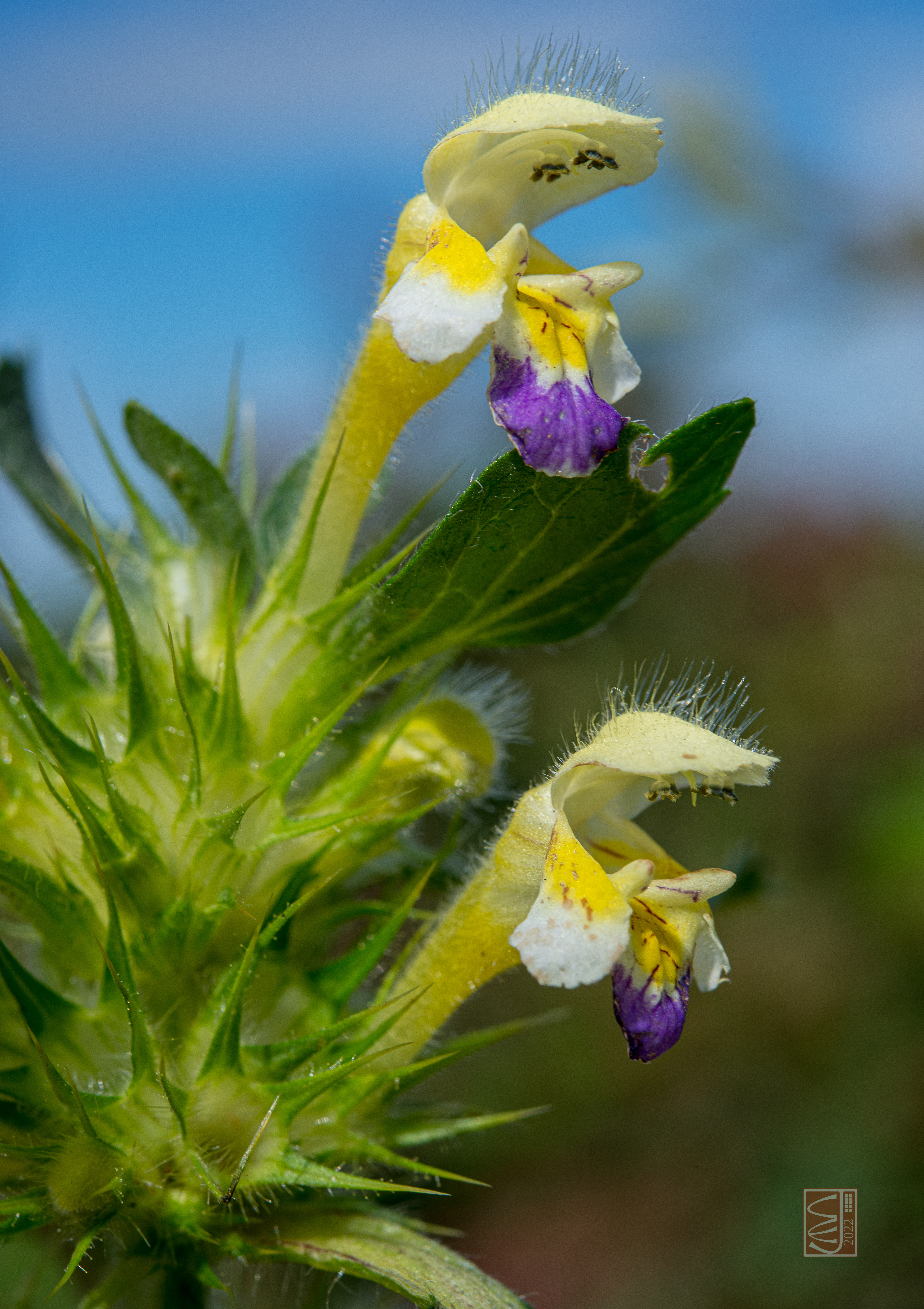
Detail of flowers and calyx. Note the coloured markings of the flowers, and the hairs on the flowers and calyx. Photo: Chris Jeffree.
The other ‘constant’ species he found in the community were Sonchus asper, Galium aparine, Rumex obtusifolius, Persicaria maculosa, Cirsium vulgare, all commonly occurring in allotment gardens.
Crawley goes further than most of us might care to, proposing a completely new category of the National Vegetation Classification (NVC). Readers who are familiar with NVC will appreciate the importance of this, but for those who are not familiar, see the background at https://jncc.gov.uk/our-work/nvc/. The new category is OV13, the thirteenth category of Open Vegetation, to be added to the list first published by Rodwell (2000). Crawley argues convincingly that this vegetation would have been common many years ago, when peatland in the north of England was made fertile by adding manure and draining. The land was used for growing root crops.
But now, the species is in decline (Braithwaite et al. 2006). In the maps below the extent of the decline is clear. The species is now largely missing from the south of England and has become scarce elsewhere. Modern farming practices and weed-control measures are not kind to this plant; and rather few farmers are likely to know of its existence as a vulnerable species.
Is it really a native? It has been here a long time. According to Pearman (2017) the species was first described by Christopher Merrett in 1666 (in Scotland it was first recorded by Thomas Hopkirk, 1813). Merrett was a clinical physician, botanist and librarian (he looked after the Harveian Library – named after his friend William Harvey, the one who discovered the circulation of blood). His writings are interesting as he was living and working in London at the time of the Great Plague and the Great Fire (Dodds 1954).
However, the herbalist Gerard knew the plant a few years earlier. In those days people called it Cannabis spuria (hence the English name ‘Hemp-nettle). Gerard’s drawing leaves little doubt that Cannabis spuria is in fact Galeopsis speciosa.

From Gerard’s Herbal, a plant he called Cannabis spuria ‘Bastard Hemp’ which is clearly Galeopsis speciosa. He wrote “This wild Hemp… hath small slender hoary and hairy stalks a foot high, beset at every joint with two leaves, smally indented about the edges somewhat like a Nettle. The flowers grow in roundels about the stalks, of a purple colour, and sometimes also white: the root is little and thready”.
It is notoriously difficult to ascertain whether any species which has been around for a long time is truly a native (see Preston et al. 2004). The definition of ‘native’ is a species that arrived here without the intervention of man (irrespective of when it arrived). We cannot be sure – there could have been seeds between the toes of Mesolithic migrants arriving from Central Europe. That would make it an ‘archaeophyte’ defined as a plant that was introduced by humans before the year 1500. For many species, like this one, it is impossible to decide.
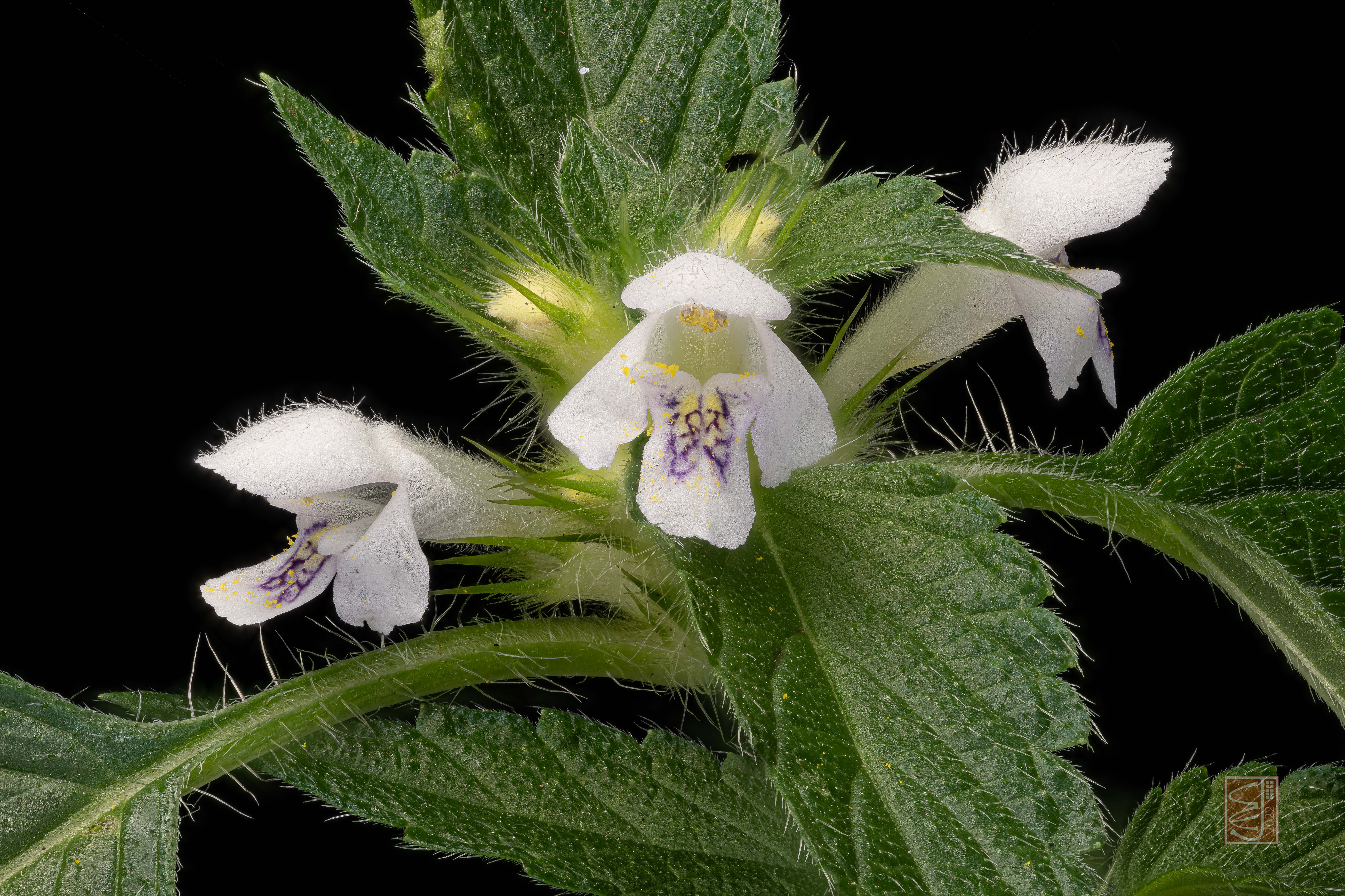
Galeopsis tetrahit. Photo: Chris Jeffree.
There are four other species in the Hemp-nettle genus Galeopsis. The Downy Hemp-nettle G. segetum hasn’t been seen since 1975. The Red Hemp-nettle G. angustifolia is extinct in Scotland. The Common Hemp-nettle G. tetrahit is widespread, and illustrated above. The Bifid Hemp-nettle G. bifida has darker markings on its lower lip, and hybridises with G. tetrahit. See the key in Stace (2019): the flower markings should enable identification and separation of G. bifida and G. tetrahit.

The records of Galeopsis speciosa before 2000 (left) and from 2000 – 2022 (right). Sharp declines are evident, with only the North-East of Scotland) showing a clear increase. The plant is conspicuous and so unlikely to have been overlooked by Recorders. Data from BSBI.
References
Braithwaite ME, Ellis RW and Preston CD (2006) Change in the British Flora 1987-2004. BSBI.
Crawley MJ (2020) Galeopsis speciosa (Lamiaceae): an Open Vegetation seed bank community at Worsley in Salford (v.c.59), revealed during construction of the new Royal Horticultural Society Garden at Bridgewater. British & Irish Botany 2, 377-406
Dodds C (1954) Christopher Merrett FRCP 1614-1695, first Harveian Libararian. Proceedings of the Royal Society of Medicine 47, 1053-154.
Hopkirk T (1813) Flora Glottiana: a catalogue of the indigenous plants on the banks of the River Clyde and in the neighbourhood of the City of Glasgow. John Smith & Sons, Glasgow.
Pearman D (2017)The discovery of the native flora of Britain and Ireland.
Preston CD, Pearman DA & Hall AR (2004) Archaeophytes in Britain. Botanical Journal of the Linnean Society, Volume 145, Issue 3, July 2004, Pages 257–294, https://doi.org/10.1111/j.1095-8339.2004.00284.x
Rodwell JS (2000). British plant communities. Volume 5. Maritime communities and vegetation of open habitats. Cambridge University Press.