Xanthoria parietina – 10th October 2022 – (Maritime sunburst lichen)
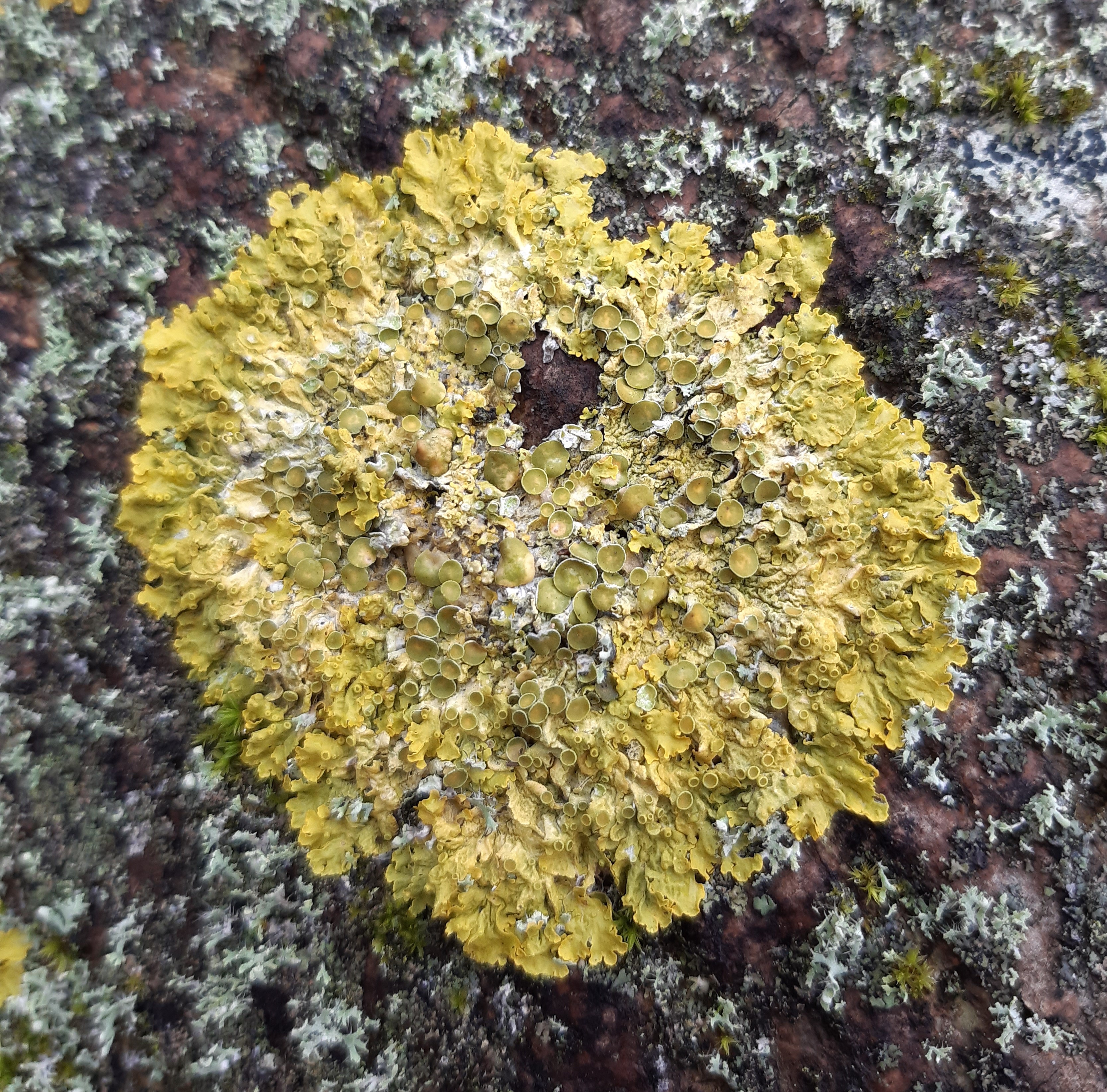
This week’s plant of the week is, in fact, a lichen, and therefore not a plant at all. A lichen is a composite organism, made up of a fungus and an alga or cyanobacterium species (at least – research is showing that multiple species can form the lichen symbiosis). The fungal tissue provides structure and protection for the algae/cyanobacteria from ultraviolet light, dessication and other dangers, while the algae/cyanobacteria partners provide food in the form of sugars from photosynthesis for the fungus.
Xanthoria parietina is a common lichen in the UK. It is known as the Common orange lichen, yellow scales, shore lichen or more lyrically as the Maritime sunburst lichen. It is classed in the family Teloschistaceae.

This species is a foliose lichen, meaning it has a thallus (body) with leafy lobes and a defined upper and lower side (crustose lichens are crusty rather than leafy, and fruticose lichens do not have a defined upper and lower side). The thallus can grow to several centimetres in diameter and comprises wrinkled lobes which overlap. The underside, if you lift up the edge, is white, and you may be able to see the tiny rhizines: root-like structures that anchor the lichen to its substrate. Rhizines are not, however, roots, as they do not take up water like the roots of plants.
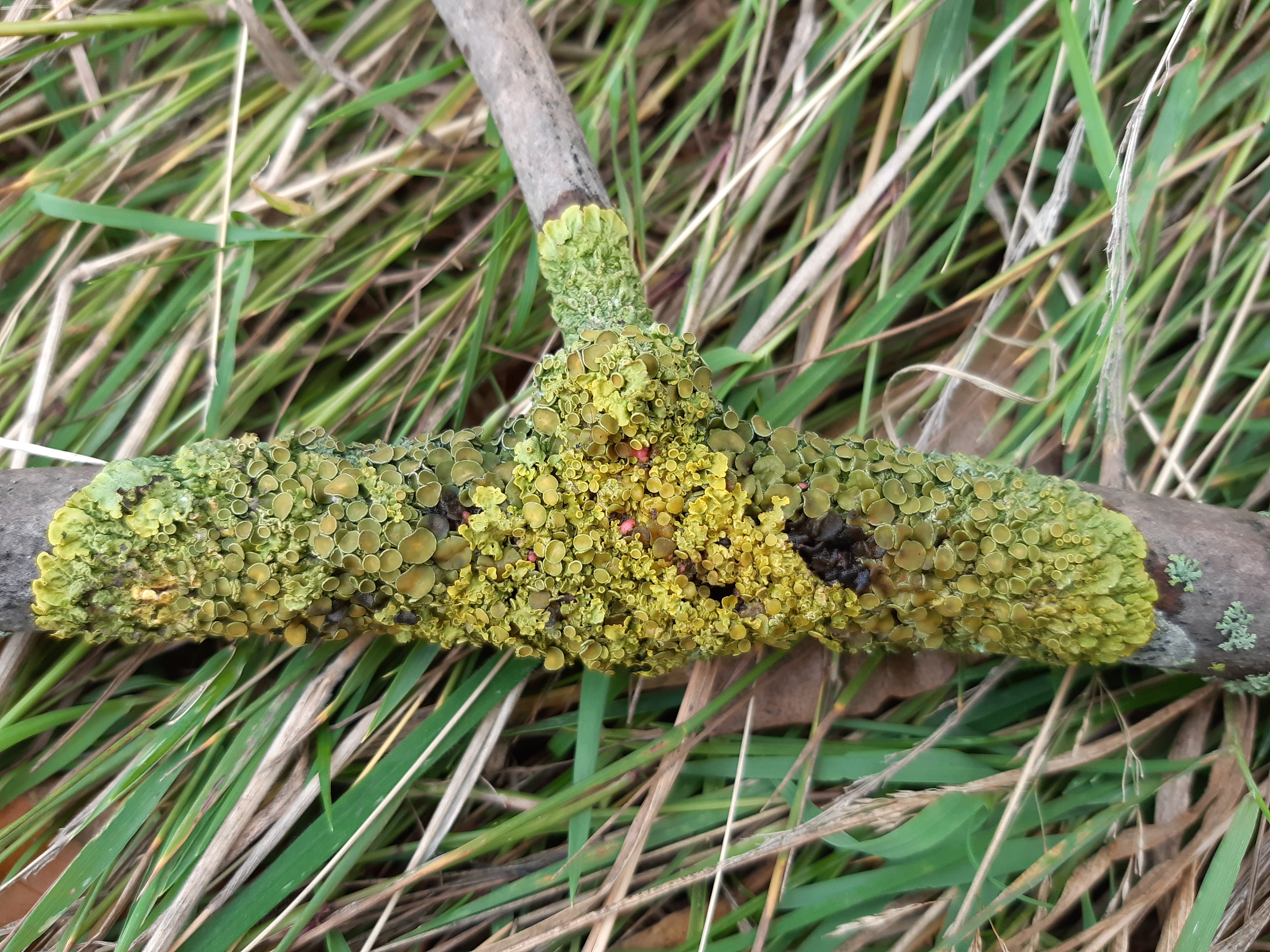
X. parietina is a bright yellow or orange colour where it receives decent sunlight and is often quite eye-catching. In shady conditions it is a more green or greyish shade. In mature specimens, disc-like fruiting bodies called apothecia are present in the centre of the thallus. Apothecia produce and disperse the spores of the fungal lichen partner. They are roughly circular, though often crowded together, and yellow inside, paler along the edges.
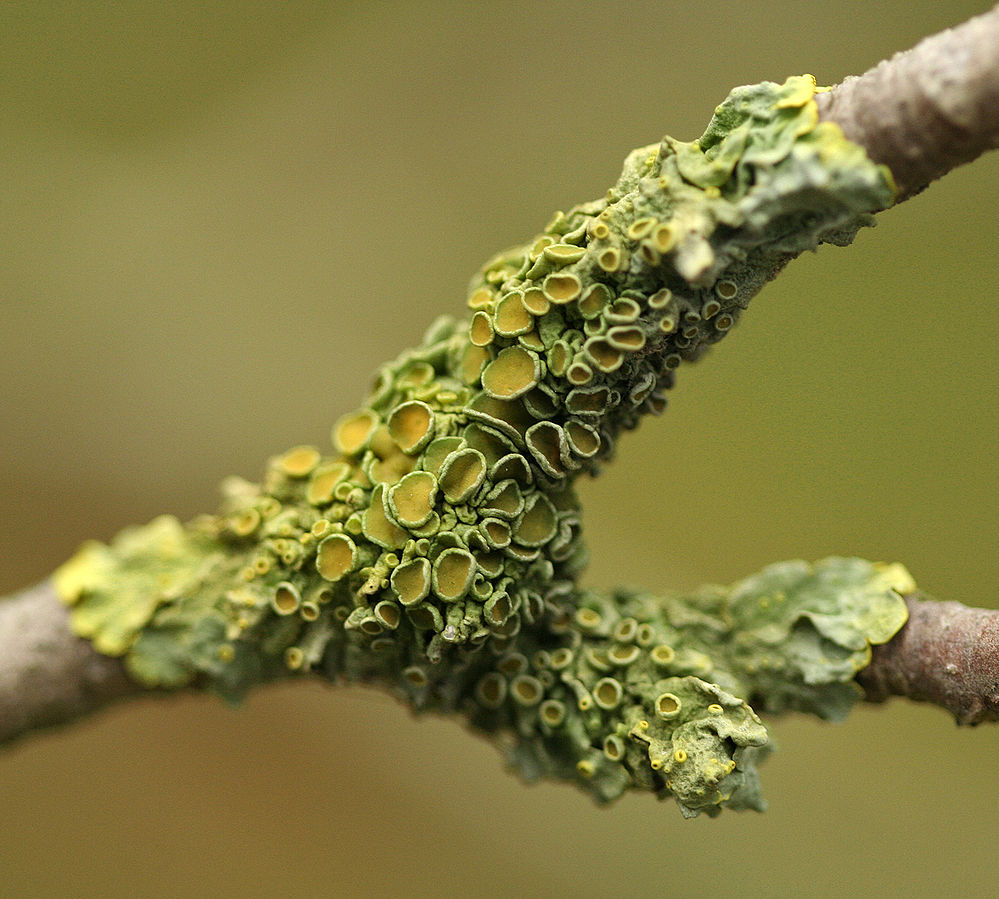
The compounds found in lichens often change colour as they react with certain chemicals and spot testing with chemicals is a recognised method of lichen identification. If a drop of potassium hydroxide (KOH) solution is dripped onto Xanthoria parietina, it will change to a deep crimson/purple colour.
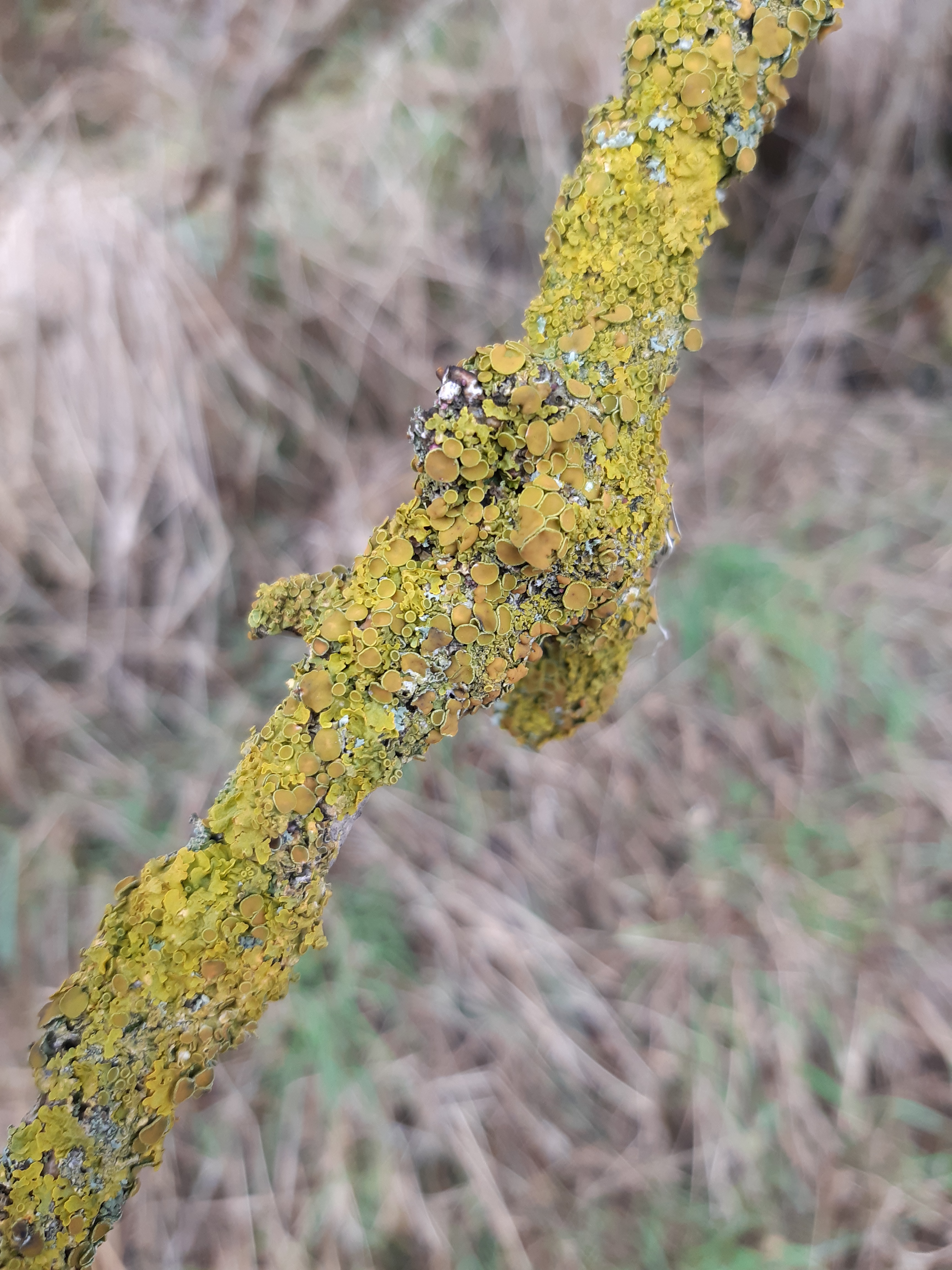
This lichen is found across the UK and Ireland, as well as further afield. It actually has a wide distribution across the world, being found across Europe, in parts of Africa, in North and South America and in Australia.
It grows in a range of habitats, from the coastal to the countryside to urban areas. It grows on a range of rocks, on tree branches and on walls and roofs. On the coast it can form an orange band above the tideline. It can often be spotted on Sambucus nigra (elder) and Fraxinus excelsior (ash) branches, especially visible in winter.
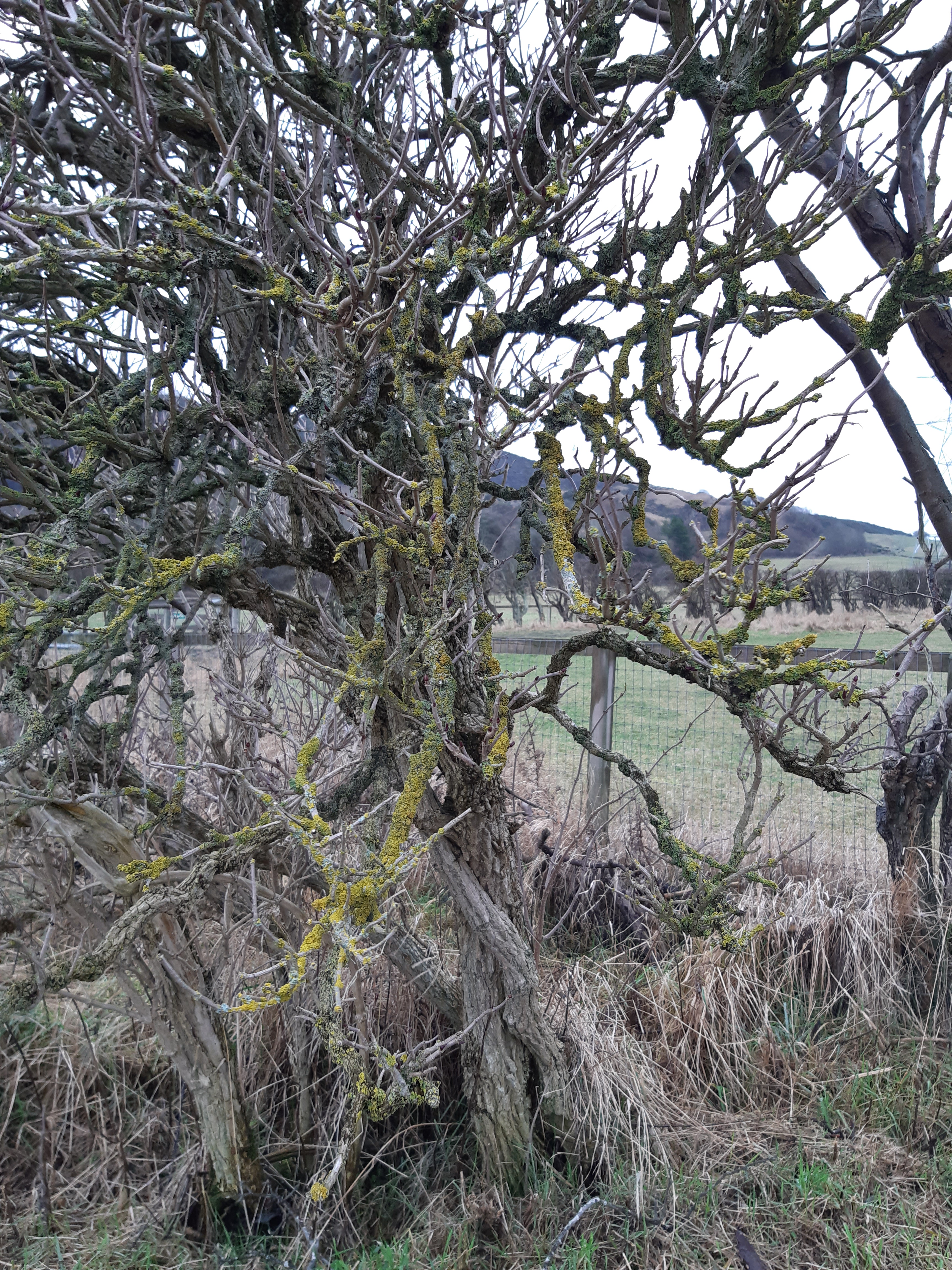
Lichens as a group are very sensitive to changes in their environment, especially to air pollution, and they are used as bioindicators: species that indicate the state of and changes in the environment. Many lichens are affected negatively by air pollutants like sulphur dioxide and nitrogen compounds. X. parietina tolerates higher levels of nitrogen than many lichens and is therefore able to survive in areas where other lichens could not, hence its presence in urban areas. In fact, it seems to thrive in high-nitrogen conditions and is often found on tree branches and rocks where birds perch and enrich the substrate with their droppings.
The photobionts (the photosynthetic partner in the lichen symbiosis) are green algae in the genus Trebouxia. At least two Trebouxia species have been identified in X. parietina. Although the fungal partner makes and releases spores via the apothecia, the algal partner does not have a similar dispersal means. It is thought that mites which feed on the lichen may disperse the algal and fungal cells in their faeces.
Trebouxia species cells. Image: Trebouxia 2 by Miguel Varona, CC BY 3.0, via commons.wikimedia.org.

Lichenicolous fungi are fungi that specialise on parasitising lichens. X. parietina hosts several species of lichenicolous fungi, including the pink Illosporiopsis christiansenii, pictured below.
Lichens are known to produce many different compounds, several of which are unique, not found in other groups of organisms. X. parietina produces parietin, the substance which gives it its yellow-orange colouration. This compound may protect the photosynthetic partner cells from UV radiation in sunlight. Parietin production does seem to be linked to sunlight, with shaded specimens not producing the bright colours, and a study on seasonal variation in parietin production showed that there was a distinct variation in the levels in the lichens throughout the year, with more produced in summer than winter.
Parietin has potential antibacterial activity and other medicinal action. It also yields an interesting dye, which starts off pale pink and turns to a pale blue on exposure to sunlight. You can see some examples of this process here: History Science Fiber.
References
– Dorset Nature, n.d. Teloschistaceae Xanthoria parietina [online] Available at: http://www.dorsetnature.co.uk/pages-lichen/lch-17.html
– Gauslaa, Y and McEvoy, M, 2005. Seasonal changes in solar radiation drive accumulation of the sun-sreening compound parietin in the lichen Xanthoria parietina. Basic and Applied Ecology, Volume 6, Issue 1, 27 January 2005, Pages 75 – 82, https://doi.org/10.1016/j.baae.2004.10.003.
– iNaturalist, n.d. Common Sunburst Lichen [online] Available at: https://www.inaturalist.org/guide_taxa/1412658.
– McDonnel, Z, 2021. Xanthoria parietina lichen (No heat) [online] Available at: https://www.historysciencefiber.com/blog/xanthoria-parietina-no-heat.
– Meier, F. A, Scherrer, S and Honeggar, R, 2002. Biological Journal of the Linnean Society, Volume 76, Issue 2, June 2002, Pages 259–268, https://doi.org/10.1111/j.1095-8312.2002.tb02087.x
– NatureSpot, n.d. Xanthoria parietina. [online] Available at: https://www.naturespot.org.uk/species/xanthoria-parietina.
– Paul, H. and Knight, S, n.d. Xanthoria parietina[online] Available at: https://britishlichensociety.org.uk/resources/species-accounts/xanthoria-parietina.
– Tyler-Walters, H. 2008. Xanthoria parietina Common orange lichen. In Tyler-Walters H. and Hiscock K. Marine Life Information Network: Biology and Sensitivity Key Information Reviews, [on-line]. Plymouth: Marine Biological Association of the United Kingdom. [online]. Available at: https://www.marlin.ac.uk/species/detail/1798.
– Wikipedia, 2022. Xanthoria parietina. [online] Available at: https://en.wikipedia.org/wiki/Xanthoria_parietina.
– text and images (unless otherwise attributed) by Heather Forbes