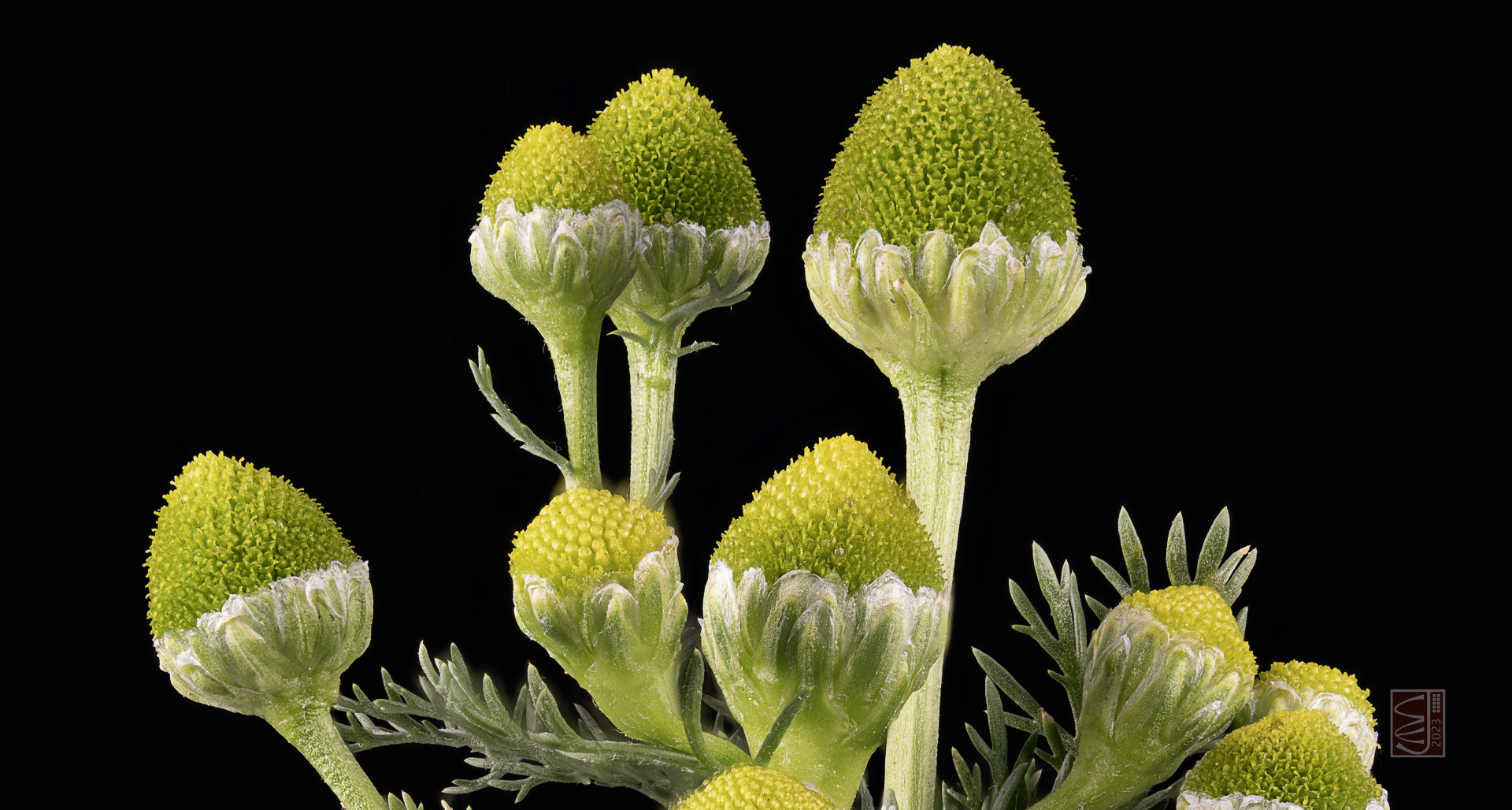
Matricaria discoidea – 31st October 2022 – Pineapple Weed
This is the most widespread and easily recognised of all the alien plant species in the British Isles. It’s in the daisy family (Asteraceae) but unlike most daisies it lacks the showy ray-florets that are so important as visual cues for pollinating insects. Think of a common daisy flower with its ‘petals’ stripped off, with just the disk-florets remaining.
It has several names. Some people call it the Rayless Mayweed, and many still use one of the older Latin names: Matricaria matricarioides or M. suaveolens.
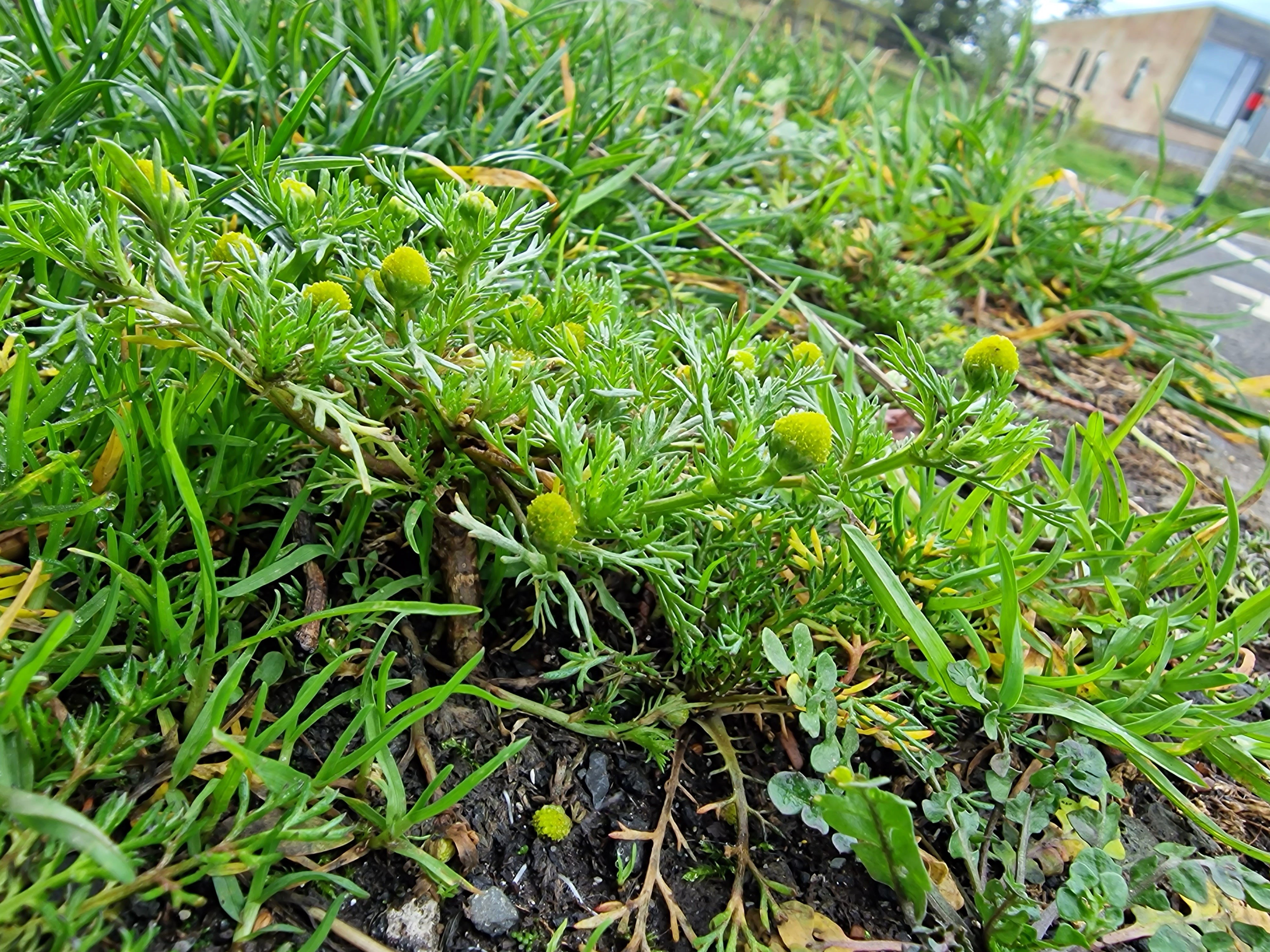
Worm’s-eye view of a single plant growing by the roadside in an urban setting. Photo: John Grace
In summertime you will find it along almost any well-used footpath, by the roadside or at the farm gate. It flourishes on waste ground. It tolerates soil compaction very well. It is also found at the edges of arable fields but never in shade. It’s an annual, taking 6-12 weeks from germination to flowering. The pineapple-shaped flowers appear in early summer and last until now (late October). The name Pineapple Weed comes from the shape of its flowers and also from the smell. Crush it and see – get a whiff of pineapple or at least an exciting fruitiness.
It came to European botanic gardens from North America in the mid 19th Century, but as with many alien species it ‘escaped’. In Britain, it escaped from Kew Gardens and was recorded ‘in the wild’ in 1869 according to Stace & Crawley (2015). There may have been other routes: its entry to western Ireland was blamed on the importation of maize from North America to feed poultry (Colgan and Praeger 1899).
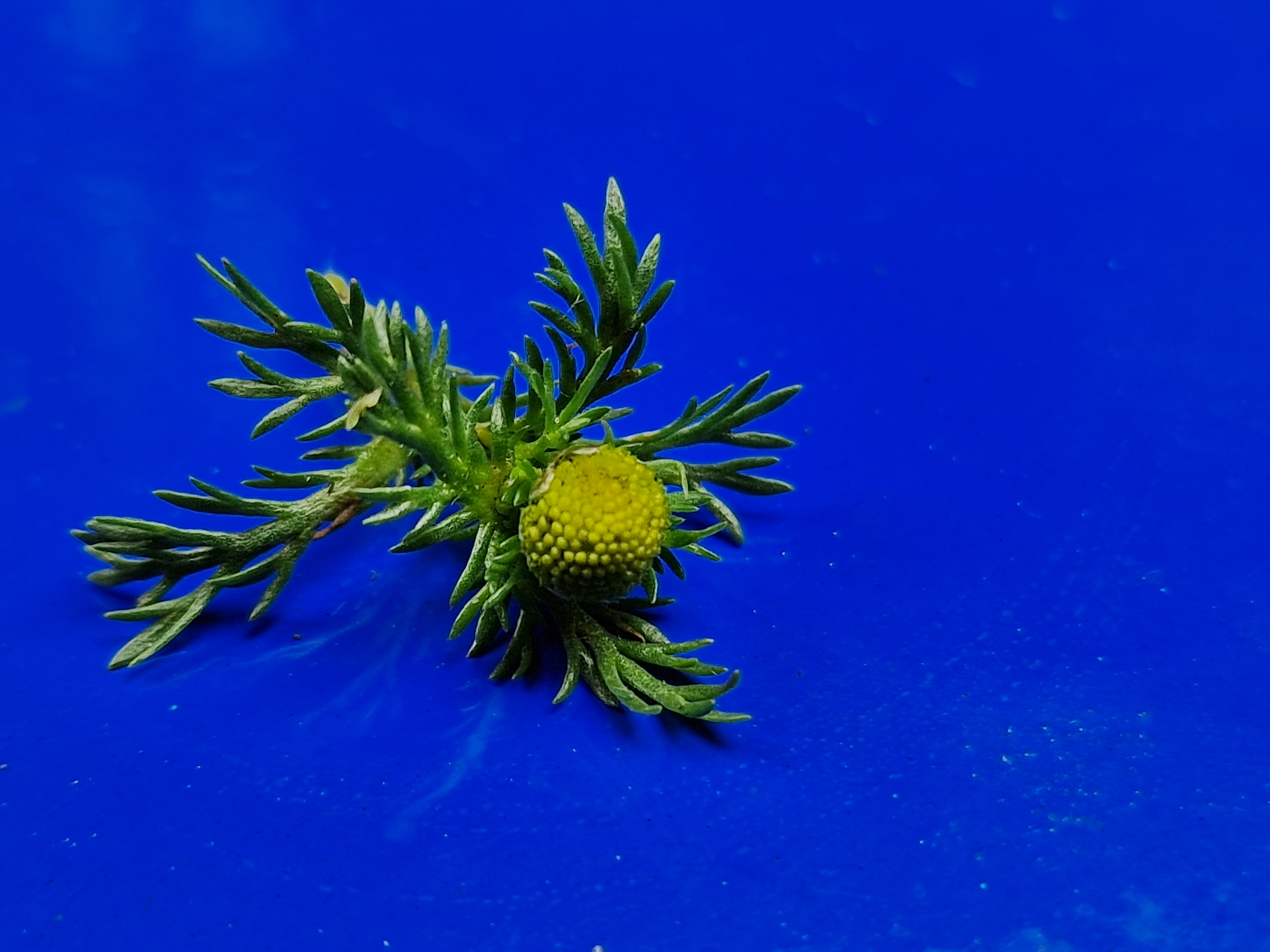
The pineapple-shaped flower-head with its many yellow florets. Leaves are fleshy. Photo: John Grace
But North America may not be its country of origin. Some authorities say it originated in Asia, spreading to North America at some earlier date. The Royal Botanic Gardens Kew are however of the opinion that its native land is indeed North America. Where is the evidence? I am not sure, but they do have an early herbarium specimen of the plant collected from California in the year 1846. You can view the actual specimen here.
Salisbury (1961) writes engagingly about its British history. It had spread slowly to several English Counties, Scotland and Ireland before 1900, but in the next 25 years it increased explosively and became common. He suggested this is because motoring became a popular pursuit, and, as the roads in those days were little more than muddy tracks, the seeds stuck to the rubber tyres, thus hitching lifts. Modern research involving washing the mud from random car tyres supports this idea: the most common species in the car-borne seed banks in Yorkshire were Plantago major, Poa annua, Poa trivialis, Urtica dioica and Matricaria discoidea (Hodkinson and Thompson 1997). All of these plants can be found by the side of most British roads.
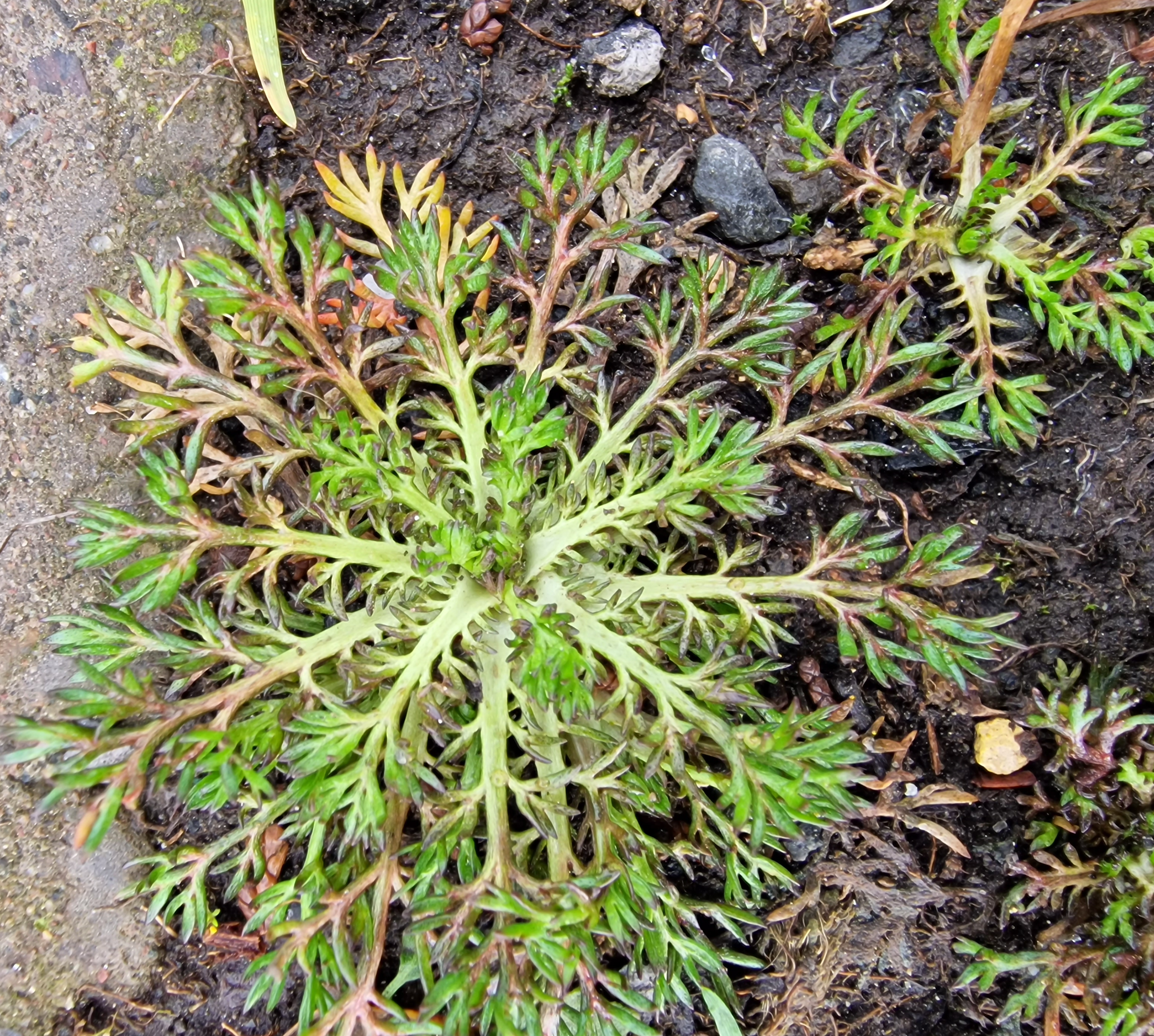
Young plants in October. They should survive the winter and flower in early summer. Photo: John Grace
Others think it spread long-distance on the feet of migrating birds (Sauer JD 1988, Stace & Crawley 2015). Such flights could have brought it to North America from Asia (or vice versa, who knows?).
I can find rather little about its floral biology. It is said to be rarely visited by insects (though it sometimes gets infested with bean aphid Aphis fabae) and so I am guessing that its sweet smell is offensive to most insects and that it must therefore rely on self-pollination. Considering its importance as a weed in arable fields, relatively little basic biological research (physiology, genetics) has been done (see Bond et al. 2007). It has developed resistance to some commonly-used herbicides, a feature of several of the common ruderal species.

Three individual florets taken from a flower-head. On the left is the achene (the fruit that contains the seed), on the right is the floret with 4-lobes (=petals). Attribution: Stefan.lefnaer, CC BY-SA 4.0 https://creativecommons.org/licenses/by-sa/4.0, via Wikimedia Commons.
Flowering is induced by the long days of summer and many seeds are usually formed – up to 7000 per plant but usually far less. These seeds need exposure to light for germination, but if they become buried a few can still germinate after 5 years. In autumn, young plants can be seen as rosettes – these will survive winter and produce lush green growth and the first flowers in early summer of the next year.
Most of the research I found on the Web of Science and Google Scholar is about its chemistry – especially essential oils and possible pharmaceutical compounds. It has plenty of both.
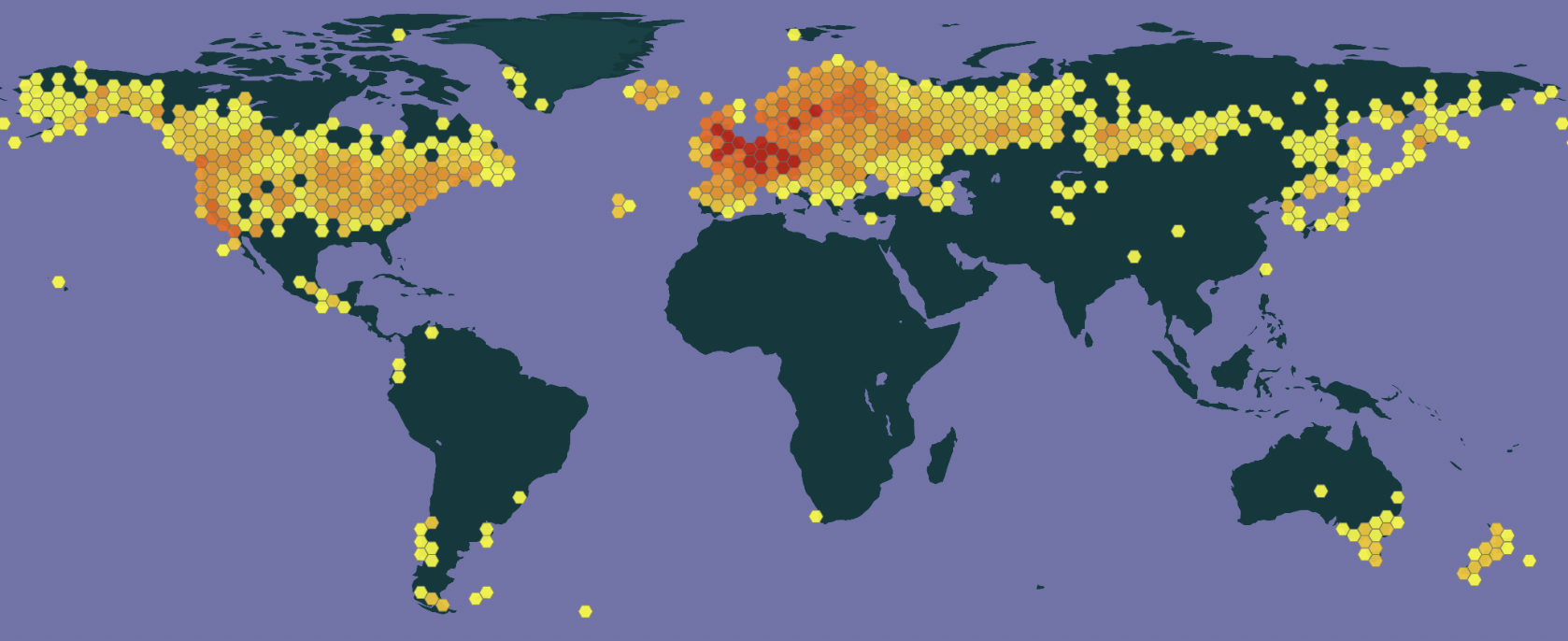
Global distribution of Pineapple Weed according to GBIF. Note its presence in Australia, New Zealand and several South American countries.
I was surprised to discover that this species was used by indigenous North American people as an insect repellent. Modern research confirms its efficacy (Cantrell et al 2018). The active constituent is α-terpineol, a common ingredient of perfumes and cosmetics, and one of the aromas of lapsang souchong tea (from the pine smoke used in curing the tea). I was reminded that one well-known skin cream in Europe today is mainly sold to campers and hikers because someone accidentally discovered it repels midges – perhaps it contains α-terpineol or an extract of pineapple weed.
It has many medicinal uses according to reports summarised by these people. They say:
“Taken as an infusion for stomach pains and gas. Laxative. Infusion of herb used for upset stomach or menstrual cramps. The tea [flowers] is reputed to be soothing for a cold and helps aid digestion and calm an upset stomach. Used as a leaf poultice in a case of severe boils on the neck. Unspecified part topically is a mild but effective anti-inflammatory agent”.
However, I would never vouch for any herbal remedies (that would be way beyond my professional expertise) but I am encouraged to do some foraging and make tea (like chamomile tea) and perhaps add it to soups. At the web site https://wildplantguides.com/2021/04/27/foraging-pineappleweed-matricaria-discoidea/ we learn that you can use chopped leaves as a tasty addition to salads and ‘try infusing sugar syrups, custards and cream with the flowers’. I will, and perhaps a cordial would be nice. But harvesting plant material well away from places where dogs and cars deposit pollution might be a challenge.
References
Bond W (2008) The biology and non-chemical control of Pineappleweed (Matricaria discoidea DC.) from the Gardening Organic website downloadable here.
Cantrell CL et al (2018) Isolation and identification of mosquito biting deterrents from the North American mosquito repelling folk remedy plant Matricaria discoidea. Plos One oi: 10.1371/journal.pone.0206594
Colgan N and Preager RL (1899). Matricaria discoidea in Western Ireland. The Irish Naturalist 8, 221-223.
Hodkinson DJ and Thompson K (1997) Plant dispersal: the role of man. Journal of Applied Ecology 34, 1484-1496.
Salisbury E (1964) Weeds and Aliens, 2nd edition. Collins.
Sauer JD (1988) Plant migration: The dynamics and geographic patterning in seed plant species. California University Press.
©John Grace