Plant of the Week, 14th November 2022: Mind-your-own-business (Soleirolia soleirolii)
Here is a plant we could not identify when we first saw it in Edinburgh in 2016. Growing on a pavement and without flowers, it offered no clue to its identity. The conversation went something like this: “A speedwell perhaps? Are you sure it isn’t a leafy liverwort? Could it be a willow-herb?” This sort of thing does happen on urban walks, and we sometimes just say to ourselves, “walk on by”. But this plant intrigued us all by its growth habit. It was a tight mass of tiny green leaves that seemed to flow, like green porridge. Eventually, after much page-turning through illustrated floras, someone said “Mind-your-own-business”. It took only a few seconds to realise that this was not a rude comment but the name of a plant.
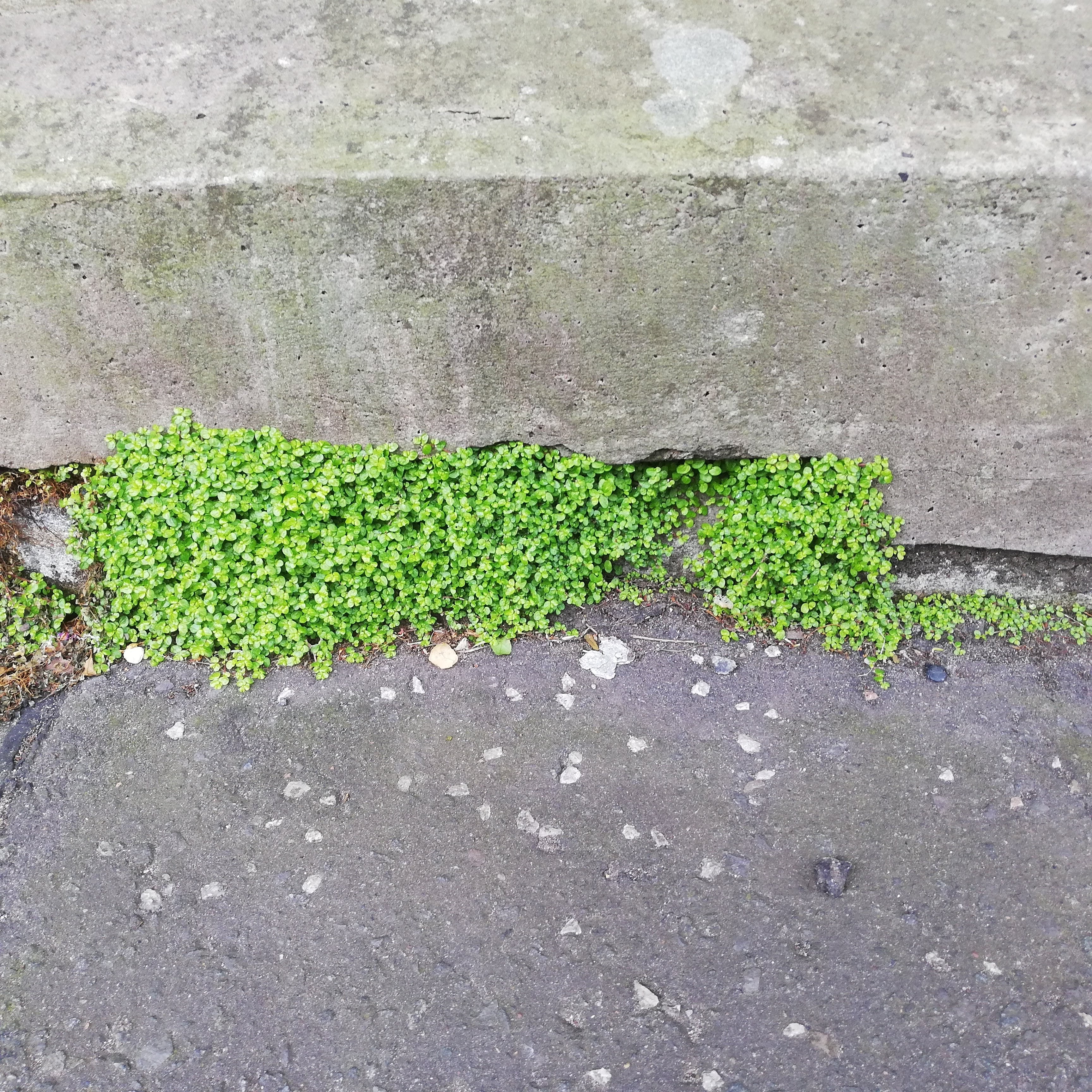
A cushion of Soleirolia soleirolii seen by the side of pavement in Edinburgh. Photo: John Grace.
The plant is native to Corsica, Sardinia and the Balearic Islands. It was first cultivated in Britain in the year 1905 as a promising rock-garden plant, admired for its habit of growing rapidly over rocks, giving them a soft, bright green, appearance.
The tight mat of plant material is made up of many interconnected strands each bearing kidney-shaped leaves (diameter is a few mm) as shown in the painting below by Mary Eaton.

The old name of the species is Helxine soleirolii, as shown here (Public domain, via Wikimedia Commons). The artist, Mary Emily Eaton (1873 – 1961), was a botanical illustrator from Gloucester, England. She worked at the New York Botanical Garden (1911-1932) where she was the principal illustrator for the Garden’s journal Addisonia, but she lost her job because of the Great Depression and returned to England in 1947.
It had been collected a few years earlier in Corsica by Henri-Augustin Soleirol a French military engineer with a keen interest in Botany and the Arts. He had a brother, Joseph-Francois Soleirol, also a military engineer, and it seems that these two young men were more interested in wild flowers than in their army work. Until recently it was thought that the plant collector was the elder brother (Joseph-Francois) but recent research credits the younger man (Henri-Augustin) with this and about 5000 other species (see Bungener and Jeanmonod 2019).
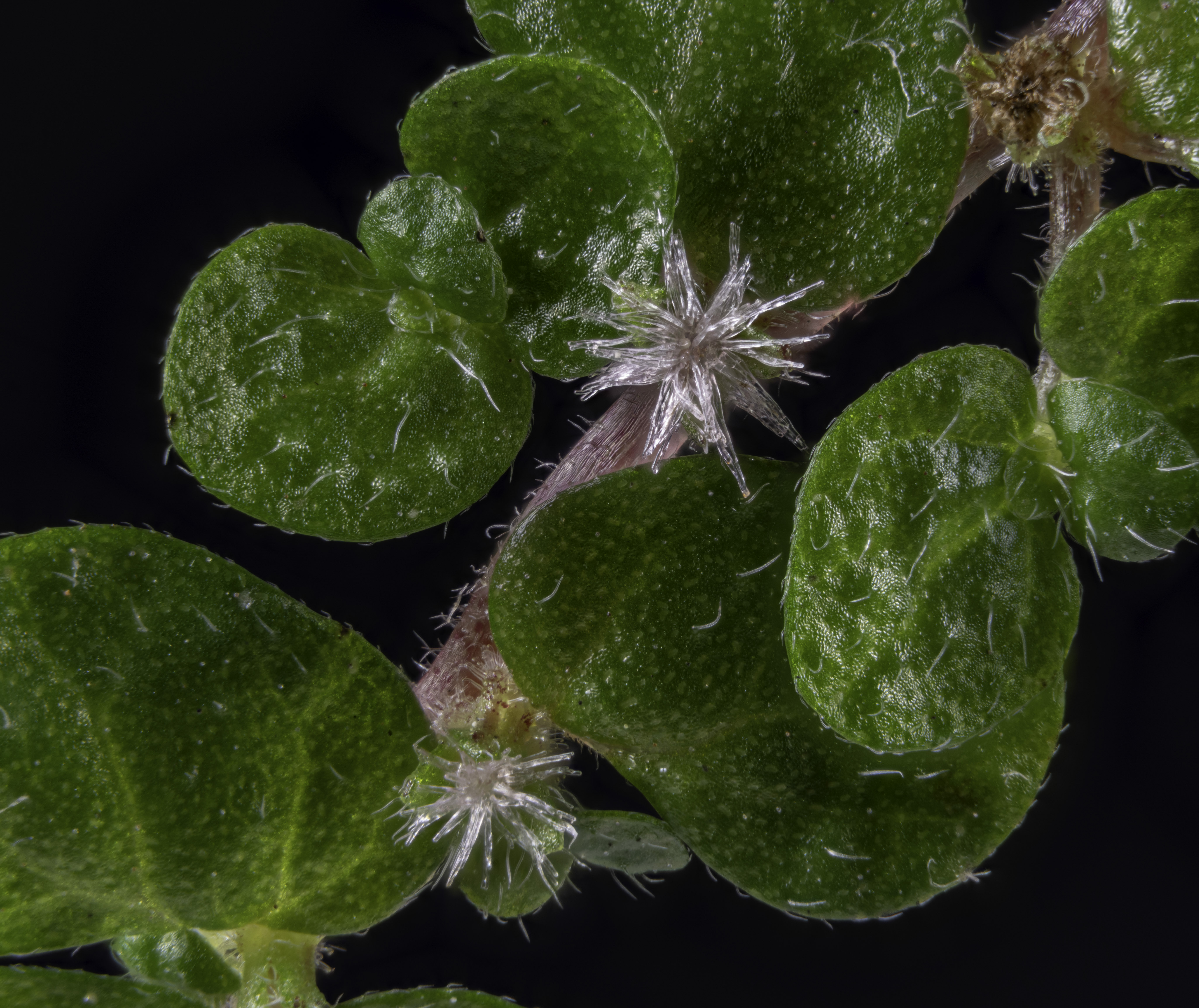
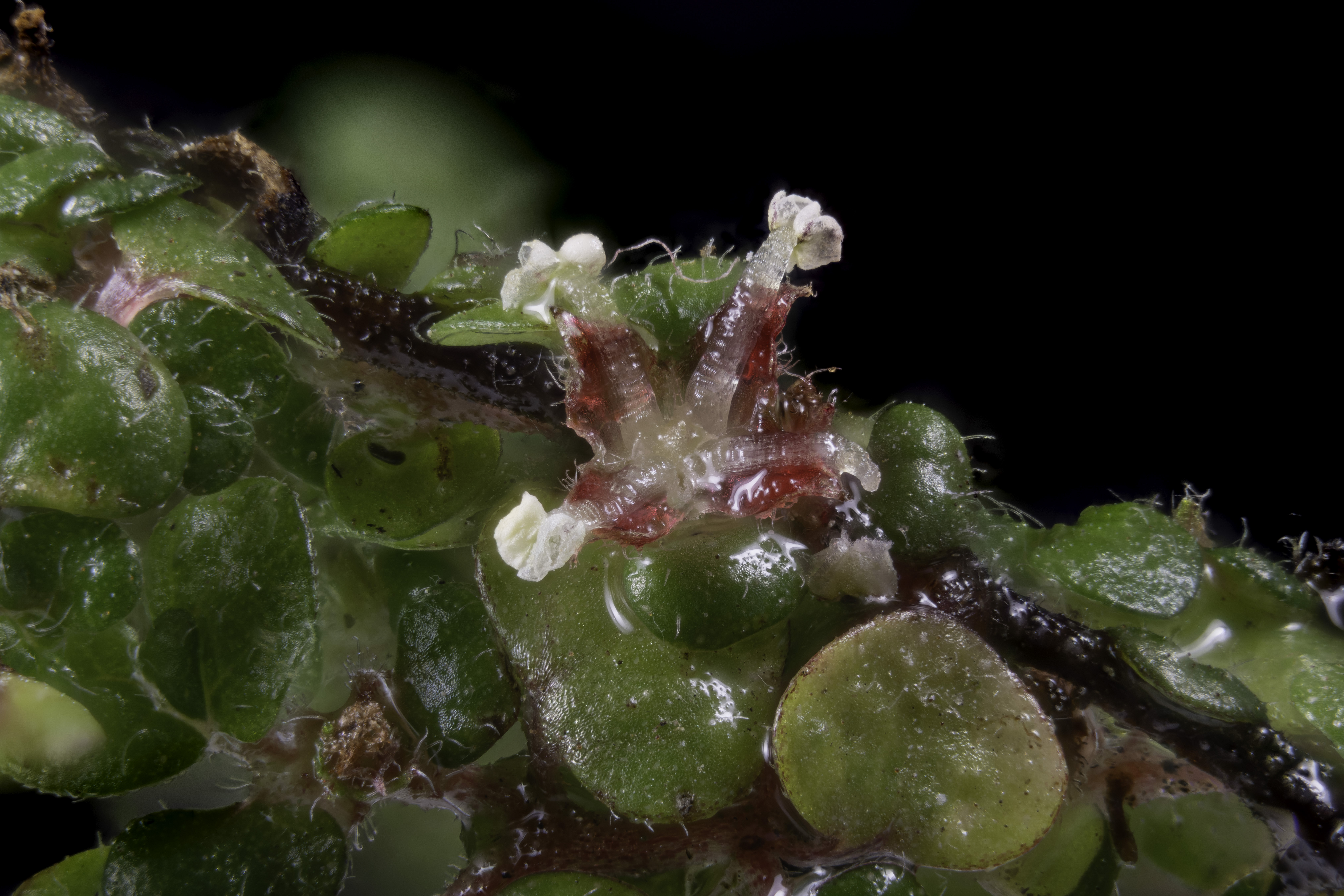
Flowers of S. soleirolii. Left: female, right: male.The image also shows that the leaves have trichomes. Photos: Chris Jeffree.
It belongs to the stinging nettle family (Urticaceae) although it looks quite unlike Urtica dioica and it certainly doesn’t sting. We featured it in a blog two years ago, demonstrating the tiny flowers which can be either male or female. You can view that blog here. Roots are formed on the trailing stems and so a small broken-off piece can root elsewhere. The species is uncommon in Scotland, although it may be spreading: I’ve seen quite a lot in Edinburgh and also in South Ayrshire. In these locations it occurs mostly as a garden weed which ‘spills’ from gardens onto pavements. I expect it is carried around inadvertently on muddy boots and also in operations involving the transport of garden soil and flower pots from one place to another. I could find rather little about its ecology – but there is much blogging by gardeners about its invasive tendency, and the difficulty some people have when trying to get rid of it.
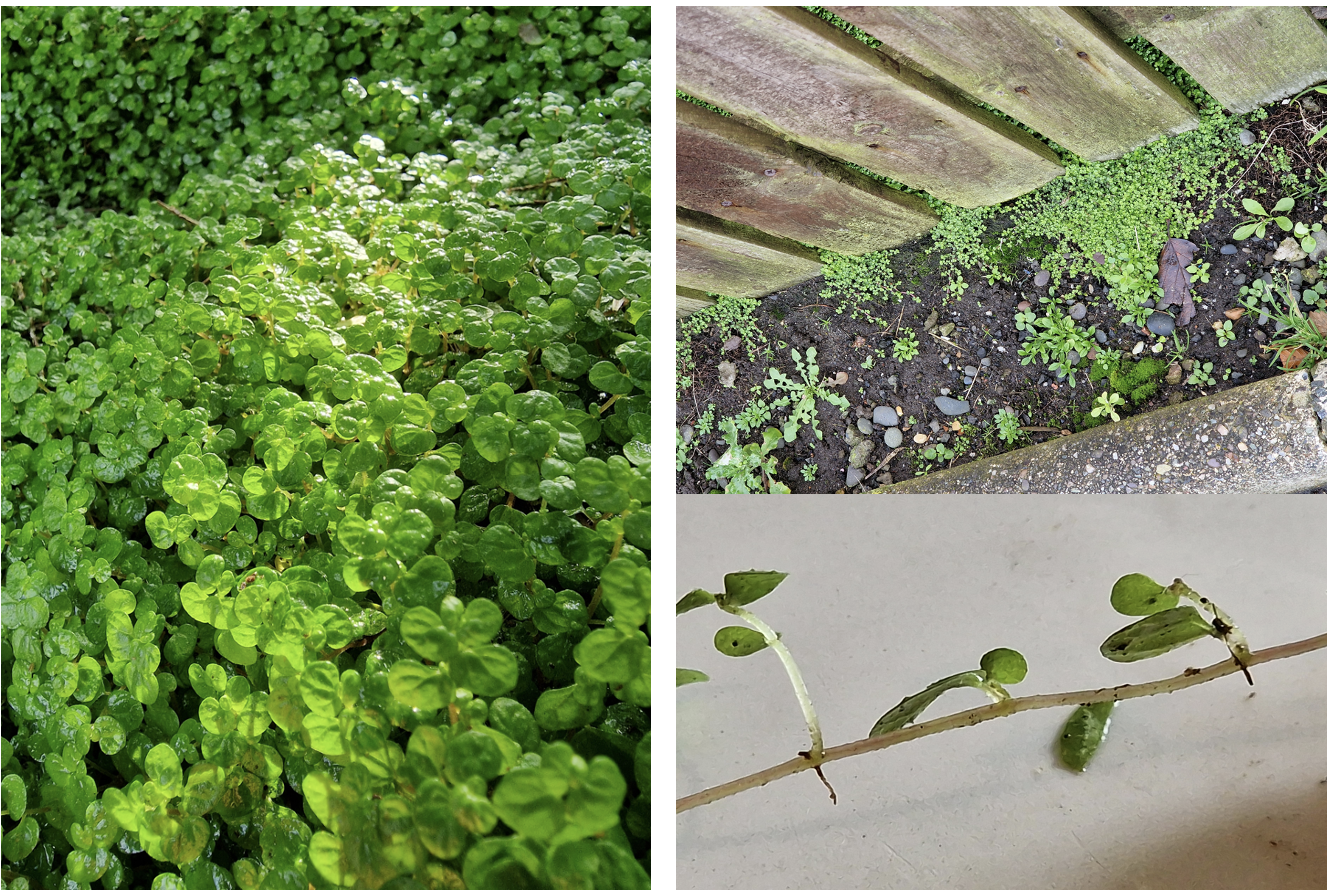
Images of the plant in Ayrshire. Left: canopy structure in dappled shade, upper right: an example of an ‘escape’ from someone’s garden (creeping under the fence), lower right: showing the roots developing on the trailing stem. Photos: John Grace.
It seems ‘shy to flower’ in Scotland. I haven’t seen its flowers yet, but others have (see the photographs). I’m reliably informed that it flowers every year in Cambridge and it seems rampant in London according to this report. I suspect Scotland is close to the limit of its cold-tolerance (though it has been recorded in Shetland). More work is needed to understand the geography of flowering, and indeed the genetics of this species. Might the British and Irish plants be one enormous clone? I’ve been wanting to visit Corsica for some time and perhaps I can find a molecular geneticist to organise a group visit!
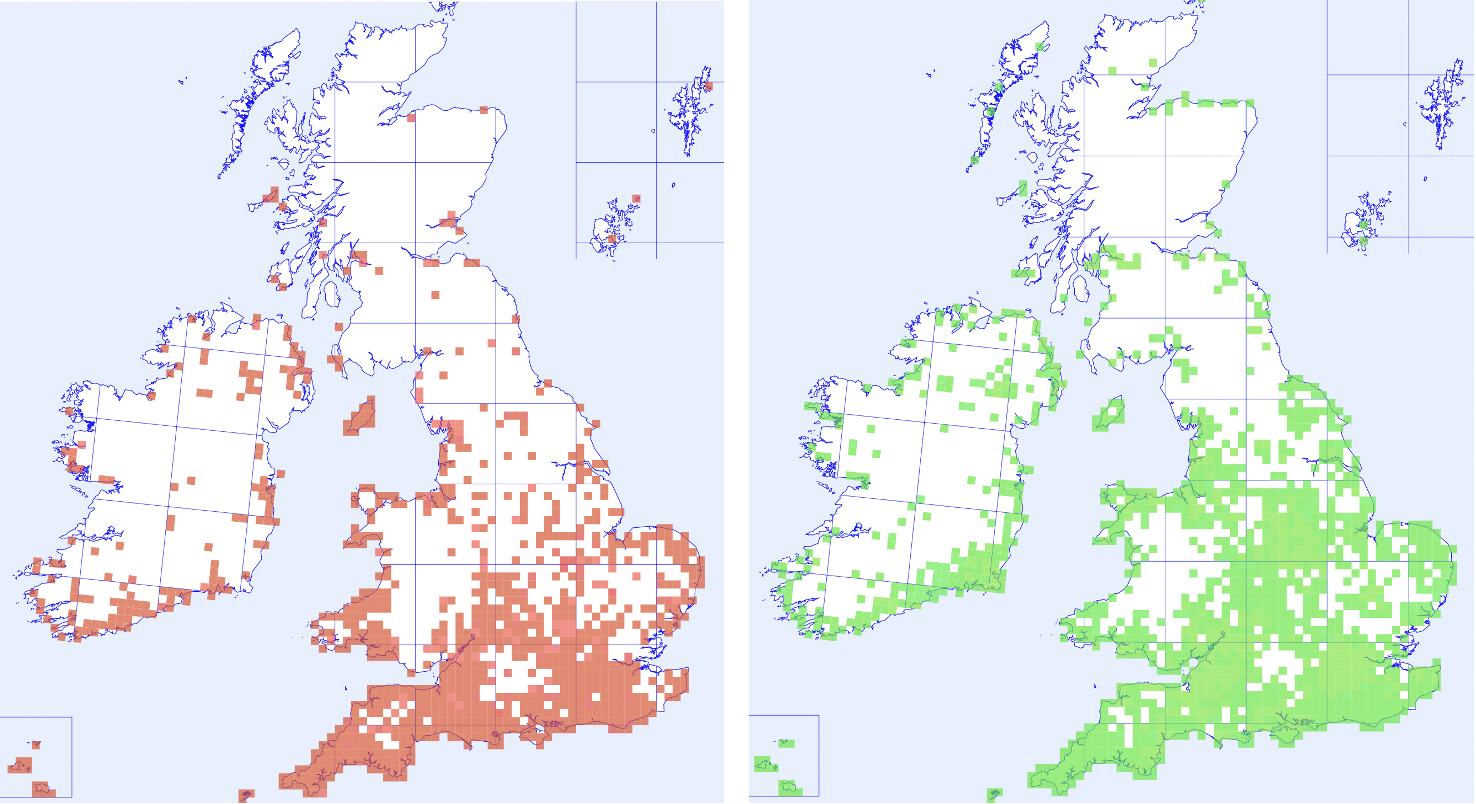
Distribution of Soleirolia soleirolii before the year 2000 (red, on the left) and after 2000 (green, on the right). Drawn using the BSBI maps data base.
In Britain and Ireland it appears to be spreading but only slowly. In the last 20 years it has made advances in Ireland, the English Midlands, Manchester and parts of Scotland.
Is it a ‘threat’ to native vegetation? It grows well in dappled shade, and potentially it could invade woodlands. Yet there is no mention of this species in the recent book Woodland Flowers (Kirby 2020). Once a mat is formed there is no room for annuals, but I would like to see it compete against some of the more tenacious perennials including grasses. I doubt that it is really a ‘threat’, but perhaps a species to keep an eye on.
It is on sale at the Royal Horticultural Society’s web site as an ‘indoor foliage plant’ and 18 other suppliers are currently listed. Yet gardeners have posted angry comments about it (see what turfgrowers have said here and read the harsh words at davesgarden). It may however have some practical value as a component of indoor cooling systems in hot countries (Urrestarazu et al 2011).
It has had many English names: baby’s tears, angel’s tears, peace in the home, bits and pieces, bread and cheese, Corsican creeper, Corsican curse, friendship plant, mind-your-own-business, mother of thousands, Paddy’s wig, and pollyanna vine. The one that has survived best is Mind-your-own-business.
References
Bungener P and Jeanmonod D (2019) The Brothers Soleirol, a centuries-long history of a confusion on a collector in Corsica. Candollea 74, 209 – 216.
Kirby K (2020) Woodland Flowers. Bloomsbury, London.
Pérez Urrestarazu, L et al. (2011). Assessment of the cooling potential of an indoor living wall using different substrates in a warm climate. Indoor and Built Environment 21, 642-650.
©John Grace