Ulmus minor ssp. sarniensis – 23rd January 2023- variously called Wheatley Elm, Guernsey Elm or Jersey Elm
I grew up in the agricultural landscape of lowland England where Elm trees were everywhere: they formed the dense hedges that defined field boundaries; they often stood tall in stately groups to form rookeries, noisy with nesting birds in the spring. Village boys like me honed their tree-climbing skills in the lower branches of Elm trees. Our beloved trees were the English Elm, Ulmus procera, probably descended from those brought to Britain in prehistoric times (or by the Romans) and used to provide foliage to feed livestock or to make boats and provide firewood. But an aggressive strain of the Dutch Elm Disease (DED) appeared in the 1960s and killed most of them.

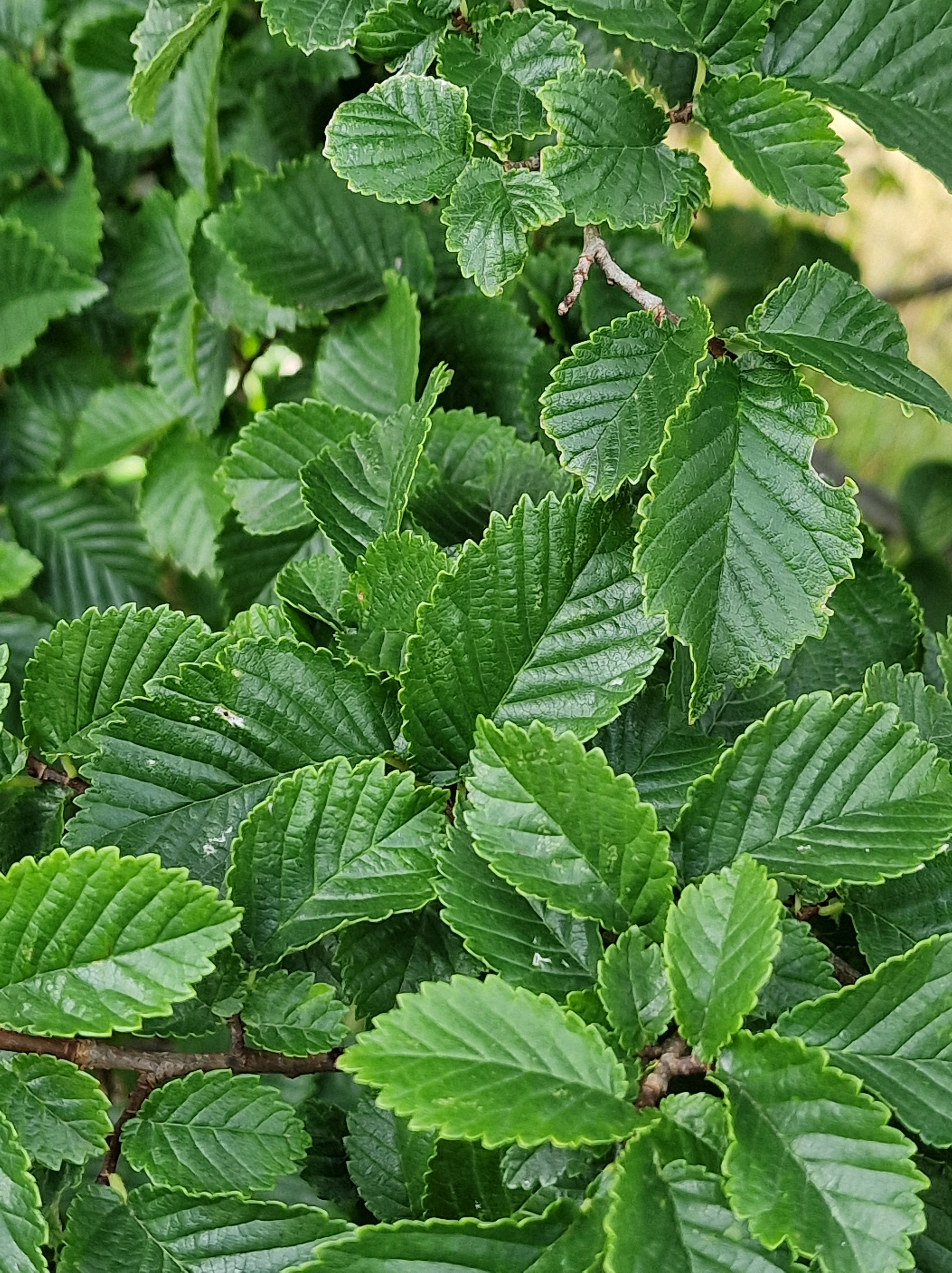
Wheatley Elms, Comiston Road, Edinburgh, by the Braidburn Valley Park and next to the major trunk road (A702) connecting Edinburgh with towns in the south. The trees were planted about 10 m apart in 1933 when the Braidburn Valley Park was created. Photos, September 2022: John Grace.
Later, as a student, I purchased The Excursion Flora of the British Isles (Clapham et al. 1959-1981). Three sorts of elm were recognised – English Elm (Ulmus procera), the Wych Elm (Ulmus glabra) and the Field Elm (Ulmus minor). But a long paragraph follows the description of the Field Elm, beginning “Very variable in habit”, and it explains how some of these variants have been considered as species in their own right. One of them is called the Jersey Elm and given the Latin name Ulmus angustifolia. Many years passed before a consensus on the Elms was reached; in fact, there is still debate. Stace (2019) describes several additional species, and precedes his description of the Elms with a paragraph beginning “an extremely difficult genus, having been interpreted in widely different ways..”. In that Flora, which most field botanists accept as definitive, Jersey Elm emerges as Ulmus minor Subspecies sarniensis, said to be synonomous with Ulmus wheatleyi, a name given in the classic book by William Bean, Trees and Shrubs Hardy in the British Isles, first published over a century ago.

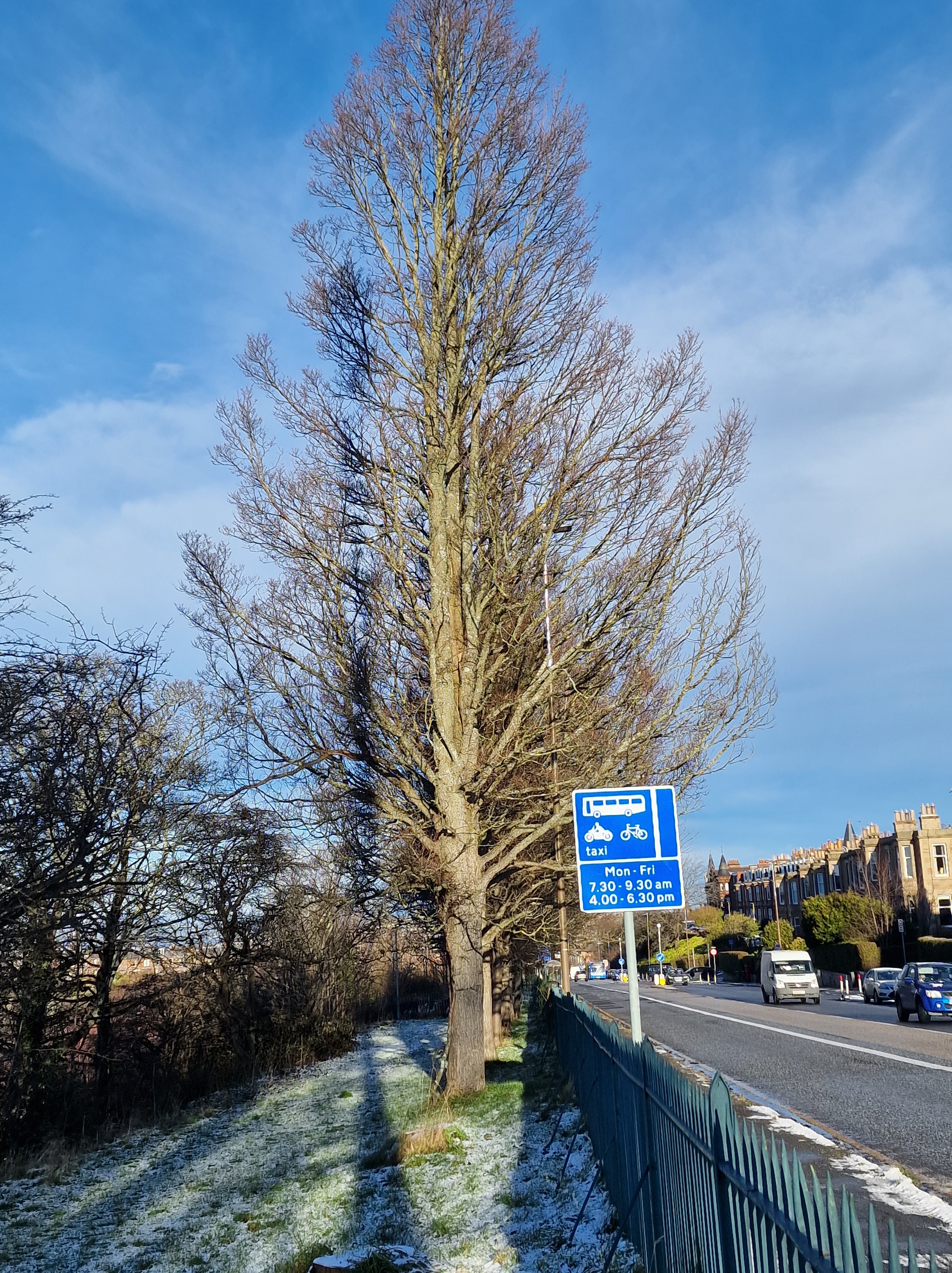
Wheatley Elms, from the Comiston Road group, pictured in January 2023, showing the main trunk extending to the apex of the tree with only light lateral branches, See also the ‘burr’ on the lower part of the trunk of the right-hand tree, a characteristic feature of Wheatley Elm but not always showing. Photo: John Grace.
Much later, living in South Edinburgh, I would often walk past a row of tall trees by the Braidburn Valley Park; they looked a bit like the Elms I grew up with but were more slender. These trees come into leaf very late and hold their leaves into November. I enquired, and a colleague informed me in a hushed and somewhat reverential voice: “they are the Wheatley Elms”.

Some of the trees are ‘missing’ but their stump remains. The stump (right hand image) shows that the bark has been stripped off to curtail further infection by DED. Photos: John Grace.
Curiosity aroused, I started to find out more about these Wheatley Elms.
They are easy to identify in the winter because their trunk does not usually branch – it goes all the way to the apex of the tree, giving the tree a ‘tidy’ conical shape. Coniferous trees are like that, but there are very few deciduous trees that grow in this way. I can only think of Lombardy Poplar. Because of its ‘tidy’ appearance the tree was planted in towns and cities as a street tree.
The tree was first reported in 1815 on Guernsey (the sub-species name sarniensis comes from the Latin Sarnia, the name the Romans used for Guernsey). Some people think the tree came to Guernsey from Brittany in northern France, as a mutant of Field Elm. It does not produce viable seeds and is propagated by cuttings. Researchers Stuart A’Hara & Joan Cottrell at Forest Research in Penicuik carried out DNA fingerprinting of samples from parts of Scotland and the Isle of Man. They demonstrated that all trees were the same i.e. a single clone. Previously, some people had thought there had been more than one introduction, but apparently this is not the case.
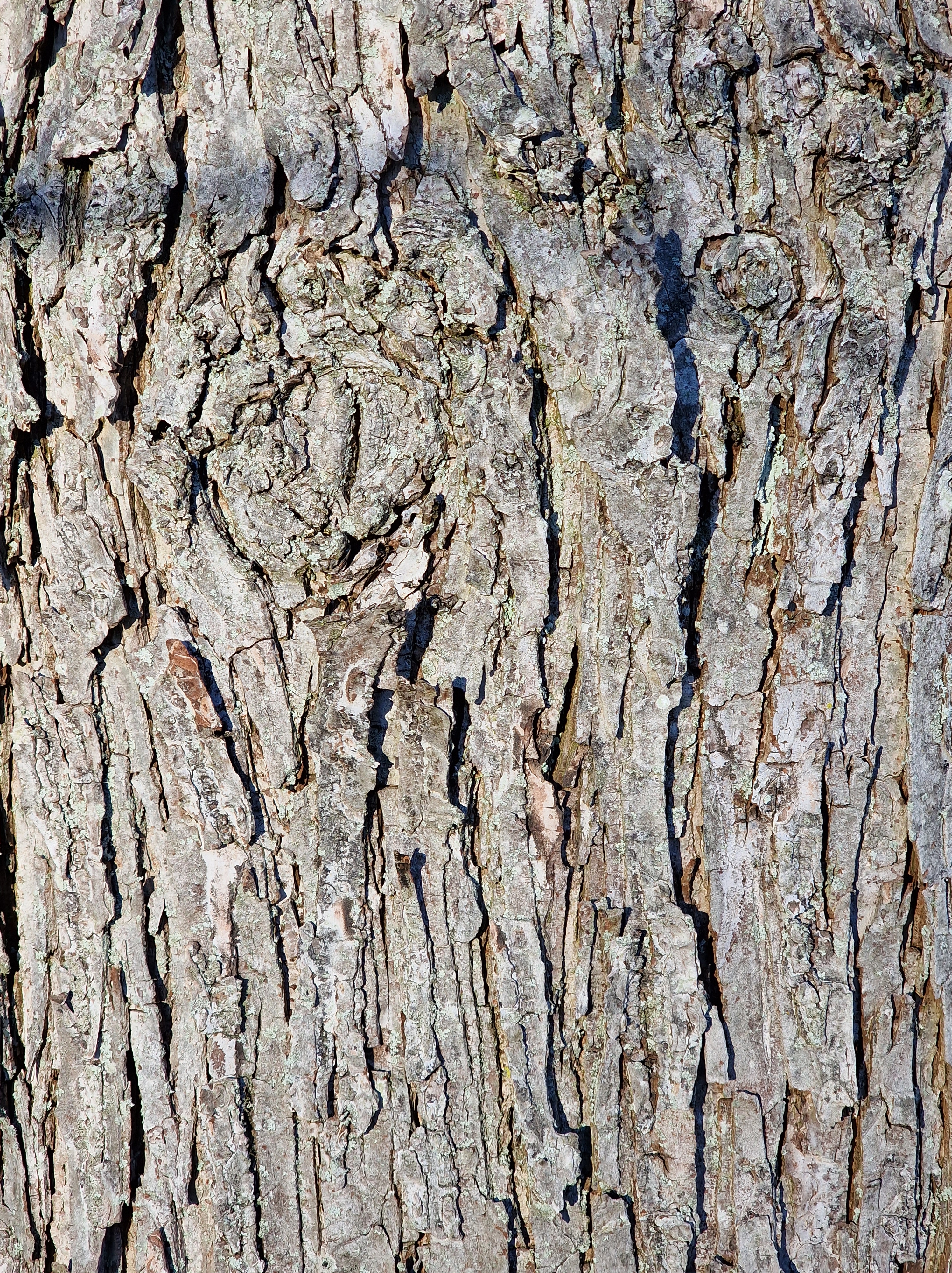
The bark of an old Wheatley Elm tree near the Meadows in Edinburgh (on the south side of Melville Drive). Photo: John Grace.
The history is told in an excellent and highly readable article here by Colin Howes of the Doncaster Museum. The tree was cultivated by Sir William Bryan Cooke (1782-1851) at a place called Wheatley Park in Doncaster (Yorkshire) on the southern banks of the tidal reaches of the meandering river Don. He liked it, and gave plants to his friends, as the landed gentlefolk of those times often did, and the name Wheatley stuck. Eventually, the Wheatley Elm became a favourite with horticulturalists and was commonly planted in city parks and along roads, especially in the Midlands of England. Local Councils realised the tree had great potential – unlike its cousins the English Elm and the Wych Elm it didn’t tend to drop its branches on peoples’ heads or obstruct passing buses or trams. Also it tolerated salt, and so could grow along roads that were heavily salted: the perfect tree for urban planting. There were many in the larger conurbations including in the south of England, Birmingham and Edinburgh.
Stace (2019) lists four subspecies of Ulmus minor, of which Ssp. sarnensis is probably the least common. One of them, Ssp cornubiensis is the Cornish Elm, which has in the past been confused with the Wheatley Elm. By the way, the name Jersey Elm is a misnomer. The tree was first recorded on Guernsey and so it should be called Guernsey Elm (or Wheatley Elm!).
Alas, like other Elms, the Wheatley Elm was ravaged by DED. Some remain, and are watched over by local authorities who remove any that are sick. As the Wheatley Elm is clonal, the trees are equally susceptible. So you might want to enjoy the remaining trees whilst they still survive.
If you live in Edinburgh you may be interested in this quote from the researchers Stuart A’Hara & Joan Cottrell which tells you where you might find survivors:
“The Wheatley elm was once a very popular urban tree and was widely planted in towns and cities across Britain. However, it susceptibility to Dutch elm disease has caused a major decline in its numbers and Edinburgh is now one of its remaining strongholds. Six specimens are present in Princes Street Gardens and the two in Warriston Cemetery are amongst the largest surviving specimens in the UK. The finest avenue of Wheatley elms in Edinburgh however, can be seen in Braidburn Park, along the side of Comiston Road. The elms in the city are carefully monitored and those showing early signs of Dutch elm disease are removed. Unfortunately, two Wheatley elms at the entrance to the Meadows have been felled in the recent past”.
Winter is a good time to investigate deciduous trees; having lost their leaves, the shape and manner of branching is revealed, and the fallen (even decomposing) leaves can usually be rescued from the ground and identified. Moreover, the twigs can be identified using John Poland’s little book (Poland 2018).
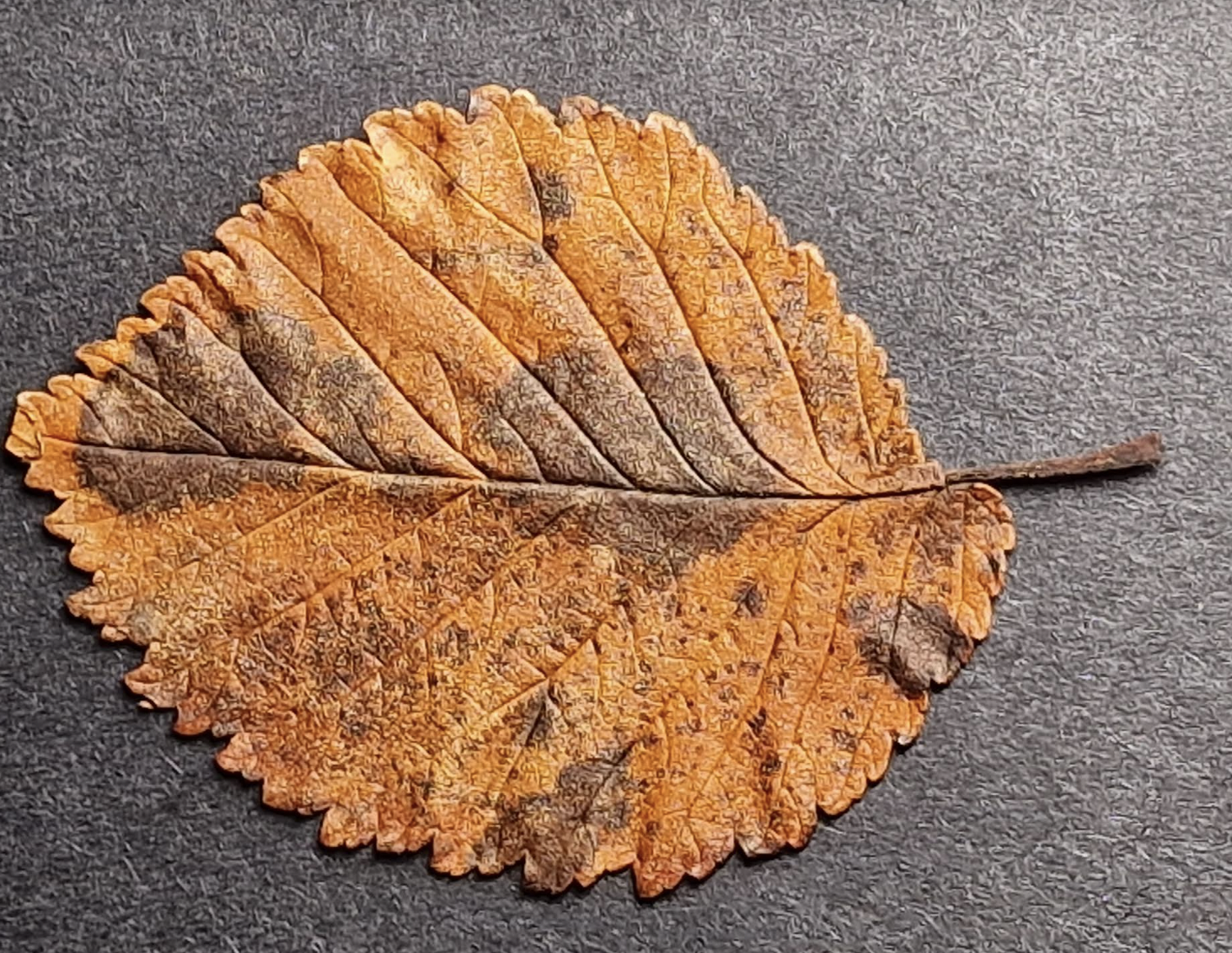
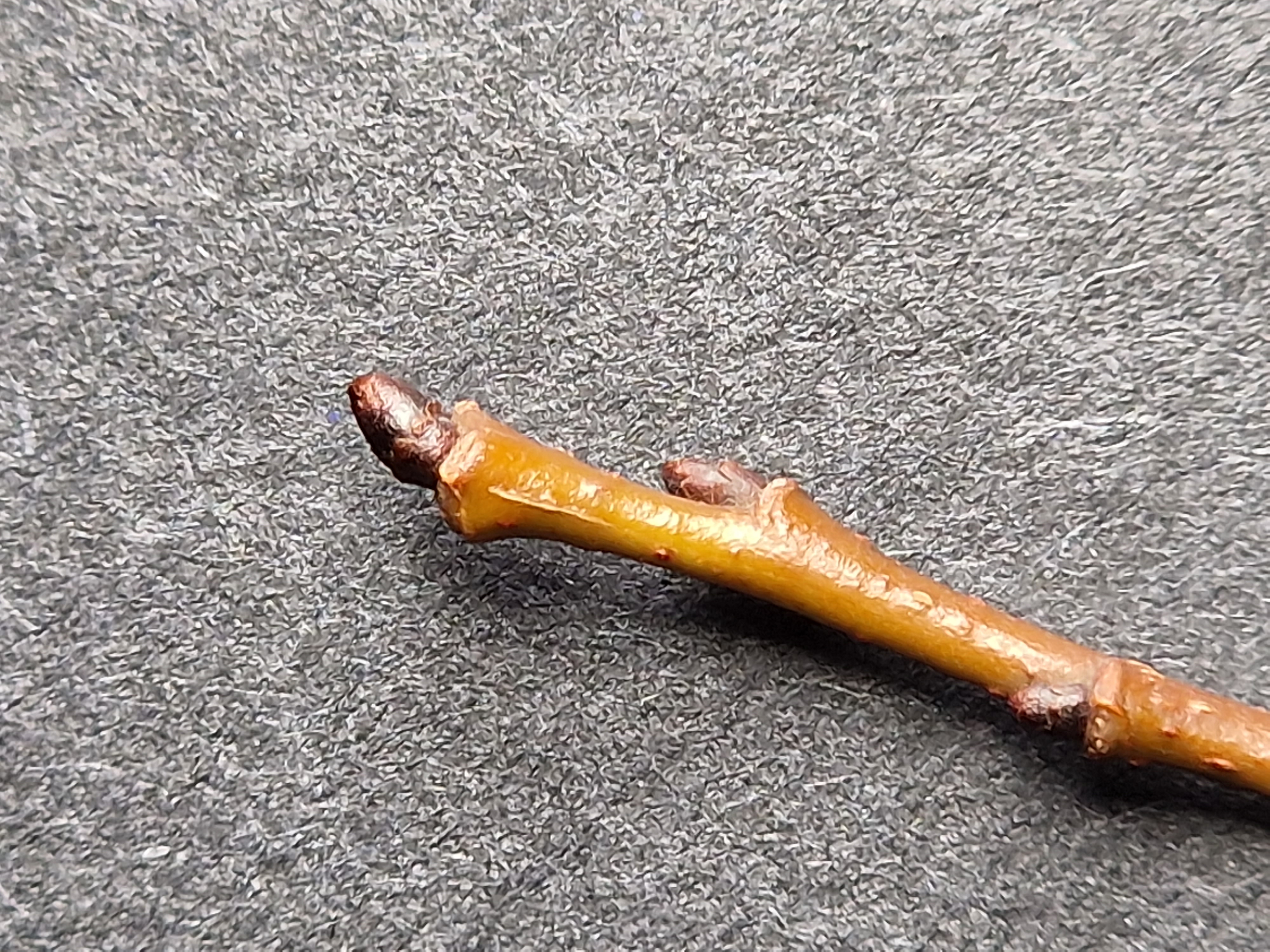
Spotting Wheatley Elm in winter. Leaves can be found on the ground in winter, and the lower branches have live twigs. Taking into account the shape of the tree, identification is easy. Like nearly all Elms, the leaves are asymmetric at the base, but in this case not markedly so. The leaves are smaller than other Elms (6.0 x 4.5 cm) and the twigs and winter buds are slender (1-2 mm). Photos: John Grace.
We hope to return to the Elms later in the year. They include some wonderful trees, and they have served mankind very well. Possibly disease-resistant forms will emerge but we may have a long wait.
Postscript
A few days after launching this blog, a reader pointed out that one of these Comiston Road trees has been marked for removal. Here is a photo I took today (26 January 2023). The tree is marked with a cross and if you look at the base of the tree you can see it has been ‘ringed’ i.e. bark removed, ensuring death. I hope that the Edinburgh Council have not mistaken the natural burr as a sign of Dutch Elm Disease.

References
Clapham AR (1959, 1968,1981) Excursion Flora of the British Isles (1st, 2nd, 3rd editions). Cambridge University Press.
Poland J (2018) The field key to winter twigs. BSBI.
Stace AC (2019) New Flora of the British Isles, Fourth Edition. C&M Floristics
©John Grace