Primula and ‘Polyanthus’ – 13th March 2023
The forecourts of all Garden Centres have been ablaze recently with the dazzling colours of the many varieties of Polyanthus. But what is Polyanthus and where does it come from? It doesn’t occur in Plants of the World Online, the authoritative list where the names of all vascular plant are shown (there are 1,417,000 names). The name ‘Polyanthus’ first appears in horticulture in the 1670s, but the plant is really a Primula. Polyanthus sounds like a ‘proper’ Latin name for a plant, but it is not!
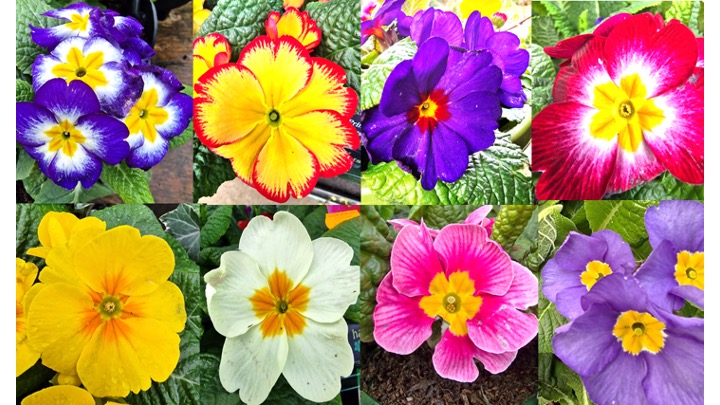
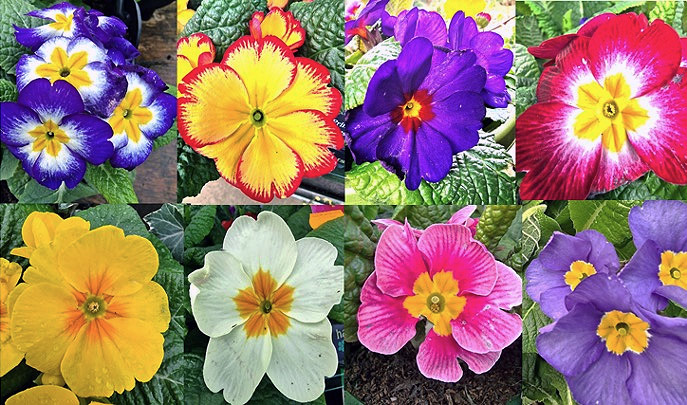
Gallery of Polyanthus flowers to show the range of pigmentation and pattern. Image: John Grace
So what exactly is this colourful garden plant we call Polyanthus? Everyone knows the native primrose Primula vulgaris, and now is the time of year to look for its pale yellow flowers. It’s an iconic native perennial that appears in Gerard’s Herbal of 1597 and several of Shakespeare’s plays. The name Primula is from the Latin primus (=first) because it is one of the first of the flowers to bloom in Spring.

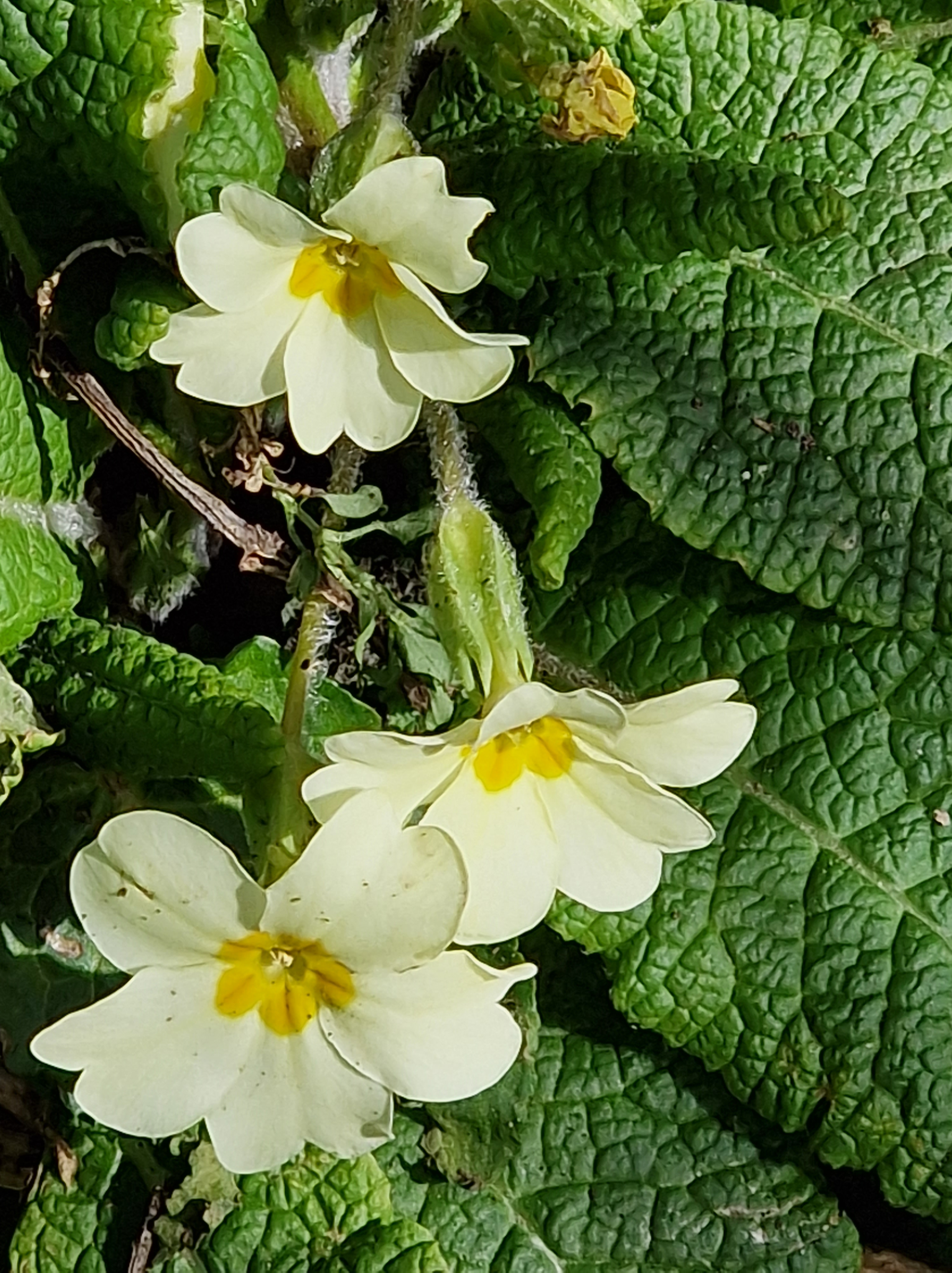

Left and centre: Primrose, Primula vulgaris growing in dappled shade at the edge of a coppice (Midmar Paddock, Edinburgh, 8th March 2023). Right: P. vulgaris clump in grassland on the Isle of Mull. Note: flowers are pale yellow, only one flower on each stem, leaves form a basal rosette, plants are long-lived and form clumps. Photos: John Grace (Midmar) and Chris Jeffree (Mull).
Polyanthus plants look a lot like Primula vulgaris, both in the flowers and the leaves. They both have the characteristic dimorphic feature in their flowers, known as ‘pin and thrum’, the curious system described by Charles Darwin in 1862 whereby some individuals have their stigmas held above the anthers whilst others have them below (see our blog here for a full explanation with images). So what is the relationship between Polyanthus and Primula?
It involves sex with the Cowslip, Primula veris, another native perennial (see here). When Cowslips and Primroses grow near to each other, hybrids are formed. The official name for this hybrid is P. vulgaris x P. veris = P. x polyantha. The English name is ‘False Oxlip’1. As might be expected, it looks intermediate between Cowslip and Primrose. It is thought to be the wild ancestor of Polyanthus.
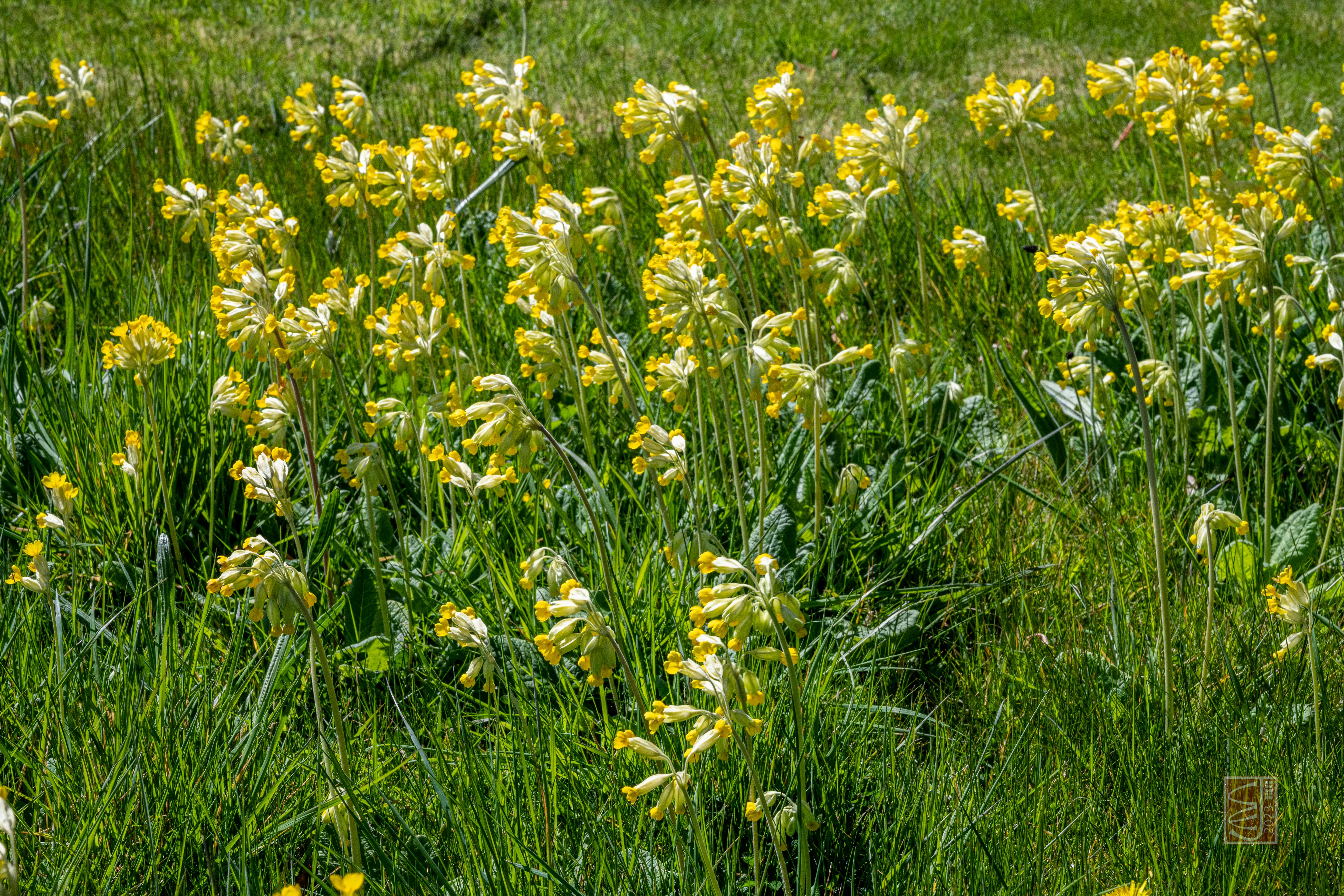
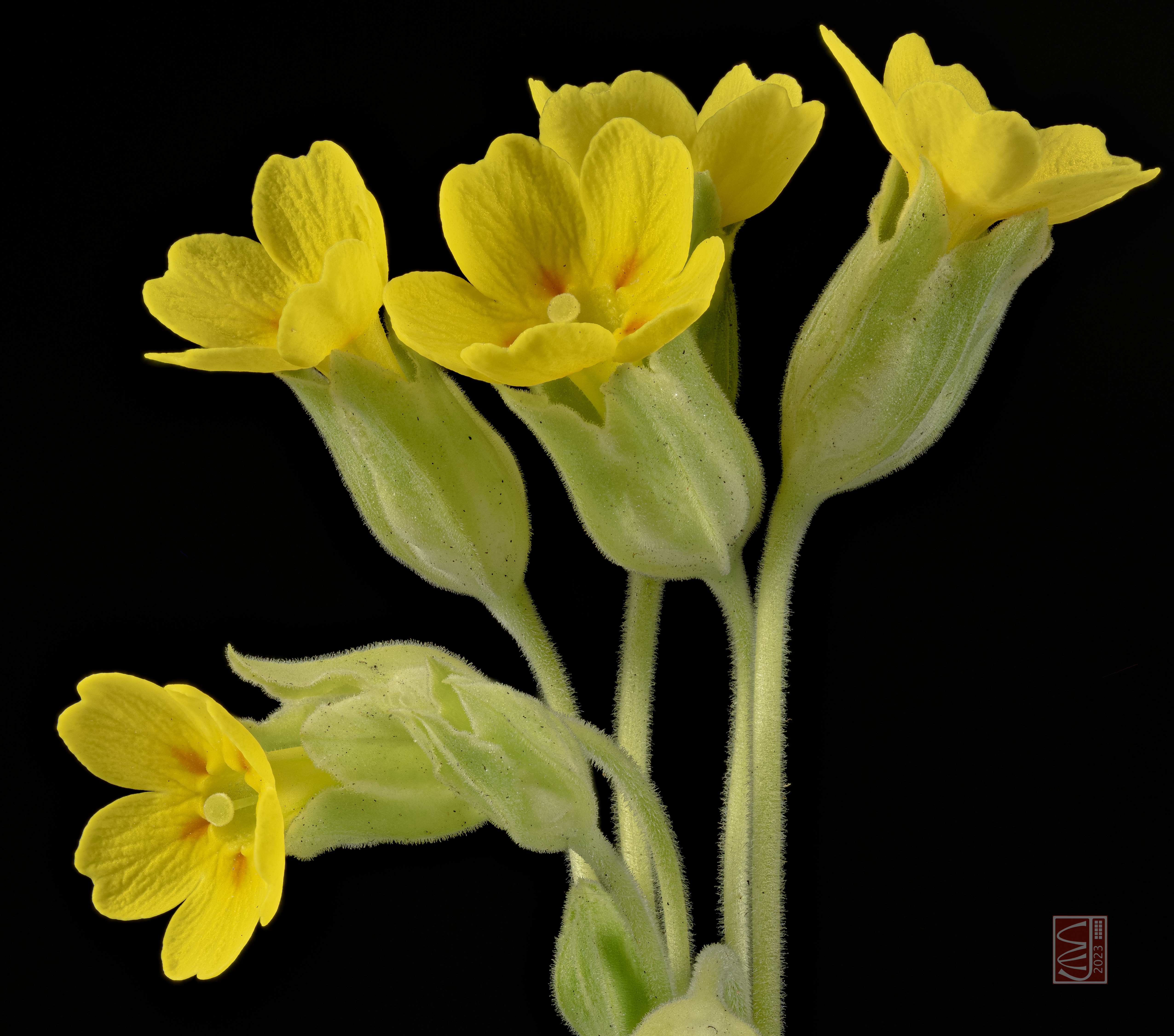
Primula veris, Cowslips in grassland. Note: several flowers bunched onto one stem. Photo: Chris Jeffree.
But garden Polyanthus is colourful and False Oxlip is merely yellow; so where did all the colours come from? Early descriptions of Polyanthus in the 1670s say the flowers were ’red’; they might have been crossed with John Tradescant’s ‘Turki-purple primrose’ from the Caucasus. When crossed with the False Oxlip the Caucasian plant might have yielded a red polyanthus.
However, more colours are needed to make the modern polyanthus, not just yellow and red. In the 1930s a young biochemist at Cambridge University, Rose Scott-Monrieff2, discovered that a Chinese Primula contains a pigment she called Primulin, in fact an anthocyanin (Scott-Moncrieff 1930). Anthocyanins are water soluble pigments that can be red, purple, blue or black depending on the pH. Often they appear magenta, a colour familiar to those who run any ink-jet printer! Unlike colours in general, magenta is not a pure colour on the electromagnetic spectrum, but a mixture of red and blue.

The CMYK colour system as used in colour printing. Note that Magenta (M), Cyan (C) and Yellow (Y) can make blue, red, green and black. Attribution: SharkD at English Wikipedia, Public domain, via Wikimedia Commons.
Several bluish-flowered Primula species are well known to alpine gardeners: P. integrifolia, P. viscosa, P. primulina. Recent work shows that not just Primulin but many other pigments are involved in the formation of the range of colours: seven anthocyanins and six flavonols (pale yellow pigments) were isolated from various Primula flowers by Tatsuzawa et al (2021). Different shades are created according to concentrations of the pigments and the pH levels. All of this is under genetic control as we see in the work of Li et al (2020).
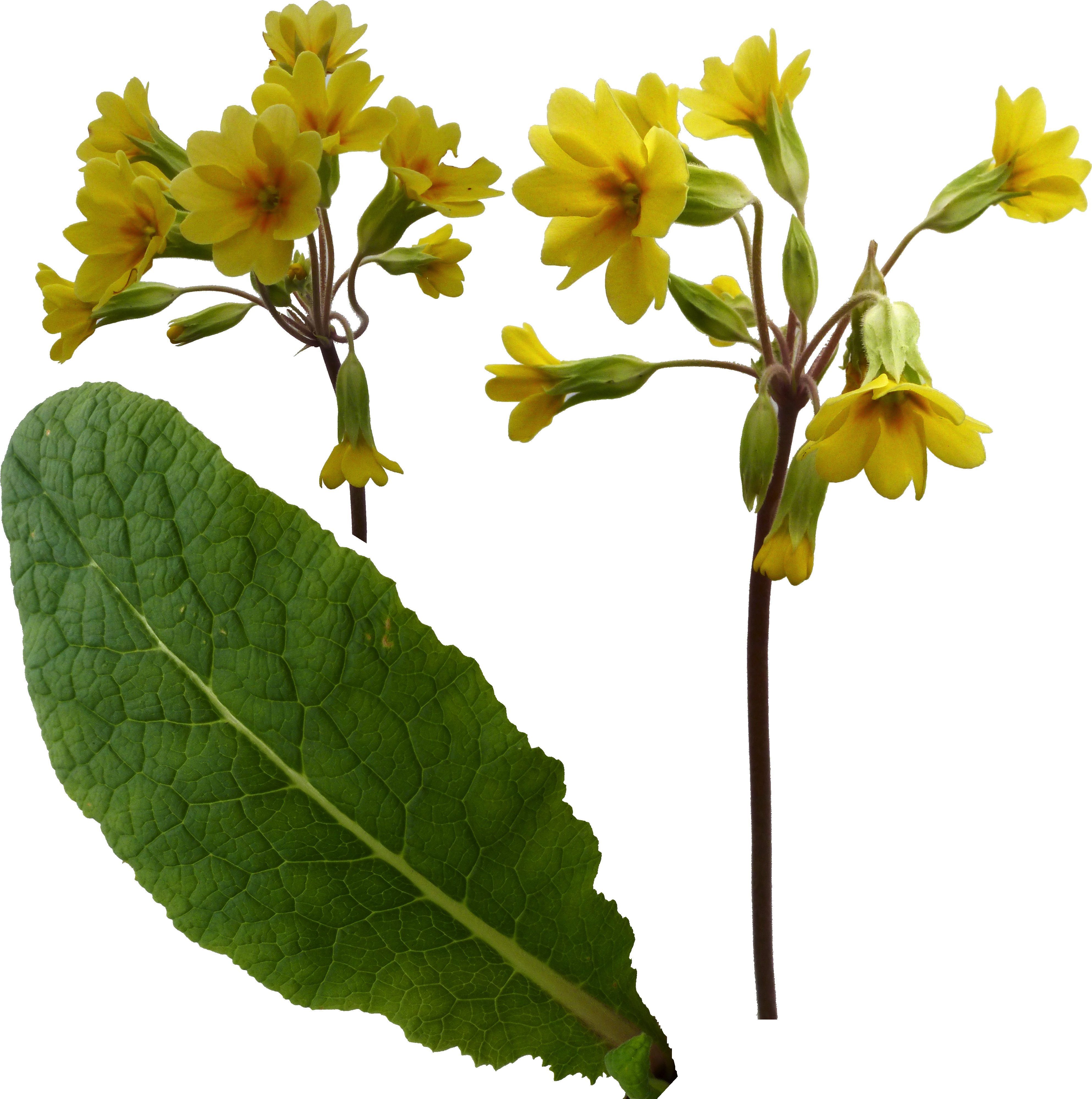
False Oxlip, P. vulgaris x P. veris = P. x polyantha. The wild ancestor (or one of the wild ancestors) of polyanthus. This one was spotted at Craigmillar Park, Edinburgh by Richard Milne who also made the image.
We don’t know all the details of how every cultivar was created and introduced. To make a proper history, we would start by trawling through the myriad of seed catalogues of the last several hundred years. We might also embark on genetic analysis of modern types to suggest an evolutionary tree. There is written material from gardeners and plant collectors of old, and there are fashions in garden flowers as in everything else that we humans consume. You may enjoy the excellent article about the historical fashions in garden primulas by J.S. Harrison here, and the brief history of polyanthus in the book by Genders3 (1971).
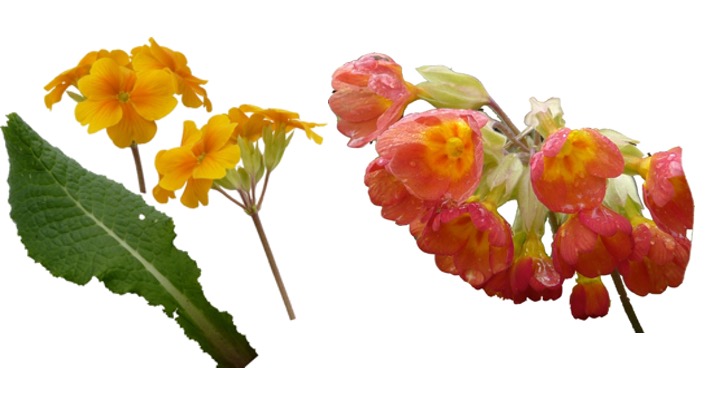
Some interesting examples. Left: a garden-bred Polyanthus hybrid, derived from hybrids of P. vulgaris and P. veris, though probably including colour forms of P. vulgaris not native to Britain. Right: a spontaneous hybrid between a wild cowslip and a garden Polyanthus cultivar (probably red-flowered), growing among cowslips by the Union Canal in Edinburgh. Specimens and photos: Richard Milne.
It would be impossible for me to write about the pigments of Primula without referring to the rare Primula scotica, endemic to Scotland, found in coastal grasslands in the far north. I doubt if anyone has examined the floral pigments but it is a good example of magenta colouration and the chemistry might be very interesting.

Primula scotica at Strathy Point in the far north of Scotland. The species is found in Orkney, Sutherland and Caithness and nowhere else in the world. Many Primula species have the mealy or oily excretion, referred to as farina, well-shown in this specimen. Image: Chris Jeffree.
We know that Primula species form hybrids rather easily and that news species have been brought to our shores by horticulturists since the 17th century. Stace (2019) lists 14 sorts of Primula that are currently found growing wild in the British Isles; most of them are garden forms that have ‘escaped’ and become naturalised. Of the 14, five are hybrids.
In conclusion, we may suppose that the False Oxlip, itself a hybrid, hybridised with blue-coloured species from Europe and Asia to achieve the range of colours we see in Polyanthus. The pigments we know about can be mixed to produce any colour, just as happens in a colour printer. The rest of the story, of how such a range of colours and such intricate patterns can be formed, is entirely a matter of the gardeners’ craft in spotting mutants (‘sports’), making selections, and carrying out cross-pollinations, just as we see in other colourful groups of flowers like Dahlias, Tulips, Sweet Peas and Snapdragons. But in most cases, the early history is obscure, perhaps because plantsmen and women in the 17th century were secretive, well-aware of the commercial possibilities of their craft and unwilling to share their secrets except with their closest friends.
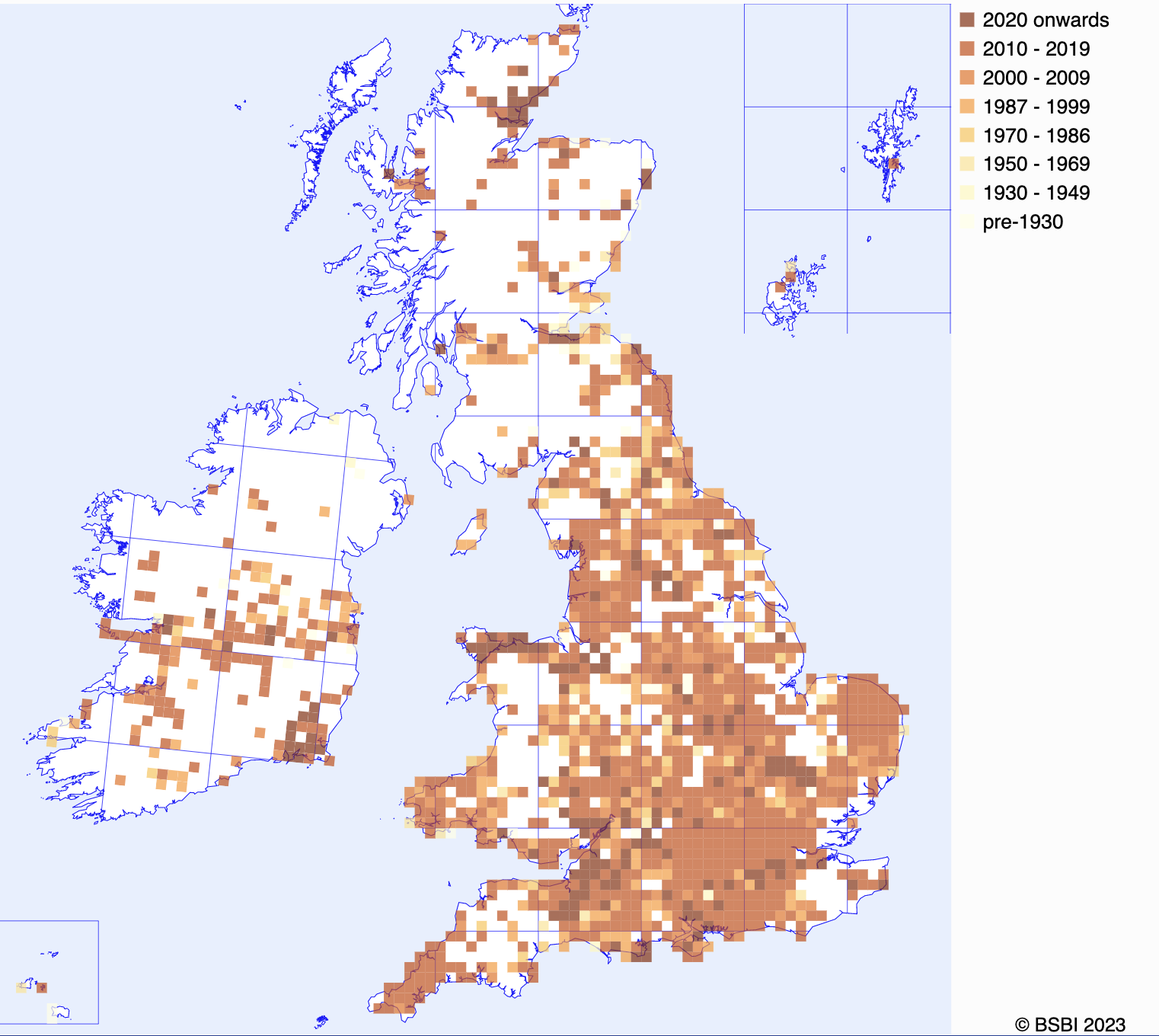
Distribution of the False Oxlip (P. vulgaris x P. veris = P. x polyantha). From BSBI.
I confess to having a soft spot for Polyanthus as my father was a part-time commercial grower who grew Polyanthus. I would help to wrap the little plants in newspaper and pack them in boxes ready for sale (we didn’t have plastic pots). We planted some in our north-facing front garden and they flowered all summer. The varieties we see now, years later, have larger flowers and brighter colours.
Footnotes
1The ‘False Oxlip’ is much like the Oxlip Primula elatior, a wild native Oxlip found only in East Anglia and Buckinghamshire.
2Scott-Moncrieff’s work on flower-colour began as part of her PhD, supervised by J.B.S. Haldane, geneticist and one of the most famous and controversial biological scientists of his time. After her PhD she worked at the John Innes Institute; however, working conditions and career prospects for female scientists were not as they are today; she married at the age of 34 and retired from science to take care of her family. She is commemorated at the John Innes Institute in Norwich by an annual lecture in her name.
3Roy Genders (1913-1985) wrote many well-researched gardening books but he was also a first-class cricketer.
References
Darwin, C. R. 1862. On the two forms, or dimorphic condition, in the species of Primula, and on their remarkable sexual relations. Journal of the Proceedings of the Linnean Society of London (Botany) 6, 77-96.
Genders R (1971) Collecting Antique Plants – the history and culture of the old florists’ flowers. Pelham Books, London.
Li L et al (2020) Characterization of Metabolites and Transcripts Involved in Flower Pigmentation in Primula vulgaris. Frontiers in Plant Science. doi: 10.3389/fpls.2020.572517. PMID: 33329630; PMCID: PMC7714730
Scott-Moncrieff R (1930) Natural anthocyanic pigments. Biochemical Journal. 24, 767-778. doi: 10.1042/bj0240767
Tatsuzawa F et al (2021) Flavonoids in the flowers of Primula x polyantha and Primula primulina. Phytochemistry. https://doi.org/10.1016/j.phytochem.2021.112827
©John Grace