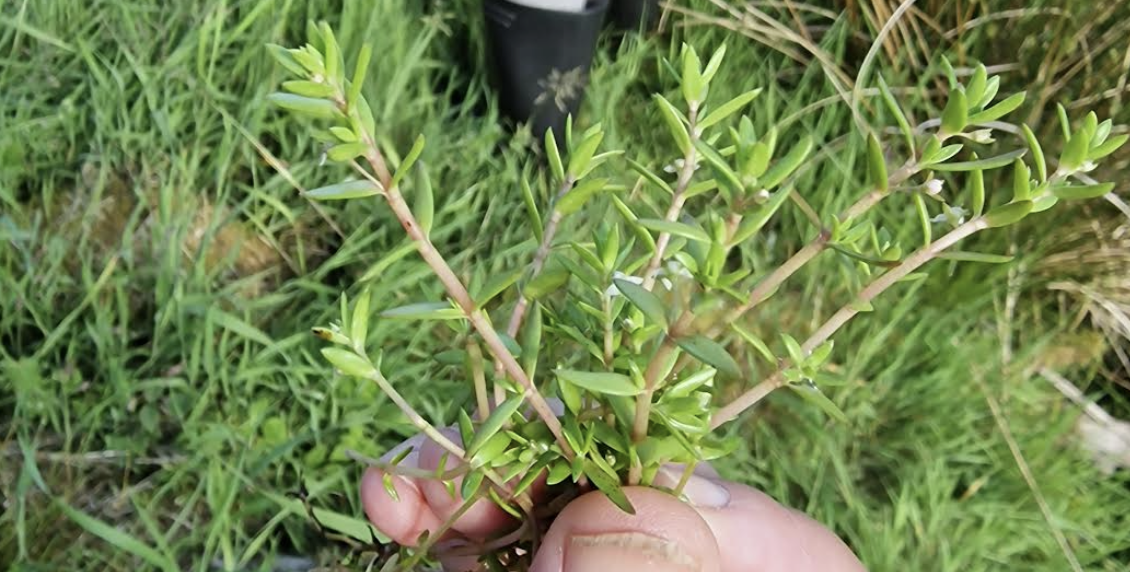
Crassula helmsii – 3rd July 2023 – New Zealand Pigmyweed
(also called Australian Swamp Stonecrop)
Here is an aquatic plant to watch out for. It is classed as an ‘invasive non-native’ although it is tiny. In its native lands of New Zealand and Australia it has its own pests and diseases to keep it in check. But here, with no natural enemies, it spreads vegetatively in ponds and ditches.
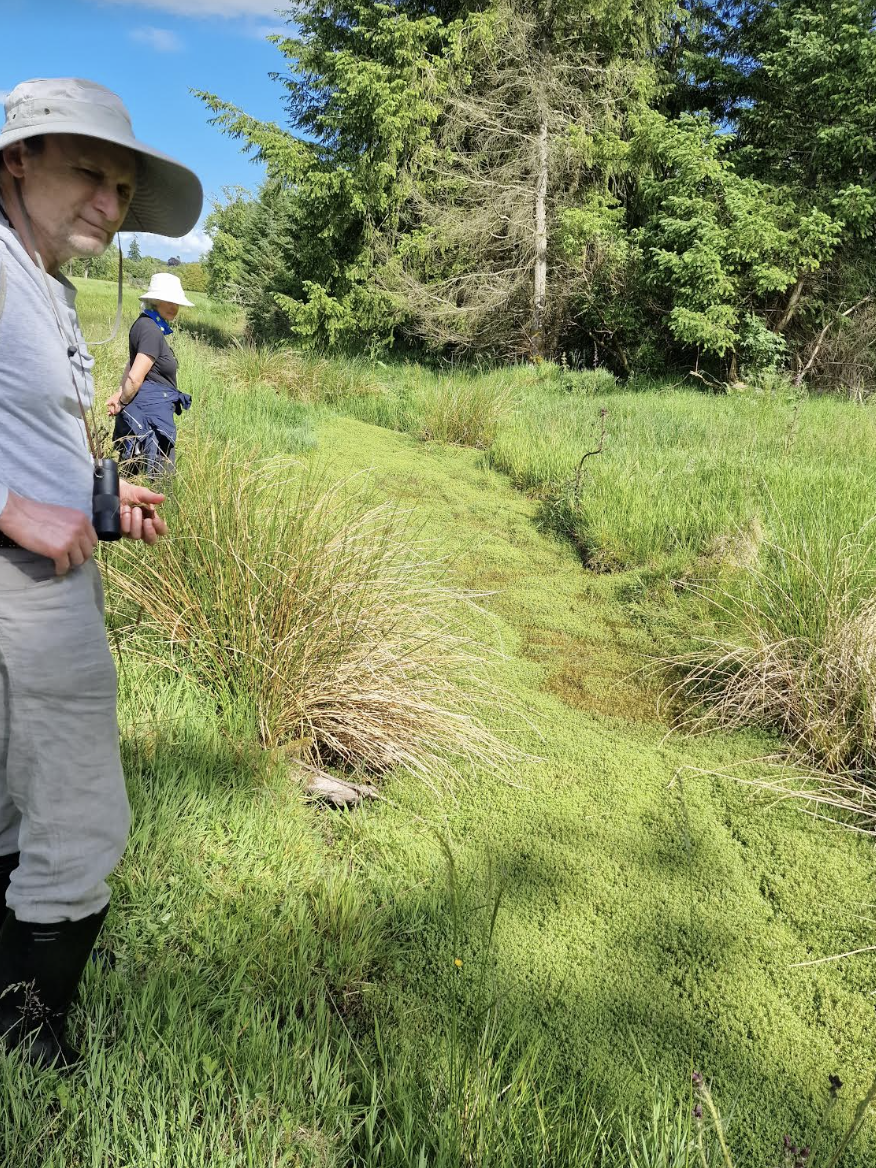
Invasion of ditch by C. helmsii, an area of about 1.5 m wide and 10 m long with a uniform cover of the plant smothering other vegetation. Photo: John Grace
Most members of the Crassulaceae are succulent plants of dry places – they have a water-saving method of photosynthesis called Crassulacean Acid Metabolism (CAM for short). Unlike most other species, CAM plants keep their stomata shut by day to avoid losing water, but they open them at night and capture CO2, making and storing the captured carbon as malic acid. In the day, the malic acid is broken down and the CO2 thus released is then turned into glucose by ‘normal’ photosynthesis ‘behind closed doors’.
The Crassulaceae make good house-plants as they are not easily killed when their owners forget to water them (or go on holiday). One group, the stonecrops (of the genus Sedum) are currently enjoying prominence as they are sold for growing on flat roof-tops, and Sedum acre often ‘decorates’ pavement edges and other ‘drought-prone’ habitats.
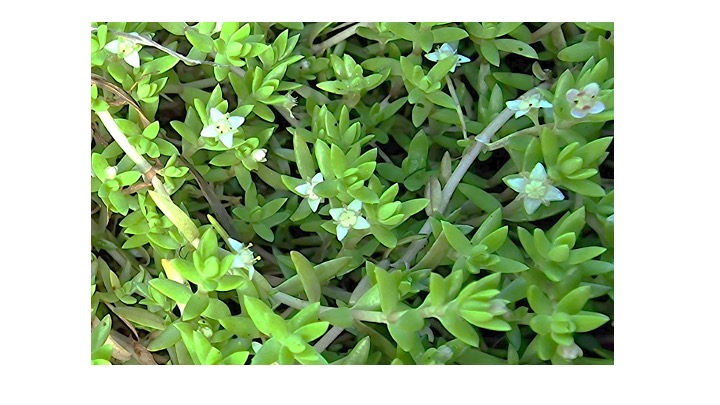
Close up of the vegetation shown in the top image, showing how the plants are entangled to form a mat. Photo: John Grace
Crassula helmsii however, is an aquatic plant. Whilst other crassulas have evolved for life in the desert, this one has taken a different evolutionary road. It can still do CAM but it also does ‘normal’ carbon capture by day (with stomata open). It retains one useful feature that is so common in the Crassulaceae: fragments take root very easily. This is the ‘trump card’ in the success of C. helmsii as an aquatic invader.
Its history in Britain is told by Smith and Buckley (2020). These authors state that all our British plants are “probably resulting from a single introduction before 1914”. It was first found growing in the wild in 1956, in South-east England (in an Essex pond, see the important account by Laundon 1961). Genetic analysis suggests the ancestor came from the Murray River in Australia not New Zealand. But how did it travel? Perhaps a piece of the plant adhered to someone’s boot, survived passage by sea, and landed in London’s dockland. South-east England became its epicentre. Now it is believed to move from place-to-place via the trade in water plants, when fragments hitch a lift with other species that are sold in nurseries to aquarists. No-one knows for sure. It spreads by vegetative reproduction via fragments and it rarely produces seeds (the reproductive biology needs further research). In Australia, C. helmsii is dispersed by fallow deer Dama dama and the grey kangaroo Macropus giganteus. In Britain and Ireland, wildfowl and livestock, such as highland cattle and New Forest ponies, may possibly disperse fragments (Smith and Buckley 2020).
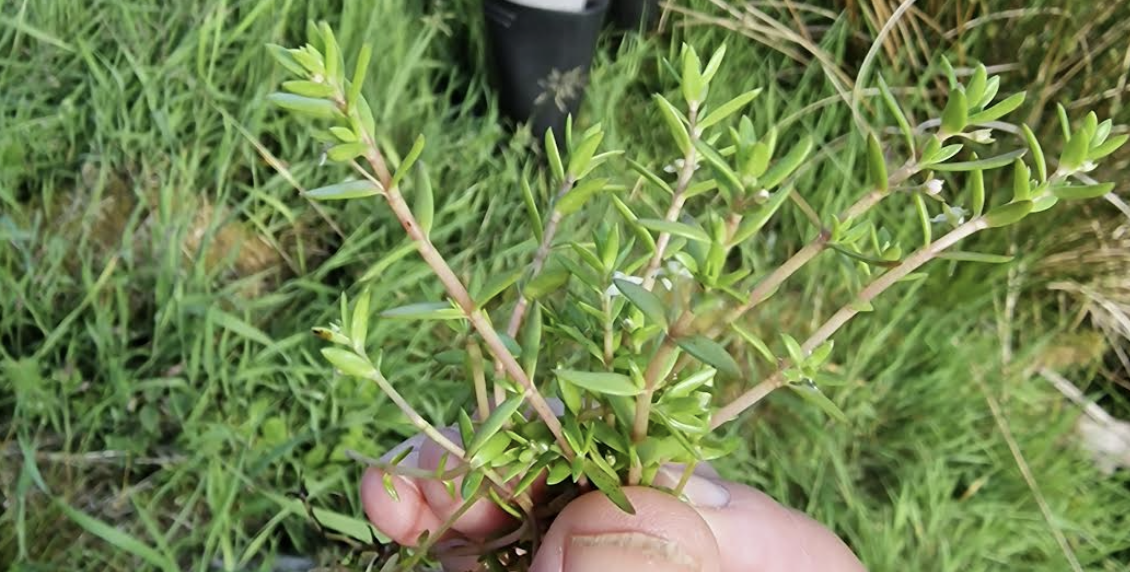
This image shows individual stems of C. helmsii with their rather fleshy lanceolate leaves arranged in opposite pairs. Photo: John Grace
The structure of the plant (creeping or floating stems, often rooting, often branched, with linear leaves arranged in opposite pairs) ensures the overall form is a tangled mat. This mat survives even when the pond partially dries in a hot summer. The flowers are very small with four white or pale pink petals about 1.5 mm in length, and the four stamens have black anthers and pink filaments.
The habitat is usually one of open ponds and ditches rather than running water. There are some records from wet woodlands. The species avoids acid waters – the lowest pH mentioned by Smith and Buckley (2020) is 5.7 and the highest is extraordinary, over 9. The species tolerates metal contamination, especially copper but also zinc and lead.
People’s attitudes to the plant have hardened. An early report in the BSBI Newsletter of 1977 says “In July 1976 this small attractive aquatic, native of Australian and New Zealand was discovered in a pond at Gorley, Fordingbridge”. Then, it was an interesting botanical curiosity. But now, this ‘attractive plant’ is demonised, as it spreads around the country, sometimes excluding other species and profoundly changing the aquatic environment. Its rate of spread can be described as ‘slow but sure’. The maps below show how it has consolidated its position in England, and gained new territory in Scotland, Wales and Ireland. Of course, the spread may be over-estimated by the maps as local recorders become more alert and start to ‘look out’ for the plant.
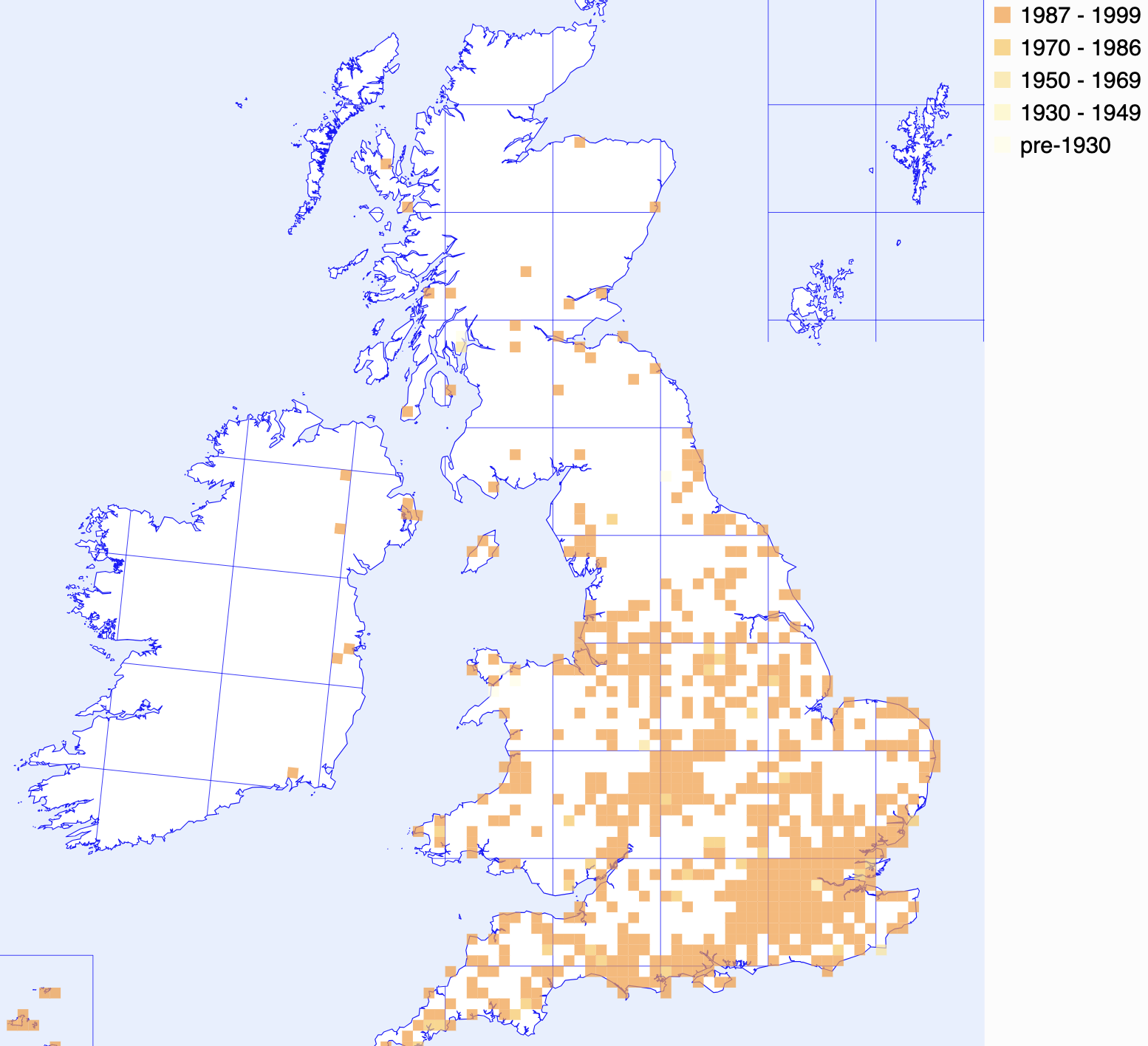
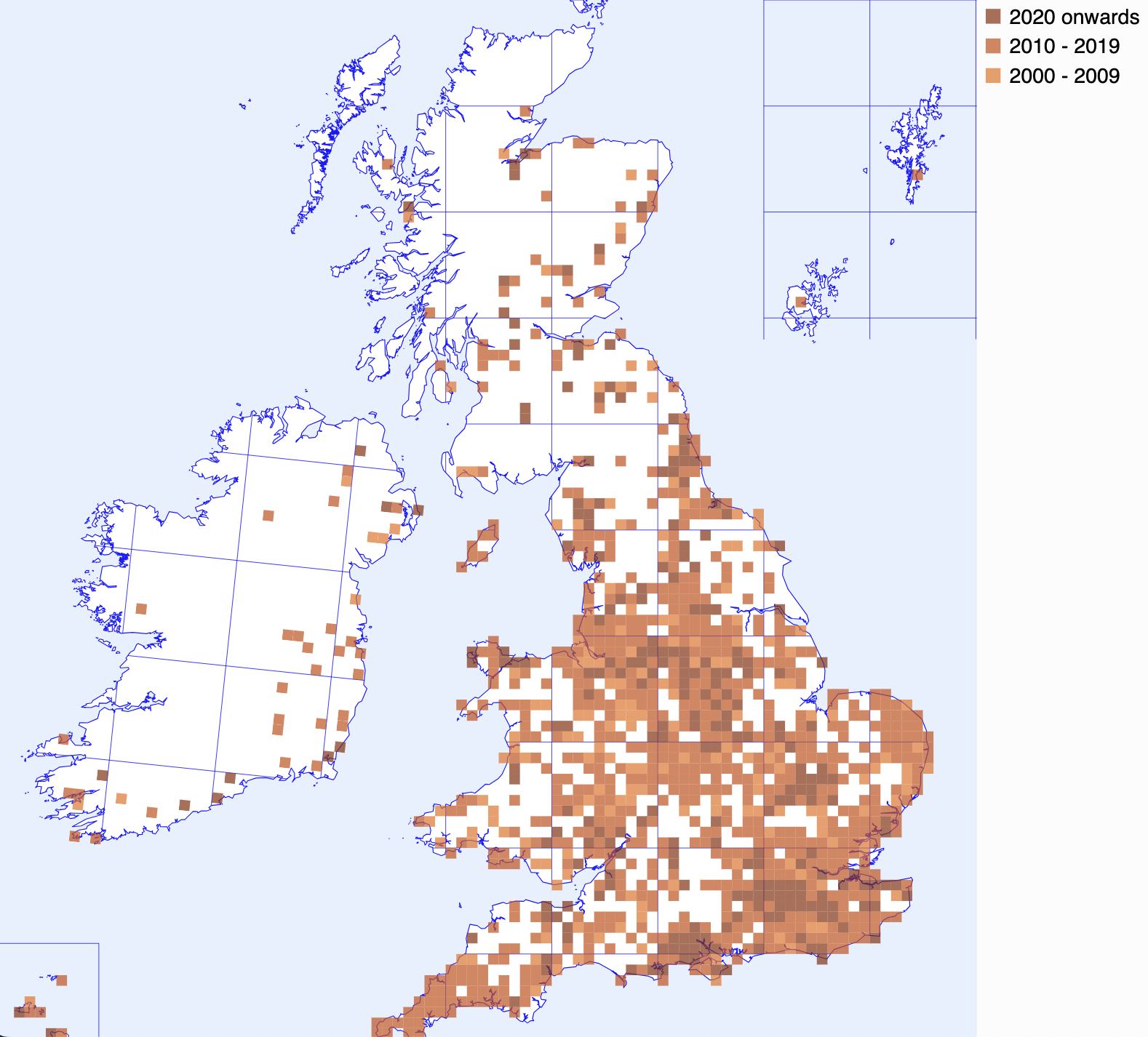
British and Irish distribution of C. helmsii from BSBI/Maps. Left, up the 1999; right, since 2000.
Now it is on the list of species that you must not import, keep, breed, transport, sell grow or permit to reproduce. The list includes formidable large plants such as Giant Hogweed and Japanese Knotweed alongside the diminutive C. helmsii. There are detailed rules on what you should do if you one day discover you have one of these on your property. The rules are complicated and open to interpretation; to make matters worse, Scotland has its own set of rules, now amended following Brexit. The UK regulation says:

It is hard to control. Attempts include the use of herbicides, hydrogen peroxide, liquid nitrogen, flame throwers and black plastic sheets. Any method is likely to work in the short term, but in the longer-term the species will regenerate from just a few remaining fragments. Biological control, mimicking the natural control in Australia, may offer a solution (or could lead to an even greater harm if the control agent itself becomes an invading pest).
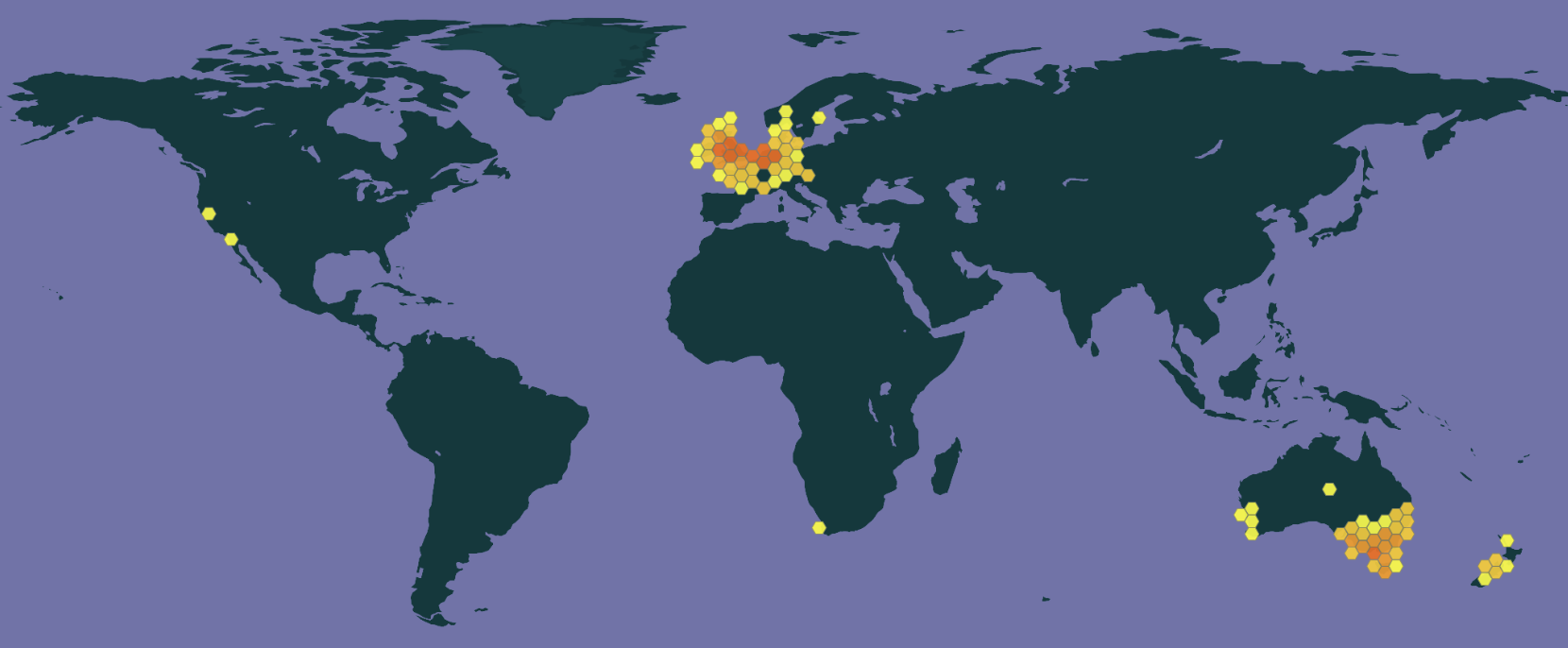
Global distribution of C. helmsii according to GBIF.
Invasive alien species cause alarm but they are not always as bad as some people make out. Often, they are no worse than common native invasive plants such as stinging nettles or horsetails. Has there ever been any case where an invasive alien has been eliminated? Giant Hogweed and Japanese Knotweed are still with us, despite the many millions of pounds spent on herbicide applications and (in the case of Japanese Knotweed) on legal fees resulting from disputes between neighbours. Invasive plants usually ‘bounce back’ from set-backs, either because they produce abundant seeds like Giant Hogweed or because they spread vegetatively (like horsetails and couchgrass. We must learn to live with them, controlling them manually wherever they cause a local nuisance.
References
Laundon JR (1961) An Australian species of Crassula introduced into Britain. Watsonia, 5(2) 59-63. https://archive.bsbi.org.uk/Wats5p59.pdf
Lockton AJ (2016) Species account: Crassula helmsii. Botanical Society of the British Isles. Retrieved from here.
Smith T and Buckley P (2020) Biological Flora of the British Isles: Crassula helmsii. Journal of Ecology 108, 797-813. Find it here.
©John Grace