Acer monspessulanum – 2nd October 2023 –Montpellier Maple
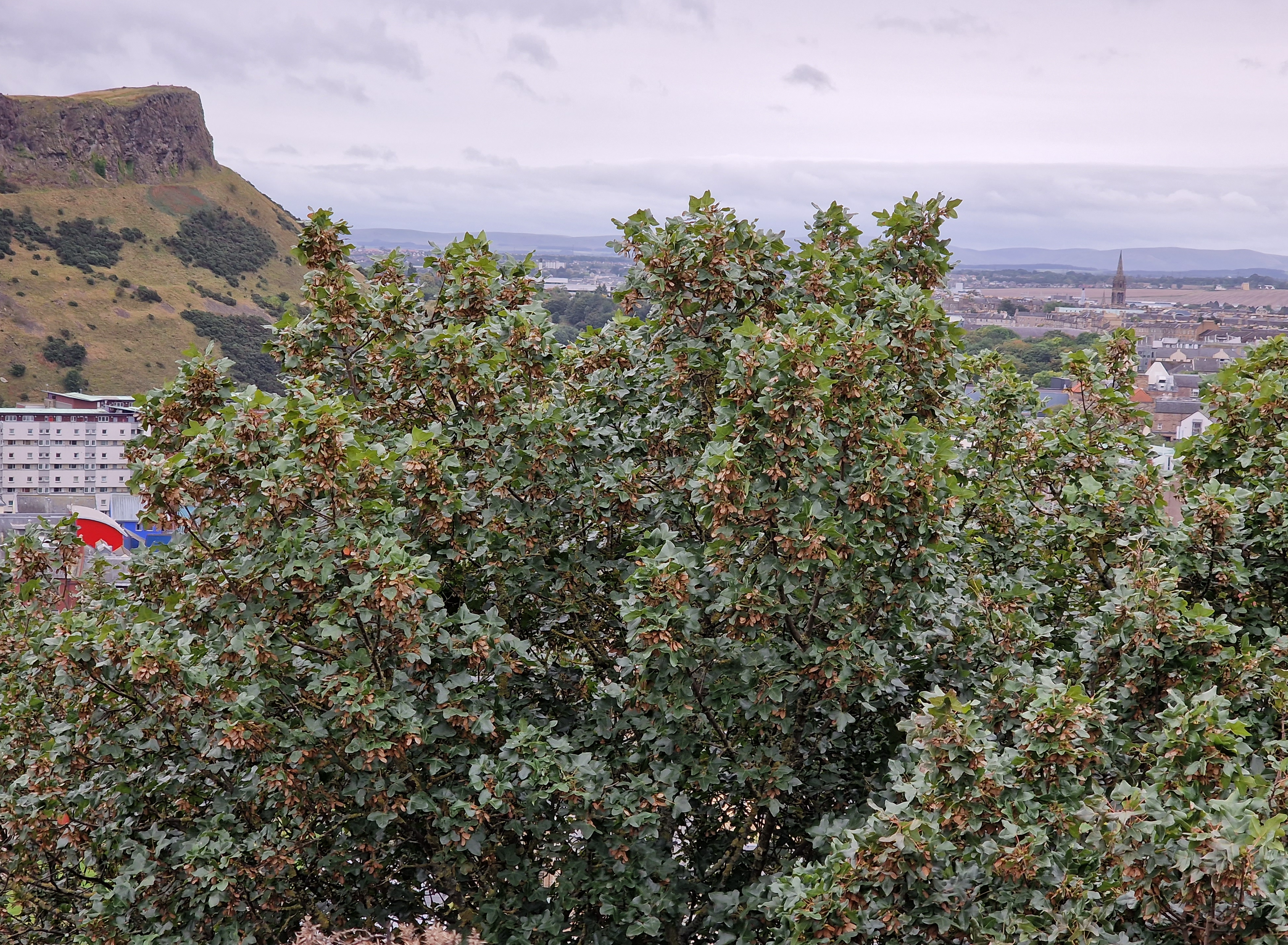
We found an unusual maple on a walk at Calton Hill, Edinburgh. Its leaves were similar to a maple, but they were darker green and more glossy than our native Field Maple, and with only three lobes. It was on the south facing part of the Hill and nearby there were several other saplings and also two large ones that might have been ‘the mother trees’. My companion was an experienced recorder, and she immediately knew what it was: ‘The Montpellier Maple’. We gazed into the canopy of the mother tree and sure enough, we saw the ‘keys’ (the nickname given to the winged fruit of Acer which dangle like keys). They are quite different from those of the native Field Maple Acer campestre.

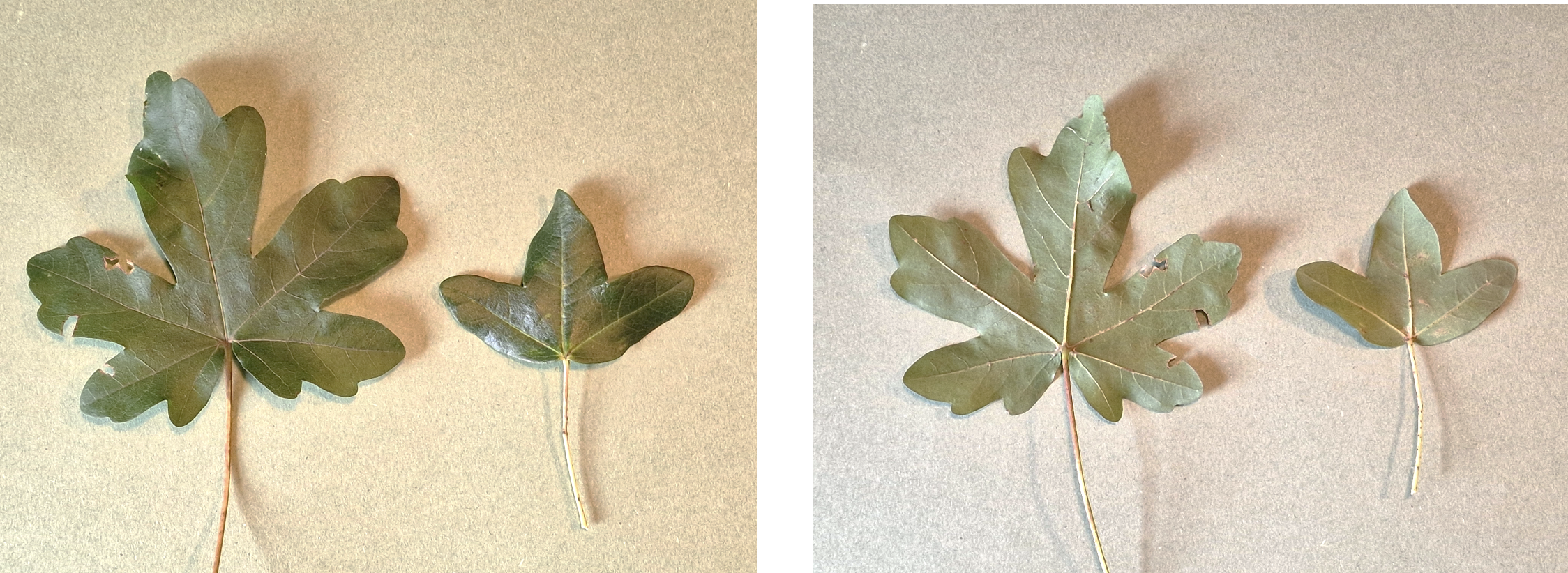
Our ‘first sighting’ of Acer monspessulanum at Calton Hill, looking south over Edinburgh (upper image with Salisbury Crags in the background). The tree is rooted on a steep slope and could not have been planted in that precarious position (but seed could have been scattered). The pairs of leaves show the difference between A. campestre (left) and A. monspessulanum (right). The pair on the left is the adaxial view. On the right is the abaxial view. Photos: John Grace
Back home I searched the records of the BSBI and found Calton Hill to be the only Scottish record from the wild. The first ‘modern’ observation was in 2001 by Barbara Sumner who was the Recorder for Midlothian. I extended my search of the data and found the species to be rare in England, with only a handful of records. Half of them are tagged as ‘planted’, and five records are by Mick Crawley (the co-author of the book Alien Plants, and a keen recorder).
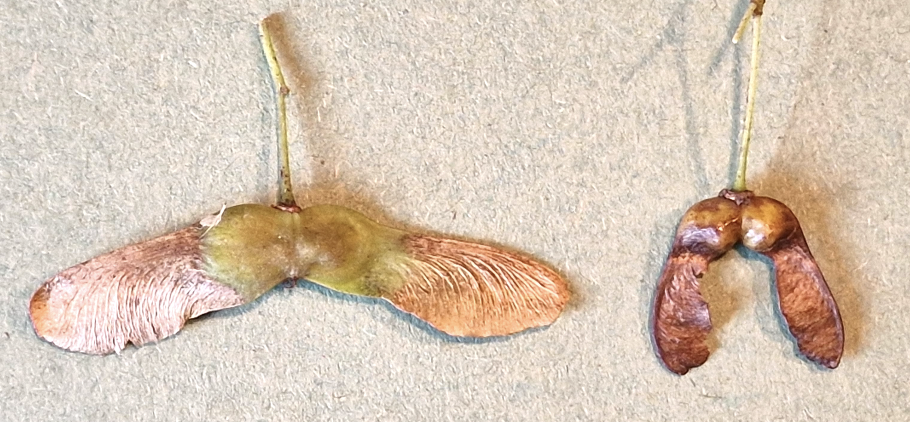
Comparison of fruits. Left, A. campestre; right, A. monspessulanum. Photo: John Grace
It is native in most of the Mediterranean countries, extending as far north as parts of Germany and south to Morocco. In the east it extends to Turkey and Ukraine. I was surprised to read that it thrived in Britain during the last interglacial (in Britain we call this period the Ipswichian but others call it the Eermian – it was about 120,000 years ago). Then the climate was warm and bones of lion and hippopotamus from the period have been recorded underneath Trafalgar square. How much warmer was it? Most people reckon it was about 2 degrees warmer than now, but not quite as warm as we expect for the year 2100.
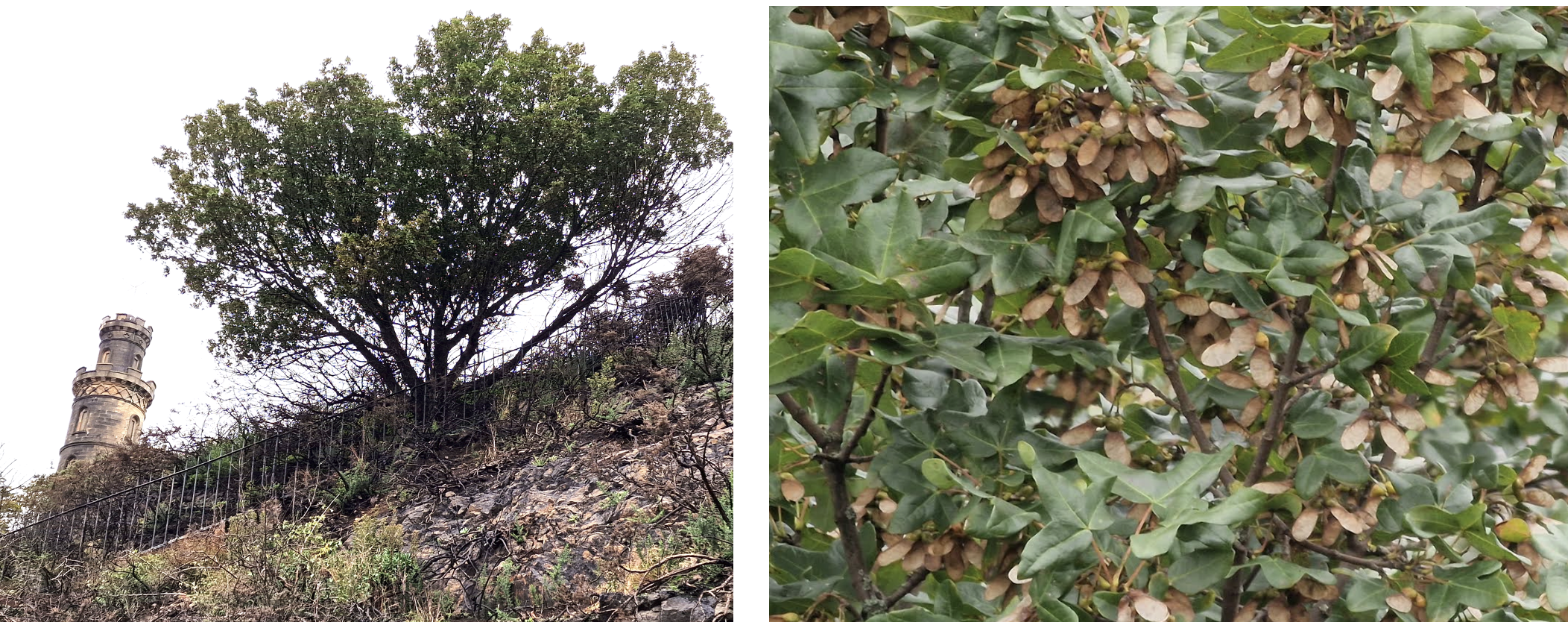
Another large specimen of A. monspessulanum, with many ‘keys’ (28th September). The Nelson Monument is in the background. Photos: John Grace
Despite having been in southern England 120,000 years ago, this species does not qualify as ‘native’. To be native it must have reached our lands by natural processes since the last glaciation. It hasn’t. It was obliterated by the ice and only returned when brought here as an ornamental tree in the 18th Century. Now it is planted in some of our Botanical Gardens and a few parklands (eg Silwood Park, Ascot and in the ‘living collections’ at the Botanic Gardens of Belfast and Edinburgh). However, I was surprised to see that now there are now 11 companies in the UK selling it, including Amazon (it makes good bonsai specimens and so perhaps the customers are hobbyists). We may therefore see more of it.
In Germany the native range is in the far south, but it is spreading north. A recent publication demonstrates the case in Berlin, where it was first planted 273 years ago (Kowarik 2023). The author draws attention to as many as 814 “local spontaneous populations mostly colonizing loose, semi-shaded anthropogenic hedges and forest patches”. Despite the somewhat alarmist ‘invader’ title of his paper, he concludes that “natural regeneration of A. monspessulanum in such settings could increase the resilience of urban forest patches to climate change”. He thinks the advantages it offers outweigh the disadvantages.
Bean (1970) and Mitchell (1974) both have good descriptions of the species. It’s a small tree or shrub, introduced to Britain in 1739. Bean distinguishes it from Acer campestre by (i) its glabrous three-lobed leaves, (ii) it is without milky sap in the stalks, and (iii) the fruits have downward-pointing wings. He says it is planted at Kew, West Ham Park and Kensington Gardens, and the one at Kew was 14 metres tall in the year 1967.
How does temperature limit its range and will warming cause it to spread? The climatic factors that limit distribution of this (or any other) species may not be temperature per se. Berlin’s summer temperatures are like those of London but its winter temperatures are lower than either London, Edinburgh or Belfast. So it is less sensitive to winter cold than one might expect for a Mediterranean species.

Flowers of A. monspessulanum in Spring. PiPi, CC BY-SA 2.5 https://creativecommons.org/licenses/by-sa/2.5, via Wikimedia Commons
An attempt to model the impact of the changing climate on the distribution of A. monspessulanum was made by Aouinti et al (2022). They found the distribution was determined by several climatic factors, of which the seasonality of temperature was the most important. They predict a shift in distribution from south-eastern Europe to the North Africa region, especially the Rif and Atlas Mountains in Morocco. They make no comment on the situation in northern Europe.
As many as 22 species of insect feed on our native Field Maple, Acer campestre. To my best knowledge, no-one has studied the phytophagous insects of A. monspessulanum in British conditions. Will they be the same as for A. campestre? Probably not. Perhaps the species thrives in parks and Botanic Gardens because there are yet no natural enemies to keep it in check.
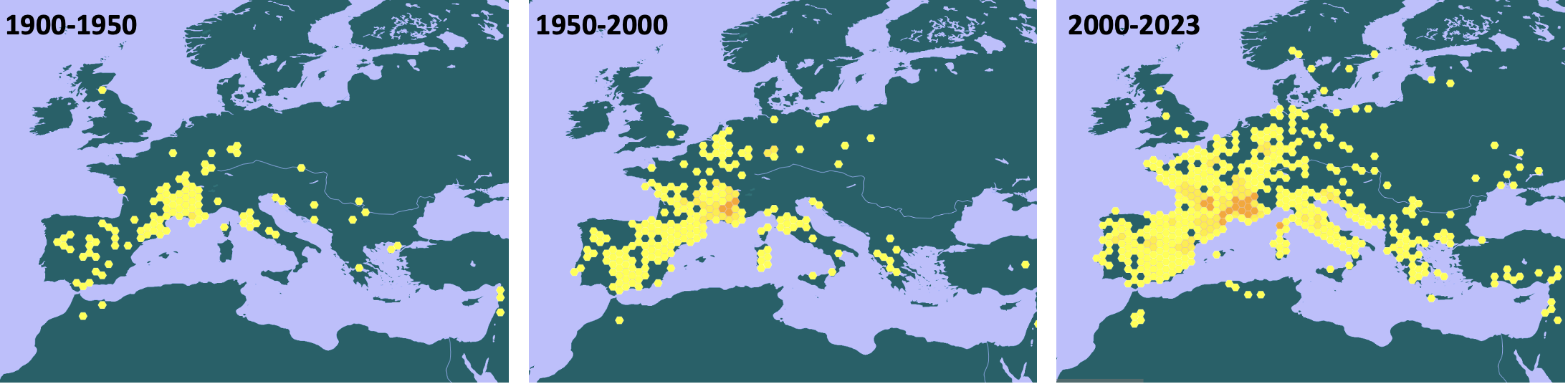
Distribution of A. monspessulanum since 1900 according to GBIF, the Global Biodiversity Informatiion Facility. Note the substantial spread since 2000. But beware: such mapping comparisons do not take into account the numbers of active and fully-skilled recorders. There were fewer such folk in previous decades and this might explain the small number of records in earlier times. Note also that there is an Edinburgh record before 1950 (but not shown in the current BSBI data base) but it is absent for the period 1950-2000.
If you are interested in the names given to plants you may already realise that the species name ‘monspessulanum’ comes from “Of Montpellier in southern France, Latinized as Mons Pessulanus.”
References
Aouinti H et al (2022) Observed and Predicted Geographic Distribution of Acer monspessulanum L. Using the MaxEnt Model in the Context of Climate Change. Forests 13, 2049. https://doi.org/10.3390/f13122049
Bean WJ (1970) Trees and Shrubs Hardy in the British Isles. Murray, London.
Franks JW (1960) Interglacial deposits at Trafalgar Square, London. New Phytologist 59, 145.
Kowarik I (2023) The Mediterranean tree Acer monspessulanum invades urban greenspaces in Berlin Dendrobiology · 89, 20–26. DOI: 10.12657/denbio.089.002
Mitchell A (1974) A field guide to trees of Britain and Northern Ireland. Collins.
©John Grace