Zostera – 27th November 2023 – (Eelgrass or Seagrass)
When you go to the seaside, look out for Zostera! The Latin name sounds somewhat fearsome and the English names Eelgrass and Seagrass might lead you to believe that these plants are grasses. They are not; they have a plant family all of their own, the Zosteraceae.
Eelgrasses are the only seed-bearing plants that complete their life cycle in the sea. They have small flowers in a tightly-packed bunch enclosed in a sheath at the leaf bases, and the flowers release threadlike pollen to be washed away by seawater before alighting on stigmas of a nearby female flower. The fruits are ‘bladdery’ and can float, and so they are dispersed over considerable distances.
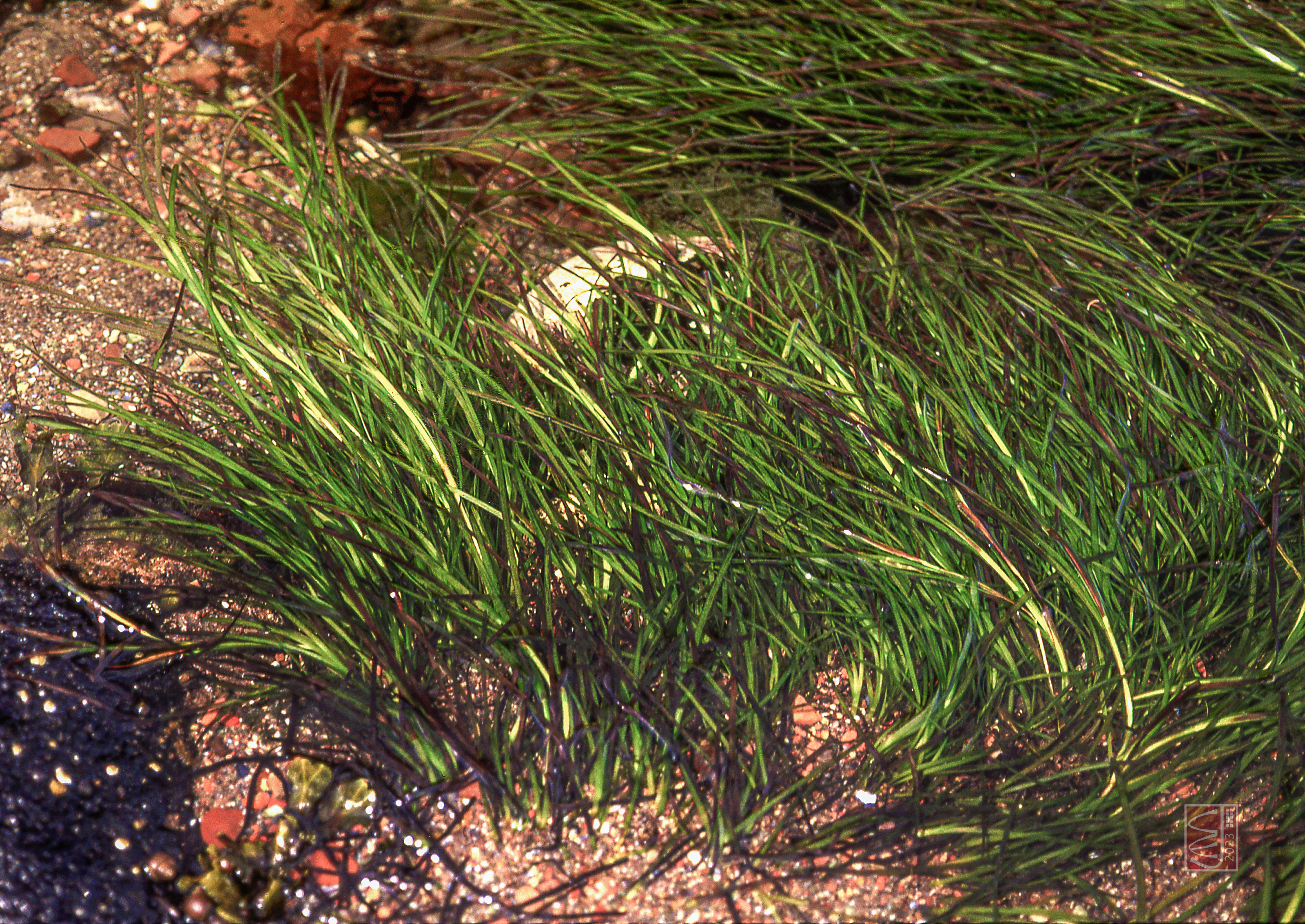
Zostera marina in shallow seawater at Tyninghame, East Lothian, Scotland. Photo: Chris Jeffree.
Eelgrasses have a completely different evolutionary history from the marine algae. The algae have never lived on land, but in the case of eelgrasses, their ancestors were terrestrial but at some stage (perhaps a hundred million years ago) they ventured into the sea. They developed an aquatic pollination mechanism and they lost their stomata and many of the enzyme systems found in land-lubber plants. Photosynthesis in water does not require such complicated structures as stomata and sub-stomatal cavities– it relies instead on diffusion of dissolved CO2 and bicarbonate ions directly through a flimsy leaf surface.
In Britain there are two species1, Z. marina ‘Eelgrass’ and Z. noltei ‘Dwarf Eelgrass’. Both have creeping rhizomes which enable rapid vegetative spread. Z. marina looks distinctly grass-like with leaves that are 2-10 mm wide and in Z. noltei they are narrower. Z. marina has branched flowering stems and in noltei they are unbranched.

Zostera marina at Tyninghame, East Lothian, Scotland. Photo: Chris Jeffree.
They are both native, and they live around the shore line, in sandy areas and mudflats, often in estuaries. You are more likely to see the dwarf one, Z. noltei, which is found from half-tide to low water. The Z. marina zone usually starts close to the low water mark and reaches seaward to a depth of a few metres; and so wellies, snorkels or canoes may be required for proper survey.
According to the records of the BSBI, both species are in steep decline, referred to by Green et al (2021) as ‘catastrophic seagrass loss’. These authors estimate that at least 44% of United Kingdom’s seagrasses has been lost since 1936. Reasons for the decline are not clear. Preston (2020) draws attention to the eelgrass wasting disease which affected Z. marina along the Atlantic coasts of Europe and North America. Populations were devastated in the 1930s by this disease, caused by Labyrinthula zosterae, and may not have fully recovered. Labyrinthula is a strange organism, neither a bacteria nor fungus but a protist – for further details see here. Other factors contributing to a decline in both species include general disturbance and storms, and the nitrification of coastal water from deposition of ammonia and NOx from the atmosphere, as well as agricultural run-off. One source of disturbance is aquaculture –commercial mussel-beds sometimes occupy the space belonging to Eelgrass. Pollution may be significant: nitrification is thought to stimulate the faster-growing brown algae at the expense of Eelgrass which struggles to compete with Laminaria and Fucus.

Zostera noltei at Tain (the County of Ross) in the Highlands of Scotland. Photo: Brian Ballinger.
Recovery of Z. marina from dieback was investigated at an estuarine site in the USA by Jarvis & Moore (2010). These authors write :
“…after a single die off event, seed germination with subsequent seedling growth is the principal method for revegetation in lower Chesapeake Bay Z. marina beds. However, no viable seeds remain in the seed bank during this first year of recovery and shoots produced by the seedling growth do not flower and produce seeds until their second year of growth. Therefore the seed-bank density is low and is not immediately replenished. This suggests that the resiliency of perennial Chesapeake Bay Z. marina populations to repeated disturbances is restricted and repeated annual stress may result in much longer term bed loss”.
In Britain, the relative importance of regeneration by seeds versus the vegetative way (by rhizomes) is not very clear. Jarvis and Tutin wrote “In the British Isles reproduction by vegetative means seems always to be far more important than reproduction by seed” (Jarvis & Tutin 1942).
In Scotland, work is underway at the Heriot Watt university to track the changing distribution of both Eelgrasses. It turns out that the situation is surprisingly dynamic from year to year, and some new sites have appeared. Perhaps we are seeing the start of a widespread recovery.
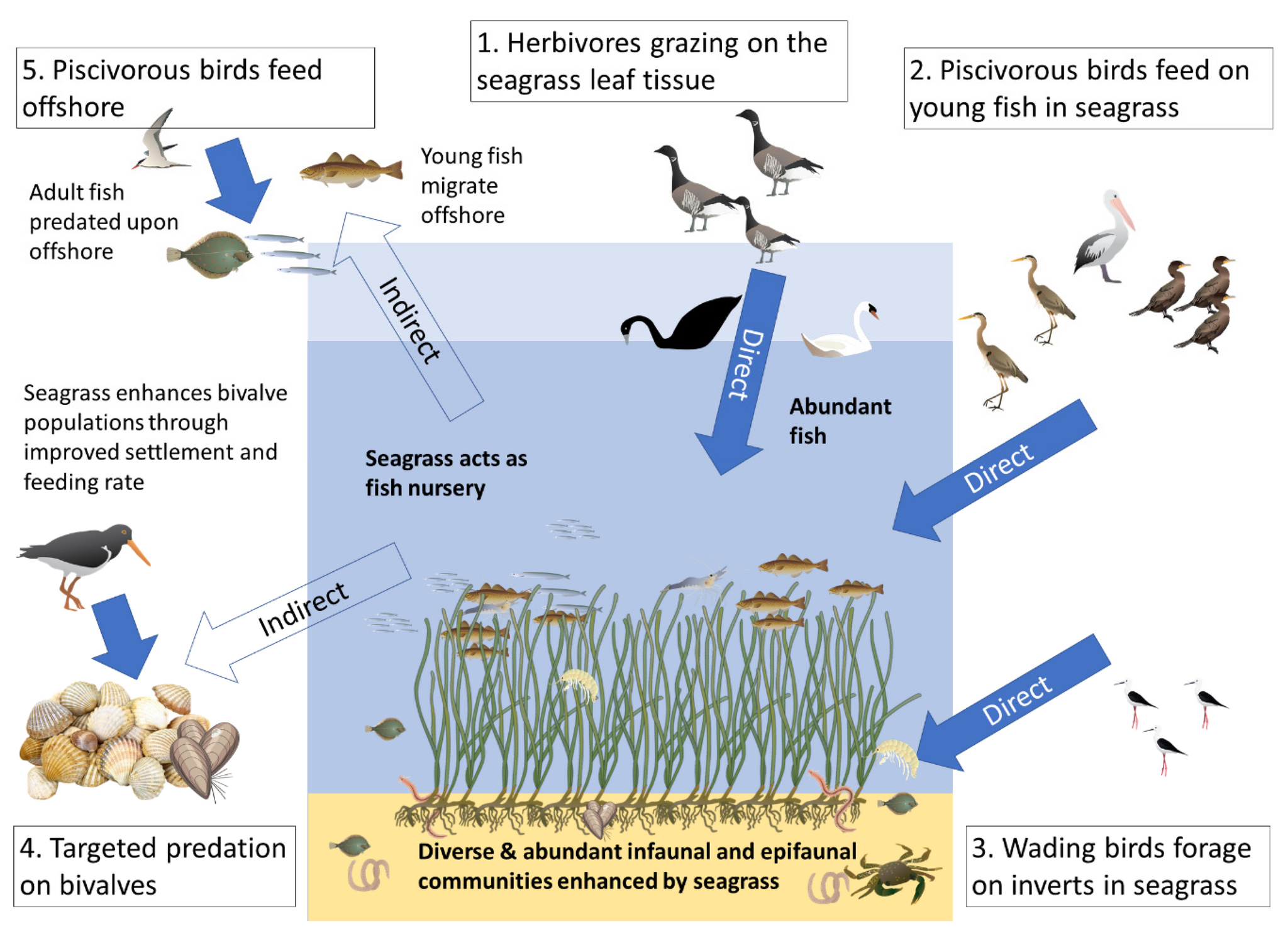
The importance of seagrass meadows for bird life and fish. Attribution: Richard K. F. Unsworth and Emma G. Butterworth, CC BY-SA 4.0 <https://creativecommons.org/licenses/by-sa/4.0>, via Wikimedia Commons
Why is Zostera important? It is considered to be an ‘ecological engineer’ because it modifies the sea bed, reducing wave action and making a relatively calm boundary layer where all manner of marine life can thrive. When fully-developed as a marine sward (a seagrass ‘meadow’) it provides habitat for a variety of marine life, especially larval forms. It also provides a food source for animals (Brent Geese can graze on it, and see the diagram above by researchers Richard Unsworth and Emma Butterworth). Some studies have emphasised a global role in helping to remove carbon dioxide from the atmosphere to mitigate global warming, although the British species have only feeble roots and may be no more effective than the brown algae.
For humans, it has served as thatching in Denmark, a feast food for North American Indians, stuffing for mattresses, fodder for cattle and grains for toasting in Mexico. It was suggested as a substitute for cotton during 1861-1865 Lancashire Cotton Famine. This was a time when workers at the cotton mills became unemployed due to a imbalance between supply and demand of the raw material. It isn’t clear whether this anonymous poem is meant to be serious or merely a satire, but I like it:
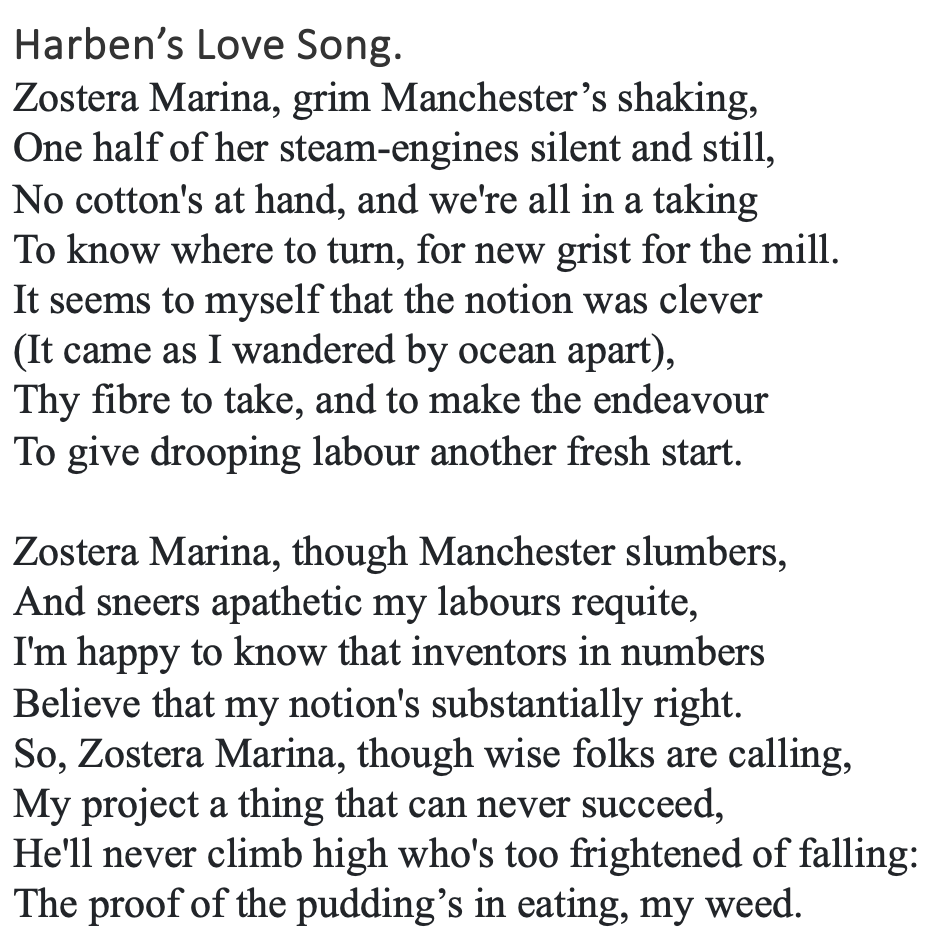
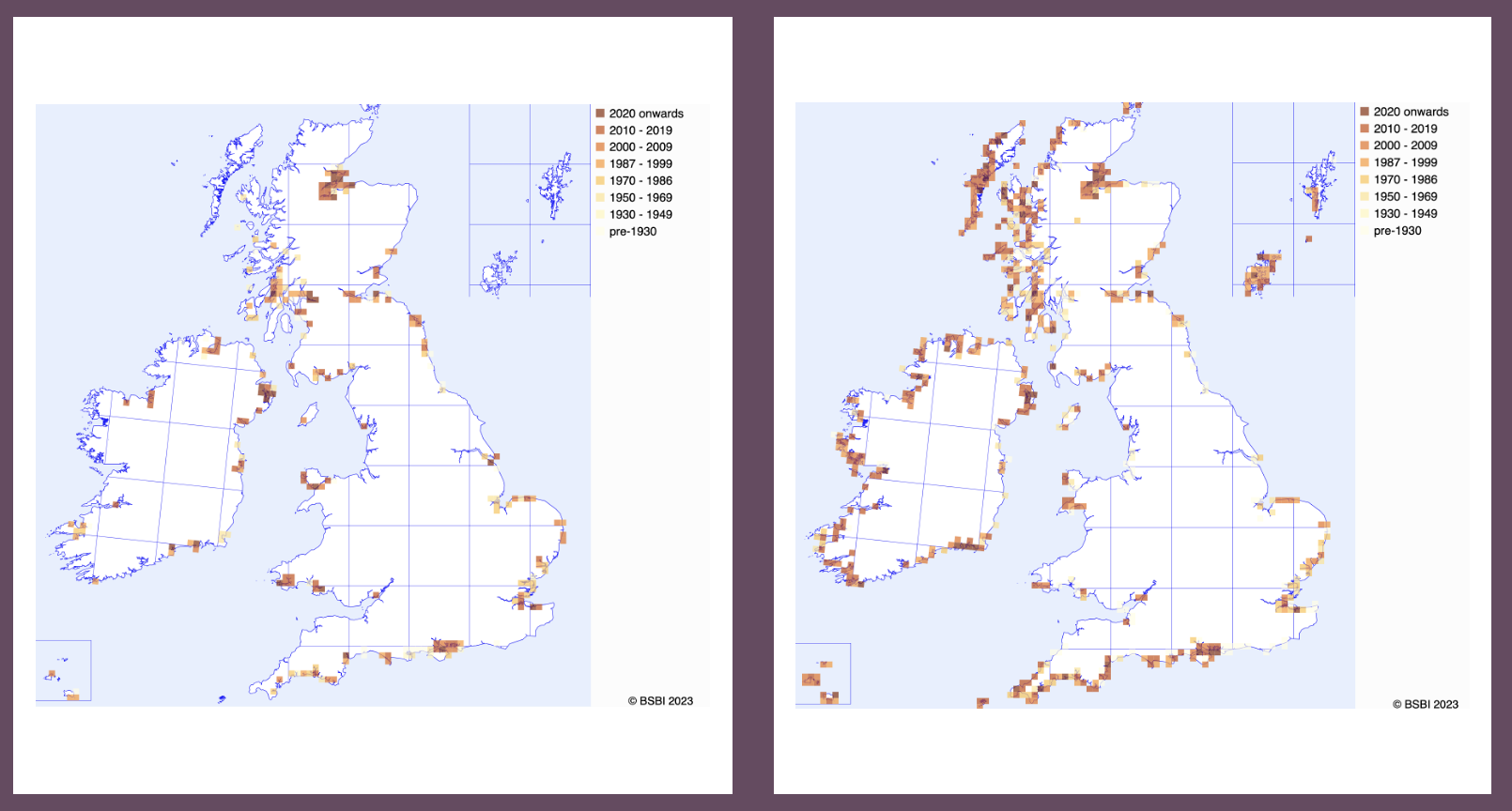
Distribution of the two species of Eelgrass. Left: Z. noltei, Right: Z. marina. From BSBI/Maps. Note: at the BSBI web site you can scroll and zoom the map to look closely at the records.
The Seagrass habitat has protected status under the UK’s Post-2010 Biodiversity Framework. Seagrass beds are on the OSPAR List of Threatened Species and Habitats. OSPAR is named after the Oslo and Paris Conventions in the 1970s, during which 15 European countries pledged to protect the marine environment of the North-East Atlantic.
Footnote
1Z. marina has two forms, which some people regard as separate species: Z. angustifolium and Z. stenophylla. To avoid taking sides on this controversy, we have followed Stace (2019) and consider these two forms of Z. marina to be varieties or merely growth forms.
References
Ackerman, JD (1997). Submarine pollination in the marine angiosperm Zostera marina 1. Influence of floral morphology on fluid flow. American Journal of Botany 84, 1099-1109. doi:10.2307/2446153. JSTOR 2446153. PMID 21708665
De Cock, AWAM (1980) Flowering, pollination and fruiting in Zostera marina L. Aquatic Botany 9, 201-220. https://www.sciencedirect.com/science/article/pii/0304377080900236
Green, AE. et al (2021) Historical analysis exposes catastrophic seagrass loss for the United Kingdom. Frontiers in Plant Science 12, doi:10.3389/fpls.2021.629962
Jarvis, JC & Moore, KA (2010)The role of seedlings and seed bank viability in the recovery of Chesapeake Bay, USA, Zostera marina populations following a large-scale decline. Hydrobiologia 649, 55–68. https://doi.org/10.1007/s10750-010-0258-z
Potouroglou, M et al (2014) The roles of flowering, overwinter survival and sea surface temperature in the long-term population dynamics of Zostera marina around the Isles of Scilly. UK Marine Pollution Bulletin, 83, 500-507.https://pubmed.ncbi.nlm.nih.gov/24731880/
Preston, CD (2020) Zostera marina L. in BSBI Online Plant Atlas 2020, eds P.A. Stroh et al. https://plantatlas2020.org/atlas/2cd4p9h.pb0
Raven, JA (1997) Inorganic carbon acquisition by marine autotrophs. Advances in Botanical Research 27, 85–183. https://www.sciencedirect.com/science/article/pii/S0065229608602815
Tutin, TG (1942) Biological Flora of the British Isles. No. 7. Zostera genus L. (pp. 217), Z. marina L. (pp. 217–224), Z. hornemanniana Tutin. Journal of Ecology 30: 217–226 doi:10.2307/2256698
©John Grace