Eucalyptus obliqua – 8th January 2024 – (Stringybark)
This is an iconic Australian tree. It was the first to be given the name Eucalyptus, after being collected in Tasmania during Captain Cook’s third and fateful voyage of discovery’ in the year 1777.

Flowers and fruits of Eucalyptus obliqua. Attribution: Russell Best, CC BY 2.5 AU https://creativecommons.org/licenses/by/2.5/au/deed.en, via Wikimedia Commons
This third voyage took his ship, the HMS Resolution, to Van Diemen’s Land (now Tasmania) on 26 January 1777 where the crew replenished their water and wood. Cook had failed to attract botanists of the high calibre of those on his first voyage (Joseph Banks and Daniel Solander). This time, the plant collectors were Willian Anderson, primarily a surgeon educated at Edinburgh University, and David Nelson a gardener.

Open-grown tree, Bruny Island, Tasmania. There are over 700 species of Eucalyptus in the world (Family Myrtaceae). Alternative names for Eucalyptus obliqua are: messmate stringybark, messmate, brown top, brown top stringbark or Tasmanian oak. Photo: John Grace.
Their rather small collections were made at a place called Adventure Bay on Bruny Island in the south of Tasmania. Unfortunately, Anderson died of tuberculosis on the way home and Cook was stabbed and killed in Haiti. Nevertheless, plant material plucked from the large trees eventually arrived at the British Museum in London where the French botanist Charles Louis L’Héritier gave the name Eucalyptus obliqua. The specimens can be viewed on-line here.
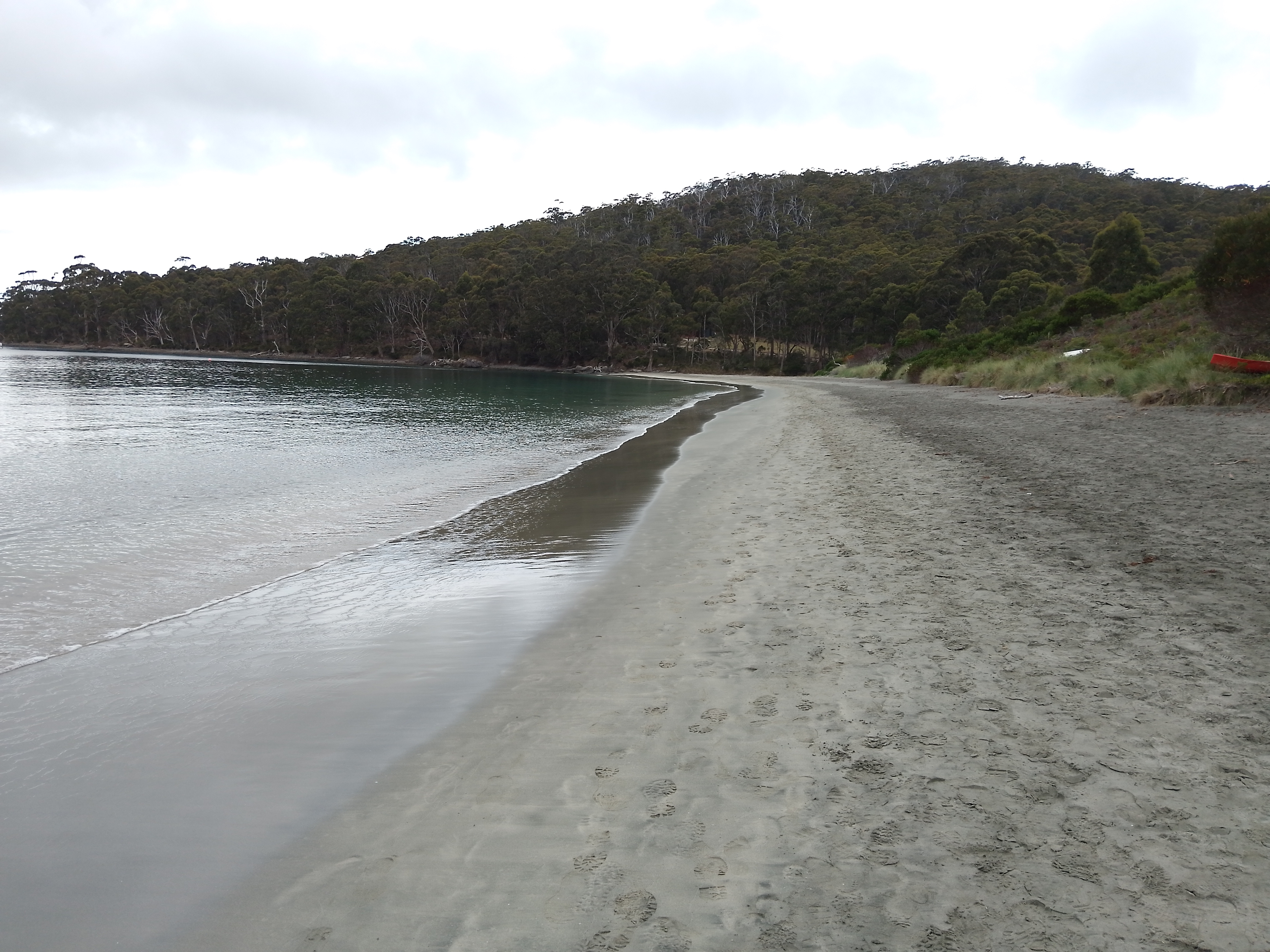
Adventure Bay, where James Cook landed in 1777. There is an excellent museum nearby with many documents and artefacts, including a piece of the Eucalyptus tree that marked the landing spot. Photo: John Grace
Last week we took the ferry to Bruny Island and drove to Adventure Bay, a fine stretch of sandy beach. The shore is still fringed with E. obliqua and various native shrubs including at least two species of Banksia. I strolled on the beach where Cook and others walked in 1777, and I could almost feel their presence. However, the illusion was somewhat spoilt by the sight of a large patch of Cirsium arvense, the Creeping Thistle of Europe. Thistles get everywhere! Who knows, perhaps Cirsium travelled as seeds with the luggage of the early mariners.

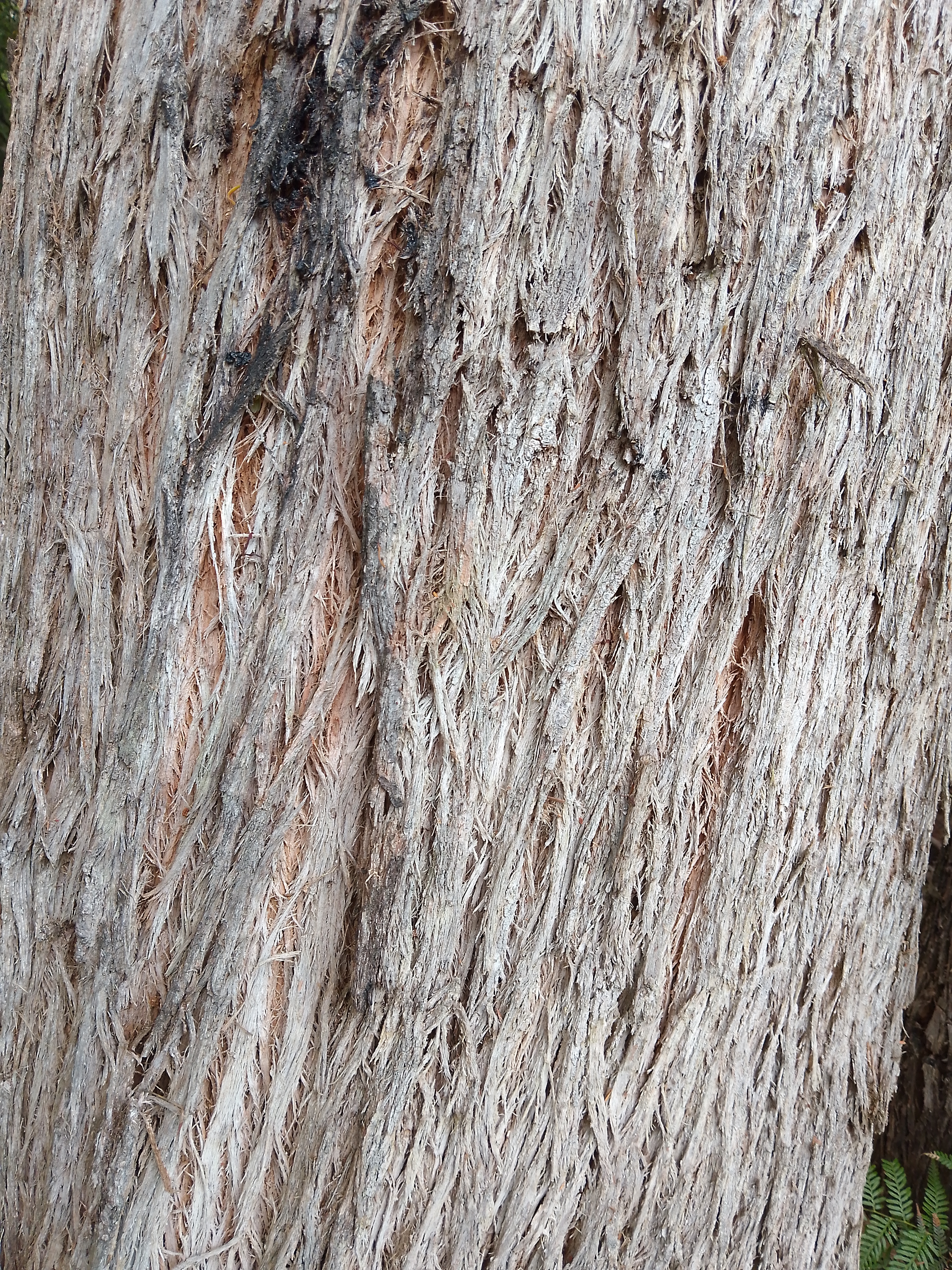
Leaves and bark of E. obliqua. For identification, the ‘stringy’ bark and the base of the leaves (‘oblique’) are good diagnostic features, as well as the great height. Left: note the asymmetry of the base of the leaf. Fresh leaves are glossy green on both sides. Right: the bark is thick and ‘stringy’. Photos: John Grace.
Eucalyptus obliqua is a handsome tree, capable of growing to a height of 80 metres or more. In the ranking of tall Australian trees, it comes a close second to Eucalyptus regnans the Mountain Ash. That one can reach almost 100 metres, and holds the record for the tallest Angiosperm tree in the world. Coniferous trees elsewhere are even taller: the Coastal Redwoods of California and Oregon are the tallest living organisms on the planet, the tallest being 115 metres, close to the theoretical limit imposed by the tensile strength of water.
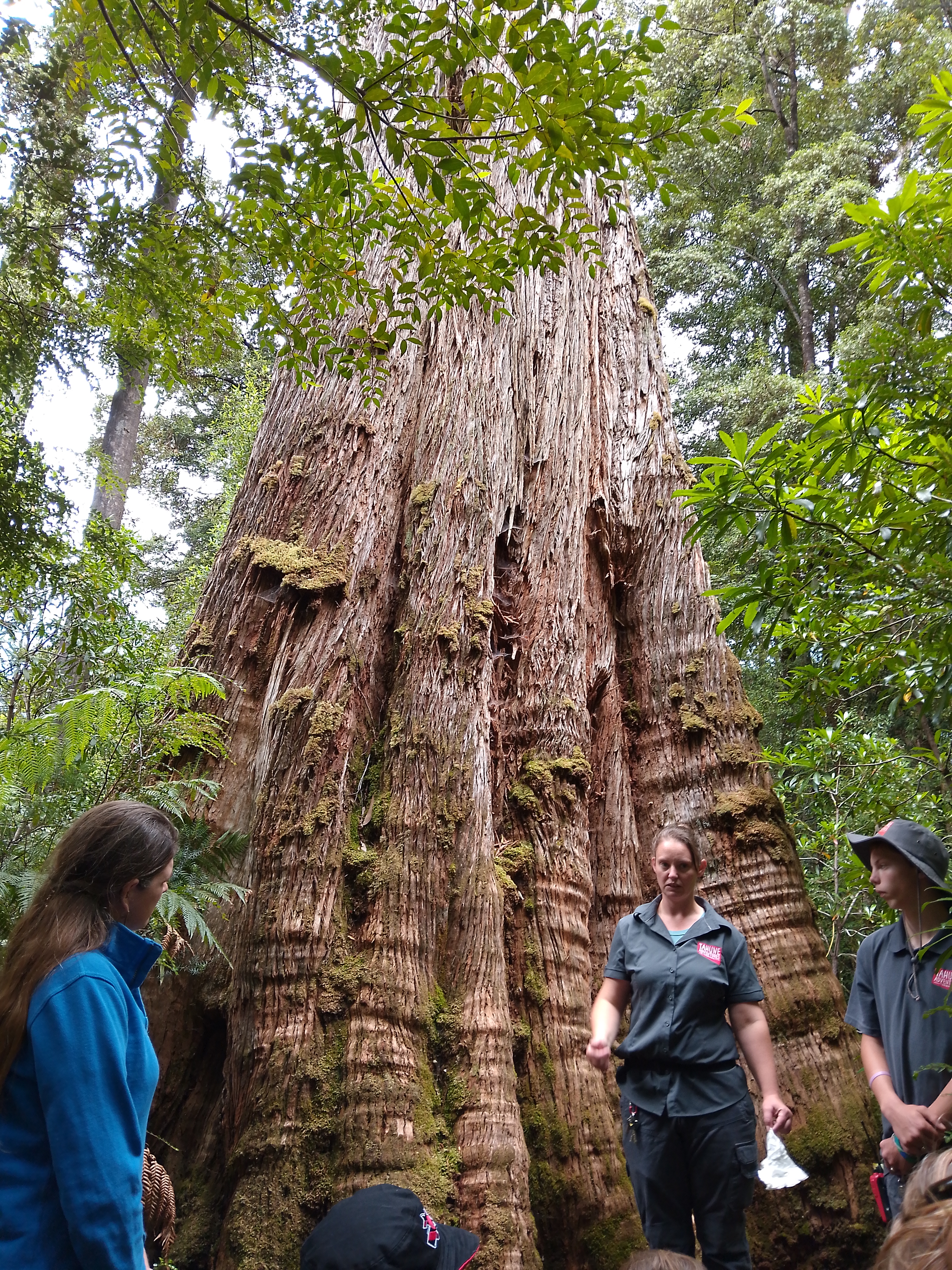
The fluted base of a large Eucalyptus obliqua, with a tour guide from Tahune Adventures. Photo: John Grace.
Eucalyptus obliqua is a very tough tree. We visited a fire-stricken region of the River Huon, on the banks of the Huon River at Tahune, and saw huge trees that were charred and had lost most of their foliage in the fires of 2019. The thick bark gives them their name of ‘Stringy’ and insulates and protects their internal tissues. Those that had been badly scorched were sprouting new foliage from their trunks (‘epicormic shoots’). Not all had survived, some had smouldered down to their roots. However, there were seedlings as well as the epicormic shoots, so the forest is expected to endure.
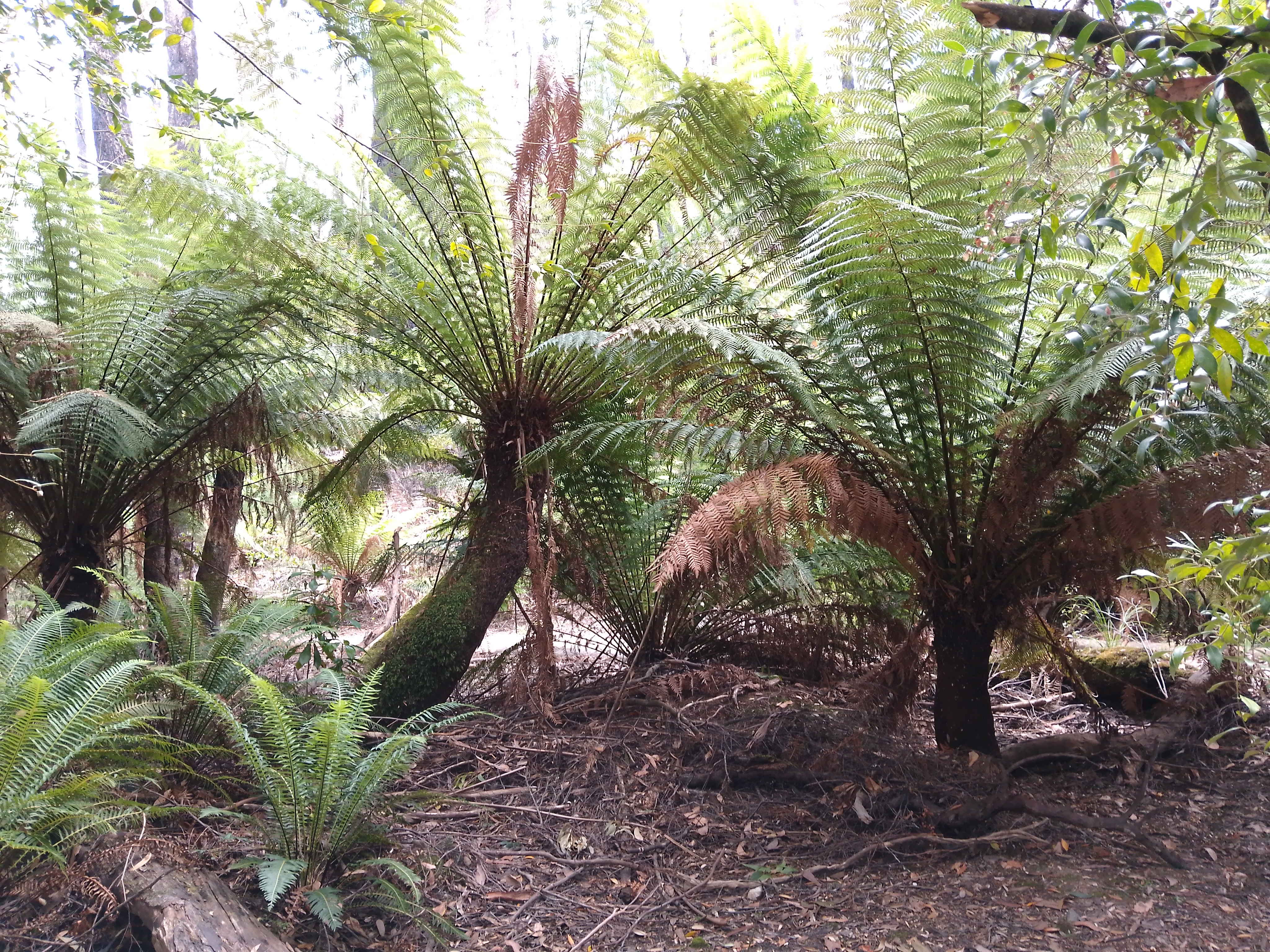
The understory of the forest is a diverse mixture of plant life including these tree ferns Dicksonia antarctica. Photo: John Grace.
The forest in the Geeveston area is also famous for the Huon Pine, Lagarostrobos franklinii . Although called ‘Pine’ it is not a true pine but a member of the Podocarpaceae. It grows very slowly, has dense wood and attains a great age (2000 years). It was heavily exploited in former times for its high quality timber but we saw only young trees along the river bank. I have read that it was once planted in Scotland, in the grounds of Crathes Castle in Aberdeenshire, Scotland, and is doing well.
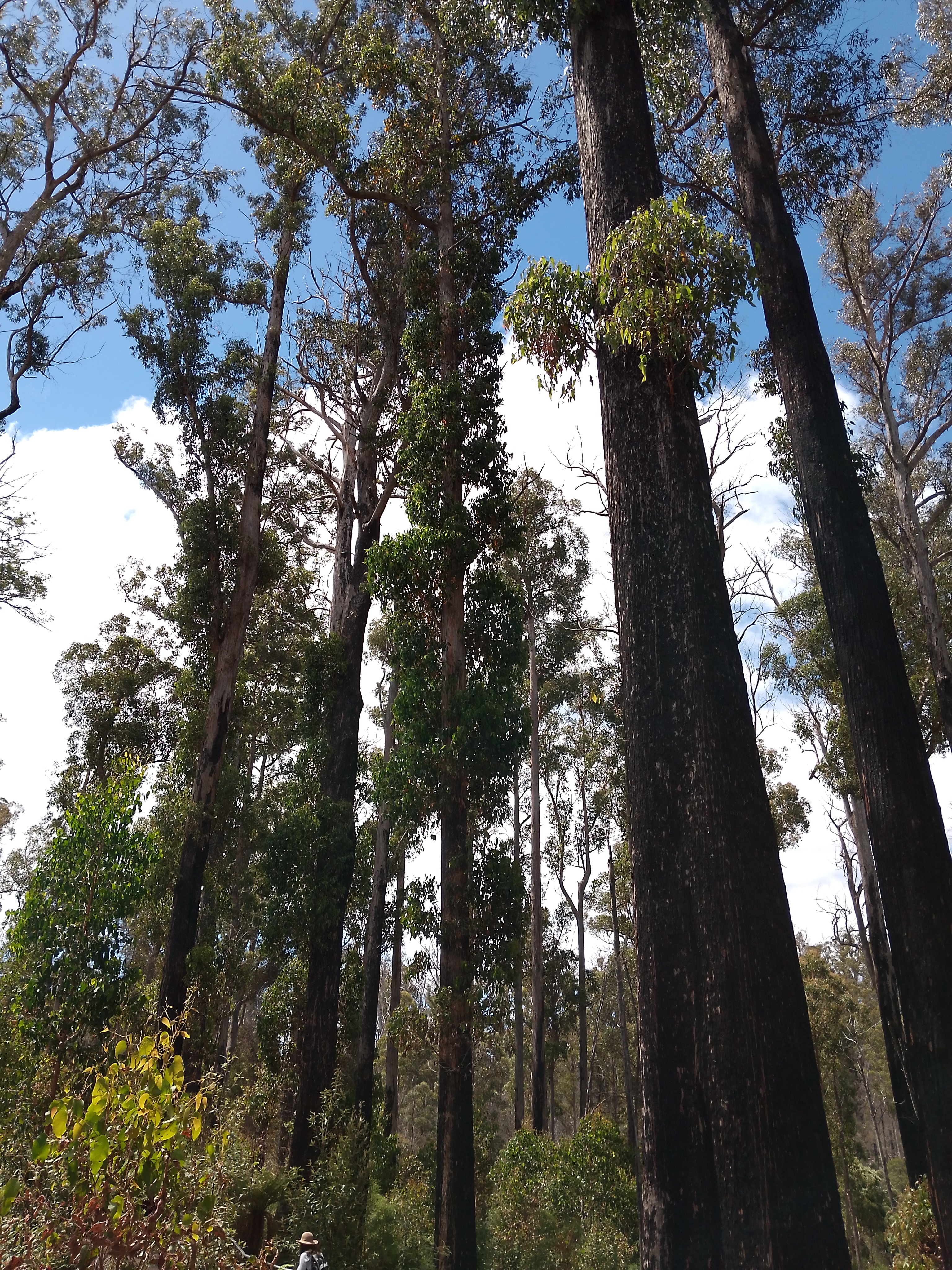
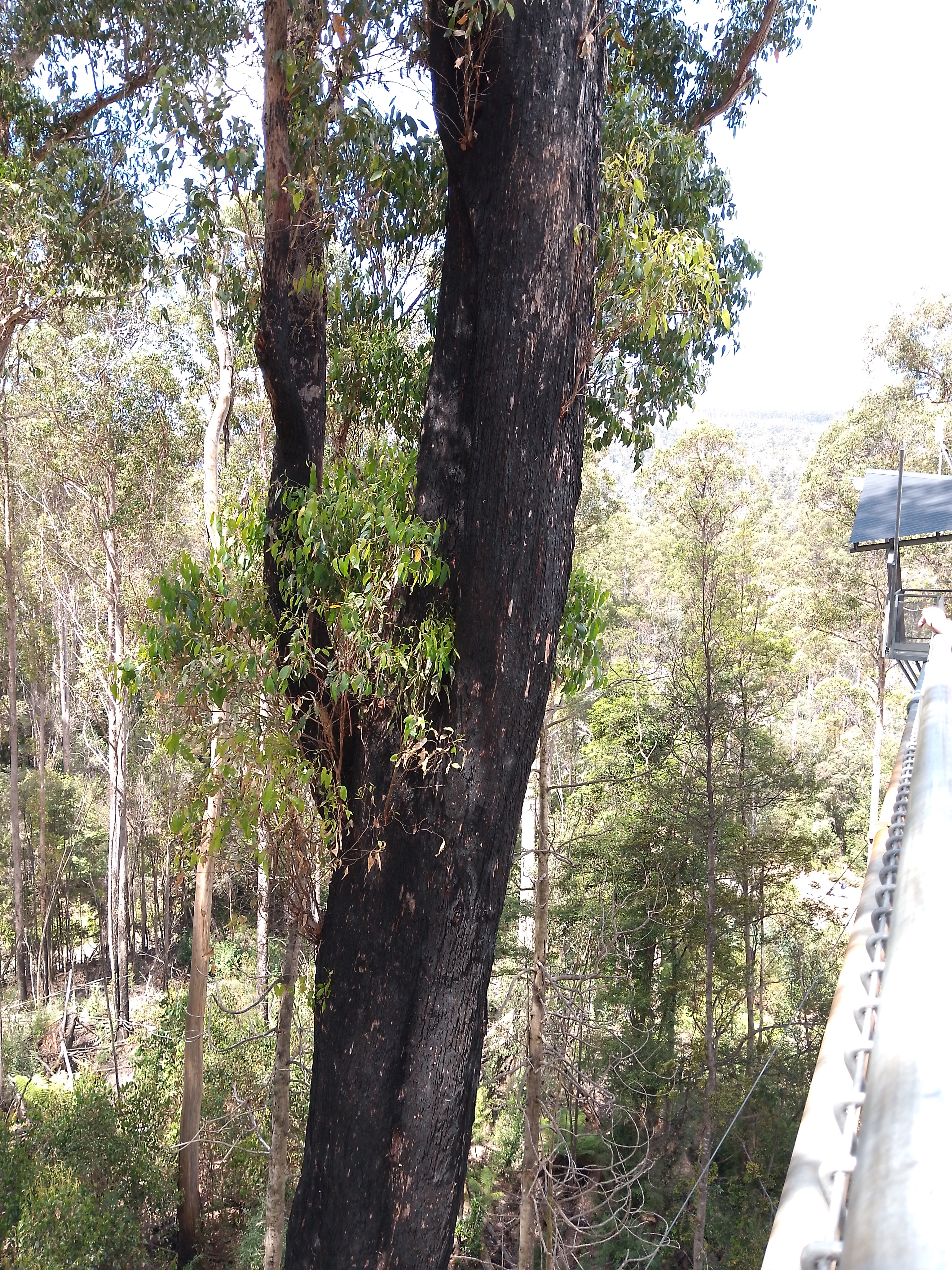
Recovery after the forest fire in 2019. The trunks are scorched but the crowns are green and epicormic shoots can be seen sprouting from the trunk. This is their appearance in early January 2024. Photo: John Grace.
Tasmania has long been a battle-ground between conservationists and commercial interests. Since 1982 almost a quarter of the land has been designated as World Heritage by UNESCO: “one of the world’s largest and most spectacular temperate wilderness areas and a precious cultural landscape for Tasmanian Aboriginal people, who have lived here for approximately 40,000 years”. Moreover, 59% of Tasmania’s native forests are protected in reserves, which includes over 80% of the old growth forests. Nevertheless, Wet Eucalyptus forests have declined by 9.5% since 1996 although the rate of decline has reduced in recent years.
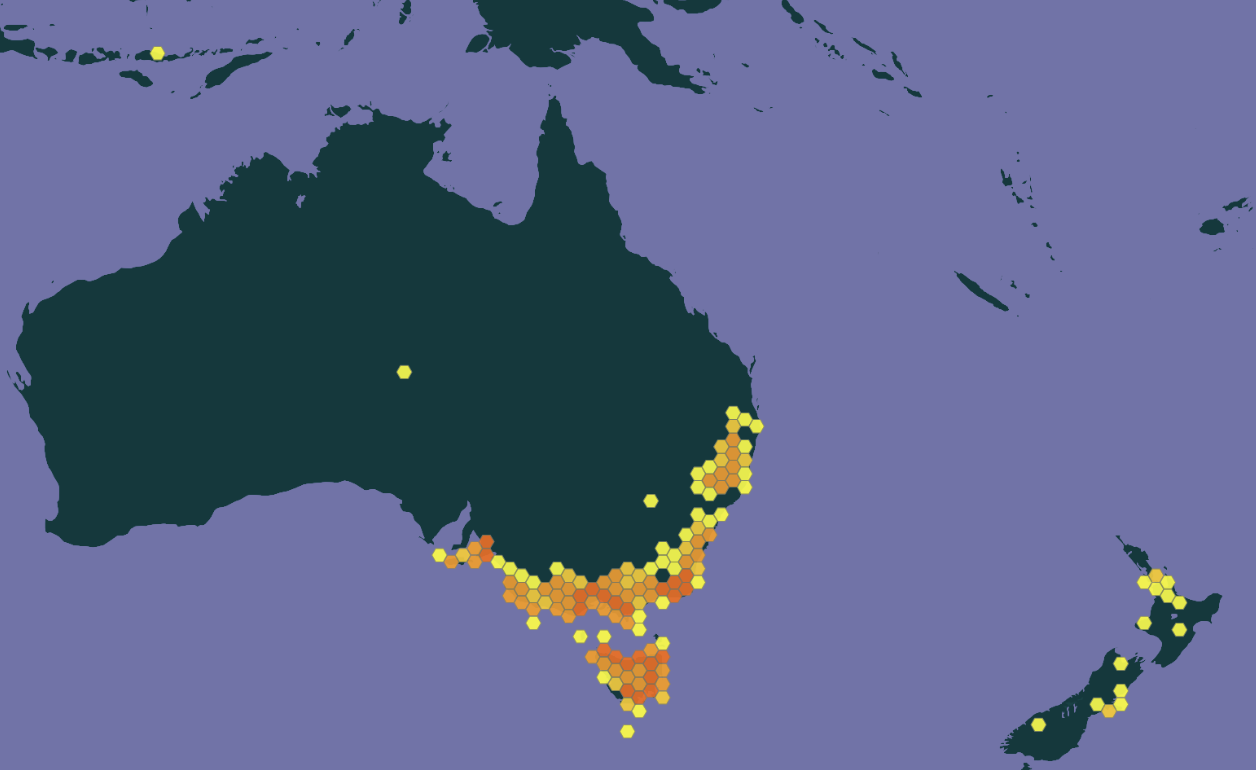
Distribution of Eucalyptus obliqua according to GBIF, the Global Biodiversity Information Facility.
Eucalyptus timber (many species) has been used to make high quality white paper (smooth, soft and strong). Magnificent trees can end up as writing paper, copy paper, cigarette paper, toilet paper or napkins. Worldwide, much of the harvested material comes from plantations, but in Australia native Eucalyptus has been harvested from the remaining wild forests. However, the market has changed. Demand for paper has fallen as electronic communication has grown and a new industry based on recycling has grown up. According to this Guardian article the white paper industry of Australia is now ‘dead’.
Worldwide, there is still strong demand for paper. I was surprised to see that global production has not fallen although I cannot find out how much comes from recycled materials. The manufacture of paper has a strong environmental impact, being responsible for much CO2 emission, water use and pollution of waterways.
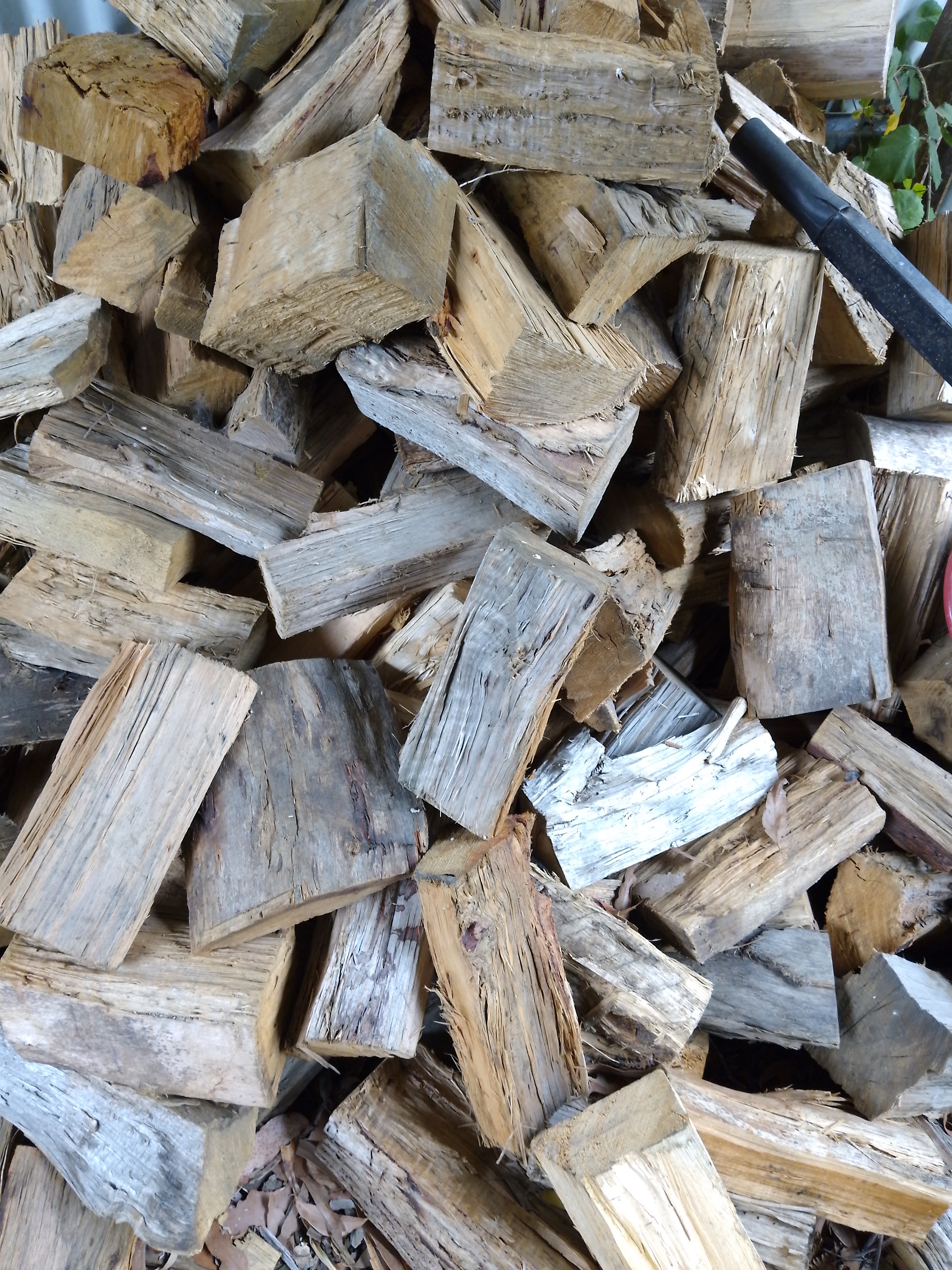
Eucalyptus logs in a woodpile outside the AirB&B residence where we are staying. Photo: John Grace.
The Eucalyptus timber has other uses. It is not especially strong but it can be used for house building, flooring and furniture. It splits easily, and so smaller pieces can be used for firewood.
Tasmania remains a wildlife haven and for most of us, it is ‘special’. As darkness falls and hundreds of short-tailed shearwaters flash over our heads, returning to their burrows to feed their young, we feel closer to nature. But we are also reminded that this wild land still belongs to the aboriginal people, having never been officially ceded to ‘settlers’ even though the last remaining pure-blooded Tasmanian woman, known as Truganini died in 1876.

Cook’s third and final voyage of discovery (1776-1779) starting in Plymouth (attribution: AlexiusHoratius at English Wikipedia, CC BY-SA 3.0 https://creativecommons.org/licenses/by-sa/3.0, via Wikimedia Commons). Cook was looking for the ‘north-west passage’ between the Atlantic and Pacific though the Arctic Ocean. He was killed on 14 February 1779 but the HMS Resolution continued under the command of Charles Clerk. But Clerk died of tuberculosis. Then the ship returned to London under the command of John Gore. Note: As global temperatures rise and ice melts, the ‘north-west passage’ will finally become a reality, though claims of ownership may impede its use.
The Tasmanian aboriginals made good use of the Eucalyptus obliqua. I’m including a photograph of a canoe made of it. These crafts were used for exploration, hunting, transport and ceremonial purposes. The design and construction method dates from around 40,000 years ago.
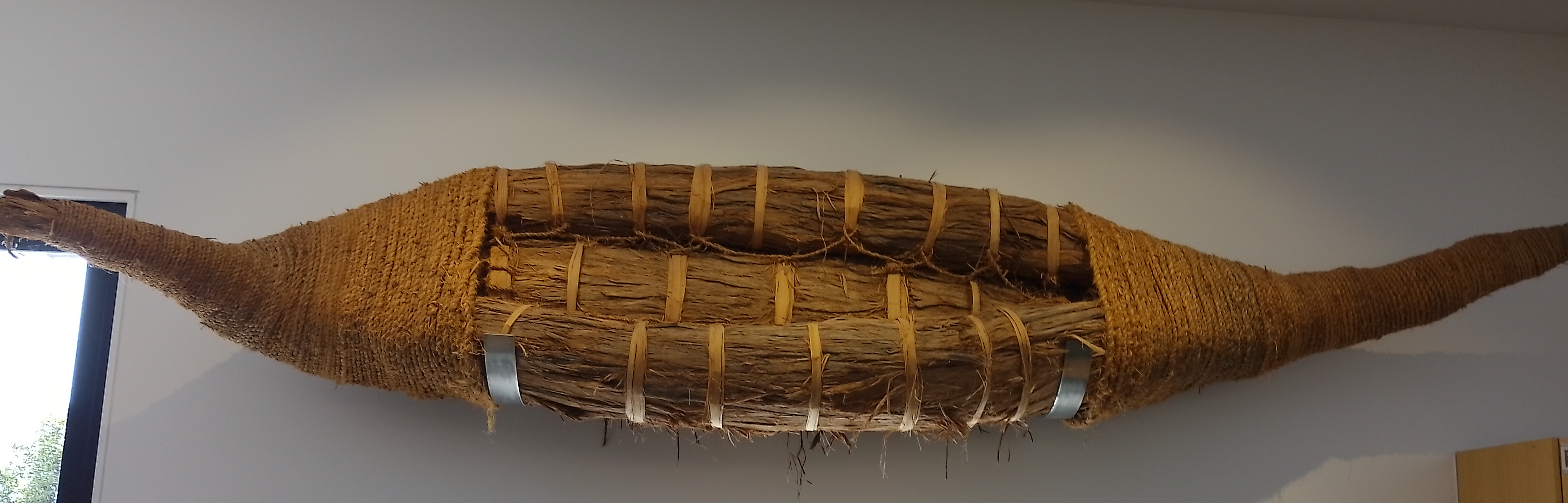
Skill and ancient knowledge passed down through many generations were used to make this aboriginal canoe, mostly using the bark of Eucalyptus obliqua. It was displayed at the 2017 Australian Wooden Boat Festival. Such canoes were used all over Tasmania and distant islands. This one adorns a wall at the Bruny Island Cruises restaurant.
Internet sources consulted
https://en.wikipedia.org/wiki/Eucalyptus_obliqua
http://tasmaniasgianttrees.weebly.com/
https://www.wilderness.org.au/iconic-places/tasmanias-forests#:~:text=The%20reality%20of%20logging%20is,burn%20the%20vegetation%20that’s%20left.
https://en.wikipedia.org/wiki/List_of_tallest_trees
https://tasmaniasgianttrees.weebly.com/
©John Grace