Armoracia rusticana – June 3rd 2024- (Horse-radish)

Illustration from Gerard’s 1597 Herbal. Gerard wrote: “Horse-Radish for the most part groweth and is planted in gardens, yet have I found it wild in sundry places, as at Nantwich in Cheshire, in a place called Milne eye, and also at a small village near London called Hogsdon, in a field next unto a farmhouse leading to Kingsland”.
Horse Radish is a long-lived perennial in the Brassicaceae (the same Family as Cabbage, Mustard and Wasabi). It has been cultivated throughout Europe for at least 2000 years, and widely used as a herbal medicine and a condiment. It was well-known to Hildegard von Bingen (1098-1179) the visionary Benedictine abbess from the Rhineland, who describes a powder made of Horseradish mixed with Galingale (the sedge, Cyperus longus). Her knowledge was derived mostly from her convent work in the herb garden and infirmary. According to von Bingen: “whoever has pain in his heart should eat this powder, before or after a meal … he will be better”. It was probably used in Germany from that time onwards; even today the French call it Moutarde des Allemands.

The large basal leaves might be mistaken for Dock (Rumex). Image: Chris Jeffree.
Horse-radish has moved westward from its native lands in Eastern Europe, perhaps via monastic gardens. The herbalist John Gerard knew it well in the 16th Century, from both the south and north of England. He says that northerners call it Red-cole. Evidently, it escaped from gardens and even in Gerard’s time it could be found growing wild. Now it is common in the southern half of Britain (the edges of tracks, paths, roads, rivers and on waste ground, railways, and sometimes sandy shores). It also gets into Scotland, even extending to Shetland.

Two sorts of leaves, large broad-leaves forming basal rosettes and narrower stem-leaves. There is considerable variation. In some forms the leaf-margins are deeply indented. Image: Chris Jeffree.
I like Gerard’s description:

How it travels is something of a mystery as it doesn’t produce much viable seed as far as we can tell. Only a few ovules are fertilized and they usually abort (Rich 1991). However, some authorities, including Gerard, say is does produce at least some viable seeds on some occasions (Sampliner and Miller 2009). Has it lost much of its ability to reproduce sexually, or is it really a hybrid of two species and therefore inherently almost sterile (as many hybrids are)? This is still an open question.


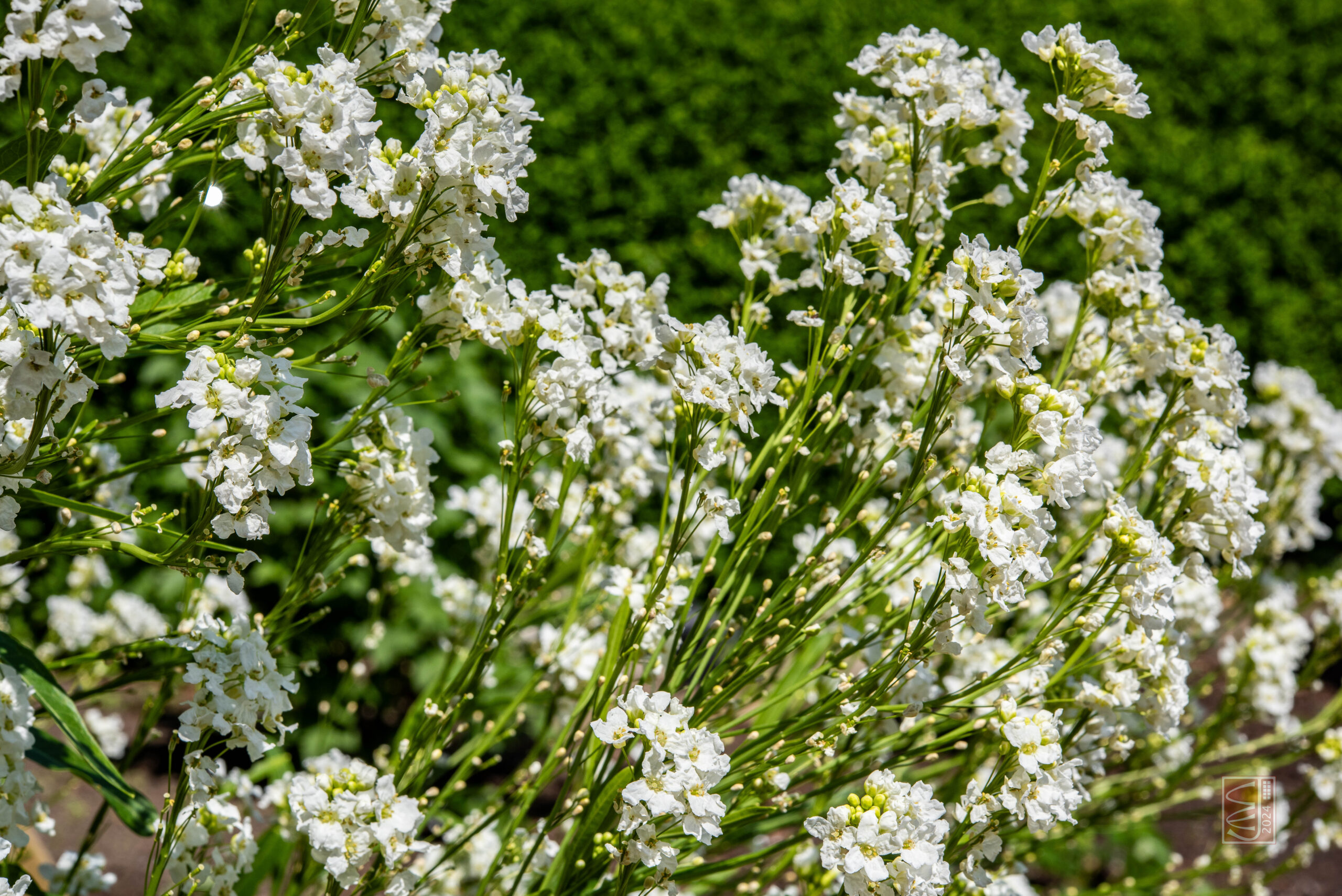
Flowering from late April to June. The flowers are small but grouped, as in many members of the Brassicaceae, to increase their apparency to insects. Images: Chris Jeffree.
It spreads vegetatively by means of its roots to form clumps that last for many years. Antiquarian gardening books show how to take a root cutting: make a clean cut, drop it into a hole in the ground, and thus obtain a new plant in a few months’ time. One can imaging gardeners-of-old doing this, and passing on cuttings to friends and neighbours, along with advice on how to make the pungent horseradish sauce as a relish to accompany roast beef, by simply grating the root and mixing it with vinegar. It is too hot for some people and should not be consumed in large quantities.


Left: young shoots emerging in early Spring; right: flower-heads are forming. Notice the leaves on the flowering stems are narrow. Image: Chris Jeffree.
The plant looks like a Dock (Rumex sp.), with leaves that are bright green and large (up to 50 cm long). But when flowering (May to June) it reveals its true identity. Flowers have the typical features of the Brassicaceae. There are four white petals and the flowers are scented. Rich (1991) says flowers are ‘often imperfect’ (in Botany, it means the flower only has male or female parts). These small flowers cannot be described as ‘pretty’, but perhaps to a passing butterfly or bee the inflorescence is not only pretty but simply irresistible.

This specimen is from the author’s garden, taken from a long-established and neglected patch at the end of May 2024. At this time of year, plants are flowering but a few new shoots are still emerging.
The part most often harvested for human consumption is the root. It is the storage organ, whereby the plant over-winters (leaves die down in winter). A well-grown root can be 60 cm long and over 2-5 cm in diameter. It can be sliced and roasted like a parsnip but more usually it is simply grated then mixed with vinegar or mayonnaise to make the hot sauce. It should be consumed when freshly made, otherwise it becomes bitter. Leaves can be eaten too, but only when they are young. Some people let the roots sprout in darkness, producing pale leaves with a milder flavour. It has also been used to make cocktail drinks, most notably Bloody Mary. The species is cultivated commercially in some parts of Europe (especially Hungary) and also in the USA.

From Kew’s Plants of the World On-line. Distribution of Horse-radish according to country. Green denotes the likely native range, and purple the introduced areas. It has also been introduced to Australia (commercially grown in Tasmania) and New Zealand (alas, not shown by Kew’s mapping).
Many of the Brassicas defend themselves from herbivores with ‘the mustard-oil bomb’. The plants produce a compound called glucosinolate and the enzyme myrosinase. In the plant’s cells these are stored in separate compartments. But when leaves or roots are torn or munched by insect mandibles the enzyme comes into contact with the glucosinolate, and rapidly breaks the large molecule to release the small sulphur-containing compound (see the diagram below). It is this compound which is nick-named mustard oil, and it gives any hungry caterpillar or slug a nasty shock. Very few creatures can withstand this but humans enjoy the piquancy and that is why they cultivate the plant.

Distribution of Horse-radish in Britain and Ireland, according to the BSBI.
When I searched the science literature using Google Scholar I found hundreds of research reports relating to potential medicinal compounds found in Horse Radish and their effects on fungi, bacteria and animals cells. This did not surprise me in view of the extensive use of the plant in traditional medicine. Rather than try to summarise the huge body of data, I refer the reader to the summary in Plants for a Future (PFAF). The website is here: https://pfaf.org/User/Plant.aspx?LatinName=Armoracia+rusticana

Illustration of the ‘mustard-oil bomb’. The molecule on the left is a glucosinolate, essentially glucose with a sulphur group attached. The enzyme myrosinase breaks the glucose-to-sulphur bond and in doing so releases the molecule on the right, known as mustard oil.
Fans of permaculture may be attracted to this plant as it is persists for many years and the green tops can be eaten (as for most Brassica species). Here is one article from the Permaculture Institute. However, the flavour is not to everyone’s taste, and I have not seen its roots on supermarket shelves so far. Its commercial use is mostly for making substitute ‘wasabi’ products and bottled sauces. One of its products, horseradish peroxidase, is used in molecular biology and biochemistry to amplify a weak signal of a target molecule.
The plant has been given a bewildering number of Latin names over a few hundred years. here are a few: Cardamine armoracia, Cochlearia rusticana, Nasturtium armoracia, Rorippa armoracia, Rorippa rusticana. I prefer the common English name Horse Radish (but ‘Horse’ doesn’t refer to equines but is a metaphor for ‘powerful’). The specific name ‘rusticana’ means ‘of the countryside’.
References
Courter JW and Rhodes AM (1969) Historical notes on horseradish. Economic Botany 23, 156–164. https://doi.org/10.1007/BF02860621
De Candole A (1884) Origin of cultivated plants. Kegan Paul, Trench & Co, London.
Lim TK (2015). Armoracia rusticana . In: Edible Medicinal and Non Medicinal Plants. Springer, Dordrecht. https://doi.org/10.1007/978-94-017-9511-1_25
Rich TCG (1991) Crucifers of Great Britain and Ireland. BSBI.
Sampliner D and Miller A (2009) Ethnobotany of Horseradish (Armoracia rusticana, Brassicaceae) and Its Wild Relatives (Armoracia spp.): Reproductive Biology and Local Uses in Their Native Ranges. Economic Botany 63, 303–313. https://doi.org/10.1007/s12231-009-9088-1
Throop P (1998) Hildegard von Bingen’s Physica – The complete English Translation of her classic work on health and healing. Healing Arts Press, Vermont.
Wythes G and Roberts H (1906) The book of rarer vegetables. John Lane, Bodley Head.
©John Grace