Neottia ovata – June 17th 2024 – (Common Twayblade Orchid)
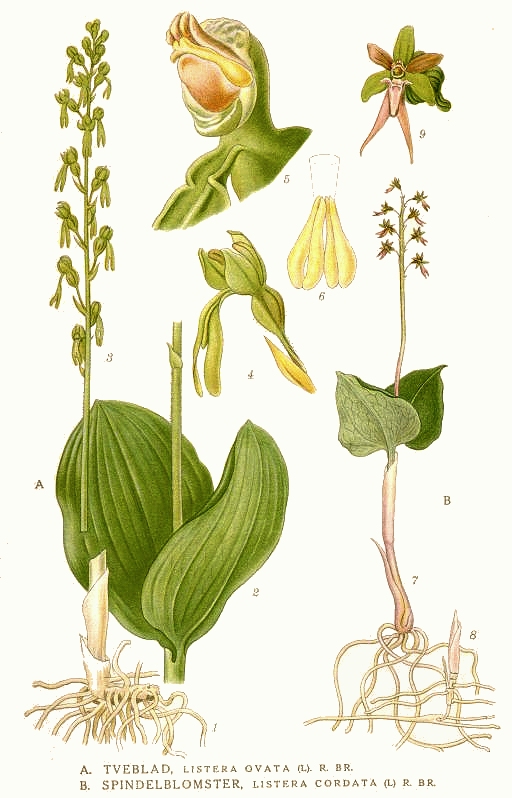
Two Twayblade orchids: Left: Neottia ovata, Common Twayblade; Right: Neottia cordata, Lesser Twayblade. Attribution: Carl Axel Magnus Lindman (1856-1928), Public domain, via Wikimedia Commons.
I found a large population of Neottia ovata last year (2023) when botanising on derelict land in Bathgate (West Lothian). The area is called Boghead, and it was once the site of the world’s first commercial oil-works, following the historic discovery of bituminous coal by James Young. The ground has been highly disturbed in past times (from the 1850’s) but is quiet now and a haven for wild plants. There are lagoons, a woodland and rough grassland. I came across this orchid but it was not yet in flower. A few weeks later I returned, but alas it was too late, the flowers had been grazed. This year I fared better: many plants were in flower when I re-visited on June 7th.

Neottia ovata in mixed deciduous woodland, Boghead, Bathgate, West Lothian. Image: John Grace.
This is a widespread European orchid. In Britain, it can be found in a range of habitats: woodlands, grasslands, hedges, dunes and fens.
At Boghead the plants are growing in a mixed deciduous woodland, and there are about 50 of them in an area of 10 square metres. Flowers of wild strawberry decorate the nearby ground. The orchids are well away from the path through the woods, where dog-walkers go. There is a network of deep ditches, once part of the thriving 19th Century industrial complex but now littered with supermarket trollies and 21st Century plastic detritus.

From the scene above, many plants were in flower. Image: John Grace.
Neottia ovata has only two leaves (hence the name ‘twayblade’) and they bear no spots or stripes. Unlike most orchids, flowers of this one are not ‘showy’. Their floral parts are much-reduced in size and they are green. Pollinators are attracted not by colour but by scent – the flowers emit sweet-smelling volatile compounds (mono- and sesquiterpenes). The ‘runway’ for incoming insect flights is the labellum, the only part of the flower that is enlarged to any extent. It is bent sharply downwards and has a longitudinal groove that becomes filled with nectar, so after touchdown the insect follows the sweet trail to the reproductive parts of the flower, where it finds its main meal of nectar.

N. ovata, showing the emergence of the flowering spike. Image from Aberlady Bay: Chris Jeffree.
In all Orchids, the male and female parts of the plant are combined to form a column, and at the top of the column are packets of pollen (‘pollinia’). Below this is the stigma. The insect visitors reach for nectar and in doing so a pollinium sticks to their heads. In Neottia the mechanism for this seems to be more exact and intricate than in other orchids. The complex process is described by Proctor et al (1995) and Kotilínek et al. (2015).

Detail of flowers to show the sharp angle of the labellum, and the nectar-filled groove on the surface of the labellum. See also the illustration at the top of this page: the artist has greatly exaggerated the groove. Image: Chris Jeffree.
The pollinating insects are mostly ichneumon wasps, sawflies and beetles. The insects feed for a while before moving on, transferring part of their pollen-load to another’s stigma. There is a mechanism to prevent self-pollination (Kotilínek et al. 2015).
The seeds are ‘dust-like’ and shed within three weeks of fertilization. They are dispersed when a gust of wind shakes the stalk, and on contact with soil they soon begin to germinate. They lack the nutritive storage tissues (endosperm) found in other flowering plants and so complete germination involves infection with one or more fungal symbionts, a process whereby Neottia gains its food from fungi in a slow development that takes as long as four years. Here is the description of the early stages in the life history of this orchid from the detailed study in Belgium by Jacquemyn et al. (2015):
“The seeds germinate in spring and the young protocorm rests during the summer. In autumn, a highly mycotrophic, short thick root develops below the apical bud. In the second and third year, similarly shaped roots develop that are a bit longer and more slender than the previous ones. Only after the fourth spring, the first leafy shoot develops. From this stage onwards, the rhizome further develops. Roots generally continue to grow and have a lifespan of about 10 years”

Neottia ovata showing a succession of flower-opening within the spike. In one of the flowers the nectar in the groove has dried and appears white. In this particular plant some flowers have the labellum pointing up instead of down. Image: Chris Jeffree.
Some of the dark mysteries of the orchid’s early life have been investigated using DNA sequencing. Jacquemyn et al. (2015) made a thorough investigation of the fungi present in the soil and roots at 28 N. ovata sites. They found a total of 68 species of “putatively mycorrhizal fungi” 21 of which occurred exclusively in roots, 25 that occurred solely in soil and 22 that were observed in both the soil and roots. Many of the fungi were agarics, in the order Sebacinales (Jacquemyn et al. 2015).
The importance of this process of seed regeneration versus vegetative spread is not clear. The distinguished Swedish ecologist Carl Otto Tamm made long-term observations of the species and thought seed production was unimportant but recent work suggests otherwise (Tamm 1972, Kotilínek et al. 2015). In any case, the plant is rhizomatous and it is likely that the colony’s expansion depends mainly on vegetative spread. Once established, and united with helpful fungal symbionts, individual plants may live for a long time, perhaps 70 years.
N. ovata is considered to be in decline. The BSBI Atlas 2020 says this:
“Some lowland sites have been lost to agricultural activities, including ploughing of grassland and hedgerow removal. The majority of losses, however, may be a result of long-term neglect or a lack of suitable grassland management, as well as the piecemeal destruction of suitable habitat for development”.

Neottia cordata at Coire an t-Sneachda, a mountain corrie in the Cairngorms. Image: Chris Jeffree.
Until 2003 the genus Neottia contained only non-green saprophytic species; in Britain there was just one member, the Bird’s-nest Orchid Neottia nidus-avis. The Twayblades were in the genus Listera. However, it was well-known that Twayblades had much in common with Neottia, especially the flower structure and pollination mechanism. Molecular genetics confirmed the relatedness, and so Twayblades were moved to Neottia and Listera is no longer a recognised genus despite being listed in all reference books written before 2003.
The Lesser Twayblade, Neottia cordata, is smaller but has a similar structure and life history to N. ovata. Its ecological characteristics are quite different: in Britain it is a distinctly northern species growing in wet moorlands, often in association with Sphagnum. Like N. ovata, its seeds are tiny, without endosperm, and it needs to form associations with fungi to complete its germination. The first green leaf emerges after three years of life as a subterranean protocorm (Kotilínek et al. 2017). The flowers are tinged with red.

British distribution of the two Twayblades: Left, N. ovata. Right, N. cordata. Note the pale-coloured squares in England, showing where the species have not been seen for many years. From BSBI.
I first saw N. cordata many years ago in the North Pennines of England, growing on rain-fed peatlands in the partial shade of heather and cotton-grass. It may not be there anymore. Survival is threatened by the management of grouse moors by fire (‘muirburn’) and the drainage of peatlands, and so N. cordata has been lost from many parts of the Pennines and some parts of Scotland and Ireland too. It is not however considered to be declining in Britain as a whole (Stroh et al 2020), unlike N. ovata.

Circumpolar view of the global distributions. Left: Neottia ovata. Right: Neottia cordata. From GBIF.
The global distribution patterns show how N. cordata occupies some of the coldest and wettest parts of the planet, whilst N. ovata is absent from such places as Alaska and Greenland.
References
Jacquemyn H et al (2015) Mycorrhizal diversity, seed germination and long-term changes in population size across nine populations of the terrestrial orchid Neottia ovata. Molecular Ecology, 24, 3269–3280.
Kotilínek M et al. (2015) Biological Flora of the British Isles: Neottia ovata. Journal of Ecology 103, 1354-1366.
Kotilínek M et al. (2017) Biological Flora of the British Isles: Neottia cordata. Journal of Ecology 106, 444-460.
Kowalkowska et al. (2019) Anatomical features related with pollination of Neottia ovata (L.) Bluff & Fingerh.(Orchidaceae). Flora 255, 24-33.
Proctor M, Yeo P and Lack A (1995) The Natural History of Pollination. Collins. (note, this very detailed book is available online).
Stroh TA et al (2020) Neottia ovata (L.) Bluff & Fingerh. in BSBI Online Plant Atlas 2020 https://plantatlas2020.org/atlas/2cd4p9h.6y5wpn
Stroh TA et al (2020) Neottia cordata (L.) Rich. in BSBI Online Plant Atlas https://plantatlas2020.org/atlas/2cd4p9h.6y5wp4
Tamm CO (1972) Survival and flowering of some perennial herbs. II. Behavior of some orchids on permanent plots. Oikos, 23, 22–28.
©John Grace