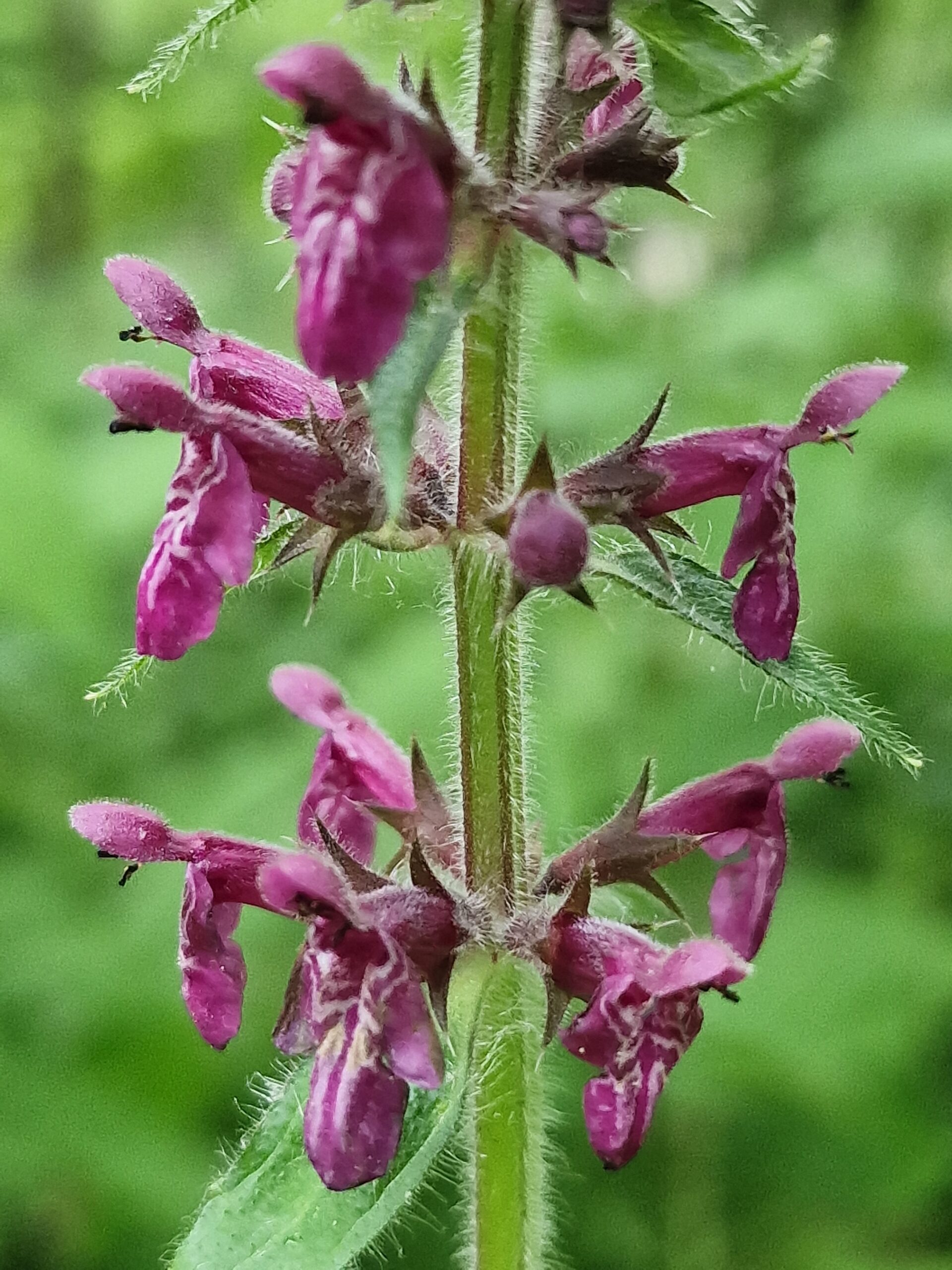
Stachys sylvatica – July 1st 2024 – (Hedge Woundwort)
This plant is just coming into flower. I saw it flowering for the first time this summer at Dumfries House, Ayrshire, last week. The books say it flowers from ‘July to August’ so perhaps it’s early this year.

Attribution: Johann Georg Sturm (Painter: Jacob Sturm). J.G. Sturm (1742–1793) was a German natural history illustrator. Jacob Sturm was his son. Public domain, via Wikimedia Commons.
I have known Stachys sylvatica since childhood and its peculiar smell reminds me of those days. It’s a very common plant but it can be confused with Stachys palustris, with which it hybridises.
Stachys sylvatica grows in the dappled shade of woodlands and hedgerows, usually on rich and somewhat damp soils with a pH in the range 5 to 8. It’s a native plant first reliably recorded in the wild in 1629 by Thomas Johnson, the Yorkshire-born botanist who thoroughly revised Gerard’s 1597 Herbal. Archaeological remains are often found from the Neolithic and Bronze Age periods, establishing beyond doubt that it is a native plant rather than an early introduction (Taylor and Rowland 2010).

Dense patch of Stachys sylvatica. Old Dalkeith High School. Image: Chris Jeffree.
The English name Woundwort refers to the healing properties of Stachys which Gerard writes about enthusiastically. Much earlier, in the 12th Century, the Benedictine abbess Hildegard Von Bingen from the Rhineland also wrote about these healing properties. More about its medicinal value later in this article.


Stachys sylvatica inflorescence. Flowers are ‘reddish purple’, plant very hairy, whorls well-seperated. Image: Chris Jeffree.
The plant tends to grow in nitrogen-rich soils, and its leaves can have as much as 4% nitrogen, rather like Stinging Nettle (Urtica dioica) and Goosegrass (Galium aparine). That’s about the same as the chicken-manure pellets used by gardeners.
It belongs to the Family of dead-nettles, mints and salvias, the Lamiaceae. It has the characteristic square stems, simple leaves with stalks arranged in opposite pairs; and flowers that look a bit like lips. Like many of that Family it is a perennial with creeping rhizomes and rather hairy stems and leaves. Also like many it has a strong smell when bruised – generally the smell is described as ‘foetid’ in contrast to the sweet smells of mint and sage as well as the many other Family members in the culinary repertoire.

A close relative, Stachys palustris by the River Esk, Musselburgh. Flowers are ‘pinkish purple’ , whorls closer together than S. sylvatica, leaves without stalks. Image: Chris Jeffree.
The flowers are borne in whorls on a slender spike, opening first at the base of the spike. They are hermaphrodite, but the stamens of each flower mature before the carpels, hence reducing self-fertilization (‘protandrous’). A wide range of insects visit the flowers; bees, bumble bees, flies and hover flies. Details of the pollination by a bumble bee are described in Michael Proctor’s book (Proctor et al 1996). Seeds are shed in the Autumn but they remain dormant until the following Spring, when some of them germinate. A small percentage of the seeds remain dormant for five years.

S. palustris, detail of flowers. Image: Chris Jeffree.
Clumps form readily by growth of the rhizomes, and pieces of rhizome can sprout roots and shoots. It is also reported to be capable of above-ground spread by means of stolons. Not all authors mention this, and I hope to check for myself this year. Despite being well-equipped for vegetative as well as sexual reproduction, the plant is generally not considered to be a weed in gardens, but it can be a rapid coloniser of disturbed woodlands.

Statchys x ambigua, the sterile hybrid of S. sylvatica and S. palustris. Characters are intermediate (see Wilcock (1974). Image: Chris Jeffree.
There is a closely-related native species, Marsh Woundwort (Stachys palustris). It also has long creeping rhizomes but in addition it produces small tubers in the Autumn. It is common by streams, ditches, swamps and fens. It differs from Hedge Woundwort in that the upper leaves are sessile (not stalked) and the lower ones are short (less than 0.5 centimetres ), whereas in the Hedge Woundwort the stalks are long (1.5- 7 centimetres). Also, in the Marsh Woundwort the leaves are relatively narrow and the flowers are paler.

Statchys x ambigua, detail of flowers. Images: Chris Jeffree.
The chromosome counts of the two species are rather variable, but for the British populations, Hedge Woundwort has 2n = 64 and for Marsh Woundwort 2n = 102. They often form hybrid offspring but the chromosomes do not pair properly and so these Stachys hybrids (called Stachys x ambigua) are nearly always infertile. Hybrids have 2n = 83 and I suppose someone has worked out what exactly happens at meiosis but I have not found any reports. Many plant species have very many small chromosomes (compared with animals) and traditional cytogenetic studies can be challenging. Attempts to make the hybrids by hand-pollination have failed. Wilcock (1974) showed how the parents and hybrids may be unambiguously distinguished by simple comparison of the leaf dimensions and lengths of leaf stalks.

Excerpt from Gerard’s 1579 Herbal, as revised by Johnson in 1633, emphasising the power of Woundwort to heal wounds.
I browsed Johnson’s 1633 revision of Gerard’s 1597 Herbal to find more about the traditional use of Stachys. Several completely different species are called Woundwort but it is quite clear that the one Gerard was enthusiastic about was not S. sylvestris but S. palustris. Despite the crudity of the wood-cut print (above), we can be quite sure of the identification (the leaves have no stalks and the tubers on the roots are shown – it must be S. palustris). Gerard gives details of several medical cases he has dealt with, all of them with wounds, and all of them with a happy outcome.
There is a recent article at the web site called woodland-ways (cited below and available to browse) where someone has tried to replicate Gerard’s methods to make a healing ointment, apparently with success. It seems this author has used S. sylvatica rather than S. palustris. He/She makes an ointment, not with hogg’s fat as Gerard did, but with olive oil and beeswax. Then the author applied the ointment to himself/herself following an injury sustained on a mountain bike. The remedy worked!

British and Irish distribution of the Stachys sylvatica (left) , S. palustris (centre) and the hybrid S. x ambigua (right). From BSBI/maps.
I recently saw an article about reporting bias in science (van der Steen et al 2019). One severe source of bias is the tendency of authors to report only the research outcomes that fit their own views. But a recent review of the traditional uses of Stachys, and the diverse content of bioactive molecules discovered in plants of this genus is quite persuasive (Tomou et al 2020).
According to The BSBI’s Atlas 2020 both species are declining slightly, whereas the hybrid is increasing, sometimes growing on roadsides having been dispersed by motor cars as rhizome fragments. Looking at BSBI records since 2020 I saw there have been 33 records of the hybrid in Lanarkshire, five in Midlothian and only two in Ayrshire. In future, I will look out for it.
References
Grime JP, Hodgson JG & Hunt R (2007) Comparative Plant Ecology. Castlepoint Press and Botanical Society of the British Isles.
Proctor M, Yeo P and Lack A (1995) The Natural History of Pollination. Collins, London. (note, this very detailed book is available online).
Taylor K and Rowland P (2010) Biological Flora of the British Isles: Stachys sylvatica L. Journal of Ecology 98, 1476-1489. https://doi.org/10.1111/j.1365-2745.2010.01725.x
Tomou, E.-M et al. (2020) The Genus Stachys: A Review of Traditional Uses, Phytochemistry and Bioactivity. Medicines 7, 63. https://doi.org/10.3390/medicines7100063
van der Steen JT et al. (2019) Causes of reporting bias: a theoretical framework. F1000Res. 2019 Mar 12;8:280. doi: 10.12688/f1000research.18310.2.
von Bingen H (date of original unknown) Physica. Modern translation from the Latin by Priscilla Throop. Healing Arts Press, Rochester.
Wilcock, C.C. (1974) Population variation, differentiation and reproductive biology of Stachys palustris L. S. sylvatica L. and S. × ambigua Sm. New Phytologist, 73, 1233–1241
Wilcock CC and Jones BMG (1974) The identification and origin of Stachys x ambigua Watsonia, 10, 139-147.
Internet sites consulted
https://www.exclassics.com/herbal/herbalv40058.htm
©John Grace