Prunella vulgaris – July 15th 2024 – (Self-heal)

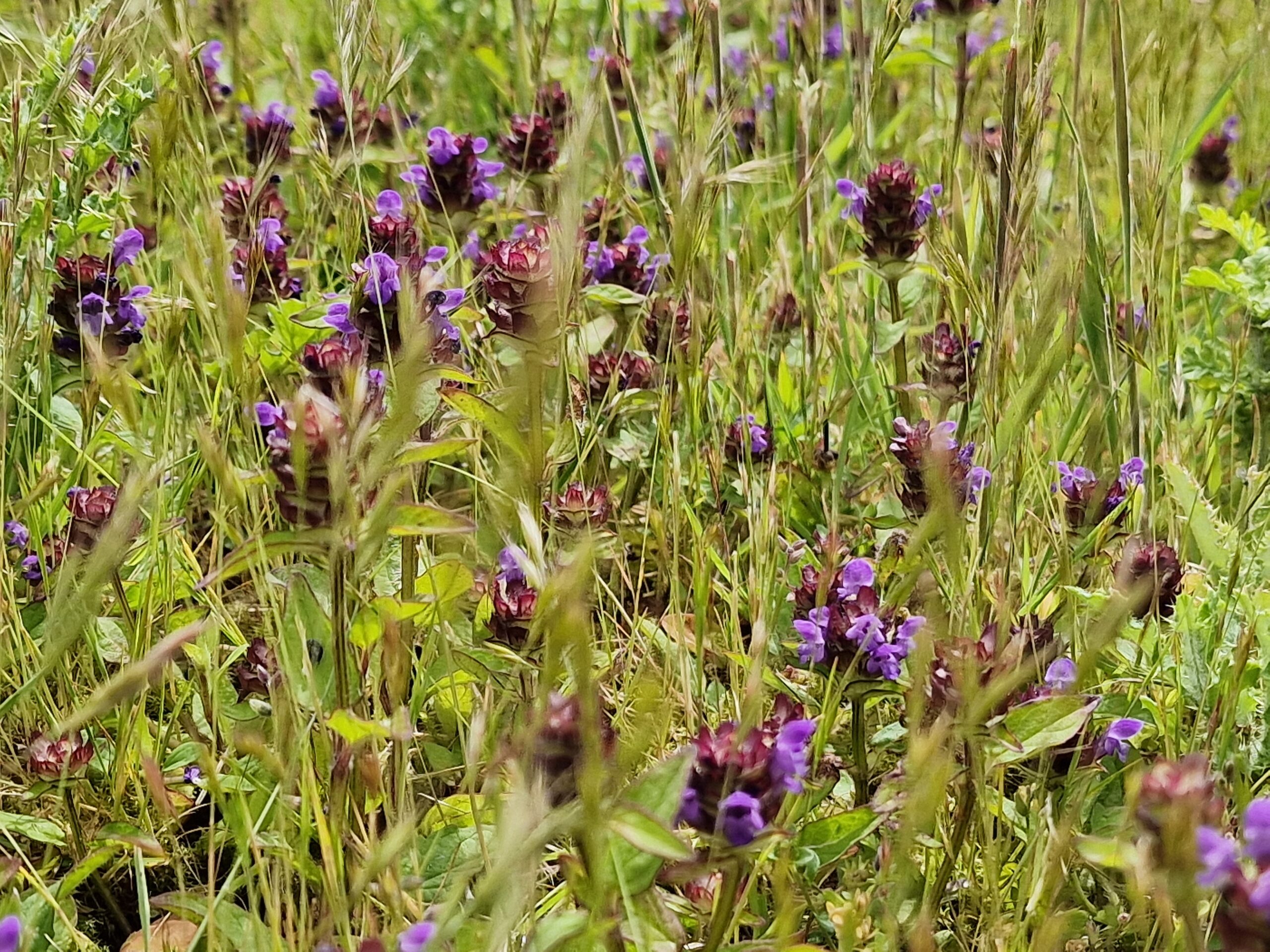
Prunella vulgaris, shown with grasses and buttercups at Breacleit, Lewis. It is often found in mixed stands with clovers, daisy, buttercups and grasses. Image: Chris Jeffree.
Prunella vulgaris is a common native perennial with a strong reputation in herbal medicine as its English name Self Heal suggests. It belongs to the Lamiaceae, the Family of deadnettles and many culinary herbs including mint, sage and origanum. Its distribution in Britain is described as ‘ubiquitous’, but most people notice it only when they cut their lawn. It thrives on suburban lawns throughout the land. Along with clovers and daisies it likes to grow in short grass, intruding into the green swards of ryegrass and fescues, with its leaves just high enough to escape competition from the grass. Some people take the trouble to dig it out, along with the daisies. Not me.
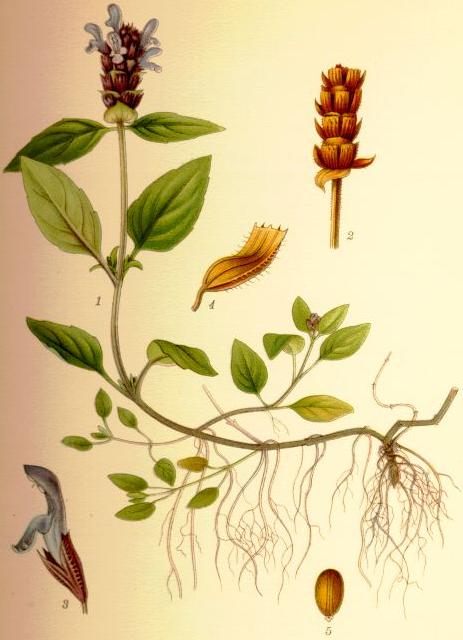
Prunella vulgaris, illustration by Carl Axel Magnus Lindman showing the tendency to creep. Public domain, via Wikimedia Commons. Carl Lindman (1856-1928) was a Swedish botanist and illustrator, and Professor of Botany at the Swedish Museum of Natural History. Some 581 of his wildflower paintings can be viewed on WayBackMachine here.
Prunella creeps. The illustration above shows how the trailing stems (stolons) sprout fibrous roots. In the 1970s John Harper and his team at Bangor University in Wales were world leaders in plant population dynamics (Harper 1977). They came up with some interesting paradigms about how plants spread. Prunella and Daisy (Bellis perennis) both have stolons but they have different tactics in colonising a lawn. Prunella forms an army of ‘guerillas’ with its longer stolons reaching out to do battle with grass whilst Bellis organises its troops with shorter stolons in a tight phalanx1, advancing slowly and relentlessly. It is possible to test which one succeeds in the battle against grass (Schmid 1986), but the result depend on the peculiarities of the environment, as there is flexibility in how the two species grow their stolons (Schmid 1986). Grazing and mowing, and applications of fertilizer are likely to affect their vegetative spread in different ways.

Prunella and ‘friends’ colonising the gravel of a car park in Biggar (South Lanarkshire, Scotland). Prunella is the clump in the top right-hand corner. Image: Chris Jeffree.
Of course, Prunella is found in many other habitats, wherever the vegetation is not dominated by taller herbs and as long as the soil pH is in the moderate range (5-8). This includes permanent pasture and many open habitats (urban areas, woodland rides, derelict land, waysides). Unlike many native species it is increasing, encouraged by urbanisation.

Prunella inflorescence. The 6-9 individual flowers are 10-14 mm and usually violet but can be white or pink. Bracts and calyx with long white hairs. Note the square stem, typical of the Lamiaceae. Image: Chris Jeffree.
The blue-violet flowers are organised in dense terminal spikes and they are visited mostly by bumblebees. Bees access the nectar with their long tongues, reach down 11-13 mm into the flower-tube; in doing so pollen is transferred from anthers to the bee’s body (Kuriya et al 2015). Seeds are produced from autumn to early winter but do not germinate until the following spring. Winn (1985) showed that seedlings do not survive in the field unless the site is open: plant litter and herbaceous cover inhibited seedling emergence in woodland habitats whilst herbaceous cover inhibited emergence in old-field habitats. Vegetative reproduction may occur from small lengths of shoot (Grime et al 1988); perhaps that applies especially to suburban lawns where plant fragments are scattered by the mower.

Prunella vulgaris showing features typical of the Lamiaceae (simple leaves in opposite pairs, square stems). Image: Chris Jeffree.
There is much interest in the quantity of nectar that flowers can produce, especially nowadays when people are buying wild seed mixtures for their gardens to encourage bees. Sometimes the same households diligently banish Trifolium, Prunella and Taraxacum from their lawns, not realising that these plants produce fuel for flying insects, especially bees and butterflies. Likewise, Local Authorities are planting ‘wildflower meadows’ whilst at the same time removing wildflowers from roadside assemblages, employing toxic chemicals, steam or shovels. My road in Edinburgh has over 50 species of wildflowers growing in its gutter, many of them nectar-bearing. In some Council elections, candidates have pledged to control the roadside weeds. So how much nectar is produced by Prunella?

Mass of nectar produced by many species found in wildflower seed mixtures (units are: nectar sugar mass per flower unit, micrograms per day). Prunella is 7th on the list of perennials. From Hicks et al (2016). This is an open access article published by PLoS ONE and distributed under the terms of the Creative Commons Attribution License, which permits unrestricted use, distribution, and reproduction in any medium, provided the original author and source are credited.
Hicks et al (2016) answered the question: Prunella produces several hundred micrograms of nectar sugar per flower per day. It compares favourably with many other perennial species that are included in seed mixtures for creation of ‘wildflower meadows’. The biggest nectar producers in the mixtures tend to be the largest flowers and the composite flowers. But Prunella clearly ‘pays its way’ in the economics of wild bees.

Global distribution of Prunella vulgaris, showing wide tolerance and efficient dispersal. Source: GBIF.
When I searched the world literature using Google Scholar, I was impressed by the many hundreds of publications relating to medicine. Prunella, like many other species, has a cocktail of biologically active compounds which may vary with season or with time of day, and which may even depend on the weather. They form the arsenal of chemical weapons in the plant’s defence system. In the case of Prunella, there are many recent publications and some of them are in very high-ranking journals. For example, in Scientific Reports, Li et al. (2023) reported on anti-aging effects and the authors point to the possibility of preventing a variety of age-related diseases such as Type 2 diabetes. An extract of Prunella vulgaris was injected into laboratory mice and various markers of aging were measured. A strong anti-aging effect was detected in the male mice but less so in the females. The details of the paper are beyond my level of competence, but I will now send a copy of the article to a medical specialist I know; let’s see what she thinks2. Like most good research, the work raises more important questions than it answers, and follow-up is required.

Image from a large area of parkland (Lagganhouse, South Ayrshire, July 2024). Prunella and Ranunculus repens have colonised mown grassland, dominating areas of up to 100 m2. Image: John Grace.
The value of Prunella as a medicine was well known to herbalists of old. Gerard and Culpepper have much praise for it, but it is also important in traditional Chinese medicine and widely used in China in herbal tea for treatment of inflammation, headaches and liver ailments (the Chinese name is xia ku cao).

An unusual sight: the whole plant has taken on a reddish appearance. Growing on the top of a wall the red colouring may indicate a specific nutrient deficiency, exacerbated by high solar radiation. Photo: John Grace.
Readers who like to read articles about folk-lore might enjoy this blog from an unlikely source: the Fareham Borough Council.
Where does the name come from? According to wikipedia, “Prunella is derived from ‘Brunella’, a word which is itself a derivative, taken from “die Bräune“, the German name for diptheria, which Prunella was historically used to cure”.
Notes
1In Ancient Greek warfare the phalanx was a tight and highly organised mass of foot-soldiers with spears.
2My medical specialist says: “……Also, of course, animal data is only the first very small step towards clinical data. Most products that show promise in animal experiments don’t make it through to human market. For example the data showing an effect on the immune system via TNF – there are two existing medications that target TNF and all of them have significant side effects in regard to risk of serious infection”.
References
Grime JP, Hodgson JG and Hunt R (1988) Comparative Plant Ecology . Unwin Hyman.
Harper JL (1977) Population Biology of Plants. Academic Press.
Hicks DM, Ouvrard P, Baldock KCR, Baude M, Goddard MA, Kunin WE, et al. (2016) Food for Pollinators: Quantifying the Nectar and Pollen Resources of Urban Flower Meadows. PLoS ONE 11(6): e0158117. https://doi.org/10.1371/journal.pone.0158117
Kuriya S et al. (2015) Altitudinal flower size variation correlates with local pollinator size in a bumblebee‐pollinated herb, Prunella vulgaris L. (Lamiaceae), Journal of Evolutionary Biology, 28, 1761–1769 https://doi.org/10.1111/jeb.12693
Li P et al. (2023) Research on the anti-ageing mechanism of Prunella vulgaris L.. Scientific Reports 13, 12398 https://doi.org/10.1038/s41598-023-39609-1
Schmid B (1986) Spatial dynamics and integration within clones of grassland perennials with different growth form. Proceedings of the Royal Society of London B 228, 173-186.
Winn AA (1985) Effects of seed size and microsite on seedling emergence of Prunella vulgaris in four habitats. Journal of Ecology 73, 831-840.
©John Grace