Erica tetralix – September 9th 2024 – (Cross-leaved Heath)
My first encounters with this plant were in student days, with visits to Kinder Scout in the Derbyshire Peak District, and blanket bog at Moor House in the Pennines. Peatlands always intrigued me. I wanted to know how they had formed and how the plants found their nutrients. I soon knew the major species, as there are not too many.

Old illustration by the Swedish botanist C.A.M. Lindman (1856–1928), from his book Bilder ur Nordens Flora (first edition published 1901–1905). Wikipedia, Creative Commons.
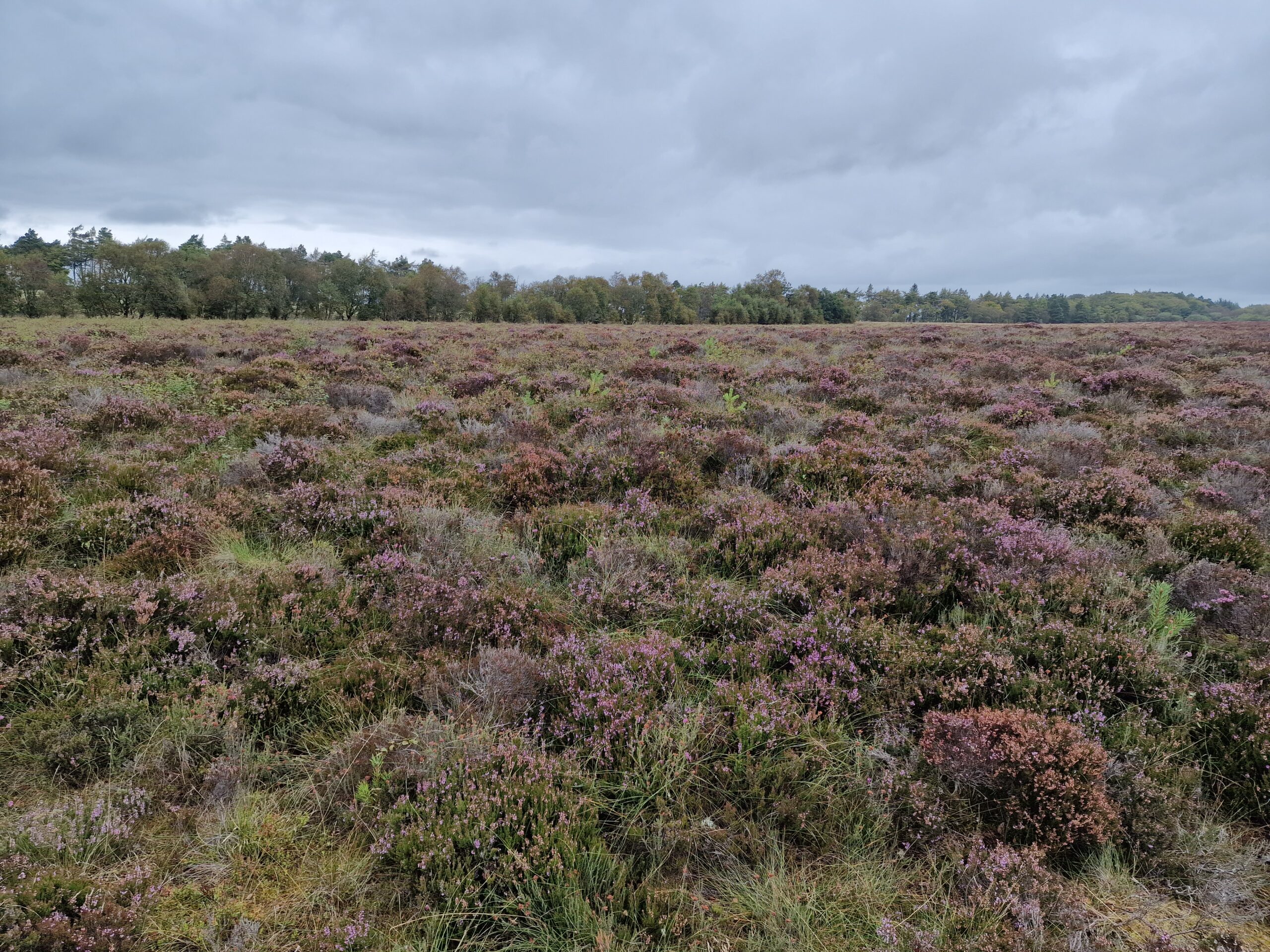
Wet, windswept bogs are extensive in the oceanic western parts of our islands. They have been quietly forming a thick layer of peat over the several thousand years since the last major ice age; now they are often protected as carbon stocks and habitats for wildlife. This is where you can find several members of the heather Family (Ericaceae). They are mostly calcifuges (literally, it means they flee from calcareous soils). The most abundant species are heather and bilberry, but two other members of the Ericaceae are nearly always there, emerging from carpets of sphagnum mosses and poking up between clumps of heather: Erica tetralix (Cross-leaved Heath) and Erica cinerea (Bell Heather).

Flower clusters of Erica tetralix (left) and E. cinerea (right). Note the subtle colouring of E. tetralix from rose-pink to almost white. The flowers of E. tetralix are organised in a tight bunch. See also the holes in the flowers of E. cinerea where insects (bees, wasps?) have gained access to the nectar within. Images: John Grace.
They are both woody perennials with bunches of urn-shaped flowers and whorls of small linear leaves, but they are easy to tell apart. Cross-leaved Heath has leaves in whorls of four (hence the name tetralix), and looks quite grey in colour because of its hairiness. Bell Heather looks brighter and greener, with leaves that appear somewhat disorganised in whorls of three. This week we focus on Cross-leaved Heath.
The tiny leaves have downward-rolled edges, just as Heather does, presumably to reduce the exposure of the stomata and thus to conserve water. It seems ironic that plants living on bogs need to conserve water, but they do experience what is called ‘frost-drought’ in the winter whenever the water in the soil turns to ice. Unlike Heather, the leaves and the young stems have glandular hairs making them slightly sticky. Charles Darwin speculated that E. tetralix might be an insectivorous plant a bit like the sundews (Drosera species), trapping small insects that became glued to the leaves and digesting them with an enzymatic secretion. As far as I know, this has never been shown.

Details of the stem, showing the glandular hairs. See also Lindman’s illustration at the top of this page. Image: John Grace.
The flowers contain pollen and nectar, and they are mainly visited and pollinated by bees. Long-tongued bumble bees (eg the carder bee, Bombus pascuorum) can reach the nectar but many other insects cannot and so they make a hole in the side of the flower to steal the nectar. Close inspection of the flowers usually reveals evidence of the theft. Very small insects may enter the flower. The most studied case is the tiny thunder flies (Thrips). Some authors have claimed they inhabit the flower for long periods and may complete their life cycle therein; for a tiny insect it’s a good home, why bother to go elsewhere?

The flowers have whithered and seed will soon be shed.
E. tetralix is a native species, first recorded in Britain in 1571 by the Flemish-born physician and botanist Matthias de L’Obel. It was also known to Gerard in his 1597 Herbal:
“Crossed Heath groweth to the height of a cubit and a half, full of branches, commonly lying along upon the ground, of a swart dark colour: whereon do grow small leaves, set at certain spaces by two upon one side, and two on the other, opposite, one answering another, even as do the leaves of Crosswort. The flowers in like manner stand alongst the branches cross fashion, of a dark overworn greenish colour. The root is likewise woody, as is all the rest of the plant”.

Growth is creeping, with vertical shoots arising rom a mass of more or less prostrate shoots. The vertical shoots gain support from the dense growth of Heather. Image: John Grace.
E. cinerea was first recorded a few years later at the unlikely location of Windsor, in 1576 by Charles de l’ Écluse, a pioneer horticulturist from Arras (then part of the Spanish Netherlands).
In Britain the two Ericas have remarkably similar distributions, occurring especially in the west but absent in the large eastern areas where the soils are calcareous with a pH exceeding about 5. There are also differences in their tolerance to waterlogging. E. tetralix can survive waterlogging for a longer period than E. cinerea. Often E. tetralix can be seen on the edge of a Sphagnum pool but E. cinerea is found in the drier spots of the bog and also in dry heathland.

British and Irish distributions. Spot the difference. E. cinerea is missing from a few high elevation areas which are colder (Pennines of England and Brecon Beacons of Wales. The Irish pattern is harder to explain. The BSBI’s 2020 Atlas mentions that “E. tetralix has undergone a widespread decline in the lowland margins of its British range since the 1960s, due to extensive loss of wet heathlands to agriculture, quarrying and forestry”.
E. tetralix seems be more tolerant of grazing and is more able to resprout after fire. Bannister (1958) states: “it may become dominant after fire, largely through regeneration from shoot bases”

European distributions showing the more easterly distribution of cold-tolerant E. tetralix. Map from GBIF.
In Europe, there are clear differences. E. tetralix ventures further east. Bannister and Polwart (2001) showed by experiment that the species differ in their frost tolerance: E. tetralix could survive freezing temperatures as low as -20 oC but E. cinerea could only survive down to -13 oC, thus seemingly explaining the geographical contrast, with E. tetralix tolerating the much lower temperatures of the eastern continental winters.

Illustration of one of the habitats: a pool at the edge of a raised bog, Red Moss, Balerno, Edinburgh. Erica tetralix is encircled. The arrows show the sundew Drosera rotundifolia at the water’s edge. Image: John Grace.
References consulted
Aunina L and Auniņš A (2015) Limiting climatic factors and habitats of Erica tetralix at the eastern edge of its distribution range. Nordic Journal of Botany 33, 624-632. https://doi.org/10.1111/njb.00736
Bannister P (1966) Erica tetralix L. Journal of Ecology, 54, 795–813. https://doi.org/10.2307/2257818.
Bannister P and Polwart A (2001) The frost resistance of ericoid heath plants in the British Isles in relation to their biogeography. Journal of Biogeography 28, 589-596. https://doi.org/10.1046/j.1365-2699.2001.00573.x
Davies MS (1984) The response of contrasting populations of Erica cinerea and Erica tetralix to soil type and waterlogging. Journal of Ecology, 197-208. https://doi.org/10.2307/2260013
©John Grace