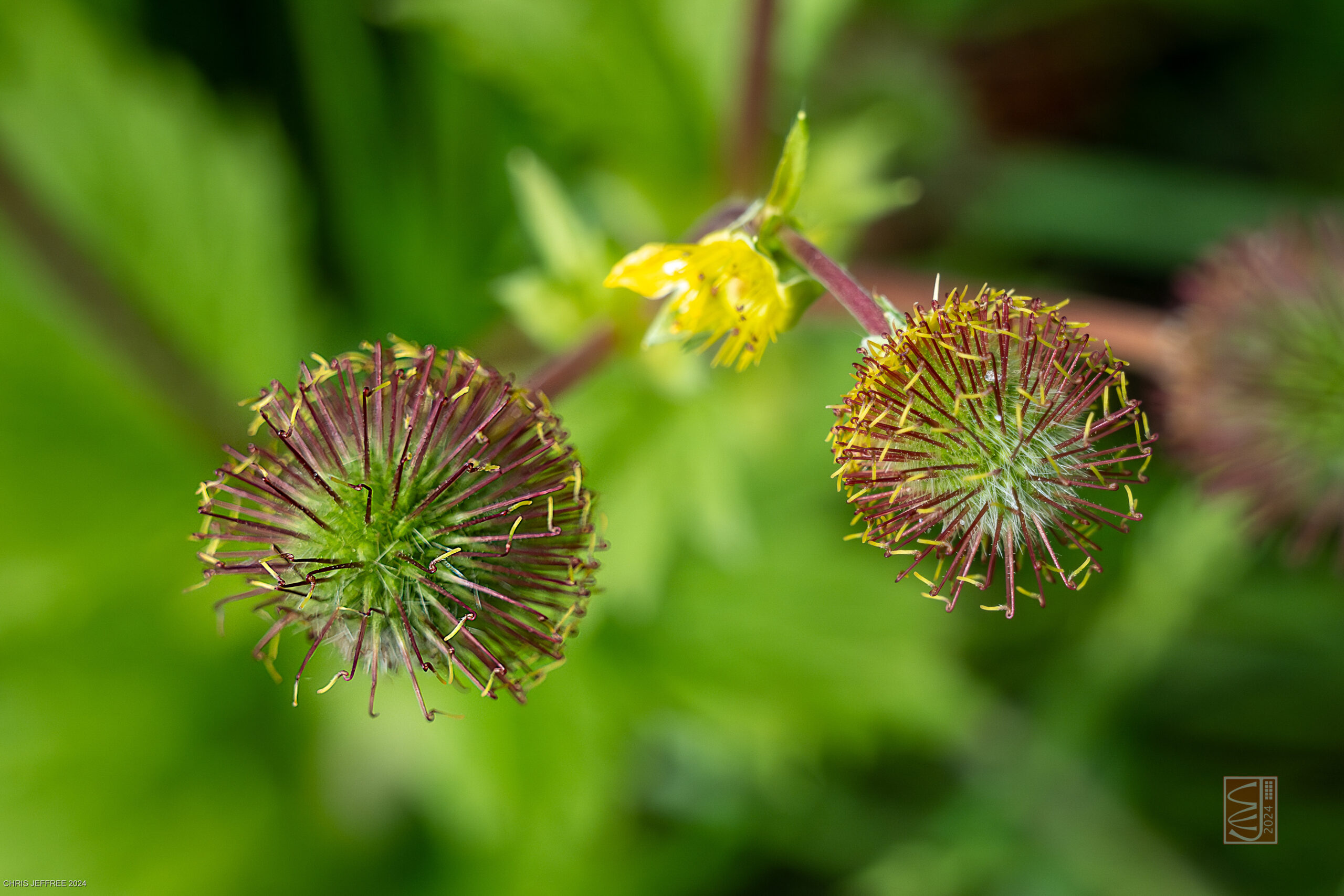
Geum macrophyllum – October 28th 2024 – Large-leaved Avens
This week’s plant is an alien that created a stir during the summer when two of our members kept finding it in their local park in north Edinburgh. It resembles our native Wood Avens Geum urbanum but its natural range is North America and the Far East. It looks so much like G. urbanum that we are now wondering how many times it has been overlooked or mis-identified by recorders.

Flowers and seed heads of Geum macrophyllum. Family: Rosaceae. Image: Chris Jeffree.
The key differences between the two species are well summarised in an article by Maria Chamberlain and Chris Jeffree that recently appeared in the BSS News. For the benefit of the many readers who are not members of the Botanical Society of Scotland (BSS)1, we are repeating some of the information in this blog.

The native Geum urbanum (left) and the alien Geum macrophyllum (right) They look similar. Images: Chris Jeffree.
Our native G. urbanum (Wood Avens or Herb-bennet) is a very common species of damp woodland that has successfully colonised roadside habitats and other man-made pockets of land around parks, playgrounds, verges, walls and tracks throughout Britain and Ireland. In Scotland it is one of the most common urban species, as the specific name urbanum suggests. In North America, G. macrophyllum occupies somewhat similar habitats; one source listed the habitats as “moist meadows, fields, clearing, roadsides, streambanks and open forests”.
G. macrophyllum came to Britain as a garden plant in 1804. From records of the BSBI we see that it was first recorded as ‘wild’ at Blairadam Wood, Kinross, in Fife (1891). The wood is still there but there are no further records of G. macrophyllum since 1891. It would be fun to go there in the summer and see if we can find it.
The images below should be sufficient for anyone to tell the difference between the native and its American cousin. A list of 13 differences are given in the BSS News (Chamberlain and Jeffree, 2024), but perhaps the most obvious contrasts are in the flowers and seed head. In G. urbanum the sepals are visible from above but in G. macrophyllum.the sepals are obscured by the petals. Also the tips of the petals are curiously curled upwards in G. macrophyllum. In the mature seed head of G. urbanum the sepals turn down (‘reflexed’) whereas in G. macrophyllum they stick out at right-angles from the stem (‘patent’).

Flowers. Left: Geum urbanum with sepals visible between the petals; centre: sepals not visible in G. macrophyllum; right: G. macrophyllum, side view to show how the sepals are pointing downwards (hence, invisible in the top view). Note also how the petals are curved upwards in G. macrophyllum and the flower-stalks are short. Images: Chris Jeffree and the BSS News.

Seed heads. Left: exposed receptacle of Geum urbanum showing long hairs and, right: the same view of G. macrophyllum with short hairs and more achenes. Note a resemblance to other members of the Rose Family: think of the flowers and fruits of strawberry where the achenes are tiny and the receptacle is greatly enlarged to form the fleshy part we like to eat. Detail of leaf tips. With a hand lens the hydathodes on the tips of the leaves can be seen. They are red in G. urbanum (upper image) and white in G. macrophyllum. Images: Chris Jeffree and the BSS News.
The two species have been found to hybridise (Wilcox 2015) although the hybrids do not produce seed. They were discovered in three locations: Shipley Glen (Mid-west Yorkshire), Rochdale (South Lancashire) and Wythenshawe Park (Cheshire). Wilcox called the hybrid Geum x convallis. They have not been seen elsewhere, although there have been ‘false alarms’ and in Edinburgh the search continues.
Geums often hybridise. In Britain, Wood Avens hybridises with Water Avens (G. rivale) and in this case the hybrids are fertile (they are called G. x intermedium). None other than the ‘father of genetics’, the Augustinian abbot from Brno in Moravia, Gregor Mendel, chose Geum as one of the groups for his experiments on hybridisation. However, the laws of inheritance proved to be much harder to discern than in his famous early work on garden pea varieties.

The spread of Geum macrophyllum, showing that most of its spread has been in the last three decades. On the right hand panel, the green squares denote records from 2019 to now. Data from BSBI/Maps.
Whenever an alien plant is found growing wild in the British Isles, the question asked is: ‘Is it invasive and will it threaten our native species?’. This one has been with us for well over a century but is still uncommon. I assembled maps from the BSBI to see if I could detect any patterns. There are several centres where it seems to be spreading: in Wales, the north of England and the north-east of Scotland. It has not yet appeared around London or in Ireland. This pattern is unusual and raises questions about the dispersal mechanism. Like G. urbanum the achenes carry tiny appendages that resemble the hooks on Velcro. They attach to animal fur and woollen clothes. The pattern of spread by this hitching-a-lift mechanism suggests a dispersal distance of tens of miles, so perhaps four-legged animals (wild and pet) are the agents. Another explanation is that the plant is really much more common than the maps portray, but recorders overlooked it until word-of-mouth or the internet spreads an alert between members of local botanical groups and then people start looking very carefully at any Geum.

Seed head of Geum macrophyllum with over 150 achenes, each with a barb for sticking to furry anaimals. Image: Chris Jeffree.
A researcher from Russia tried to estimate the competitive advantage of G. macrophyllum against G. urbanum (see the 2010 translation of Vinogradova 2008). The two species were grown in the nursery of the Moscow Botanic Garden. The conclusion was:
“The alien G. macrophyllum has less competitive ability than the indigenous G. urbanum. In the case of interspecific competition in the mixed population, the potential seed productivity of G. macrophyllum was 3– 4 times lower than that of G. urbanum, since it had a fewer number of plants reaching the generative phase of development”.

In the upper panel (Kew’s Plants of the World Online) the native territories of the species are shown in green whilst the countries and territories into which the species has been introduced are purple. Note: this projection gives a false impression in Canada’s inuit terrritory of Nunavut. The lower panel (from GBIF) shows actual records.
Note
1Please consider joining the Botanical Society if you haven’t done so already. Go back to the top page to discover how.
References consulted
Chamberlain M and Jeffree C (2024) Geum macrophyllum. An alien that is spreading. BSS News, 123, 23-25.
Vinogradova YK (2008) translated as Vinogradova YK (2010) Biological Features and Competitive Relations between Alien and Indigenous Species of the Genus Geum L. Russian Journal of Biological Invasions 1, 55–59. DOI: 10.1134/S2075111710020013
Wilcox MP (2015) Geum × convallis (G. macrophyllum × G. urbanum, Rosaceae): a new Geum hybrid from England. New Journal of Botany 5, 26–31. doi:10.1179/2042349715Y.0000000003
New York perspective:
https://nyflora.org/wp-content/uploads/2020/02/NYFA_Newsletter_Vol_28_2_2017.pdf
Alien in Siberia
https://link.springer.com/article/10.1007/s40333-013-0166-y
About Mendel
https://academic.oup.com/genetics/article/204/4/1327/6072051
©John Grace