Phacelia tanacetifolia – November 11th 2024 – Phacelia
Many thousands of plant species have entered our country via garden centres and seed merchants. They bring colour, sweet scents and food for insects to our gardens and parklands. An interesting question is: how many of them escape and become naturalised? The answer is ‘only a small fraction’. Yes, but how many is that? The answer to this question, according to Stace and Crawley (2015), is 1,809 of which 1,138 are considered to be ‘naturalised’. The native flora of Britain and Ireland consists of 1390 species.

Inflorescence, made up of spiral cymes. Individual flowers are 6-10 mm. Note the hairiness of the flower-stalks. Image: Chris Jeffree.
This week’s plant is one of the escapees. It has been cultivated in Britain since 1832, with the first ‘wild’ record in 1881 (from Yorkshire). Most authorities put it in the Family Boraginaceae (it certainly looks Borage-like) but Stace (2019) places it in the Hydrophyllaceae. Frankly, I had never heard of Hydrophyllaceae until writing this article; at present it is considered to be a subfamily of Boraginaceae. Most authorities reckon our plant is still in the Boraginaceae.

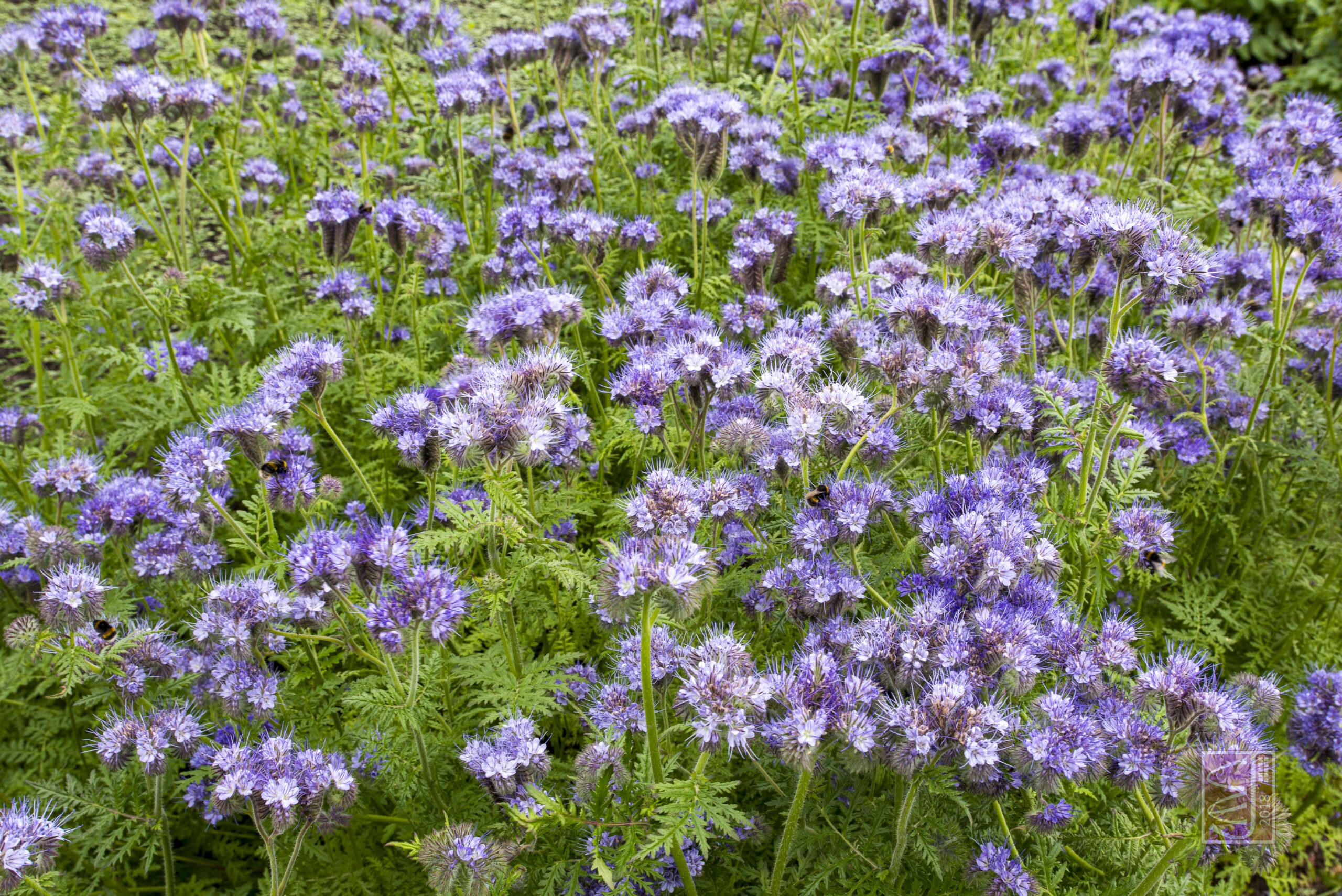
A mass of plants in flower at Inveresk allotments. Two bumble bees are visible (can you see them?). The plants are typically up to 70 cm tall. Image: Chris Jeffree.
It’s a very hairy annual, originating from the arid southwest region of the United States and Mexico; it came to Europe as a garden ornamental where it was given its Latin name by George Bentham (1800 –1884). The name Phacelia derives from a Greek word for a fascicle or bunch, referring to the tight clusters of flowers; tanacetifolia means the leaves are like those of the tansies.
I can see how this plant might have been an interesting curiosity for Victorian gardeners. It has an ‘other world’ appearance, with flowers in a very tight spiral, hence increasing visibility to foraging insects. Such spirals can be seen in at least two other members of the Boraginaceae, Amsinckia micrantha (Common Fiddleneck) and Myosotis scorpioides (Water Forget-me-not). As in most other family-members has (usually) blue flowers and is very hairy (compare with its hairy relatives, comfrey and Viper’s Bugloss).

Data from the BSBI showing distribution of records up to 1970 (left) and after 1970 (right).
If we look at BSBI records we can see that it was rarely recorded in Britain before 1970 but has rapidly spread over the last few decades. The reasons for this remarkable increase relate to changing attitudes to gardening, starting in the late 1970s when people began to turn their backs on the use of pesticides and ‘chemicals’ in general. They were perhaps influenced by Rachel Carson’s book Silent Spring and some ‘green-thinkers’ embraced close-to-nature styles of cultivation. Horticulturists realised that weeds and soil health could be managed by planting a ‘cover crop’ in periods between cropping. Also, more recently, gardeners have seen that certain plants attract the much-needed pollinating insects, so they plant a few ‘bee-friendly’ species.
Enter Phacelia, to join its family member Comfrey as a favourite plant of many British gardeners. If sown in the late summer, after a crop has been harvested, it grows quickly and will cover the ground to prevent annual weeds from germinating. It will also protect the soil from being leached of nutrients by rainstorms. In the spring it can be dug in before it flowers, thus adding organic matter to the soil. Or, for those who prefer ‘no-dig’ gardening, it can be strimmed-off, leaving the work of digging to the earthworms.

Phacelia used as a cover crop on an allotment: left, general view; right, close up to show how the spreading leaves obscure and shade the ground below. Images: John Grace.
Somewhat later, gardeners began to think about ‘bee-friendly’ species, and it was shown that Phacelia is one of the best, producing much nectar over a long period. In California it was first used in vineyards to attract pollinators. In central and eastern Europe, it is cultivated on a large scale for honey production. It’s a ‘long day plant’ which means it won’t flower until the daylength reaches around 13 hours, so don’t expect nectar until after the equinox. It is somewhat frost-tender: it dies in winter if the temperature falls below -7.5 oC.

Distribution of Phacelia from Kew’s Plants of the World Online. Green areas show the native distribution, purple shows countries into which the species has been introduced.
From gardens and allotments, it would have been exported to other habitats on boots and shoes. BSBI list its habitats as: “refuse tips, waste ground, pavements, and as a volunteer or seed contaminant in cereal and oil-seed rape crops and in newly sown grass leys”. They say it also occurs in birdseed and pheasant feed.
Of all the 1,138 alien species that have become naturalised in Britain and Ireland, only 57 are considered as ‘invasive’. We know most of them rather well, and some well-meaning people spend fruitless hours trying to eradicate them altogether. But Phacelia is not invasive. We like it.
References consulted
Bacq-Labreuil A et al (2019) Phacelia (Phacelia tanacetifolia Benth.) affects soil structure differently depending on soil texture. Plant Soil 441, 543–554. https://doi.org/10.1007/s11104-019-04144-4
Killick HJ (2020) Phacelia tanacetifolia Benth. In BSBI Online Plant Atlas 2020, eds PA Stroh, TA Humphrey, RJ Burkmar, OL Pescott, DB Roy & KJ Walker. https://plantatlas2020.org/atlas/2cd4p9h.gxn
Stace CA and Crawley MJ (2015) Alien Plants: Book 129 (Collins New Naturalist Library)
Williams IH and Christian DG (1991). Observations on Phacelia tanacetifolia Bentham (Hydrophyllaceae) as a food plant for honey bees and bumble bees. Journal of Apicultural Research, 30(1), 3–12. https://doi.org/10.1080/00218839.1991.11101227
Also:
This freely available article from 2003 is intended to advise small farmers in the USA. A very easy read and highly informative:
https://seriousaboutcamo.typepad.com/files/phacelia_farmer_version.pdf
©John Grace