Pinguicula vulgaris – January 20th 2025 – Common Butterwort

Pinguicula vulgaris. Attribution: C Prof. Dr. Otto Wilhelm Thomé Flora von Deutschland, Österreich und der Schweiz 1885, Gera, Germany
My first encounter with this plant was during my student days, walking in the Pennines, trudging around in the pouring rain on squelchy moorland tracks. “What a strange little plant, like none other” was my first thought. Its star-like rosette of leaves were such a pale green that I wanted to measure its rate of photosynthesis (that was the sort of project I had in those days, but this was not one of my target species).

Close-up of the leaf surface with emerging flower. Insects are in various stages of being digested. On the left you can see the glandular hairs as dots on the leaf surface. The leaf margins roll up when flies alight, but only slowly. Note also the paleness of the leaf in comparosn with the Hydrocotyl vulgaris, Marsh Pennywort, on the bottom-left part of the picture. Image: Chris Jeffree.
Close inspection of the leaf surface usually revealed insects in various stages of being digested by the mucilaginous cocktail of enzymes that the plant secretes on its leaf surface. It is of course an insectivorous plant, but with none of the complex mechanical insect-trapping mechanisms that fascinated Charles Darwin and many others.

This is a continuation of the previous image, the far end of the leaf that showing the leaf-rolling. Image: Chris Jeffree.
A few people have measured the rates of photosynthesis of these pale leaves. Rates are very low. So low, that it is remarkable that the plants can even grow. Moreover, the substrate they grow on can scarcely be called soil; usually it is wet organic material quite often at the edge of a sphagnum pool. The British authority on this species is Yolande Hesslop-Harrison; she says “This insectivorous perennial occurs mainly in seepage channels in the less acid parts of bogs, mires, calcareous fens and flushes, wet heaths and on wet rocks”. Evidently it requires watery surroundings and perhaps very humid air. Its habitats are usually very low in plant nutrients, especially nitrogen and phosphorus, and Pinguicula doesn’t even have mycorrhiza to help it absorb nutrients. It apparently gets what it needs by digesting insects, and perhaps a little from rain and mist.

The flowers attract flying insects, bees especially. See the extract below from Heslop-Harrison’s (2003) article for the pollination mechanism and look at item 5 in the painting at the start of this blog. Image: Chris Jeffree.
My immediate thought was that Pinguicula must surely be obtaining glucose and other organic materials from its prey, but some of those who have worked on the subject say that it doesn’t. They say it just gets the mineral nutrients and that it relies on its own meagre photosynthesis for its organics. I turned to Darwin’s book on the subject of insectivorous plants. He tested the effect adding all manner of likely food materials to the leaf surface, including bits of beef and even glass; he carefully placed them on the leaf surface and watched what happened. If you download the pdf version of his book, look at pages 197 to 318. His observations and his many experiments amazed me, and I enjoyed his conclusion that the plant is “partly a vegetable as well as an animal feeder”. Here is the extract from his book:
.

An extract from Darwin’s book, written in 1888, Insectivorous plants. 2d edition.
I still could not believe that no organic materials are taken up by the leaf surface, and I searched for research papers that pointed to the contrary. I was rewarded by one article where 14C-labelled protein was placed on the leaf surface. Afterwards, the leaf was placed on X-ray film, and the result showed that carbon had indeed been taken up.

Visualisation: the stalked glands secrete droplets of digestive juices, whilst the sessile glands are concerned with digestion. Attribution: Noah Elhardt, via Wikimedia Commons
The question at the back of my mind, still not answered by research that I can find, is: what proportion of its carbon is obtained from digesting insects as opposed to its own photosynthesis? Most of the research deals with nitrogen and phosphorus – not even calcium and micronutrients. For me, the published research is only the first part of the story. Please leave a comment if you know of recent relevant research.


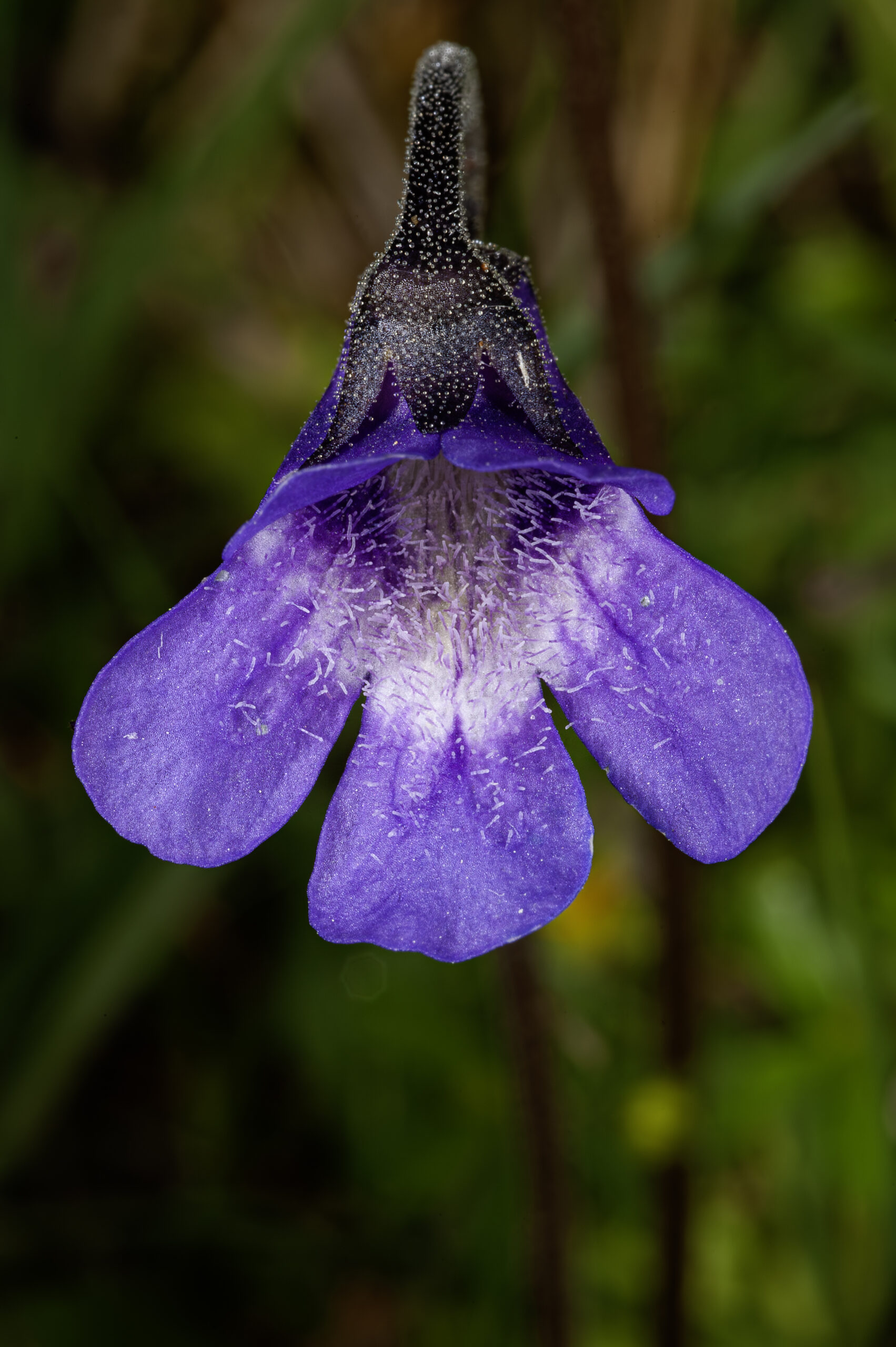
Various views of the flower. Note the spur, which contains nectar. Flowers are more or less solitary, bisexual and zygomorphic. They assume a horizontal posture at anthesis. Note the glands seen on the leaf are also on parts of the flower. These images and the one at the head of this article are by Chris Jeffree.
Turning now to the biology of the plant. It tolerates a remarkable range of pH, from very acid (3.94) to mildly alkaline (7.56). The plant is very fragile, and does not stand trampling, grazing or competition with other plants. In the winter it forms a neat structure called a hibernaculum, like a small bud, which lies in a pocket formed where last season’s rosette of leaves grew (see images in Heslop-Harr.ison, 2004). In spring, the hibernaculum sprouts leaves and roots, awakened by the increasing daylength and rising temperatures. Before long, the plant is capturing its prey, especially Collembola (springtails) and Nematocera (gnats, midges, blackflies), and the margins of the leaves roll inwards. The prey struggles in the mucilage and is gradually overcome and then digested over a few days. A mature leaf looks like a battleground, but new leaves are produced about every five days, overlapping the old leaves. According to some research the ‘meal’ enhances leaf and root growth.
The digestive process is achieved with digestive juices and glands. The leaf surface is covered with two types of gland: stalked and sessile (unstalked). The stalked glands secrete droplets of digestive juices, whilst the sessile glands are concerned with digestion. Amylase is one of the enzymes released by the stalked glands whilst proteolytic enzymes are produced by the sessile glands (Heslop-Harrison and Knox, 1971). It is suggested that detergents are also secreted so that the digestive juices can come into intimate contact with the prey (overcoming surface tension effects).
The flowers attract bees and other flying insects. The pollination mechanism as described by Heslop-Harrison is as follows:

In Britain the plant is most often recorded in the north and north-west. I have some difficulty in understanding why it is not found in the south-west of England, as microclimates and habitats of Dartmoor and Exmoor are surely not very different from those in the west of Scotland. Nationally it has suffered declines due to land drainage and perhaps because of infection with a fungus known as anther smut (Smith et al 2022).

British distribution of Pinguicula vulgaris. Note the many pale squares where the species was recorded in the past. Image: BSBI/Maps.
Globally, Pinguicula vulgaris occurs as far south as the Mediterranean and as far north as the northernmost parts of Scandinavia.

Global distribution of Pinguicula vulgaris from GBIF. In Kew’s Plants of the World Online it is considered native in almost all of the territories where it is found (Alaska, Alberta, Austria, Baltic States, Belarus, Belgium, British Columbia, Buryatiya, Czechoslovakia, Denmark, East European Russia, Finland, France, Føroyar, Germany, Great Britain, Greenland, Hungary, Iceland, Ireland, Irkutsk, Italy, Krasnoyarsk, Labrador, Maine, Manitoba, Michigan, Minnesota, Mongolia, Netherlands, New Brunswick, New Hampshire, New York, Newfoundland, North European Russia, Northwest European Russia, Northwest Territories, Norway, Nova Scotia, Nunavut, Ontario, Poland, Portugal, Québec, Romania, Saskatchewan, Spain, Sweden, Switzerland, Tuva, Ukraine, Vermont, West Siberia, Wisconsin, Yakutskiya, Yugoslavia, Yukon).
In Britain we have three species of Pinguicula: (i) P. vulgaris, (ii) P. grandiflora and (iii) P. lusitanicabut, but P. vulgaris is the most common. In Europe there are 14, in the world as a whole there are 80.
The genus belongs to the Lentibulariaceae, a family of carnivorous plants containing three genera: Genlisea, the corkscrew plants; Pinguicula, the butterworts; and Utricularia, the bladderworts.
The English name butterwort may derive from the appearance of the surface of the leaves …to some people it looked like butter.
References consulted
Adler PH, Malmqvist B (2004) Predation on black flies (Diptera: Simuliidae) by the carnivorous plant Pinguicula vulgaris (Lentibulariaceae) in northern Sweden. Entomol Fennica 15(2):124–128
Darwin, C. R. 1888. Insectivorous plants. 2d edition. Revised by Francis Darwin. London: John Murray https://darwin-online.org.uk/content/frameset?itemID=F1225&viewtype=text&pageseq=1.
Hájek, Tomáš and Adamec, Lubomír. Photosynthesis and dark respiration of leaves of terrestrial carnivorous plants. Biologia, vol. 65, no. 1, 2010, pp. 69-74. https://doi.org/10.2478/s11756-009-0211-7
Heslop-Harrison, Y (2004) Pinguicula L. Journal of Ecology 92, 1071-1118.
Heslop-Harrison, Y., & Knox, R. B. (1971). A cytochemical study of the leaf-gland enzymes of insectivorous plants of the genus Pinguicula. Planta, 96, 183-211.
Lustofin, K., Świątek, P., Miranda, V.F.O. et al. (2020) Flower nectar trichome structure of carnivorous plants from the genus butterworts Pinguicula L. (Lentibulariaceae). Protoplasma 257, 245–259 (2020). https://doi.org/10.1007/s00709-019-01433-8
Méndez, M., & Karlsson, P. S. (1999). Costs and benefits of carnivory in plants: insights from the photosynthetic performance of four carnivorous plants in a subarctic environment. Oikos, 105-112.
Pavlovič, A. (2022). Photosynthesis in Carnivorous Plants: From Genes to Gas Exchange of Green Hunters. Critical Reviews in Plant Sciences, 41(5), 305–320. https://doi.org/10.1080/07352689.2022.2132710
Smith PA et al. (2021) Anther smuts on Butterworts (Pinguicula spp.), Field Mycology 22, 5-11.
©John Grace