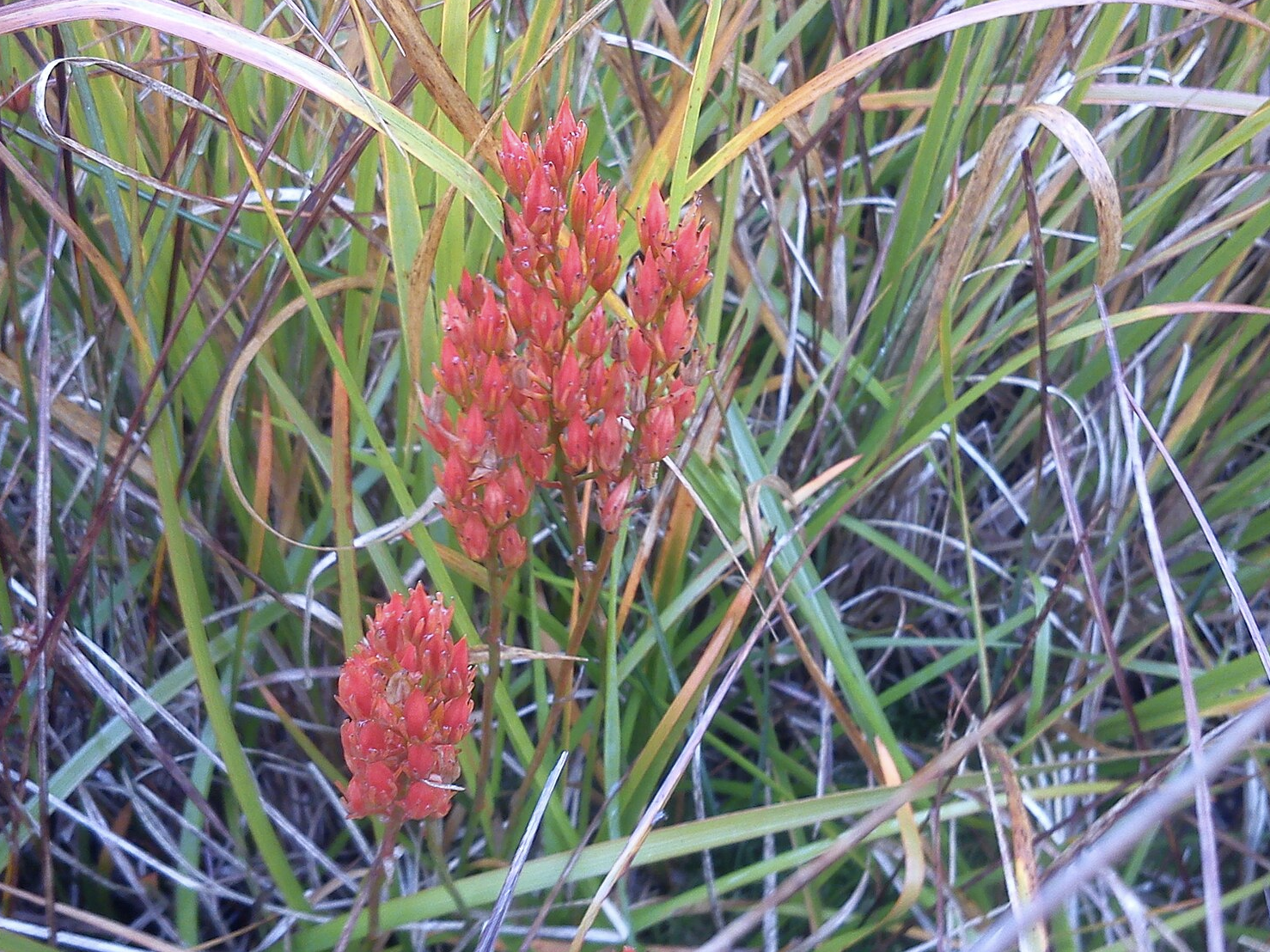
Narthecium ossifragum – February 3rd 2025 – Bog Asphodel
My first encounters with this plant were in my student days, rambling over the blanket bogs of the North Pennines, squelching my way across ‘lawns’ of Sphagnum and leaping over the many becks that led to the larger streams eventually becoming the two great rivers, the Tyne and the Tees. Bog Asphodel was one of the easily-recognised plants of this very wet habitat. I grew up in the lowlands much further south, and the vast bogs of the north appeared ‘other-worldly’ to me. Some of the species seemed to have a magical quality. This is one of them.

Attribution: Johann Georg Sturm (1742–1793). Public domain, via Wikimedia Commons
Bog Asphodel is not really an asphodel. It belongs to a very small Family, the Nartheciaceae, although before 2003 it was placed in the Lily family. The herbalist John Gerard (1545–1612), and many followers, thought it was an asphodel and called it the Lancaster Asphodel. He said “it groweth in moist and marsh places near unto the town of Lancaster, in the moorish grounds”. He goes on “it was found by a worshipful and learned Gentleman, a diligent searcher of simples, and fervent lover of plants, Mr. Thomas Hesket, who brought the plants thereof unto me for the increase of my garden”. Although Gerard was born in Cheshire, he spent his life in London and his famous herbal describes the plants he grew in his garden. As far as I can tell, he never ventured north to the ‘moorish grounds’.

Fertile and sterile shoots of N. ossifragum. Note the sword-shaped leaves. You can also see Drosera in the foreground – they are often found together in open areas of blanket bog. Image: Chris Jeffree.
Bog Asphodel is a perennial rhizomatous plant that grows on acidic soils and peats. Leaves are 6-15 cm long, narrow and sword-shaped, often tinged orange. The inflorescence is a spike bearing star-like flowers, bright yellow with brick-red anthers. There is no nectar but the plant is said to have the smell of carnations (Summerfield 1974). One early author wrote the flowers were pollinated by raindrops but this is now considered unlikely (Hagerup 1951). It is visited by a range of insects, mostly flies and bees, and usually cross-pollinated. Occasionally seed is set even though the flowers have not opened, i.e. the phenomenon called ‘cleistogamy’ (Jacquemart & De Sloover 1992). After pollination the orientation of the flower changes to vertical and the seed-case becomes brick-red (shown in the image at the top of this article). Leaves die down in winter and an overwintering bud is formed at ground level.

As above. These shoots may be all from one system of rhizomes. Image: Chris Jeffree.
Many of its original lowland sites have been drained and limed for agriculture over centuries and upland sites may have been affected by sheep over-grazing. One of the longest studies on the effect of sheep grazing was on blanket bog in the North Pennines: when sheep are removed Bog Asphodel increased significantly (Rawes 1983).
It seems strange that sheep like it so much, because it poisons their young. Saponins occurring especially in the flowers and fruits cause kidney damage in young animals. Also the animals become photosensitized to UV radiation in sunlight: “Affected lambs develop lesions on the ears, face and sometimes the back, with erythema, oedema, ulceration and necrosis that can be followed by secondary infection and death” (Pollock et al. 2015). In Norway the reaction to sunlight is manifest as a skin condition of sheep called alveld (‘elf fire’). Some evidence suggests the intake of active compounds is from the drinking of water that has drained from around Narthecium ossifragum (Tønnesen et al 2013). The list of possible toxins extracted from the fruits is large, and includes compounds of fungal origin, suggesting a fungus may have a part to play in the toxicity (Vu et al 2016).

Detail of inflorescence. Note: the stamens have orange anthers and very hairy filaments. The petals are 6-9 mm long. Image: Chris Jeffree.
Despite its toxic compounds, N. ossifragum has been used as a medicinal plant to treat hernias, coughs, inflamed genitals and ulcers. It is likely that some of its compounds have antibiotic activity.

Illustration from Gerard’s 1597 Herbal. He called it Asphodelus Lancastriae. The many woodcut images in the herbal were not his own work. It is thought that they originally came from the Flemish physician-botanist Rembert Dodoens (1517 – 1585). In those days copyright law did not exist. The image faithfully shows important features including the short leaves on the flowering stem. Compare with the photographs above.
All vegetation in the developed world receives a dose of nitrogen from the atmosphere (nitrate and ammonium), the result of human activities. This nitrogen is taken into plant tissues; for many species it increases the growth rate (Reay et al 2008). When bog vegetation was experimentally transplanted from a (relatively) unpolluted site in Wales to a polluted site in the southern Pennines, the foliar nitrogen content of N. ossifragum increased (Spink & Parsons 1995). The authors suggested that the species would inevitably suffer from competition under nitrogen pollution, as fast-growing species that are more able to use the added nitrogen, would out-compete it. The general effect of N-deposition on slow versus fast-growing species is now widely accepted, and likely to have caused floristic changes and a general decline in biodiversity practically everywhere throughout the British Isles.

Distribution of Narthecium ossifragum. Left: British and Irish, from BSBI/Map; right, global distribution from GBIF. Note: N. ossifragum has not been recorded in North America, although there are two similar species: N. californicum and N. americanum. The record in Tanzania is strange, but the country does have many wetlands.
Linnaeus gave the plant its Latin name, Narthecium ossifragum. The name Narthecium may come from the Greek word meaning ‘a casket for ointments’ but it may also refer to ‘giant fennel’ (but I don’t see a connection). The Latin name ossifragum means bone-breaking, implying that livestock will have broken bones if they eat it. The brittle bones would have been the result of the sheep grazing more generally on low-calcium acid moorlands rather than on this specific plant.
References consulted
Chen Y, Quinn JC, Weston LA, Loukopoulos P (2019) The aetiology, prevalence and morbidity of outbreaks of photosensitisation in livestock: A review. PLoS ONE 14(2): e0211625.
Díaz, A. E. C., Herfindal, L., Rathe, B. A., Sletta, K. Y., Vedeler, A., Haavik, S., & Fossen, T. (2019). Cytotoxic saponins and other natural products from flowering tops of Narthecium ossifragum L. Phytochemistry, 164, 67-77.
Hagerup, O (1951) Pollination in the Faroes-in spite of rain and poverty in insects. Kongelige Danske Videnskabernes Selskabs Skrifter 18, 1-48.
Hayati, A. A., & Proctor, M. C. F. (1991). Limiting nutrients in acid-mire vegetation: peat and plant analyses and experiments on plant responses to added nutrients. The Journal of Ecology, 75-95.
Jacquemart, A. L., & De Sloover, J. R. (1992). The part taken by cleistogamy in Narthecium ossifragum reproductive strategy. Flora, 187, 67-72.
Pollock, M. L., Wishart, H., Holland, J. P., Malone, F. E., & Waterhouse, A. (2015). Photosensitisation of livestock grazing Narthecium ossifragum: Current knowledge and future directions. The Veterinary Journal, 206(3), 275-283.
Proctor, M. C., McHaffie, H. S., Legg, C. J., & Amphlett, A. (2009). Evidence from water chemistry as a criterion of ombrotrophy in the mire complexes of Abernethy Forest, Scotland. Journal of Vegetation Science, 20(1), 160-169.
Rawes, M. (1983). Changes in Two High Altitude Blanket Bogs after the Cessation of Sheep Grazing. Journal of Ecology, 71(1), 219–235. https://doi.org/10.2307/2259974
Reay, D. S., Dentener, F., Smith, P., Grace, J., & Feely, R. A. (2008). Global nitrogen deposition and carbon sinks. Nature geoscience, 1(7), 430-437.
Seaton, F. M., Robinson, D. A., Monteith, D., Lebron, I., Bürkner, P., Tomlinson, S., … & Smart, S. M. (2023). Fifty years of reduction in sulphur deposition drives recovery in soil pH and plant communities. Journal of Ecology, 111(2), 464-478.
Spink, A. J., & Parsons, A. N. (1995). An experimental investigation of the effects of nitrogen deposition to Narthecium ossifragum. Environmental Pollution, 90(2), 191-198.
Summerfield, R. J. (1974). Narthecium ossifragum (L.) Huds. Journal of Ecology, 62(1), 325-339.
Tønnesen, H. H., Mysterud, I., Karlsen, J., Skulberg, O. M., Laane, C. M., & Schumacher, T. (2013). Identification of singlet oxygen photosensitizes in lambs drinking water in an alveld risk area in West Norway. Journal of Photochemistry and Photobiology B: Biology, 119, 37-45.
Vu M et al (2016) Toxic aromatic compounds from fruits of Narthecium ossifragum L., Phytochemistry, 132,76-85.
Attribution of the image at the head of the blog
TravelPit, CC BY-SA 4.0 https://creativecommons.org/licenses/by-sa/4.0, via Wikimedia Commons
More images:
https://www.wildflowerfinder.org.uk/Flowers/A/Asphodel(Bog)/Asphodel(Bog).htm
©John Grace