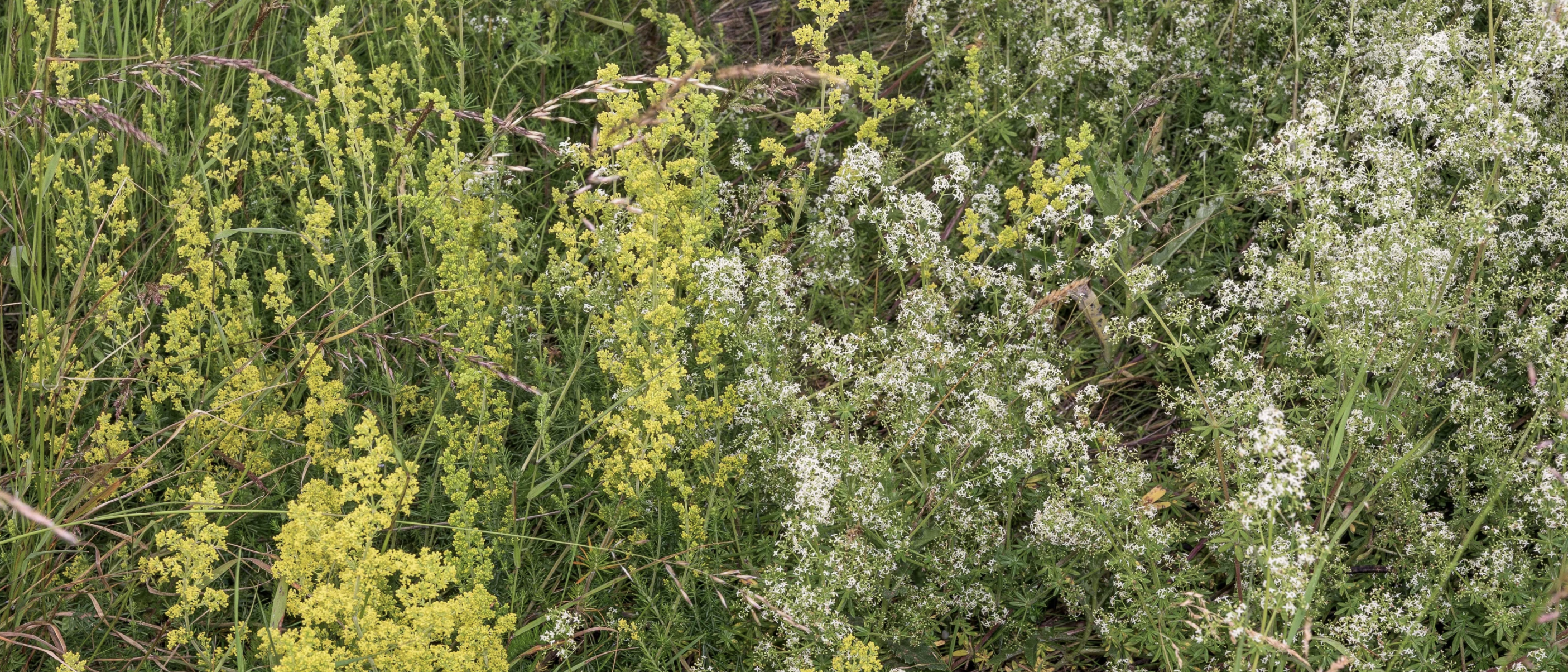
Galium sp. – March 17th 2025 – beautiful bedstraws
The Bedstraws are so-called because they were used in ancient times to fill mattresses. When dried, they are springy but I guess they would soon lose their springiness and require replacing. Some of them have pleasant odours, perhaps helping the sleeper to dream sweet dreams. They had many other uses, as pointed out in Chapters 460-464 of Gerard’s 1597 Herbal. To read his text you can click here.

Author: Prof. Dr. Otto Wilhelm Thomé in Flora von Deutschland Österreich und der Schweiz. 1885. From wikipedia: cleaned-up version from http://www.biologie.uni-hamburg.de/b-online/thome/band4/tafel_091_small.jpg
Botanically, bedstraws are mostly in the genus Galium. They all have tiny 4-petalled flowers and leaves in whorls. They are in the huge Family Rubiaceae, which rather surprisingly contains coffee, Coffea arabica.


Galium aparine, showing whorls of leaves and prickles all over the plant. The prickles enable it to scramble over other plants and discarded garden materials. It also has a fast growth rate, making it a formidable weed. Image: Chris Jeffree.
The most common bedstraw in Britain is the sprawling plant that everyone knows: Galium aparine, variously called Goosegrass, Cleavers or Sticky Willy. It likes the rather rich soils found in the odd patches of waste land in towns and cities, and it thrives in community gardens. It has tiny recurved prickles all over, and it sticks to clothing. I still like to play the pranks of my childhood, sticking it to coats and jumpers of unsuspecting friends and relatives. They wonder why everyone is laughing. This plant is an annual, and you may see young plants from autumn onwards, in gardens and on roadsides. Plants are quite large now (March) and soon it will sprawl and scramble, producing white flowers and then sticky fruits that may attach themselves to passing furry animals. The name aparine means ‘clinging’, and it certainly does. The name Goosegrass refers to the alleged fondness of geese for eating this species.

Fruit of Galium aparine (diameter 2-5 mm). Note the recurved prickles for attachment to passing mammals, akin to Velcro. Image: Chris Jeffree.
The second most common is Galium saxatile, the Heath Bedstraw, also with white flowers. You will nearly always see it on walks in the uplands and on moorland, but never on limestone which it doesn’t like at all. With a hand-lens you can view the prickles on the margins of the leaves. It’s very like the Limestone Bedstraw Galium sterneri but that one has backwardly-directed prickles.

Galium verum, Lady’s Bedstraw. Image: Chris Jeffree.
The third most common is probably Galium verum, Lady’s Bedstraw. Its flower are numerous and yellow, appearing as a ‘yellow froth’. It sprawls but also makes erect stems up to 1 metre tall. It prefers calcium-rich soils and is often found near the sea. It has no prickles. In former times its roots were used to make a red dye, and the above-ground part was used to make a form of rennet, in cheese-making. If you want to try cheese-making with this plant, see here. In medieval times it may have been over-collected but now it’s common and sometimes used in wild-flower seed mixes.

Cruciata laevipes (Crosswort), formerly called Galium cruciata, looking stately in this close-up image (it grows to 15–70 cm), honey-smelling and pollinated by flying insects. Image: Chris Jeffree.
Also bearing yellow flowers, you may often see Galium cruciata (Crosswort) but now we must call it Cruciata laevipes. It’s hairy, with erect stems up to 60 cm tall; the flowers are in the leaf axils and the whole plant smells of honey. It’s called Crosswort because the whorls have only four leaves like a cross +. It appears in ungrazed grassland, banks and waysides, common in the south but rare north of Aviemore.

Galium album (or G. mollugo) the Hedge Bedstraw. See also the image at the head of this blog, with G. verum and G. album (unusually) growing together at Leith sewage works. Images: Chris Jeffree.
A moderately common species is Galium odoratum known as Woodruff or the Sweetscented Bedstraw. It’s a woodland plant, and it smells of coumarin (a compound also found in the grass Anthoxanthum odoratum, and that’s what gives us the smell of new-mown hay). Until recently it was used in Germany to make sweets but coumarin can cause liver-damage and now I’m told the sweeties contain a harmless coumarin-derivative.
The most difficult bedstraw to write about is Galium mollugo, Hedge Bedstraw, now called Galium album by Stace (2019). It grows in rather rich and well-drained soils, usually calcium-rich. There are many subspecies in Europe, where the normal number of chromosomes varies. Stace (2019) explains that on the continent the diploids (2n=22) are called G. mollugo and tetraploids (2n=44) are called G. album. Only the tetraploid has been recorded in Britain so we should call ours G. album. Until further work has been done, I would like to call it “the Uncertain Bedstraw”.

The rare Galium parisiense. The inflorescence consists of clusters of tiny greenish-white or purplish-tinged flowers. It grows on historic stone walls and also on calcareous rubble. Its status as a native plant is disputed but it was first recorded in England in 1690. Image: Richard Milne.
There is local (Midlothian) interest in the rare Wall Bedstraw, G. parisiense. It’s a southern plant, but Richard Milne found it (2012) on derelict land at Millerhill near Edinburgh. It was the only existing Scottish record in the BSBI Atlas 2020. Richard has emailed to say:
“I first found it at Millerhill with a 2-week old Lawrence on my front, causing me to step more carefully and spot it when I’d missed it previously! Sadly a few years later it was destroyed in the first wave of development work”
On the BSBI database it was recorded three times at Millerhill in 2012 (Richard himself, then Barbara Sumner) but I see there is also a more recent record, 2022, by D. Merrick, from another spot at Millerhill. Perhaps it’s coming back.

Distribution of three Bedstraws according to BSBI/Maps. Downloaded 14.03.25
Whilst compiling the maps I was surprised to discover that Wall Bedstraw appeared in Forres (Morayshire) in 2022. How did it arrive there, of all places? Stuck to a botanist’s coat perhaps? We’ll see how it fares.
There are of course other British bedstraws: the Northern ~, the Fen ~, the Marsh ~ but we’ll save them for another time.
References consulted
Ballinger B (2021) Checklist of the Urban Flora of Scotland. Botanical Society of Scotland.
Delay J and Petit D (2020) Le complexe Galium mollugo–Galium album dans le Nord-Pas-de-Calais. Societe de Botanique 73 (1-4) 41-54. (In French)
Mersereau D and DiTommaso A (2003) The biology of Canadian weeds. 121. Galium mollugo L.. Canadian Journal of Plant Science. 83, 453-466.
Stace CA (2019) New Flora of the British Isles. 4th edition. C&A Floristics.
Thompson, K. (1985) Buried seed banks as indicators of seed output along an altitudinal gradient. Journal of Biological Education 19.2, 137-140.
Taylor, K. (1999) Galium aparine L. Journal of Ecology, 87, 713–30.
©John Grace