Nature’s palette: understanding how flowers pattern their petals
Dr. Edwige Moyroud, University of Cambridge, Sainsbury Laboratory
Thursday 17 April 2025
Lecture Theatre, Royal Botanic Garden, Edinburgh
Date: Thursday 17 April 2025 Edinburgh, from 6:00-7:00 pm – (Tea/coffee and biscuits will be available from 5:30 pm)
After the Lecture: We plan to take the speaker for dinner. Let us know at the lecture if you would like to join the party.
Venue: Royal Botanic Garden Edinburgh, Science Building, 20a Inverleith Row, EH3 5LR
Venue Note: To access the lecture please enter via the Science Buildings main reception, 20A Inverleith Row, Edinburgh EH3 5LR. Note this is NOT the public entrance to the gardens. what3words ///ROPES.DINNER.CLUBS
Title: Nature’s palette: understanding how flowers pattern their petals
Abstract: Flowering plants very often display striking colourful motifs on their petals. These patterns are key to attract pollinators and are very elaborate, combining different pigments with an amazing array of microscopic features that play a key role in plant-insects communication. Recent research discovered that petal patterns are multifunctional as they also allow flowers to deal with environmental stresses such as UV radiation and water loss. How flowering plants control the development of their petals to produce those patterns is still mysterious. This talk will explore the functions and evolution of floral patterning before looking at what plant scientists are doing to try and solve the enigma behind their formation.
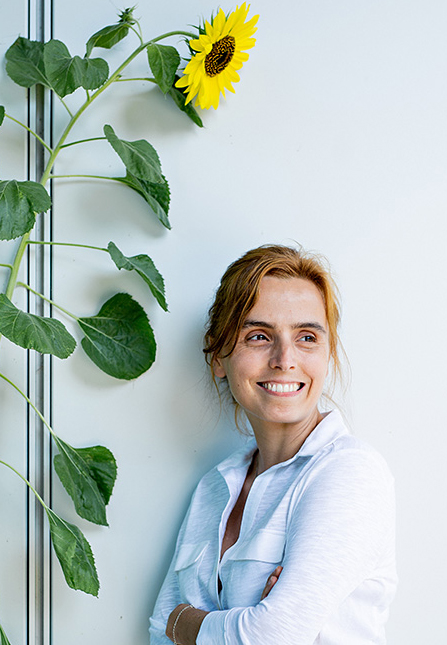
Bio: I am a molecular and cell biologist specialising in plant development and evolution. I lead a research group at the Sainsbury Laboratory Cambridge University (SLCU) to investigate flower development and evolution. I lecture in the Department of Genetics, and I am the Nicolli Fellow in Natural Sciences at Queens’ College at the University of Cambridge. In parallel, I lead several outreach initiatives to make science more inclusive and accessible to a wider society. Our work was recognised through a Bicentenary Medal of the Linnean Society (2018), a Plant Journal Fellowship for new investigator (2020) and a Rising Star in Plant Sciences award (2023).