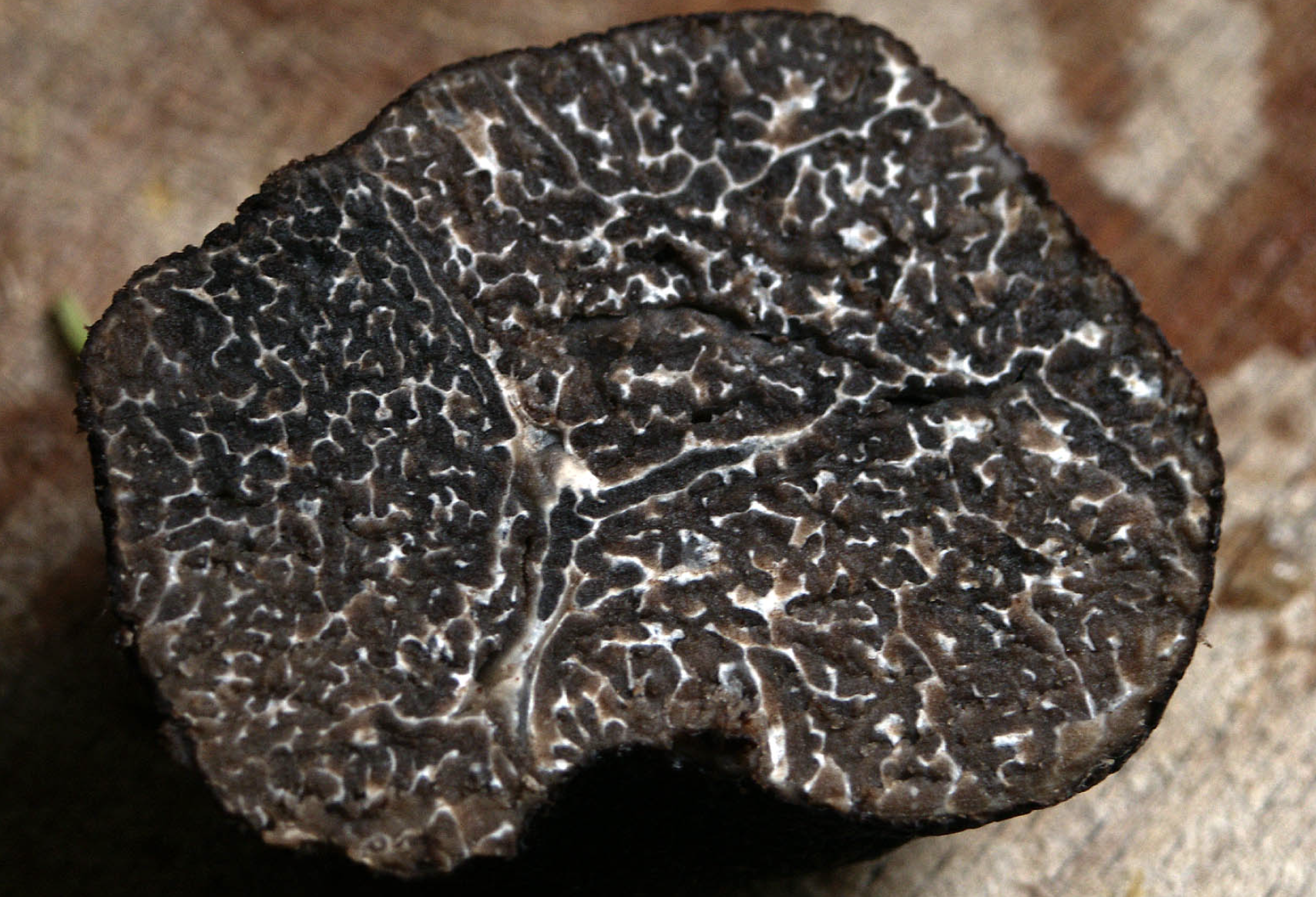
Tuber sp. – April 7th 2025 – Truffles
Robert Campbell writes:
The truffle fascinates. How do you describe the aroma? How did this warty looking fungus become such a sought-after delicacy? Do people really pay thousands of pounds for a White Truffle? For a long time, the truffle’s allure has been in its rarity. You could not ‘farm’ a truffle – they either appeared or they didn’t – and you needed an experienced truffle hunter to find them in the wild. However, new advances in the last twenty-five years have enabled the successful cultivation of truffles in continental Europe, particularly in the production of the black winter truffle (T. melanosporum) in France, Italy and Spain. Of course areas of France and Italy in particular are famous for their wild truffles. However, what is less well-known, is that there was a tradition of hunting wild truffles in the UK as well, which largely died out about a century ago. Recent successes in inoculating saplings with spores of the Black Summer Truffle (Tuber aestivum) and the Black Autumn Truffle (Tuber uncinatum) for the first time in the UK raises the possibility of producing British cultivated truffles, which perhaps gives them a role in agroforestry. While the potential rewards of producing truffles on demand is enticing, planting saplings inoculated with truffle spores in the UK is still a huge gamble. A few farmers have devoted productive land to rows of inoculated saplings only to find years later that the site was unsuitable as no truffles appeared. An expensive mistake.

Distribution of four truffle species in the wild: A, Tuber melanosporum; B, T. aestivum; C, T. uncinatum; D, T. borchii. There is some debate about the status of T. aestivum and T. uncinatum. The variety of Summer Truffle sometimes found in Britain and other northern European countries has been called the Burgundy Truffle, Tuber aestivum var. uncinatum. The Burgundy Truffle was formerly treated as a separate species, Tuber uncinatum, but molecular analysis has shown that the Summer Truffle and Burgundy Truffle are the same species. Maps from GBIF, the Global Biodiversity Information Facility.
Our son-in-law and daughter encouraged us to take this gamble in 2009 by giving us 150 young trees (Common Oak, Holm Oak and Hazel) inoculated with Black Summer Truffle (Tuber aestivum) alias Burgundy Truffle, Black Autumn Truffle (T. uncinatum) also called Burgundy and Black Winter Truffle (T. melanosporum) alias Perigord. These were bought from Dr Paul Thomas’s Mycorrhizal Systems. We cleared a site of about 0.2 hectare, ploughed in five tons of crushed limestone to raise the pH from around 6 to the recommended 7.2 and surrounded the site with a thick membrane buried to a depth of one metre to protect the hoped-for mycelium from intruders. We were told to wait 6-8 years for our truffles.
Over the years the trees grew successfully and the site and surrounding area are being used to host a forest school for local primary school children. This was an important and valued use of the developing woodland, but we had all but given up on finding truffles there. It was 12 years after the original planting, in the autumn of 2021, that we came across a half-eaten Summer Truffle probably dug up by squirrel.

The site where the Summer Truffle was found. Also used as a forest school. Image: Bob Campbell.
This one ‘find’ encouraged us to increase our efforts to encourage truffle growth. We added more limestone and pruned the trees as apparently truffles like some sun on their backs. The following year, in 2022, we searched the site more thoroughly and with the help of an adviser, Tom Lywood, and his Italian truffle hound (the Lagotto Romagnolo breed – well known in Italy for their truffle-finding abilities) we found 23 truffles in November and December. They were probably a mixture of aestivum and uncinatum which are now thought to be one species if not first cousins. There was no sign of the Black Winter Truffle.
With the help of Tom and his dog Tabacco, we went on to find 60 truffles from the autumn in 2023 through to January 2024. We contacted three restaurants and they all said they would take them straightaway. They like to use local produce but did not expect this might include truffles. Clearly there is an eager market. One huge advantage was that we could supply genuinely fresh truffles; a strong incentive to source locally is that the aroma fades within five or six days.

Use of a truffle-finding dog seems essential, unless you like pigs. Image: Bob Campbell.
Finding truffles is difficult and can be glossed over with suggestions of how to find them by sight and hand. A specially trained dog is essential. Pigs can also be trained to hunt for truffles, but are more difficult to handle. We tried training a young Springer Spaniel and had professional help but after 18 months, gave up. Then we got lucky. We bought a Cocker Spaniel puppy from a good local breeder/trainer and Tom suggested we try training him immediately. We were visiting a nearby farmer who was interested in setting up a truffle orchard and thought we should check if there were already wild truffles. The soil pH was around 7.2 as the farmer had been regularly cultivating with limestone. Tom’s Lagotto found two large truffles (aestivum) in a clump of Hazel within five minutes. We had kept the spaniel close by to watch. As soon as we released him, he copied the Lagotto and within five minutes, he also found truffle albeit smaller.

The truffle harvest. Image: Bob Campbell.
Armed with such an amazing dog we had high expectations for2024 but we only scored 18 truffles, all in September with no sign of autumn or winter truffles. Apparently, it proved to be a poor season across the UK but perhaps we should have searched earlier. In our first survey we found fully grown truffles that had been partially eaten. If we had the spaniel working in say June/July we might have been ahead of the squirrels.
So, what can we do better? We may be able to boost production by introducing spores into the soil near the mycorrhiza to add to the high genotypic diversity. The practice of digging holes or even a trench and filling them with truffles mashed up with compost, lime if needed and various secret ingredients is established in Spain (hence the name Spanish Wells) and is being adopted elsewhere. We are trying a new combination of the Italian Stone Pine (Pinus pinae) and Tuber borchii known as Bianchetto. Early trials of this combination in the USA indicate we can expect truffles within 4/5 years of planting. We prepared a new site of 0.4 hectare and planted 80 Stone Pines in early 2024 plus some Holm Oak (Quercus ilex) inoculated with borchii and Common Oak (Quercus robur) inoculated with uncinatum.

The new site, soon after planting. Could this be a start of something big in British agroforestry? Image: Bob Campbell.
Bianchetto (a white truffle, Tuber borchii) offers several advantages: robustness, spring production when no other truffles are available, tolerance of a lower pH and the much shorter span, 4-5 years from planting to cropping. We have been trying to persuade neighbouring farmers to invest in truffle farming to enable us to provide a more reliable supply of truffles to restaurants. However, it is difficult (perhaps impossible) to come up with a business plan based on an uncertain harvest at least 10 years after site preparation and planting. In our experience truffle farming based on established European species is unlikely to be much more than a hobby. But if borchii plus Stone Pine works as well as early trials indicate we have a serious candidate for agroforestry based on multi-cropping. There are also other combinations being trialled with some success such as Pecan trees (Carya illinionensis) with commercial truffle species (T. aestivum and T. borchii).
Despite recent advances, some exciting finds among our own trees and many delicious meals, there are still no guarantees in cultivating truffles in the UK. We will continue to encourage our original planting and have hopes for the new variety but in the meantime, perhaps the element of risk and the stubborn illusiveness of the truffle is what makes this humble-looking tuber so fascinating.
©Robert Campbell
Old School, School Lane, Stadhampton, Oxfordshire, OX44 7TR