Symphytum x uplandicum – May 26th 2025 – Russian Comfrey
This is the comfrey commonly grown in gardens and allotments, valued as a source of manure and liquid fertilizer; beloved by organic gardeners and increasingly appreciated by conservation-minded people as a source of nectar for bees and other flying insects. Russian Comfrey is a hybrid between Rough Comfrey S. asperum and our native Common Comfrey S. officinale. The name Russian Comfrey comes from its likely origin in the garden of Catherine the Great, Empress of Russia from 1762 to 1796. Later, it was introduced to British gardens. Now it can be found as a relic of cultivation throughout much of Britain and Ireland, on road verges, waste ground and along hedgerows.

S. x uplandicum inflorescences, shaped-like a scorpion’s tail (‘scorpioid cyme’). Image: CHris Jeffree.
Catherine the Great of Russia, born a princess in Germany, was a formidable character famous for overthrowing her husband Peter III and becoming the Empress of Russia. For her garden at the royal palace in St. Petersburg she sought Europe’s most skilled gardeners. She chose John Busch, a well-known nursery-man from Hackney, London, who had grown up in Germany and would be able to hold conversations with the Empress. In 1771 he sold his nursery business to another famous nursery-man Conrad Loddiges and travelled to Russia, where he worked at the royal palace for 18 years; as the Head Gardener he became quite famous. He grew many species for her, and made a colourful herbaceous border of comfreys. He had Symphytum officinale and other comfries growing side by side and some of the seedlings may have been hybrids. Busch sent shipments of plants back to London. One of them, from the Caucasus, was a tall and somewhat prickly plant called Symphytum asperrimum and later re-named S. asperum.

S. x uplandicum. Flower colour may change as the flower develops (a feature of some other members of the Boraginaceae too). Image: Chris Jeffree.
The agricultural possibilities of comfries from Russia were soon realised and remarkable yields were claimed using a regime of five to six cuts a year to provide foliage for fodder on farms and smallholdings. S. asperum was featured in The Encyclopaedia of Agriculture (1825) by John C. Loudon, the Scottish botanist and author. But the crop soon it fell out of favour.

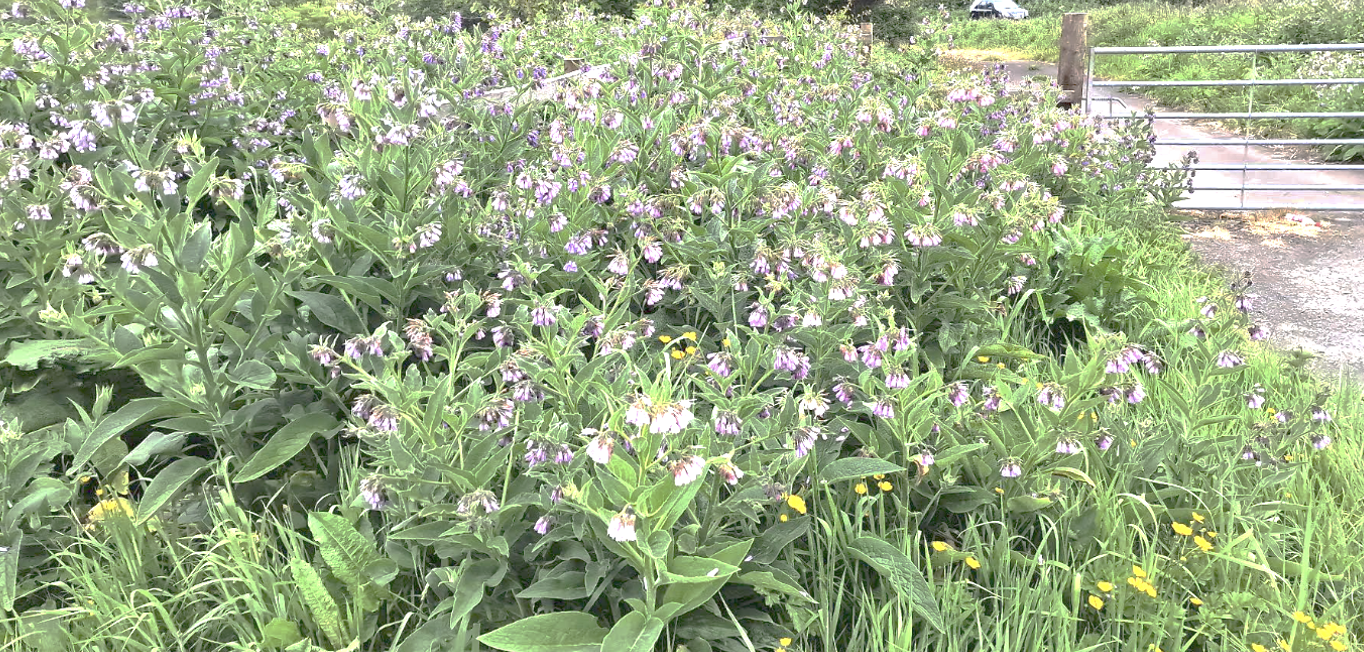
S. x uplandicum develops extremely rapidly in the month of May when on fertile soils, here competing well with Stinging Nettle and Cleavers. The foliage is an excelent source of garden compost, material for mulching or for making liquid fertilizer. Image: Chris Jeffree.
Henry Doubleday (1813–1902) a quaker and inventor from Essex in England was at first interested in potatoes, attempting to produce strains that were resistant to potato blight. He ran a small starch factory and dreamed of inventing a glue for the Penny Black postage stamps. He heard that comfrey sap was sticky and he asked for plants from Russia. Busch’s flower borders were still in the royal garden although Busch himself was dead. The Head Gardener dug up some chance seedlings growing as weeds between the rows of his highly prized S. officinale and S. asperum, and posted them to Doubleday. A similar package had been sent to Sweden. Some of the plants happened to be F1 hybrids of S. officinale and S. asperum, and they were given the name Symphytum uplandicum named after the Swedish province of Uppland. Extremely high yields were reported but Henry was not commercially-minded and the mucilage was not destined to become the glue of postage stamps. He died poor, but in 1954 his name was given to the Henry Doubleday Research Association (now called Garden Organic) by horticulturist and author Lawrence Hills, who wrote an excellent account of the history of this plant (Hills 1976).
So ends the generally-accepted story of the origin of Symphytum x uplandicum, but it may have arisen also in Britain (see Wade 1958), although the parent S. asperum is rather rare.
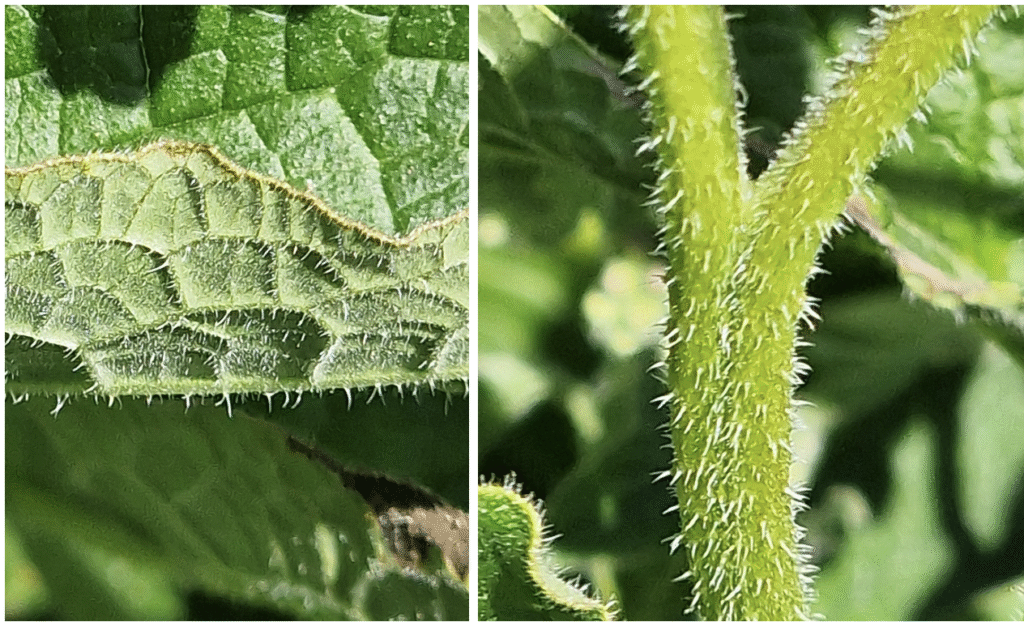
S. x uplandicum is quite rough on human hands. Right: note the leaf base usually not running down the stem. Images: John Grace.
Comfries belong to the Family Boraginacea alongside the many well-known blue-flowered plants including forget-me-nots, borage, lungwort and viper’s bugloss. The two most common comfries in Britain are the native Symphytum officinale and the hybrid Symphytum x uplandicum and they can easily be confused. In Scotland we also have quite a lot of the yellow-flowered S. tuberosum, but as discussed in our recent blog it is quite different.

A very large population of S. x uplandicum forming the verge of the B743 near Girvan (South Ayrshire, Scotland), extending onto abandoned ground to the north. Here, the plant may be considered ‘invasive’ as it excludes all other plant species. Image, 23/05/25: John Grace
The usual way of telling apart officinale and uplandicum is to look at the stem. In S. officinale the base of the leaf runs down the stem (‘decurrent’) and forms so-called wings on the stem that run all the way down to the next leaf base. These wings sometime occur in uplandicum but they are less well developed. There are differences in the colours of flowers too, although the colours are variable. Stace et al (2015) say “fully open flowers exhibit a range of colours including pink, bluish purple, violet and mauve, but never blue or reddish purple as in the parents”. The native Symphytum officinale has purplish to pale creamy-yellow flowers.

Symphytum officinale, showing the pale coloured flowers and the ‘winged’ stem, quite unlike S. x uplandicum. This is the native comfrey, as used for wound-healing in former times. Image, 22/05/25: John Grace
Their habitats are different, but again, this is not a diagnostic feature: Symphytum officinale typically grows by rivers and ditches, uplandicum is found in drier places. Differences between the two species may be confused by a general tendency for hybridisation within the genus Symphytum.
S. x uplandicum is a herbaceous perennial species with very deep tough roots, and therefore able to access nutrients and water from great depths in the soil. Chemical analysis of its foliage show it to be rich in all essential elements but its claim to fame in the organic gardening world is that it is high in potassium and therefore it promotes flowering and fruiting of crop plants, tomatoes especially. Commercially, it contains a useful compound, allantoin, occurring these days as an ingredient in over-the-counter cosmetics, toothpaste, shampoos and lipsticks. Analysis of the nutritional value of leaves shows high levels of protein and amino acids, and for a time (1940s to the 1970s) it was hailed as a wonder crop, especially in the USA. However, as food for humans or livestock, it is nowadays not recommended because it contains pyrrolizidine alkaloids which can cause liver damage. Some of the selections made by the Henry Doubleday Research Association have a reduced concentration of the toxic ingredient. However, it is best to ignore the tempting soup recipes in Laurence Hill’s book.

S. x uplandicum root system is extensive and may reach depths of 2 metres. Pieces of root may be used for propagation. Attribution: graibeard, Wikipedia, creative commons, CC BY-SA 2.0.
Grown in the garden, S. x uplandicum is best used for making liquid manure by soaking leaves in water for about a month, straining and diluting the product. There are many You Tube movies showing how folk do this messy and smelly process. The preferred strain, available as root cuttings online, is called ‘Bocking 14’ .

Distribution of S. x uplandicum in Britain and Ireland, from BSBI Maps.
Of all flowers, comfries are especially interesting for bumblebees. Sarah Corbet described the phenomenon of ‘buzz pollination’. She wrote: “Buzz pollination involves a distinctive behaviour pattern in which pollen-collecting bees embrace the anthers, close their wings and emit one or more brief, often audible high-pitched buzzes”. By buzzing at the right frequency, clouds of pollen are discharged onto the body of the insect (see Corbet et al 1988).
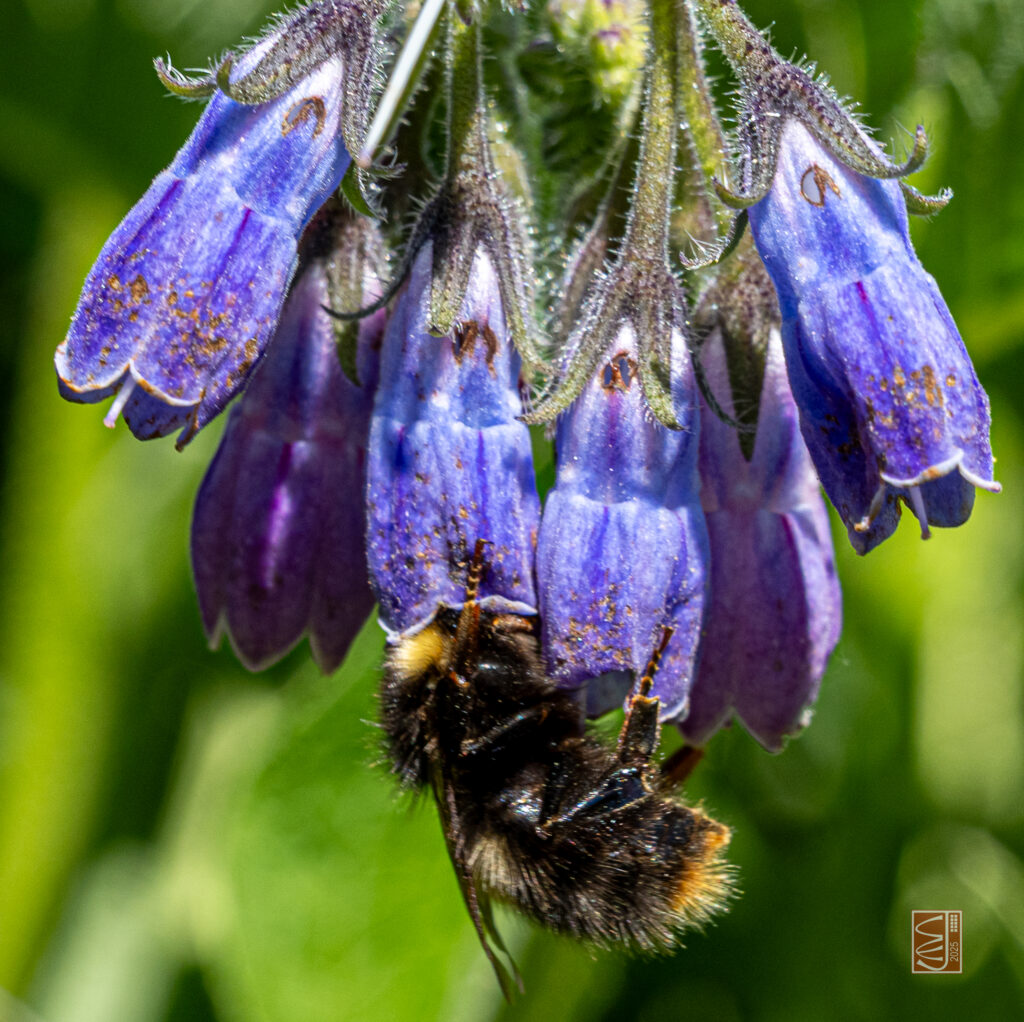
Symphytum x uplandicum with bumblebee. All of the flowers in this specimen have been attacked by nectar robbers (elliptical lesions at base of corolla tube). See also the speckled brown where bees’ feet have damaged the flower. Image: Chris Jeffree.
.
Other perspectives
As I was finishing this writing this article, another blog on comfrey dropped into my mailbox. https://northwestnatureandhistory.co.uk/2025/05/22/comfrey/
There are several youtube movies on how to make liquid fertiliser with comfrey leaves. This may be the best https://www.youtube.com/watch?v=YPBJcdExDaI
References consulted
Corbet SA, Chapman H & Saville N (1988) Vibratory pollen collection and flower form: bumble-bees on Actinidia, Symphytum, Borago and Polygonatum. Functional Ecology, 147-155.
Gadella TW and Kliphuis E (1969). Cytotaxonomic studies in the genus Symphytum II Crossing experiments. Acta Botanica Neerlandica, 18, 544-549.
Hicks DM et al. (2016) Food for pollinators: quantifying the nectar and pollen resources of urban flower meadows. PloS one, 11(6), p.e0158117.
Hills LD (1976) Comfrey: Past, Present and Future. Faber. London.
Rich TCG and Jermy AC (1998) Plant Crib. BSBI, London.
Stace CA, Preston CD and Pearman DA (2015) Hybrid Flora of the British Isles. BSBI, Bristol.
Syme M (2019) John Busch in London.The London Gardener 23, 22-30.
Wade AE (1958)The history of Symphytum asperum Lepech. and S.× uplandicum Nyman in Britain. Watsonia 4, 117-118.
©John Grace