Sisymbrium officinale – June 16th 2025 – Hedge Mustard
Hedge Mustard can be seen in most parts of Britain and Ireland. It belongs to the cabbage Family, Brassicaceae, and as its name implies it is ‘mustardy’ and bitter in taste, being related to the gently pungent Rocket, the fully pungent Mustard and the hotly pungent Wasabi and Horseradish1.

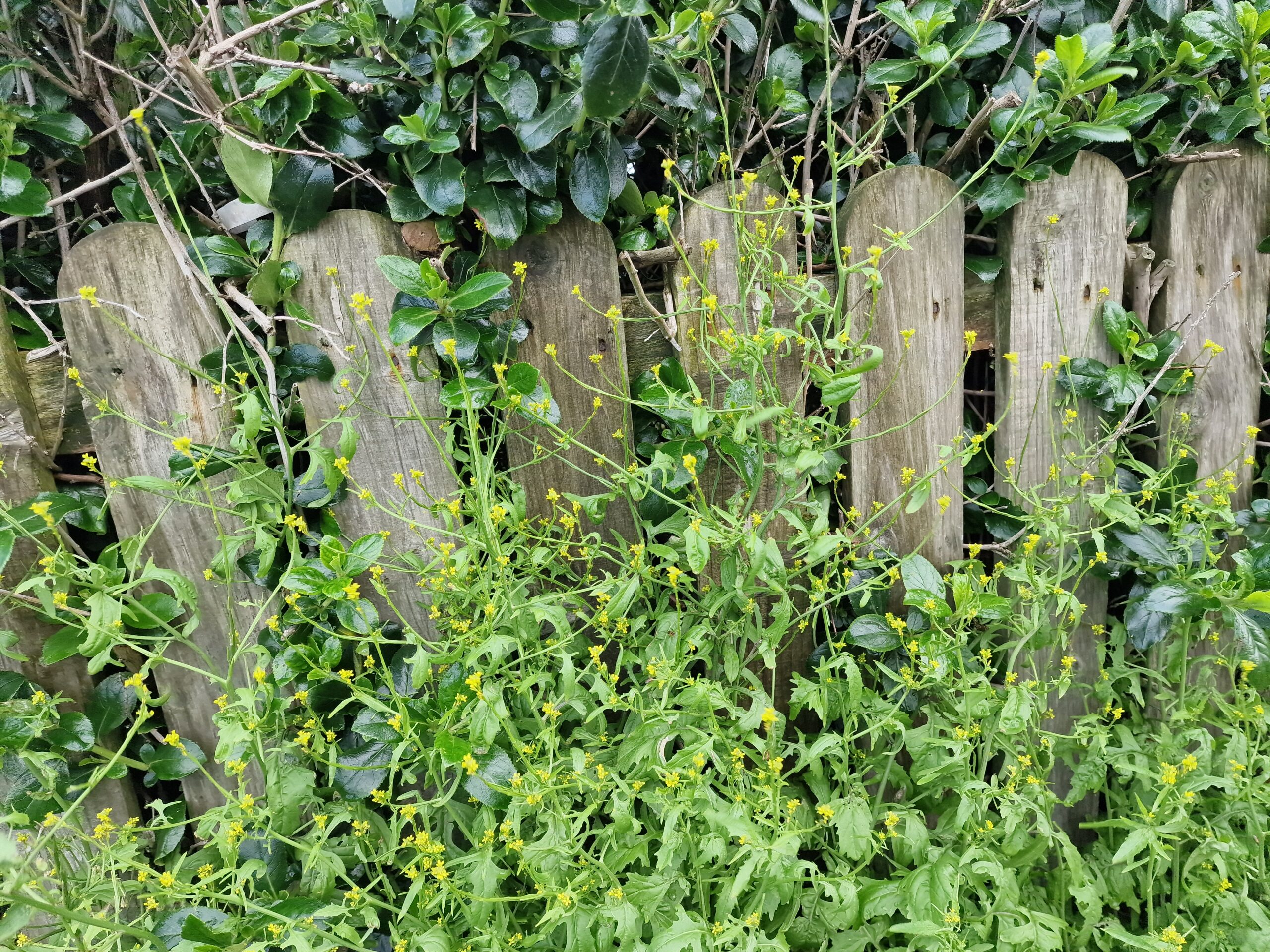
Sisymbrium officinale in its typical habitat. Note the branches arise more or less at right-angles to the stem (‘patent’) and curve upwards. Image: Chris Jeffree.
It lives mostly at the edges of roads, pavements and waste ground, and it seems especially fond of towns and cities. Probably this is related to its liking for rather fertile soils with a high pH (over 6) and a high calcium content. It finds these conditions in the mortar-dust and concrete crumbs of urban sprawl, where its wind-blown seeds tend to accumulate in the cracks and crevices of pavements and rubble. It is missing from most of NW Scotland, presumably because its preferred habitats are scarce – towns in the north-west are widely scattered and soils are usually too acid.

Sisymbrium officinale, clusters of flowers. Note the stems are hairy. Image: Chris Jeffree.
Hedge Mustard is an annual plant with a long flowering period, from April to September, but most flowers appear from mid-June to late July when the plant is fully established. The very small pale-yellow flowers are usually self-pollinated and the seed pods each contain around 15 tiny wind-dispersed seeds. Germination may occur in the autumn or in the following spring and early summer. A few seeds remain viable for five years, qualifying the plant as a very successful ‘weed’.

Flowers have four petals as in all Brassicaceae and in this case they are usually self-pollinated. They are 3-4 mm in diameter. Image: Chris Jeffree.
The plant has a distinctive and unusual structure, as well shown in Chris Jeffree’s images. There are several other Sisymbriums in Britain, including the wool-aliens London Rocket (S. irio) and French Rocket (S. erysimoides) but none are common, and they do not bear much resemblance to Hedge Mustard (the pods being closely pressed to the stalks is an unusual and strong feature helping us to distinguish the Hedge Mustard from its close relatives, see the image of the pods, below).

Note the unusual structure, and see how the pods are tightly appressed to the stem. Image: Chris Jeffree.
Formerly it was thought to be a native plant, but its status has been reconsidered. I could not find it in the Mustard section of Gerard’s Herbal (published 1597) nor in the records from mediaeval gardens. It appears only once in the archaeological record (an Anglo- Roman well). So now, it is regarded as an archaeophyte (non-native, a species introduced in ancient times – in this case perhaps the late 16th Century). The first proper botanical description was by Linnaeus in 1753, but he placed it in the genus Erysium, along with the wallflowers.2
Linnaeus called the plant Erysium officinale. The specific name officinale means ‘of or belonging to the storeroom of a monastery, where medicines and other necessaries were kept’. He knew that the plant was a medicinal herb, widely used in Europe.

Sisymbrium officinale in a mixed roadside planting, Prestonpans, East Lothin. Image: Chris Jeffree.
On the website Plants for a Future, the whole plant is said to be antiaphonic, diuretic, expectorant, laxative and stomachic. I needed to look up the rare word ‘antiaphonic’ in the Oxford Dictionary: it is defined as “Of, involving, or characteristic of singing, recitation, or playing performed alternately by two groups; characterized by the use of responses”. Indeed, it was used to soothe sore throats – one French name for this plant is the herbe aux chantres (the singers’ plant) or herbe des orateurs. However, please do not try to eat the leaves if you are suffering from a sore throat. I haven’t found the recipe, but the medicine seems to have been made from the flowering shoots, turning them into a syrup using honey and sugar. Perhaps the honey alone would have been sufficient. I saw an online offer for an Italian product called Mother Tincture ERISMO, but no medicinal claims are made in the advertisement or on the bottle itself as far as I can see. Does the product have a respectable future?

S. officinale, distribution in Britain and Ireland (left, from BSBI/Maps) and in the world (right, from GBIF). The plant is native to Europe, parts of western Asia and North Africa.
Such herbal preparations are routinely examined by the European Medicines Agency. I turned to their report about Hedge Mustard here. I was deeply impressed by the thoroughness of their investigations into the chemistry and clinical use of the species. If you are interested in herbal remedies and (preferably) have some knowledge of chemistry, please read what they say. Evidently there are many biologically active chemicals in this species.
According to Wikipedia, this plant is widely cultivated across Europe for its edible leaves and seeds and it is widely used as a condiment in Denmark, Norway and Germany.
Notes
1Latin names: Rocket (Eruca sativa), the fully pungent Mustard (Sinapis alba) and the hotly pungent Wasabi (Eutrema japonicum) and Horseradish (Armoracia rusticana)
2see http://legacy.tropicos.org/Name/4100260 for details of the second author of the species, the Italian Giovanni Antonio Scopoli, who described Sisymbrium officinale in 1772.
References consulted
Preston CD, Pearman DA and Hall A R (2004). Archaeophytes in britain. Botanical journal of the Linnean Society, 145(3), 57-294
Roberts HA. And Boddrell JE (1983). Seed survival and periodicity of seedling emergence in eight species of Cruciferae. Annals of Applied Biology, 103, 301-309.
Upson R and Lewis R (2014). Updated atlas and checklist. Report to Falklands Conservation. 225 pp.
©John Grace