Linum usitatissimum – August 4th 2025 – Flax

From Köhler’s Medicinal Plants a German herbal written principally by Hermann Adolph Köhler (1834–1879, physician and chemist. Public Domain, from Wikipedia via the Missouri Botanical Garden’s Rare Books Collection.
Flax (Linum usitatissimum) gives us linen, linseed oil and, nowadays, a health food. The species has served humankind for thousands of years and is mentioned several times in the Bible. Temple walls in ancient Egypt showed paintings of the blue flowers, and dead Egyptians were wrapped with linen to create mummies. In ancient China linen was a valuable textile for making clothing, burial garments and upholstery. Cultivation of linen spread throughout the Roman Empire and hence to our islands. Like the ancients, we used linen for its durability and whiteness: it made excellent sailcloth, everyday clothing and drapery. It also features heavily in Gerard’s 1597 herbal1. Most importantly, it launched the textile industry in several European countries, including here in Scotland.

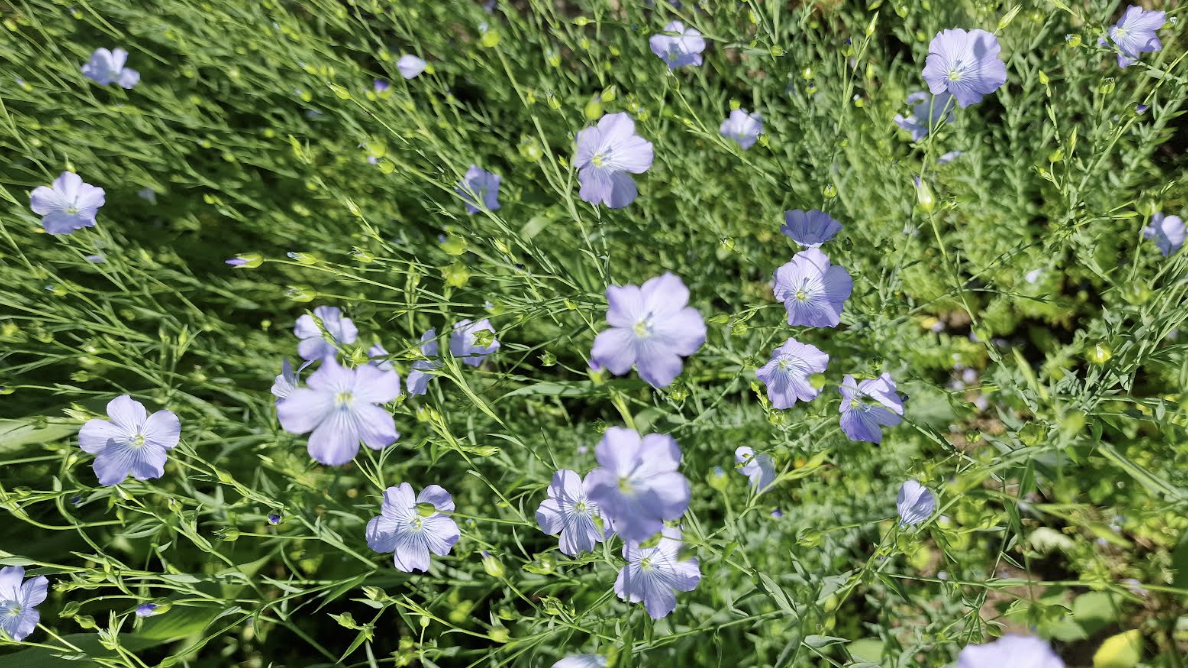
Flax (Linum usitatissimum, an annual plant introduced to Britain and Ireland in ancient times. The stems are up to 85 cm tall, remarkably tall in relation to their diameter, but cultivars used for oil are shorter and more branched. Images: John Grace.
In the early stages of the Industrial Revolution, Scotland had a cottage industry based on the manufacture of linen for use at home and for sale elsewhere. The traditional craft involved pulling (not cutting) the mature plants, and then the time-consuming process of ‘retting’ whereby bundles were placed in ponds or ditches so that the soft tissues would gradually decompose. Another method of retting was to lay the material out in the field to be soaked in dew (rain as well, presumably). After retting, came the ‘scutching’ wherein the stems were beaten to extract the fibres. Any readers interested in the process may wish to read an excellent account by Boase (1919). Much time and effort was required and I suppose the ancient Egyptians and Romans used slave-labour. Machinery eventually took over: I read that the first scutching machine was invented in 1797 by Neil Snodgrass of Johnstone, near Glasgow.

The petals are 12-20 mm and nearly always blue. The flower is visited by flying insects but self-pollinated. Image: John Grace.
Flax was grown in many parts of Scotland and in the 18th Century, with government help, it became the country’s most important industry. Farming villages grew to become sizeable towns with the development of spinning and weaving. For example, when the Airdrie Weavers’ Society was founded in 1781, flax was being grown in sixteen farms in the area and the population of Airdrie increased from 2,745 in 1801 to 4,862 in 1821. The rise and fall of home-grown flax production is described by Turner (1972). Flax was easy to grow, even on rather low-quality arable land but villagers were not skilled in the complex rural craft of processing the harvested material. Eventually, home-grown flax was overtaken by foreign imports, especially when trade with Russia resumed following the end of the Crimean War (1856). Another factor was the introduction of cotton from the United States and India, and the successful spinning of that fibre.

Seed capsules of Linum usitatissimum. Each contains five seeds. Image: Chris Jeffree.
I asked myself, what’s special about the stems of flax that makes the plant so useful? My knowledge of plant anatomy is ‘rusty’, but I found a helpful PhD thesis by Camille Goudenhooft from the Université de Bretagne Sud. She illustrates the anatomy of the mature stem. The great strength comes from the spindle-shaped fibre cells that collectively form a cylinder beneath the epidermis. They are several centimetres long and their thick walls are made of cellulose. She tested their biophysical properties and found remarkable tensile strength. Later, the author published papers in collaboration with others on the use of flax to make composite materials for structural purposes, recalling its use in the construction of aircraft during WW2 (Baley et al. 2021).

Seeds, rich in oils. Most of the oil is used in industry for the manufacture of paints, varnishes, inks and soaps. After the oil has been pressed out, the remaining oil ‘cake ‘is a feed for cattle. The seed is widely used in food products. Image: John Grace
I haven’t been to the north of France for many years, but I do remember the shimmering blue fields of flax. France is still a major producer and production has been increasing since the 1930s. Major producers elsewhere include Belgium, Kazakhstan, Germany and Canada. In Britain, flax grows perfectly well and so why don’t we grow more of it here?

The Women’s Land Army in Britain 1915-1918, pulling flax in Somerset. From the Imperial War Museum via Wikipedia Commons.
Well, flax-farming may be about to make a come-back. There are several reasons for a possible resurgence. (i) The textile industry is under attack for its over-use of non-degradable synthetic fibres made from petrochemicals, especially when people realise that cotton garments are more comfortable and are biodegradable too. They count as ‘regenerative textiles’. (ii) linseed oil is increasingly used as a dietary supplement, being rich in Omega-3 fatty acids which may have benefits for cardiovascular health. (iii) oil-seed rape is falling out of favour with farmers because of its susceptibility to flea beetle, and flax may therefore be easier to grow (iv) flax allegedly has a lower demand for nitrogen fertiliser than oil-seed rape and is therefore ‘climate-friendly’ (v) as discussed by Goudenhooft (2018), the fibres have applications in materials technology, to add strength to existing structures.
There are several projects in the south of Scotland where flax is being grown experimentally on a small-scale. They can be found near Edinburgh at the Phantasee Farm in East Lothian, at Lauriston Farm in north Edinburgh and several places elsewhere.

Distribution of Flax, Linum usitatissimum, in Britain and Ireland according to the BSBI. In the BSBI Atlas 2020 we read “found as a volunteer on the margins of arable fields as well as on road verges, refuse tips, pavements and waste ground. It is also a moderately frequent birdseed alien and is occasionally grown in game crops sown in arable fields”.
Flax belongs to the Linaceae, a world-wide Family of flowering plants with 250 species in 14 genera. In Britain and Ireland we have only one genus, Linum. There are six species of Linum mentioned in Stace’s New Flora of the British Isles. The most common is the Fairy Flax, Linum catharticum, but another is Pale Flax Linum bienne. The latter may be a close relative of Linum usitatissimum, and sometimes has been considered a subspecies or even an ancestor of it.
The British and Irish distribution (see the map above) deserves comment. Historically, flax was grown especially in Ireland and Scotland, yet the BSBI records do not reflect that, so I think the plants recorded in the wild are generally not survivors from that historic period. Recent agricultural statistics for UK (from DEFRA) show that areas of land cultivated for linseed peaked in the 1990s but thereafter dwindled. I did however find that BSBI records of Linum usitatissimum were rather rare before the 1990s. We may guess that the current distribution shown in BSBS/maps reflects the distribution of linseed-growing, although several sources suggest birdseed is the origin. I have found flax plants growing at the edge of an Edinburgh pavement, alongside canary-grass Phalaris canariensis. Both are occasional components of commercial bird-seed mixtures.

Recent trends in linseed-growing in the UK, plotted from DEFRA’s data2. Before 1989, no records.
Will there be an upsurge? According to the magazine FarmingUK there may well be, as market prices for the linseed have risen.
Notes
1Flax has been used in traditional medicine. You may read about this in Gerard’s 1597 Herbal by clicking here, or, for modern opinion look at the entry on the web site Plants for a Future.
2This flax is grown as an oil-seed crop. The remarkable figure for 1999 was 209,182 hectares, still much lower than oil-seed rape which was 417,250 hectares.
References consulted
Baley C, Bourmaud A, Davies P (2021) Eighty years of composites reinforced by flax fibres: A historical review,Composites Part A: Applied Science and Manufacturing, 144, 106333.
Boase WNN (1919) Flax. Cultivation, Preparation, Spinning, Weaving. Journal of the Royal Society of Arts, 67, 369-382. https://www.jstor.org/stable/41347952 but you need access to JSTOR. (licensed mainly to academic institutions, public libraries, research institutions, museums, and schools).
Esau, K. (1943) Vascular differentiation in the vegetative shoot of Linum. III. The origin of the bast fibers. Am. J. Bot. 1943, 30, 579–586, doi:10.2307/2437468.
Goudenhooft C (2018) Multi-scale characterization of flax stems and fibers : structure and mechanical performances. Materials. Université de Bretagne Sud, 2018. English. ffNNT : 2018LORIS500ff. fftel02301223f
Turner, W. H. K. (1972). Flax Cultivation in Scotland: An Historical Geography. Transactions of the Institute of British Geographers, 55, 127–143.
©John Grace