Ophioglossum vulgatum – October 6th 2025 – Adder’s Tongue

Attribution: Carl Axel Magnus Lindman (1856-1928, Swedish botanist and botanical artist). Public domain, via Wikimedia Commons.
My interest in this quirky fern was kindled during the summer when a group of us went looking for it in Holyrood Park, Edinburgh. Twenty-five years ago Smith et al (2000) described Adder’s Tongue as being ‘locally abundant’ in the Park, and plenty of more recent records exist from the low-lying area known as Hunter’s Bog. However, we had some trouble finding the Adder’s Tongue, which appeared to have been overgrown by tussocks of tall grasses. Parting the grasses, we exposed a single individual Adder’s Tongue, as shown in the image below. The dominant grass was Tall Fescue1 which, as its name suggests, is tall, growing to over 1.5 metres and forming sizeable tussocks, whereas the Adder’s tongue is diminutive.

A poor specimen at Hunter’s Bog, displayed here by parting the grass leaves. Image: John Grace.
I decided to find out more about this little fern. In Britain there are two others, the Small Adder’s Tongue and the Least Adder’s Tongue – all looking like no other ferns, except the close relative Botrychium lunaria (Moonwort). Both Ophioglossum and Botrychium belong to a Family of ancient ferns, the Ophioglossaceae. The Family emerged in the late Permian to Triassic, between 250 and 370 million years ago.

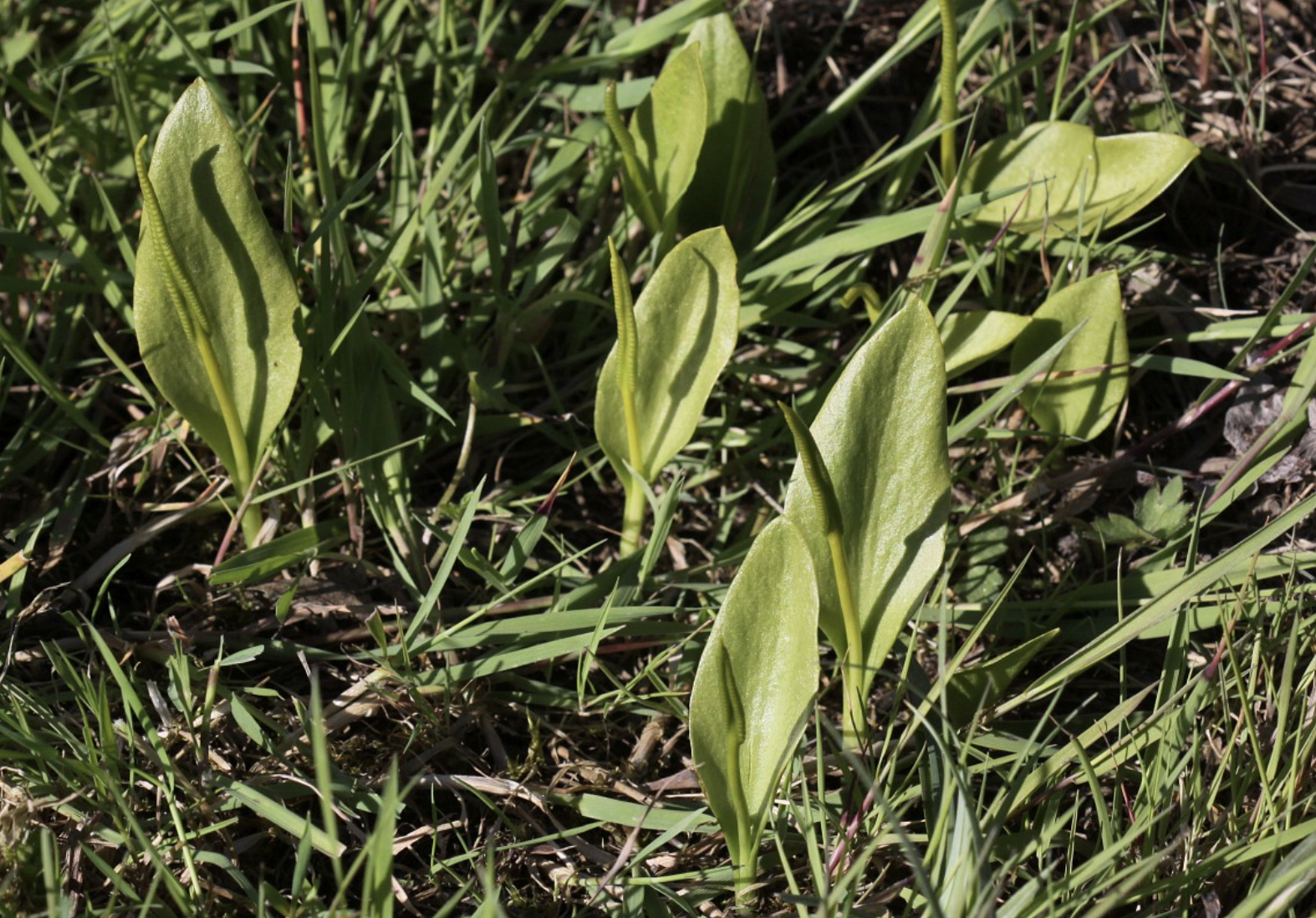
Ophioglossum vulgatum at the Burren, Ireland. Plant 8-30 cm, leaf-blade up to 15 x 6 cm. The spike (bearing the sporangia) may be shorter or longer than the leaf-blade. Image: Chris Jeffree.
Ferns have a sexual reproductive cycle known as the ‘alternation of generations’ whereby the plant has two ‘lives’. What we normally see as the first life of a fern is a clump of green and beautiful leaves (‘fronds’), the ‘sporophyte’, which may produce thousands or millions of spores to be carried in the air. Some of these germinate on wet soil to form the second life, a tiny heart-shaped piece of green tissue (‘gametophyte’) which lies on the ground and makes male or female gametes. The male gametes (‘antherozoids’) swim in water films and may fertilize a female egg (‘oosphere’). The result of the fusion is the birth of a new sporophyte, completing the cycle2. It pokes its way through the vegetation, soon emerging complete with the familiar fronds.


Other examples, both from wet sites (left, with Hydrocotyl, right, with Eleocharis). Images: Chris Jeffree.
In most ferns the gametophyte and the developing sporophyte are on the soil surface, green and capable of photosynthesis. But in the Ophioglossaceae they are in the soil and lack chlorophyll, so instead of making their own glucose by photosynthesis they must rely on the generosity of a nearby fungus for their carbon, energy and nutrients in an unusual form of symbiosis. Recent work has suggested that carbon invested by fungal partners in supporting the gametophyte (and early subterranean sporophyte) may be repaid later by the established green (i.e. photosynthetic) sporophytes which return their borrowed goods to the fungus. This mutualistic arrangement, still not well understood, is described as ‘take now, pay later’. You can read more about it in the article here by Katie Field and others at the University of Sheffield.

In favourable conditions the sporophyte produces rhizomes, from which new plants sprout, creating patches of ‘locally abundant’ plants. Botanical illustrations from 19th Century sources, public domain
Considering this apparently fragile form of mutualism, it is perhaps surprising that these plants survive at all. Their evolution preceded that of the grasses, yet today they often grow in grasslands, poking their pale young fronds through a considerable thickness of grass sward.
Jermy and Camus (1991) describe the habitat of Ophioglossum vulgatum thus: Tolerant of a wide range of soil types; in old damp meadow pastures, chalk grasslands, chalk downlands, old chalk and marl pits, sand-dune slacks, damp peaty sites, on light sandy soils amongst bracken and in woods, copses and hedge-banks, and on deep peat soils of fenland mowing marshes.
There is one other way in which O. vulgatum is unusual. It has more chromosomes than any plant in the British Flora (but counts do vary3). The chromosomes are all very small (see below). The high number is the result of polyploidy, meaning there are multiple copies but (usually) not more genes. Somewhat related, I recall the BBC news last year about the fern from New Caledonia which has the largest genome and 416 chromosomes. The significance of such ‘genomic gigantism’ is not really clear, but it occurs in a range of organisms including salamanders and lungfish.

This is what the chromosomes of Ophioglossum vulgatum look like: a remarkably good preparation made in the early days of cytogenetics, viewed with a light microscope with a magnification of x1575. From Verma SC (1958) Cytology of Ophioglossum vulgatum. Acta Botanica Neerlandica 1, 629-634.
Returning now to the situation in Holyrood Park. We have seen how the Tall Fescue (Lolium arundinaceum)1 has increased over the last two or three years and we suspect this is at the expense of other species. It is a native grass, but like many grasses it has been ‘improved’ for use as cattle fodder and exists as numerous cultivars, some faster-growing and with more effective rooting systems. Holyrood’s may be one of these, and perhaps it has been given a helping hand from climate warming and the deposition of atmospheric nitrogen (as ammonium and nitrate) from agriculture and road traffic. For whatever reason, Tall Fescue seems to have become invasive in the Park.
Can Tall Fescue be controlled? In past times (the 1970s) the Park was grazed by sheep, and this would have maintained a shorter turf, letting in light for some of the delicate species and therefore favouring floristic diversity. Horses are known to be partial to the grass, even though its leaves are quite tough. Light mowing is another way to keep it in check. Clearly, further work is needed to understand what is happening. The plants die down at the end of summer, and so visits in the spring are required, when the plants will be easier to find and their development might be followed.

Ophioglossum vulgatum, distribution in Britain and Ireland, according to BSBI Maps. In the Plant Atlas 2020 we read ‘it has certainly been extirpated from many lowland sites due to the destruction or neglect of its principal habitats’.
Notes
1Tall Fescue has undergone name changes in recent years. I first knew it as Festuca arundinacea, then it became Schedonorus arundinaceus, but recently it became Lolium arundinaceum following the realisation that it is not a Fescue at all. Its English name remains as Tall Fescue.
2 My description of the alternation of generations is brief. For details, look here
3Stace’s Flora says 2n = 540 for Ophioglossum vulgatum. The database of the Guiness Book of Records goes further: “The organism with the highest chromosome number recorded (in the whole world) to date is estimated to be 1,440 (or 720 pairs) found in the adder’s tongue fern Ophioglossum reticulatum”.
The image at the top of the blog is from http://www.freenatureimages.eu/.
References consulted
Chamberlain M and Grace J (2025) Celebrating 900 plants in Holyrood Park. BSS News, 125, 10-11. This is a short account of a Field Meeting in late June, available to members of the Botanical Society of Scotland (BSS).
Field KJ et al. (2015) From mycoheterotrophy to mutualism: mycorrhizal specificity and functioning in Ophioglossum vulgatum sporophytes. New Phytologist 205.4, 1492-1502.
Field KJ and Pressel S (2018). Unity in diversity: structural and functional insights into the ancient partnerships between plants and fungi. New Phytologist 220(4), 996-1011.
Gibson DJ and Newman JA (2001) Festuca arundinacea Schreber (F. elatior L. ssp. arundinacea (Schreber) Hackel). Journal of Ecology 89, 304-324.
Gibson DJ and Taylor I (2003) Performance of Festuca arundinacea Schreb.(Poaceae) populations in England. Watsonia 24.3, 413-426.
Jędrzejczak, Natalia, et al (2025). Allocation of Resources to Growth and Spore Production in a Fern Ophioglossum vulgatum L.: Effects of Mowing and Simulated Herbivory. Ecology and Evolution 15.6 (2025): e71555.
Jermy C and Camus J (1991) The illustrated field guide to ferns and allied plants of the British Isles. Natural History Museum, London.
Smith PM, Dixon ROD and Cochrane MP (2002) Plant Life of Edinburgh and the Lothians. the Lothians. Edinburgh University Press.
Verma SC (1958) Cytology of Ophioglossum vulgatum. Acta Botanica Neerlandica 1, 629-634. Click here: https://natuurtijdschriften.nl/pub/539136/ABN1958007004007.pdf
©John Grace