Thinopyrum intermedium – October 20th 2025 – Intermediate Wheatgrass
Last week I was in Czechia, busy in a conference, with no time to look for interesting plants in the fields, parks and woodlands. From a talk by a young researcher, I did however learn about a grass that is attracting attention in Europe and North America. This wild grass is in the process of being ‘domesticated’ to make a new cereal crop that we might see in Britain in the years ahead. Unlike wheat and barley, which started as wild annual grasses back in the neolithic, this is a perennial grass which can provide grain year after year without the need to be re-sown. It is envisaged as a component of ‘no till’ or ‘low till’ agriculture.
The grass is called Thinopyrum intermedium; formerly known as Intermediate Wheatgrass but now given the name Kernza by the Land Institute in the USA and heralded as ‘the world’s first commercially available perennial grain’ and ‘wheat’s more sustainable cousin’.
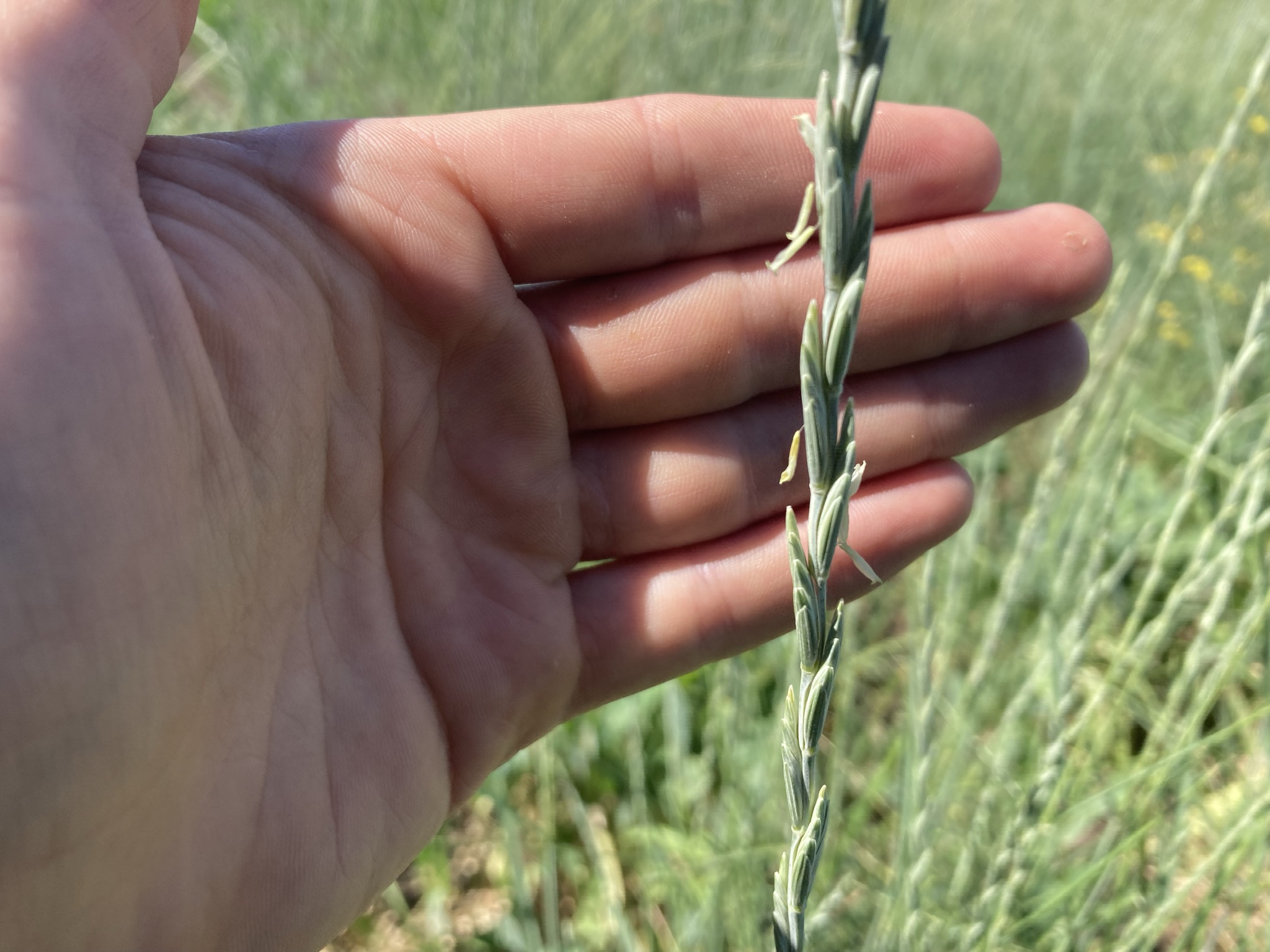
Flowering spike of Thinopyrum intermedium. Source: Jpukabeals, CC BY-SA 4.0 via Wikimedia Commons
So, what’s so good about it? It has very deep and extensive roots and therefore it builds a stock of carbon in the soil (roots and arbuscular mycorrhizas, alive and dead). It is therefore acting as a carbon sink, removing CO2 from the atmosphere and depositing stable forms of carbon in the soil. Moreover, it is ‘dual-purpose’ – it can be used as grass for animals and as grain for the bakery and breakfast table. Its yield of grain is not as much as wheat or barley, but by ‘domestication’ through selection and by creating hybrids with wheat this will be increased. Please note that so far this has been the same procedures that made the traditional cereals. Now, it will not take thousands of years, as we understand the process better than those early farmers working in the Fertile Crescent some 8,000 years ago. Moreover, technologies of the plant breeders are now available, including gene editing, and they can address issues of disease resistance and harvestability.

Images to show root development of Thinopyrum intermedium and comparison with Wheat. Note the deep rooting. Source, wikipedia; Jerry Glover; Author=Dehaan .
But I bristled when I saw how the flowers of T. intermedium resemble those of the dreaded weed, couch grass (Elymus repens). Indeed, they are related, although this grass is probably closer to wheat (Triticum) than to Elymus. It can form hybrids with wheat, thus opening up the possibility of transfer of genes between the two species. But invasive? I was assured that T. intermedium is not considered ‘invasive’ where it is widely planted in North America.
There are of course many wild species of perennial grass but none have been domesticated. Here is a brief account of the reason for choosing Intermediate Wheatgrass (see Bajgain et al. 2022):

Note that back in 1990 when Wagoner was writing, there was no mention of the carbon sink, but that has now become a key motivation for further development of land use.
The development of no-till agriculture in Britain has barely started (Alskaf 2019). Our farmers are conservative, and the economics of farming today does not lend itself to risky experimentation. Wheat yields vary across the country and with the weather conditions, but the range is between 3 and 10 tonnes of grain per hectare. This is achieved with ‘high inputs’ of fertilisers and pesticides, and a substantial environmental cost. On the other hand, Thinopyrum intermedium (in its domesticated form) produces a mere 0.5 tonnes of grain per hectare but many tonnes of below-ground biomass as roots.

Global distribution of Thinopyrum intermedium according to Kew’s Plants of the World Online. Green is the native range, Purple is introduced, and orange is ‘uncertain’. Unfortunately the presence of the species in Australia and New Zealand has not been mapped.
We Brits are not yet ready to re-invent farming, although British farmers took rapidly to oil-seed rape as it was highly profitable. Moreover, the business model for developing a new crop which doesn’t need fresh seeds every year and several doses of pesticides annually is not clear (the agri-industry thrives from an annual cycle). The future is uncertain, but so far no Kernza is grown in Britain, not even as a ‘niche crop.’ Curiosity drove me to see whether I could buy seeds in the UK, but I found no offers on the internet. Thinopyrum intermedium has never been recorded as a wild plant in Britain, but I wonder whether it has been overlooked (our handbooks and Floras never mention it).

Global distribution of Thinopyrum intermedium according to GBIF. Note its occurrence in New Zealand, where it was introduced perhaps as early as the 1870s, and is known as a forage grass.
References Consulted
Bajgain P et al. (2022) Breeding intermediate wheatgrass for grain production. Plant breeding reviews 46, 119-217.
Becker R (1991). Compositional, nutritional and functional valuation of intermediate whatgrass. Journal of Food Processing and Preservation. 15, 63–77.
DeHaan L et al. (2020). Roadmap for accelerated domestication of an emerging perennial grain crop. Trends in Plant Science, 25, 525-537.
Kamal A (2019) The uptake of different tillage practices in England. Soil Use and Manageement 36, 27-44.
©John Grace