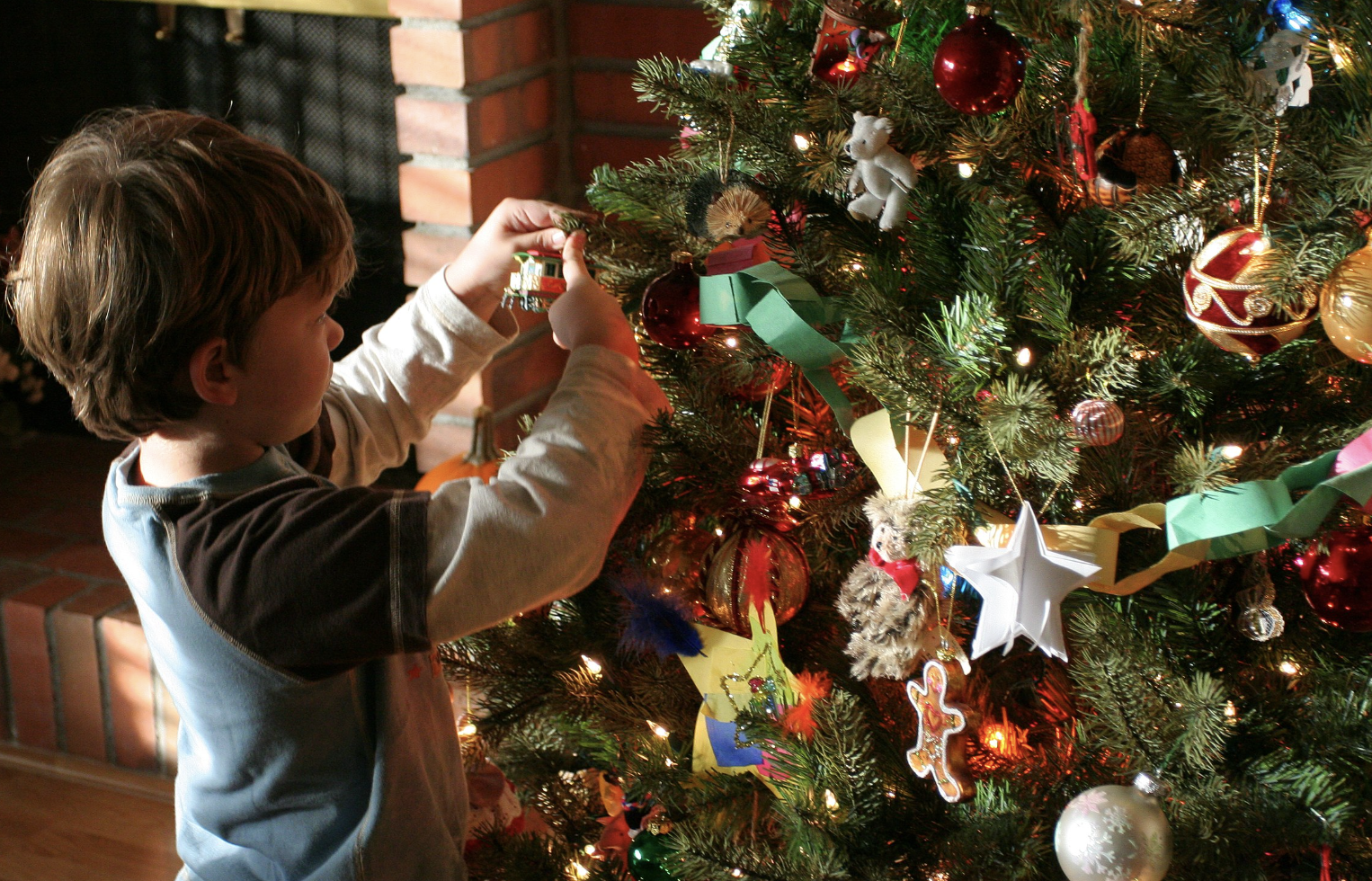
Christmas Tree – December 22nd 2025
I hope you have your Christmas tree already. The seasonal habit started in 16th Century Germany, but the true origin was much earlier. The story goes like this: there once was a Benedictine monk, called Boniface, who in the First Century travelled from England to the continent to evangelise. On reaching Thuringia he encountered a wild pagan celebration around an oak tree (‘the Oak of Jupiter’). Enraged, Boniface stepped forward with an axe and destroyed the tree, but from it sprang ‘a fir tree’ which resembled a cross. Everyone was amazed and praised the Lord. Later, a church was built from its timber. That ‘fir tree’ was the first Christmas tree. You don’t need to believe this story; there are several versions. A marginally more credible version is found in Willibad’s Life of Saint Boniface written in the 8th Century.
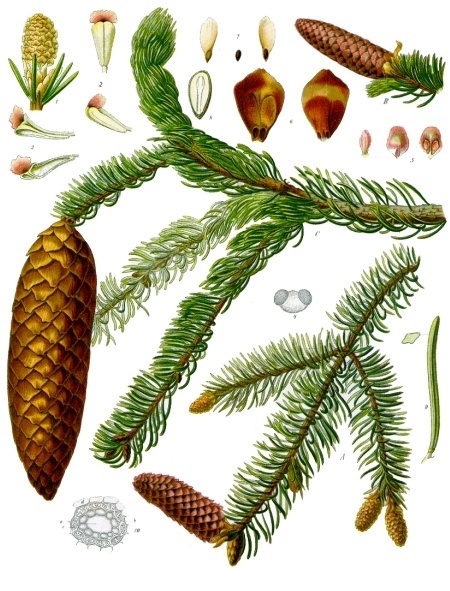
Picea abies by Franz Eugen Köhler, Köhler’s Medizinal-Pflanzen, Public domain, via Wikimedia Commons. The native range of Norway Spruce is Northern Europe (but not Britain) and mountain areas of central and southern Europe. The tallest trees can be 50 metres and the oldest European trees are 600 years old. It has very long cones: 12-15 cm long when mature.
Even before Christianity people would bring greenery and berries into their dwellings at the winter solstice (yule-tide) to ward off evil spirits, but somehow Christianity ‘took over’ the yule celebration.
The ‘Modern’ Christmas tree originated in 16th Century Germany where the Protestant Christian Reformer Martin Luther is supposed to have been the first to attach lighted candles to an indoor conifer at Christmas. It sounds like a risky thing to do and no-one knows how many houses burned down after this fad became widely adopted. But very likely, Luther’s tree would have been Picea abies, the Norway Spruce, as that was by far the most common conifer in that part of Germany.

Martin Luther and family gather around the first indoor Christmas tree. By J. Bannister – https://nantucketantiquesdepot.files.wordpress.com/2013/11/martin-luther-christmas-tree1.jpg, Public Domain, Wikipedia.
I have a childhood memory to share. I was at a Church of England Christmas service. The usual Parson was unable to take the service due to illness and his place was taken by a lay-preacher. In the sermon he distinctly said ‘Christ was born on a Christmas tree’ but no worshipers in the congregation seemed to notice the error. I considered reporting him to the Bishop but no-one would have believed me.

The royal Christmas tree is admired by Queen Victoria, Prince Albert and their children, December 1848. Anonymous author, Public domain, via Wikimedia Commons
Christmas trees came late to Great Britain: it was Charlotte, the wife of George III, coming from northern Germany, who brought the custom to our shores. She bore 15 children, and in the year 1800 she produced a Christmas tree for a childrens’ party. Later, Queen Victoria began having a Christmas tree at her Christmas celebration and the habit spread to her loyal subjects and then to North America, more or less at the time of Edison’s development of the electric light bulb. In 1882 New York had the first known electrically illuminated Christmas tree, thanks to the Edison Corporation.
Until very recently, most British Christmas trees were Picea abies, the Norway Spruce. Its conical shape makes it most suitable for use as a Christmas tree. Though an alien in Britain, P. abies was here a million years ago when our Islands were connected to Europe by a land bridge. It disappeared during glacial periods but was re-introduced in the 16th Century and adopted by British foresters around 1800. It grows well in Britain on a range of soil types but the North American Picea sitchensis establishes more rapidly, grows faster and tolerates extremely poor/acid soils and windy/wet conditions; this one has long been the mainstay of British and Irish plantation forestry. Picea abies is only the fifth most frequently planted species in Britain; foresters these days regard it as ‘a minor species’.
Spruce wood has many uses, being strong relative to its weight (Picea sitchensis has been used in aircraft construction). It is widely utilised in the building industry and also in the manufacture of paper. Woodworkers of all kinds like it because it is easily cut and carved although not particularly decorative. Norway Spruce has long been used to make the sound boards of violins, violas and cellos, most notably by the Italian family of Stradivari in the 17th and 18th Centuries. Somehow, its physical properties are just right to catch the vibrations of the strings, and these old instruments have celebrity status. Good ones can sell for over £10 million despite the scientific discovery that their sound is the same as a modern well-built instrument (but musicians may beg to differ). Scotland’s foremost violinist, Nicola Benedetti has played a Stradivarius (on loan) since 2012.

Antonio Stradivari making violins from Norway Spruce. Edgar Bundy, 1893; public domain, via Wikimedia
The most famous Christmas Tree in Britain is the one in Trafalgar Square, London. It’s a present from Norway. The Norwegian King, Haakon VII, sent the first tree in 1947 as a ‘thank you’ after having sanctuary in Britain when Nazi Germany invaded Norway. There is one in Edinburgh too, from the people of Hordaland and Vestland as thanks for support Scotland gave to Norway during World War II.

Edinburgh’s Christmas Tree 2022, viewed from the East, at the place called The Mound, with the castle behind it and spires of churches in the background, echoing the shape of the tree. Photo: John Grace.
Norway Spruce is often seen as an element of the landscape. In former times it was often used in shelter-belts and around farm buildings and remote cottages. It is sometimes seen in suburban gardens (when Christmas is over the trees have been planted out in a flower-bed). Such specimens often die, and even when they survive they are less statuesque than some other conifers.


Left: remote cottage sheltered by Norway Spruce (Lamancha, Peeblesshire); Right: in a suburban garden (has it outstayed its welcome?). Photos: John Grace.
As a Christmas tree, Norway Spruce has fallen out of favour in recent years because it sheds its leaves in the warm dry atmosphere of modern dwellings and can look like a skeleton by the first week of January. It has been replaced largely by Nordmann Fir, Abies nordmanniana (a rather rare tree from Turkey, Georgia and the Russian Caucasus). The Daily Telegraph listed the possible Christmas trees like this:
- Best smelling real Christmas tree: Norway spruce
- Best non-drop real Christmas tree: Nordman (sic) fir
- Best looking real Christmas tree: blue spruce
- Best for decorating: Fraser fir
- Best slim real Christmas tree: Serbian spruce
- Best large real Christmas tree: Douglas fir
- Best pine real Christmas tree: lodgepole pine
- Thickest branches: noble fir
- Best native real Christmas tree: Scots pine
There are of course plastic options, some resembling ‘real’ Christmas Trees and others being entirely symbolic. My choice? In recent years it has been Nordmann’s Fir, but this year I’m trying Fraser Fir, Abies fraseri, named after the Scottish botanist John Fraser (1750–1811) who collected it on an expedition to the Appalachian Mountains of the USA.
A visitor from another planet would wonder why so many Earthlings bring trees into their house to mark a Christian festival, especially when so few people attend church. What is all the fuss about? And does a conifer tree really symbolise the Cross of Calvary; if so, shouldn’t it be deployed at Easter? The visitor might need reminding of the Earthlings’ belief that ‘God moves in mysterious ways’.
©John Grace
Note: this blog was first published on 5th December 2022.