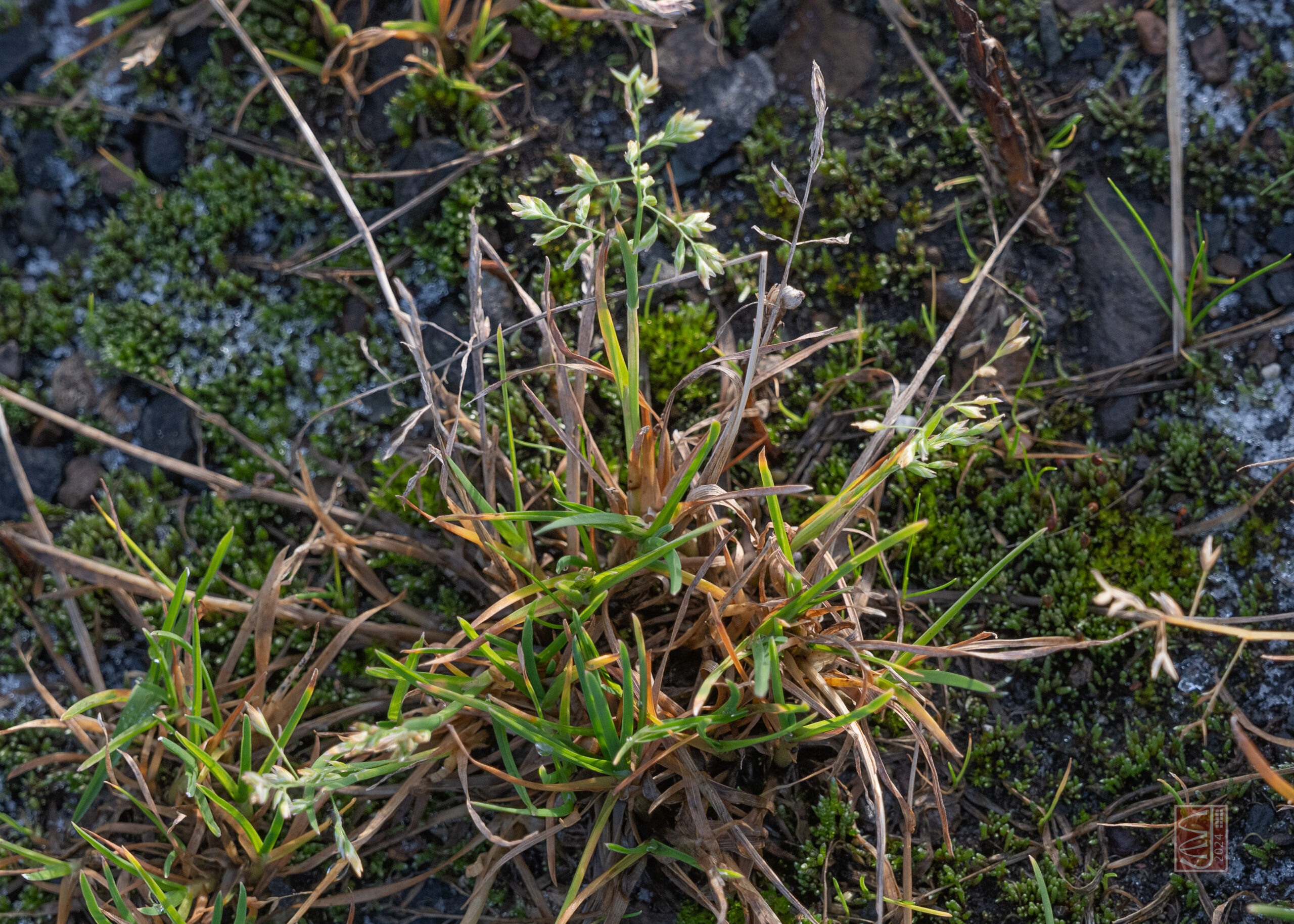
Poa annua – January 12th 2026 – Annual Meadow Grass
It’s cold outside. So cold that the fountain in Edinburgh’s Princes Street gardens froze last week and many schools in the northern part of Scotland were closed. How do plants cope? Many die back but others keep going, even flowering. These include a few garden plants (my favourites: Christmas rose, Cyclamen coum and Winter Heath). Outside the confines of the garden, one of our common native plants that continues to grow and even flower and germinate its seeds in the depths of winter is the humble Poa annua. Its common name, Annual Meadow Grass, doesn’t do it justice, as it isn’t always annual and it grows in many places other than meadows.

Poa annua. A demonstration of broad temperature tolerance. Left: flowering in winter, image from allotment garden on January 1st 2021; Right: flowering on a hot summer’s day on a pavement near the coast, Stranraer, June 2025. Images: John Grace.
It’s a ruderal species, germinating readily on any bare patch of soil, growing and flowering very quickly. It tolerates a wide range of conditions, including being trampled on (when growing on cracks in pavements), and it grows on most soils except for those which are strongly acidic (pH< 5.0). It regarded as a weed and it is one of the many ‘weed’ species that have evolved resistance to herbicides.

Detail of inflorescence. Spikelets are 3.5-7 mm long. Note also the shape of the leaf (‘boat shaped’). Image: Chris Jeffree.
The BSBI’s Atlas 2020 describe it thus:
“an almost ubiquitous weed of a wide range of disturbed and man-made habitats, including overgrazed and trampled grasslands, lawns, arable fields, road sides, waste ground, paths, waysides and wall-tops”.

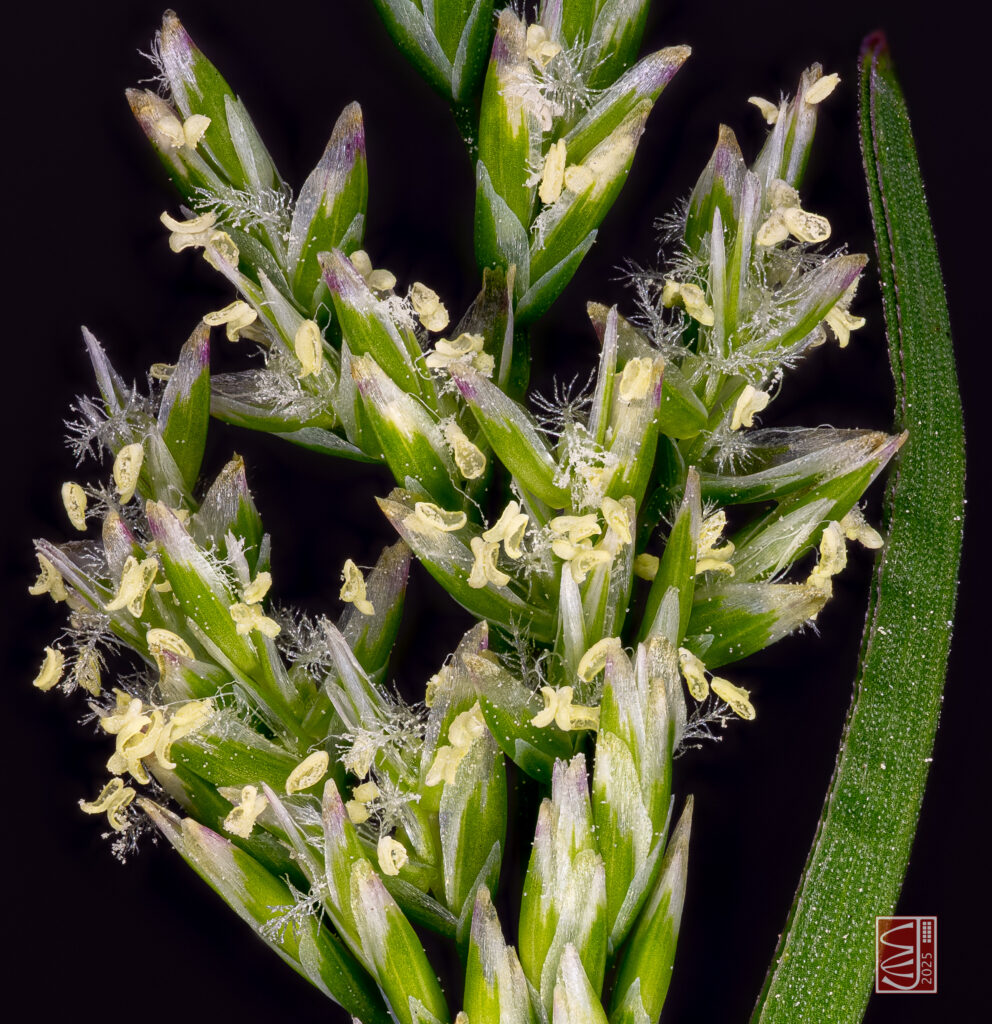
Ultra close-up images of flowers. Note: feathery stigmas to catch airborne pollen, pale yellow anthers in pairs (about 1 mm long) with pollen grains visible. In the lower image the anthers are fully dehisced and some of the pollen adheres to the stigmas. Top image made on 8/1/2026, lower one on 11/1/2026 by Chris Jeffree.
Thomas Tutin (of Clapham, Tutin and Warburg’s Flora of the British Isles) wrote as follows:
“Poa annua is a grass which is all too familiar to most people. It is more abundant in the neighbourhood of habitations than anywhere else, being one of the commonest of garden weeds and forming the bulk of vegetation of suburban pavements. It also occurs in places less modified by man, though, as it is essentially a plant of open habitats, it is rather restricted and is practically absent from closed communities”.

Global distribution of Poa annua. Note the northern extreme (Spitsbergen) and the southern limit (in Antarctica). In the tropics it is on mountains. Note also the numerous oceanic islands where it has been recorded.
In North America, where it was introduced centuries ago, along with early European settlers, it has a reputation as a serious weed, yet it has its uses. In golf, it can make “an excellent putting surface” (Warwick 1979). On the other hand, an article from the Nairn Dunbar Golf Club says this:
“Poa Annua is one of the most widely distributed weed problems that Course Managers in the Uk face as it is a prolific seed producer, producing 13,000 seeds per plant with no obvious dispersal mechanism. The seed can live for years in the soil and will germinate when it is exposed by a ball mark so this is why it is essential to repair your pitch marks regularly. Annual meadow-grass is also the most susceptible grass species to Microdochium nivale, the number one disease on fine turf surfaces in the UK. The surface conditions associated with annual meadow grass Poa annua are the polar opposite to those associated with the fine fescue and bent grasses. Greens which are dominated by grasses such as fescue and bent are typically firm, smooth, true and fast, whilst greens where Poa annua makes up the majority of the sward are typically soft, wet, spongy, unpredictable to play on and slow”.

Showing two forms of Poa annua: left, annual; right, perennial. Note the often-present ‘ripple’ in leaves (d), and the rooting of stems in the perennial form (f). These images are line drawings from the paper by Warwick (1979) in the Canadian Journal of Plant Science.
Anges Arber (1934) had much to say about Poa annua in her great book The Gramineae. About dispersal she wrote:
“Tufts of Poa annua have been seen to drift down the Thames and establish themselves eventually at its margin.This grass travels the country in a variety of ways. Its spikelets may be blown about, the grains remaining enclosed in the glumes which act as wings. They are also carried by rain-wash along paths and roadsides and even streets…Poa annua is one of a number of grasses which have been found in birds’ nests in Willows near Cambridge…”
Its ability as an annual, to flower, germinate, grow very fast and produce seeds in six weeks, seems extraordinary. It can thus fit (perhaps) six generations into a year. Only a few British plants can do that. But it is quite variable and can be either an annual or perennial. The drawings above from Warwick (1979) show the form of the plant in both annual and perennial modes. When a perennial, trailing stems form roots at the nodes, forming a patch of rather short grass. The very early research by Tutin (1957) demonstrated not two but four different ‘races’ based on the form of growth. He maintained populations for several years and found they retained their character and did not interbreed. Nowadays, some experts tells us there are over 40 races, but their real taxonomic status is not known.
Several authors have taken Tutin’s observations further. Benson et al (2023) investigated the evolutionary origin of the species using modern techniques. Evidently, it arose less than 50,000 years ago as a hybrid from the cross of Poa infirma (which lives in arid mediterranean climates) and Poa supina (from boreal and alpine regions of central Europe). It is an ‘allotetrapolyploid’ and thus has four sets of chromosomes (in this case, 2n=28), having inherited two sets from each parent; it therefore has climatic tolerances passed down from both. Its northern limit is at Spitsburgen (nearly 80 degrees North), and in South America it is found in the extremely dry region between the Andes Mountains and the Pacific Ocean (rainfall is 1-10 mm). Its southern limit is Antarctica. Also remarkable is the presence of P. annua on many oceanic islands, presumably taken there as seeds on the boots of early explorers. These oceanic races presumably have significant salt tolerance, a feature which must help its survival along our salted roads.
The cold-tolerance of plant species is controlled by perhaps thousands of genes, determining a range of attributes. In tolerant plants, ice forms in the intercellular spaces rather than inside the cells. Water is extracted from the cells, causing a controlled dehydration. In addition, sucrose, glucose, and fructose lower the freezing point of cellular water and so-called ‘antifreeze’ compounds are synthesised, including proteins and the amino acid proline; they inhibit ice formation and the cell membranes are modified. These attributes are developed slowly, over several days of chilling; this is the ‘hardening’ process known to gardeners. So sudden freezing can kill.
References consulted
Benson CW et al. (2023) Homoeologous evolution of the allotetraploid genome of Poa annua L.. BMC Genomics 24, 350 (2023). https://doi.org/10.1186/s12864-023-09456-5
Carroll DE et al. (2022) Poa annua: An annual species? PLoS ONE 17(9): e0274404. https://doi.org/10.1371/journal.pone.0274404
Grime JP, Hodgson JG & Hun R. (1988). Comparative Plant Ecology. Edn. 2. Castlepoint Press and Botanical Society of the British Isles. Unwin Hyman, London.
Hovin AW 1957. Variation in annual bluegrass. GolfCourse Rep. 25, 18-19.
Hutchinson CS and Seymour GB (1982) Biological Flora of the British Isles. No. 153. Poa annua L. Journal of Ecology 70, 887–901.
Mao Q and Huff DR (2012). The evolutionary origin of Poa annua L. Crop Science 52,1910-1922.
Sudhakar S et al. (2025) Confirmation of Glyphosate Resistance in Annual Bluegrass (Poa annua) Via EPSPS Duplication in a Soybean and Rice Rotation. Weed Science 73(1), 1-9, (5 February 2025). https://doi.org/10.1017/wsc.2024.86
Tutin TG (1957) A contribution to the experimental taxonomy of Poa annua L. Watsonia, 4, 1-10.
Warwick SI (1979)The biology of Canadian weeds. 37. Poa annua L. Canadian Journal of Plant Science 59, 1053–1066 doi:10.4141/cjps79-165
©John Grace
Plant of the Week – January 5th 2026 – Lesser celandine (Ficaria verna)
Leave a comment