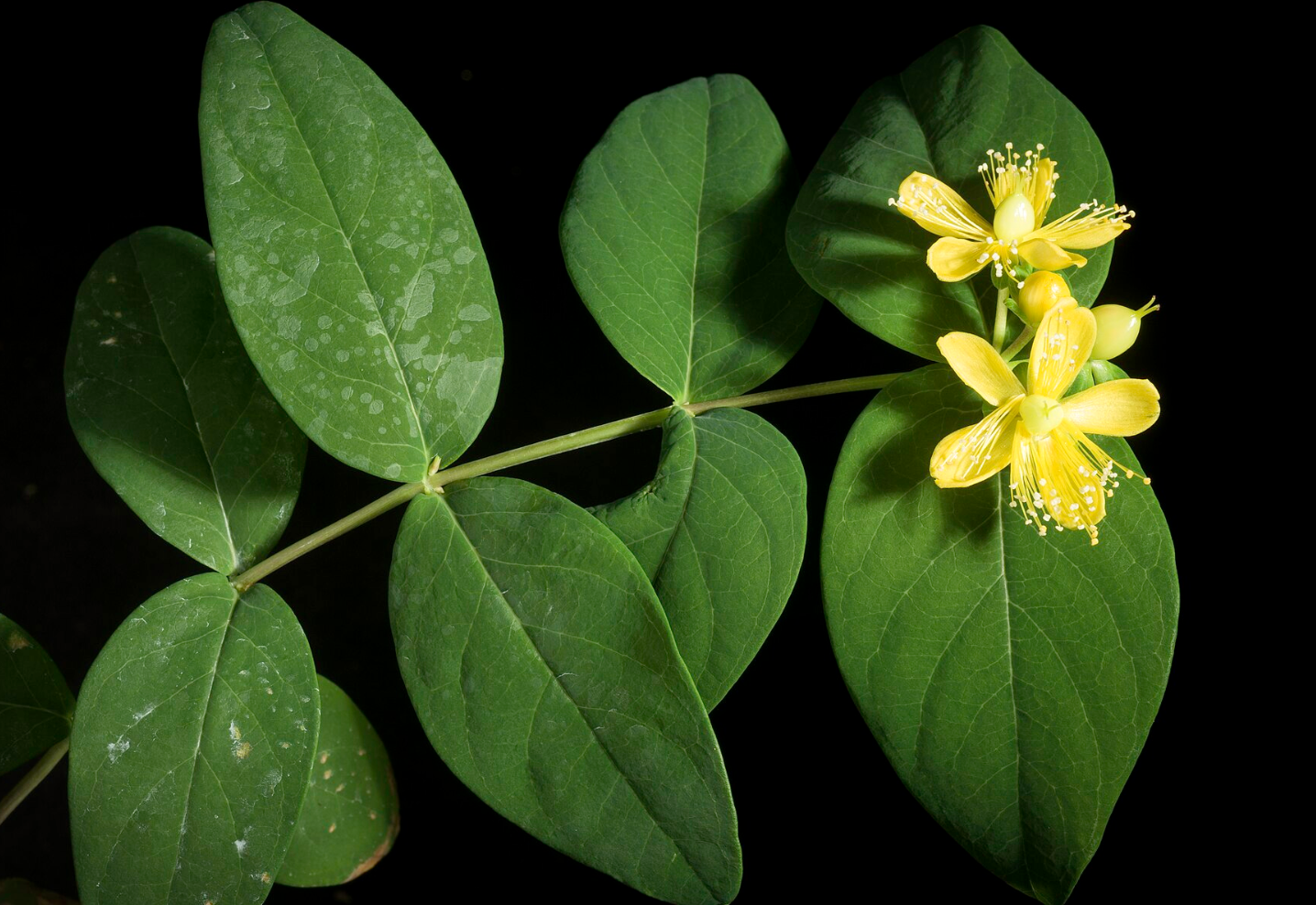
Hypericum androsaemum – February 2nd 2026 – Tutsan
Until recently I believed this plant to be an alien, introduced to our shores as a garden ornamental. It does have a distinctively exotic look, far exceeding the size and ‘showiness’ of our native St John’s Wort Hypericum perforatum. I was wrong, it is an undisputed native, described in Chapter 160 of Gerard’s 1597 Herbal as ‘Tutsan St. John’s Wort’ – although the Latin name was then Androsaemum hypericoides. He said it grew in woodland and hedges, and it still does, but now we often see it in urban areas. There are several horticultural varieties, with evocative names like ‘Autumn Blaze’, ‘Albury Purple’ and ‘Sweet Amber’, and these may now account for some of the individuals seen in the wild. They may have interbred with the true ‘wild type’ – so not all of today’s Tutsan may be like those known to Gerard.

Hypericum androsaemum (Tutsan) in a typical urban habitat on waste ground. Note the red-brown colour of the bush, and note the presence in the centre of the image of Epilobium hirsutum, the Great Hairy Willow Herb, with its spikes of purple flowers (the Willow Herb is an indicator of damp ground). Image: Chris Jeffree.
In our survey of Scotland’s towns, we recorded Tutsan 153 times over a period of ten years, but only 19 of those are from woodlands and hedges – the rest are from every imaginable urban habitat. Beyond towns, it also occupies many habitats that are not wooded. Mabey reports it “lurking deep in a crevice in the limestone pavements below Ingleborough in Yorkshire, or a sunken lane in the Hampshire Weald”. It does however prefer the west of the country, and most authors mention its affinity for damp places. I scanned recent data for Midlothian (there are 193 BSBI records since 2020) and I saw that many had been recorded by water or in places containing the word ‘bog’ (such as Bog Wood).

Tutsan with flower buds and a newly-opened flower. Image: Chris Jeffree.
It is easy to recognise, although it can be confused with the hybrid it makes with the Stinking Tutsan Hypericum hircinum, a rarer species said to smell of goats. H. androsaemum has five yellow petals and numerous stamens groped in bundles (like all hypericums) but each flower is 1.5 – 2.5 cm across and the many brownish-red stems up to 1 metre long forms a robust and somewhat woody shrub.

Flower of Tutsan with surrounding flower-buds. Note the red tinge. Image: Chris Jeffree.
The leaves are distinctive. They are arranged in opposite pairs and lack stalks (see the image at the head of this article, from Motohiro Sunouchi). Sometimes they are tinged red. The leaf blade is 4–12 cm long by 2–8 cm wide. The leaves are hairless and have oil glands dotted over their surface; the glands give off a pungent smell and may leak red sap. The compounds produced by these glands include β-pinene (22.0%) and limonene, both of which are present in the smell of conifers. Usually some leaves are retained in winter and so it is reckoned to be ‘semi-deciduous’.

Developing fruit of Tutsan. They will change from red to black. Image: Chris Jeffree.
How does Tutsan come to occupy so many sites? It seems to tolerate a wide range of soil types (all except for the very acid) and it has a wide latitudinal range (from North Africa to Shetland). It possibly cannot stand severe cold, and this may be the reason it is rarely seen in the cold North-East of the Scottish mainland. It is for example absent from Vice-County of South Aberdeenshire, where the lowest UK winter temperatures are usually recorded.

In late Autumn, at least some of the fruits become dry and remain on the plant. Image; Chris Jeffree.
Flowering occurs over a long period, June to August. Flowers are visited by flying insects including bees for their pollen and nectar1, and thus cross-pollination normally occurs. The fruits are initially green, then red and then shiny black. These ripe black berries look very tempting to children and birds. Each fruit contains 800-900 seeds, and surely, the fruits are consumed by birds, and the seeds are thus carried around and finally defecated far and wide? However, we have never seen birds feeding on the plant in our garden and the berries remain uneaten (other writers have also reported an absence of birds). Yet the nutritional content of the ripe berries is very high: Caprioli et al. (2016) reported ripe berries to be 11.3 % sugar and rich in amino acids. The red berries have very high concentrations of ascorbic acid. But many berries remain in place in December, drying up to form a brownish capsule-like structure, before finally dropping. My guess is that birds don’t like the taste (the berries are said to ‘taste of conifers’, and they contain monoterpenes like those in conifer leaves). Possibly, small birds peck at the fallen ‘capsules’ and thus carry away the seeds. Or, it may be carried by animals, clothing and vehicles. We don’t know.

The dry fruit has been opened to reveal the arrangement of the many seeds, each seed being less than 1 mm. Image: Chris Jeffree.
Are the berries poisonous? We have been unable to find an authoritative answer but Google’s AI friend says: “The berries are considered mildly to moderately toxic. While they are unlikely to be fatal in small quantities, they can cause significant gastrointestinal distress, especially in children”. We can find no reports of fatal poisoning, and no mention of toxic compounds. The plant is, however, unpalatable to livestock.

Detail of the leaf surface. The pale dots are the oil glands. Note also: hairless. Image: Chris Jeffree.
The plant contains a huge range of essential oils – 135 of them according to one source (Caprioli et al. 2016). It also has many biologically-active chemicals, consistent with its long history of use in folk medicine (Aguiar et al 2023). Returning to Gerard’s 1597 Herbal, we read(eth):

In modern times the use of Tutsan as a medicinal plant tends to be overshadowed by Hypericum perforatum (St John’s Wort) but as Tutsan doesn’t contain hypericin, which is a compound present in other Hypericums and causes photosensitisation of the skin, it has been used for skin care and mixed with lard to make wound dressings. It is also used as an antidepressant. An up-to-date scientific review of medicinal properties can be found online (Sharma 2024).

Distribution of Hypericum androsaemum in Britain and Ireland. From BSBI/Maps.
Tutsan was introduced to New Zealand in 1870 and became recognised as ‘weedy’ from 1920. It became invasive in pasture, forestry and conservation areas. It was at first kept in check by the rust fungus Melampsora hypericorum, but this seems to be no longer the case. There are plenty of articles from New Zealand’s researchers on the best methods of control, many of them using herbicides that may no longer be allowed including picloram2 and aminopyralid3 (these are persistent, unlike glyphosate which can also be used). It is also troublesome in Australia, especially in Victoria, New South Wales and Tasmania. It occurs too in Chile, but we have found no reports of an invasive tendency there.

World distribution of Tutsan according to Kew’s Plants of the World Online. Green regions are where the plant is native, purple is where it has been introduced (the map needs updating for SE Australia).
‘St John’s Wort’ is found frequently in folk-lore, but this could be one of several species (usually the commonest, H. perforatum). Vickery (1981) cites an example which is more exact: in Dorset the leaves of H. androsaemum were placed in the bible to give it a pleasant odour (perhaps also as a bookmark). The plant acquired the local name of ‘bible-flower’.
As for the name: ‘Hypericum’ comes from Greek, hyper (‘above’ or ‘over’) and eikon (‘image’ or ‘picture’), referencing the ancient tradition of hanging the plants over household icons, doors, or windows to ward off evil spirits. Androsaemum is from old Greek andros = man and haima = blood, thus we have ‘man’s blood’ referring to the red sap of the plant.
Notes
1We found no references to the species as a nectar source, and this requires further examination.
2picloram is a systemic herbicide used by the USA in the Vietnam war. It is still allowed in UK but only available for professionals (farmers, commercial growers).
3symptoms of aminopyralid damage were recorded on crops growing in allotments in Edinburgh, coming from manure supplied by horse stables. The animals had been grazing in a field where ragwort and docks had been sprayed with aminopyralid.
References Consulted
Aguiar R and do Céu Costa M (2023). Active compounds and biological activities of Hypericum androsaemum L.: A review. Journal of Pharmacognosy and Phytochemistry 12, 48-58.
Beğen, HA et al. (2024) Honey Plants of Artvin (Türkiye). Biological Diversity and Conservation 18, 243-282.
Caprioli G et al. (2016). Volatile profile, nutritional value and secretory structures of the berry-like fruits of Hypericum androsaemum L. Food Research International 79, 1-10.
James TK and Rahman A (2015). Management and control options for tutsan (Hypericum androsaemum) in hill country pastures a review. New Zealand Plant Protection, 68, 124-131.
Mabey R (1996) Flora Brittanica. Chatto & Windus.
Sharma, P (2024) Exploring the bioactive constituents and medicinal properties of Hypericum androsaemum L: A detailed review. Journal of Medicinal Plants Studies 12(4), 385-391.
Vickery, A. R. (1981) Traditional uses and folklore of Hypericum in the British Isles.” Economic Botany 35.3, 289-295.
©John Grace